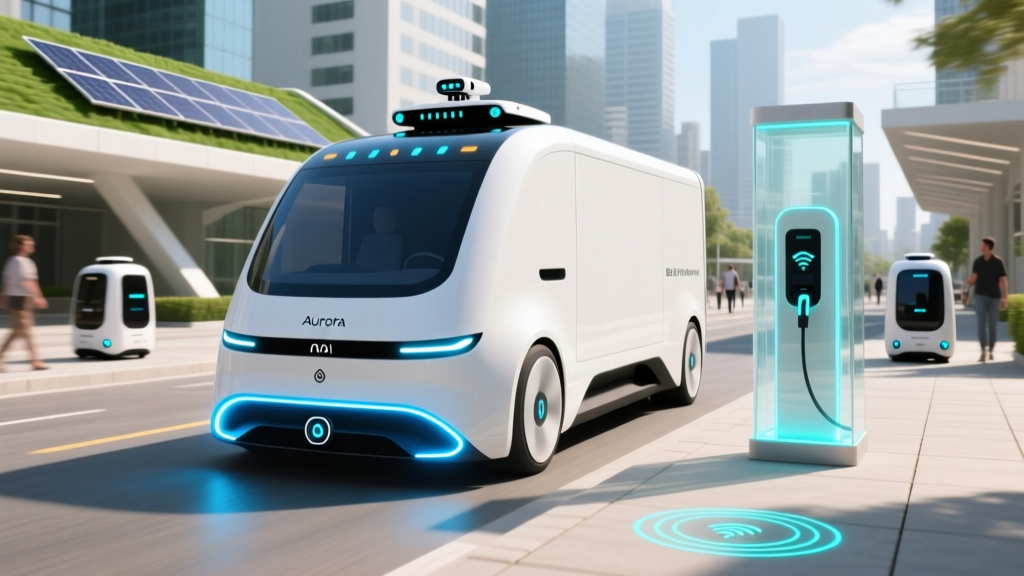
Aurora Innovation has spent years developing autonomous trucking technology, and by 2026, Aurora self-driving delivery trucks are actively hauling commercial freight on Texas highways. Unlike consumer robotaxis that ferry passengers through city streets, Aurora's platform targets the long-haul and regional freight market — moving goods between distribution centers with no human behind the wheel.
This is a fundamentally different application of autonomous driving than Waymo's Phoenix taxis or Tesla's FSD Supervised. Aurora's trucks operate at SAE Level 4 within defined corridors, carry no passengers, and represent one of the first commercially viable autonomous freight operations in the United States. Here's what the data shows about where they run, how they work, and what their safety record looks like.
What Aurora Self-Driving Trucks Actually Are (and What They're Not)
Aurora's product is the Aurora Driver, a full-stack autonomous driving system integrated into Class 8 semi-trucks — primarily the Volvo VNL and PACCAR Peterbilt 579 platforms. The system handles all aspects of highway driving: lane-keeping, merging, on-ramp/off-ramp navigation, speed management, and interaction with other traffic.
Aurora's trucks operate at SAE Level 4, meaning the system performs all driving tasks within its defined operational design domain (ODD) — specific highway corridors under mapped conditions — with no human driver present in the cab. This is categorically different from Level 2 systems like Tesla Autopilot or GM Super Cruise, which require continuous driver supervision. If the Aurora Driver encounters a situation outside its ODD, it is designed to execute a safe stop or pull over — it does not hand control to a human.
The key distinction for anyone tracking autonomous vehicles: Aurora is not selling a driver-assist system to truckers. They are operating a driverless freight service where the autonomous system is the operator. Human drivers still handle the first and last mile — moving trailers from warehouse docks to highway-adjacent transfer yards — but the highway segment is fully autonomous.
Where Aurora Trucks Are Running Right Now
As of early 2026, Aurora's commercial driverless operations are concentrated on a specific Texas corridor network. The company launched its first driverless freight lanes in late 2024 and has been expanding route density since.
| Corridor | Distance | Type | Status |
|---|---|---|---|
| Dallas–Houston (I-45) | ~240 miles | Interstate highway | Active / Driverless |
| Dallas–Laredo (I-35) | ~400 miles | Interstate highway | Active / Driverless |
| Fort Worth–El Paso (I-20/I-10) | ~630 miles | Interstate highway | Announced / Expansion |
| Phoenix–Dallas (I-10) | ~880 miles | Interstate highway | Planned / Future |
The Dallas-to-Laredo lane is particularly significant: it's one of the highest-volume freight corridors in the country, connecting major distribution hubs to the U.S.–Mexico border crossing. A single autonomous truck can cover this distance in one continuous run — something that requires two human drivers under current hours-of-service (HOS) regulations, which limit human drivers to 11 hours of driving within a 14-hour window.
Aurora's trucks aren't available to the general public as a service you can hail. They operate under commercial freight contracts with partners including FedEx, Schneider, and Werner Enterprises. If you're a shipper or logistics manager, access comes through these carrier partnerships rather than a consumer app.
The Technology Stack: How Aurora's Trucks See the Road
Aurora's sensor suite is substantially more complex than the camera-centric approach Tesla uses for its FSD system. The Aurora Driver relies on a multi-modal perception stack:
Aurora Driver Hardware Suite
- FirstLight Lidar: Aurora's proprietary frequency-modulated continuous-wave (FMCW) lidar, which measures both distance and velocity of objects simultaneously. Range exceeds 400 meters — critical at highway speeds where a loaded 80,000-lb truck needs over 300 feet to stop from 65 mph.
- High-resolution cameras: Multiple forward, side, and rear-facing cameras for lane detection, traffic-sign recognition, and object classification.
- Imaging radar: Long-range radar units for detecting vehicles and obstacles in rain, fog, and dust — conditions where lidar and cameras degrade.
- HD mapping: Centimeter-precision maps of every operational corridor, updated regularly. The truck knows the exact geometry of every lane, ramp, and overpass before it arrives.
- Redundant compute and actuation: Dual independent computing platforms and redundant steering, braking, and power systems. If one system fails, the backup takes over without interruption.
The FMCW lidar is Aurora's key technical differentiator. Traditional time-of-flight lidar (used by Waymo and Cruise) fires laser pulses and measures the return time. FMCW lidar uses a continuous frequency-modulated beam, which gives it native velocity detection — the system can tell not just where an object is but how fast it's moving, without needing to track it across multiple frames. At 70 mph highway speeds with 400+ meter sightlines, this is a meaningful advantage.
The entire system runs on Aurora's custom compute platform and is geofenced to approved highway corridors. The truck will not operate autonomously on surface streets, in construction zones it hasn't mapped, or outside its approved ODD.
Safety Record: What the Data Shows
Aurora has been testing with safety drivers since 2021 and transitioned to driverless operations in late 2024. The company publishes safety data through its quarterly reports and regulatory filings.
Aurora Safety Data Points (through Q4 2025)
- Total autonomous miles driven: Over 4 million miles (combined safety-driver and driverless operations)
- Driverless commercial miles: Approximately 1.2 million miles on Texas corridors since late 2024 launch
- At-fault collisions: Zero reported at-fatal collisions during driverless commercial operations as of early 2026
- Disengagement rate (safety-driver testing phase): Declining trend; Aurora reports fewer than 1 disengagement per 1,000 miles in recent testing — though direct comparison with other operators requires standardized metrics
- Critical incident response: The system is designed to execute a "minimal risk condition" (controlled stop on shoulder) if it encounters an unresolvable scenario
Sources: Aurora Safety Reports, NHTSA AV Safety Data. Exact figures updated quarterly; check Aurora's latest report for current numbers.
Context matters here. Comparing autonomous truck safety to human truck-driver safety requires looking at the right metrics. The FMCSA reports that large trucks are involved in approximately 1.1 fatal crashes per 100 million vehicle-miles traveled. Aurora's driverless mileage is still too low (roughly 1.2 million miles) to make statistically definitive claims about being "safer than humans" — you'd need hundreds of millions of miles for that level of confidence. What the data shows so far is a clean record within a tightly controlled ODD.
It's also worth noting that highway driving is a more structured, predictable environment than urban robotaxi operations. There are no pedestrians, cyclists, or complex intersections. The primary risks are other vehicles, weather, and road-debris edge cases.
Pricing and Economics: Aurora vs. Traditional Trucking
Aurora doesn't publish per-mile consumer pricing because this isn't a consumer service — it's a B2B freight operation. The economics work differently from robotaxis like Waymo, which compete with Uber and Lyft on passenger fares.
| Factor | Traditional (Human Driver) | Aurora Driverless |
|---|---|---|
| Cost per mile (all-in) | $1.50–$2.00 | Targeting $1.20–$1.60 (at scale) |
| Driver cost per mile | $0.55–$0.75 (wages + benefits) | $0 (replaced by Aurora's per-mile fee) |
| Hours-of-service limit | 11 hrs driving / 14-hr window | No HOS limit — 20+ hr continuous runs |
| Dallas–Houston transit time | ~4.5–5.5 hrs (one driver) | ~3.5–4 hrs (no rest breaks) |
| Dallas–Laredo transit time | ~7–8 hrs (team drivers or layover) | ~6 hrs (continuous) |
| Utilization (hrs/day) | ~10–11 hrs | ~20+ hrs (limited by maintenance/fueling) |
The core economic thesis is utilization. A human-driven truck is revenue-generating for roughly 10–11 hours per day. An autonomous truck can run 20+ hours, limited only by refueling (these are diesel trucks, not electric — more on that below) and scheduled maintenance. For a lane like Dallas–Laredo, an Aurora truck can complete a round trip in a single day; a human-driven truck requires an overnight layover or expensive team drivers.
Aurora charges carriers a per-mile fee for the autonomous driving service. The carrier still owns or leases the truck, pays for fuel, and handles loading/unloading. Aurora's fee replaces the driver's wages. At scale, Aurora projects this will reduce total cost-per-mile by 15–25% — meaningful in an industry operating on thin margins.
Current Limitations: What Aurora Trucks Cannot Do
Level 4 autonomy is powerful but bounded. Aurora's trucks have a well-defined set of constraints:
Operational Limitations (2026)
- Geofenced highways only: Trucks operate exclusively on mapped interstate corridors. They cannot navigate surface streets, truck stops (for refueling), or distribution-center yards. Human "yard jockeys" handle trailer pickup and drop-off at transfer points near highway exits.
- Weather restrictions: The system suspends autonomous operation in heavy rain, snow, ice, fog below visibility thresholds, and high crosswinds. Texas weather is relatively favorable, but even there, severe thunderstorms can trigger operational pauses.
- Construction zones: Unmapped or significantly altered construction zones may require the truck to pull over and wait for remote assistance or a human driver to take over (in current operations, the system defaults to a safe stop).
- No urban or last-mile delivery: Aurora's system is highway-only. The final 5–20 miles from the highway transfer yard to the actual warehouse or store is handled by a human driver in a conventional truck.
- Diesel-powered platforms: Current Aurora trucks are diesel-powered Class 8 tractors (Volvo VNL, Peterbilt 579). They are not electric vehicles. Refueling requires human intervention at the transfer yards, adding to turnaround time.
- Payload restrictions: Hazardous materials (HAZMAT) shipments currently require a human driver under federal regulation, limiting Aurora's addressable freight on certain lanes.
The transfer-yard model is the most important operational detail to understand. Aurora's system doesn't eliminate truck drivers entirely — it restructures the job. Instead of one driver spending 10 hours on the highway, you have yard drivers doing short local runs at each end, and the highway segment is autonomous. The total number of driving hours is reduced, but the role shifts from long-haul to local.
Regulatory Landscape: Who Approves Autonomous Trucks?
Autonomous trucking regulation in the U.S. is a patchwork of federal and state authority:
- Federal (NHTSA/FMCSA): The National Highway Traffic Safety Administration sets vehicle safety standards. The Federal Motor Carrier Safety Administration regulates commercial trucking operations, including hours-of-service rules. Currently, FMCSA rules technically require a human driver in commercial motor vehicles — Aurora operates under specific exemptions and state-level approvals.
- State (Texas DOT): Texas has been the most permissive major freight state for autonomous trucking. The state passed legislation (Texas Transportation Code §547.601 et seq.) explicitly allowing autonomous vehicles on public roads, and the Texas Department of Transportation has worked with Aurora on corridor approvals.
- Insurance and liability: Aurora carries commercial liability insurance for its operations. In a driverless configuration, Aurora — not the carrier — is the "driver" for liability purposes during autonomous segments.
Other states are watching Texas closely. Arizona, Florida, and Tennessee have shown openness to autonomous freight, while California has been more restrictive — the state's DMV and CPUC have imposed tighter permitting requirements, and labor groups have pushed back against driverless trucking. Aurora's expansion beyond Texas will depend heavily on state-by-state regulatory progress.
How Aurora Compares to Other Autonomous Truck Players
Aurora isn't the only company pursuing autonomous freight, but it is the first to reach sustained driverless commercial operations at scale. Here's how the landscape looks in 2026:
| Company | Status (2026) | Primary Corridor | Approach |
|---|---|---|---|
| Aurora | Driverless commercial ops | Texas (I-45, I-35) | Full-stack L4, proprietary lidar |
| Kodiak Robotics | Testing / limited driverless | Texas | Modular sensor pods, carrier partnerships |
| Waabi | Testing with safety drivers | Texas / Ontario | AI-first approach, simulation-heavy |
| Gatik | Commercial ops (with attendant) | Texas, Arkansas, Louisiana | Short-haul B2B, box trucks |
| TuSimple (wound down U.S.) | Exited U.S. market (2024) | N/A | Shifted focus to Asia-Pacific |
TuSimple's exit from the U.S. market was a significant industry event — it demonstrated that the autonomous trucking business requires enormous capital with a long runway before profitability. Aurora has survived partly through its diversified approach: the same Aurora Driver platform is also being developed for passenger vehicles (notably a robotaxi partnership), which spreads R&D costs.
What This Means for EV and Freight Buyers
If you're an EV-focused reader, the obvious question is: why aren't these trucks electric? The answer comes down to energy density and infrastructure. A Class 8 truck hauling 40,000+ lbs of freight over 400-mile routes needs roughly 150–200 gallons of diesel equivalent in energy. Battery-electric trucks like the Tesla Semi or Freightliner eCascadia currently offer 300–500 miles of range with massive battery packs (900+ kWh), but charging infrastructure for heavy trucks doesn't exist along rural Texas interstates. Megawatt Charging System (MCS) stations capable of delivering 1+ MW to a truck are still in pilot phases.
Aurora has indicated it plans to support electric truck platforms as the charging ecosystem matures, but for now, diesel remains the practical choice for long-haul autonomous freight. The autonomy layer is platform-agnostic — the Aurora Driver can be integrated into electric trucks when the economics and infrastructure align.
For logistics professionals evaluating Aurora's service, the decision framework is straightforward:
Consider Aurora If:
- Your freight moves on Texas interstate corridors (I-45, I-35) at high volume
- Transit time matters — you need same-day or next-morning delivery over 200–400 mile lanes
- You're currently paying for team drivers or overnight layovers on long lanes
- You can accommodate the transfer-yard model (freight must be accessible near highway interchanges)
Stick with Traditional Trucking If:
- Your lanes are outside Texas or involve non-interstate routes
- You ship HAZMAT or require in-transit human oversight
- Your freight destinations are deep inside urban areas, far from highway transfer points
- Your volumes are too low to justify the integration overhead with Aurora's carrier partners
Frequently Asked Questions
Where can Aurora self-driving delivery trucks operate right now?
As of 2026, Aurora's driverless trucks operate on Texas interstate highways, primarily the Dallas–Houston (I-45) and Dallas–Laredo (I-35) corridors. The Fort Worth–El Paso lane is in expansion. Operations are geofenced to these mapped highway routes — the trucks do not drive on surface streets or in other states yet.
Is Aurora truly self-driving, or is there a human in the truck?
Truly self-driving within its operational domain. Aurora's commercial trucks operate at SAE Level 4 with no human in the cab during highway segments. Human drivers handle trailer pickup and delivery at transfer yards near highway exits. This is fundamentally different from Level 2 systems like Tesla FSD Supervised, which require a human driver to remain engaged at all times.
How much does Aurora's autonomous trucking service cost?
Aurora charges carriers a per-mile fee that replaces driver wages. Exact pricing isn't public, but the target is to reduce total cost-per-mile by 15–25% compared to human-driven trucking at scale. The service is available only through carrier partners (FedEx, Schneider, Werner) — it's not a consumer-facing product.
How safe are Aurora's self-driving trucks?
Aurora reports zero at-fault collisions during approximately 1.2 million driverless commercial miles through Q4 2025. This is a strong early record, but the mileage is still too low for definitive statistical comparison to human truck drivers (who average ~1.1 fatal crashes per 100 million miles). The system uses redundant sensors, compute, and actuation, and defaults to a controlled stop if it encounters an unresolvable scenario.
What happens if the Aurora system fails on the highway?
The Aurora Driver has redundant systems across compute, steering, braking, and power. If a primary system fails, the backup takes over. If the system encounters a scenario outside its operational design domain (e.g., an unmapped construction zone or severe weather), it executes a "minimal risk condition" — typically a controlled stop on the highway shoulder with hazard lights activated, and alerts Aurora's remote operations center.
Are Aurora's trucks electric?
No. Current Aurora trucks are diesel-powered Class 8 tractors (Volvo VNL and Peterbilt 579). The Aurora Driver platform is designed to be powertrain-agnostic and could integrate with electric trucks in the future, but long-haul electric trucking is limited by battery weight, range, and the lack of megawatt charging infrastructure along freight corridors.
Will autonomous trucks eliminate truck-driving jobs?
Not in the near term. Aurora's model replaces the long-haul highway segment but still requires human drivers for first-mile and last-mile operations at transfer yards. The role shifts from multi-day long-haul routes to local, same-day driving — potentially more desirable for drivers who want to sleep at home. Industry-wide adoption will take years and depends on regulatory approval state by state.