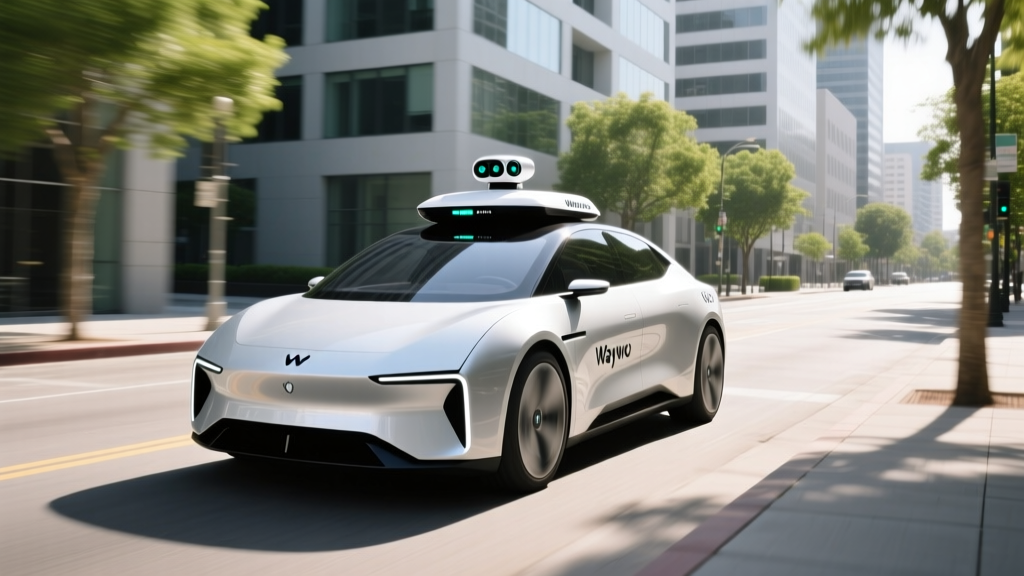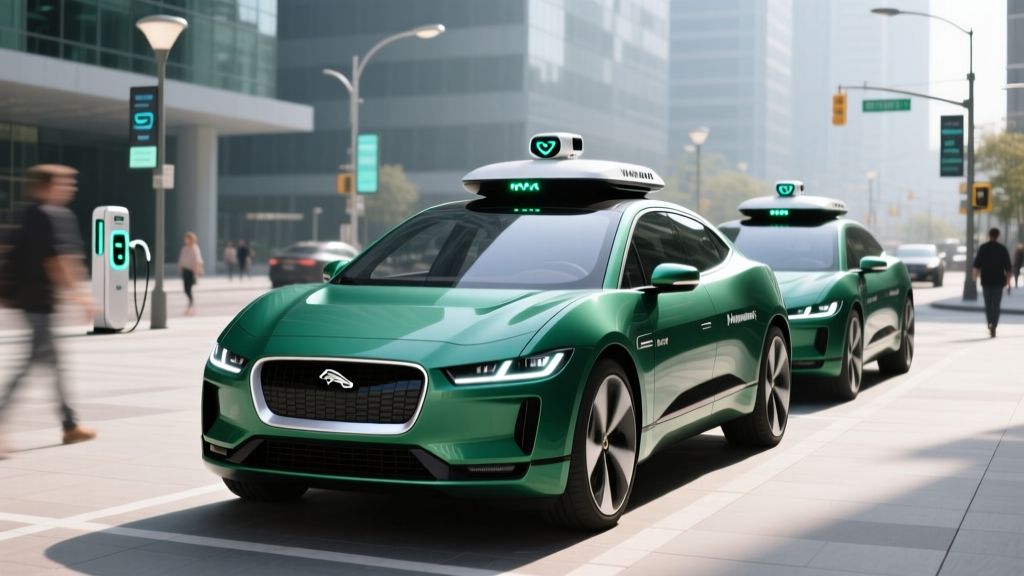
If you've seen a white Jaguar I-PACE gliding through Phoenix or San Francisco with a distinctive roof-mounted sensor array and no one behind the wheel, you've witnessed a fully electric, fully driverless robotaxi. Waymo, the Alphabet-owned autonomous driving company, operates the largest commercial robotaxi fleet in the United States — and every vehicle in that fleet is a battery-electric vehicle (BEV).
But "are Waymo's electric" is just the starting question. The more important ones are: what EV platform do they use, how does the 6th-generation Waymo Driver hardware stack up, where can you actually hail one, and what does the real safety and pricing data show? This guide answers all of it with current 2026 figures.
The EV Platform: Jaguar I-PACE and the 6th-Gen Waymo Driver
Waymo's commercial fleet is built on the Jaguar I-PACE, a luxury electric SUV that has served as Waymo's primary vehicle platform since 2018. The I-PACE was chosen for its flat battery floor, responsive electric drivetrain (critical for precise autonomous control), and spacious cabin that accommodates Waymo's extensive sensor and compute hardware.
Jaguar I-PACE (Waymo Edition) — Key EV Specs
| Battery Capacity | 90 kWh (usable ~84 kWh), NMC lithium-ion |
| EPA Range | 234 miles (stock I-PACE; Waymo upfit reduces to ~190-200 mi due to sensor power draw and added weight) |
| Drivetrain | Dual-motor AWD, 394 hp, 512 lb-ft torque |
| 0-60 mph | 4.5 seconds |
| DC Fast Charging | 100 kW peak (CCS1), 10-80% in ~45 min |
| Level 2 Charging | 7.4 kW onboard charger (J1772) |
| EPA Efficiency | 76 MPGe combined (stock); lower in Waymo config |
| Battery Warranty | 8 years / 100,000 miles (Jaguar baseline) |
The stock Jaguar I-PACE carries a 90 kWh NMC (nickel manganese cobalt) battery pack. In Waymo's configuration, the vehicle's effective range drops to roughly 190-200 miles because the 6th-generation Waymo Driver system — including its compute units, lidar, cameras, and radar — draws continuous power from the traction battery. The added weight of the sensor suite and reinforced mounting structures also reduces efficiency.
For robotaxi operations, this range is more than sufficient. Most Waymo One trips are under 15 miles, and vehicles return to dedicated charging depots between shifts. Waymo manages fleet charging centrally, primarily using Level 2 depot charging overnight and DC fast charging for mid-day top-ups.
SAE Automation Level: True Level 4, Not Driver-Assist
SAE Level 4 — High Automation (Geofenced Driverless)
Waymo operates at SAE Level 4, meaning the vehicle performs all driving tasks within a defined operational design domain (ODD) — specific geofenced areas in approved cities — with no human driver required. There is no steering wheel interaction, no "driver monitoring" camera watching your eyes, and no expectation that a passenger will take over.
This is fundamentally different from SAE Level 2 systems like Tesla Autopilot, Ford BlueCruise, or GM Super Cruise, which require an attentive human driver ready to intervene at any moment. Waymo's vehicles have no driver seat occupant. The car handles everything — or if it encounters a situation it cannot resolve, it performs a minimal-risk maneuver (pulling over safely) and contacts remote assistance.
Where Can You Ride a Waymo Right Now?
As of early 2026, Waymo One — the company's commercial ride-hailing service — operates in the following metropolitan areas. Availability is geofenced: you can only request rides within each city's approved service zone, which Waymo expands incrementally as it validates new road segments.
Phoenix remains Waymo's most mature market, with the broadest geofence and highest ride volume. San Francisco is the second-largest operation and the most technically demanding, given dense urban traffic, steep hills, and frequent construction zones. Los Angeles is scaling rapidly but covers a smaller percentage of the metro area due to the sheer sprawl involved.
How to Use Waymo One and What It Costs vs. Uber/Lyft
Hailing a Waymo is straightforward: download the Waymo One app (iOS/Android), create an account, and request a ride just as you would with Uber or Lyft. In some markets, you can also request Waymo vehicles through the Uber app as a ride option.
Pricing is set to be competitive with UberX and Lyft Standard, not premium. Waymo has stated publicly that its goal is to price rides at or slightly below comparable rideshare tiers to drive adoption, though surge-style pricing applies during peak demand.
Estimates based on typical Phoenix and San Francisco fares, early 2026. Actual pricing varies by demand, distance, and time of day. No tipping required for Waymo (no driver).
The cost advantage of robotaxis over human-driven rideshare is structural: Waymo doesn't pay a driver per ride. However, the company absorbs enormous capital costs per vehicle — each 6th-gen Waymo-equipped I-PACE is estimated to cost $150,000-$200,000+ when fully outfitted with sensors and compute hardware. Waymo's long-term profitability depends on achieving high vehicle utilization (15+ hours/day) and reducing per-unit hardware costs across fleet scale.
Safety Record: What the Data Actually Shows
Waymo Safety Data — Key Figures
- Total autonomous miles driven: Over 40 million fully driverless miles as of late 2025 (across all markets)
- Injury-causing crash rate: Waymo's published data (submitted to NHTSA) shows an injury-causing crash rate approximately 85% lower than the human benchmark in comparable urban environments
- Police-contactable crash rate: Approximately 57% lower than human drivers in the same geographies
- Most common incident type: Low-speed contact events (under 10 mph), often involving other human drivers rear-ending or side-swiping the Waymo vehicle at intersections
- Serious injuries to passengers: No reported fatalities; serious passenger injuries are extremely rare relative to ride volume
Source: Waymo safety reports, NHTSA Standing General Order crash data, and peer-reviewed analysis published by the Insurance Institute for Highway Safety (IIHS).
Waymo's safety record is the strongest among robotaxi operators, but it is not incident-free. The company has experienced low-speed collisions — primarily situations where a human-driven vehicle violated the Waymo's right of way. In several documented cases in San Francisco, Waymo vehicles made contact with pedestrians in complex crosswalk scenarios, prompting NHTSA investigations and software recalls.
The critical distinction: Waymo's vehicles don't get drowsy, intoxicated, or distracted. Their 360-degree sensor coverage (see tech stack below) eliminates blind spots. But they do occasionally exhibit overly cautious behavior — stopping unexpectedly in travel lanes when encountering ambiguous situations, which can cause rear-end collisions from following human drivers.
Technology Stack: Lidar + Camera + Radar (Not Camera-Only)
6th-Generation Waymo Driver — Sensor Suite
Unlike Tesla's camera-only FSD approach, Waymo uses a redundant, multi-modal sensor stack designed for the specific demands of driverless operation:
| Lidar (5+ units) | Custom-built roof and fender-mounted lidar provides a real-time 3D point cloud of the environment out to 500+ meters. Lidar works independently of lighting conditions — critical for night driving, direct sun glare, and shadow-heavy urban canyons. |
| Cameras (29+) | High-resolution cameras cover 360 degrees at varying focal lengths for object classification (pedestrian vs. cyclist vs. cone), traffic-light state detection, and sign reading. |
| Radar (6+) | Imaging radar supplements lidar for velocity detection of moving objects, particularly in heavy rain or fog where lidar scatter increases. |
| External audio | Microphone arrays detect emergency vehicle sirens from multiple directions, triggering appropriate pull-over behavior. |
| Compute | Custom AI inference hardware (Waymo-designed) processes sensor fusion in real time. The system runs Waymo's proprietary "Waymo Driver" software stack, trained on billions of simulated and real-world miles. |
HD Mapping: Waymo pre-maps every road in its service area at centimeter-level precision. The vehicle localizes itself against this map in real time, providing a layer of redundancy beyond live sensor perception. This is why Waymo can only operate in geofenced, pre-mapped areas — a new road segment requires a mapping run and validation before the system will drive it autonomously.
The lidar-vs-camera debate is one of the most consequential technology choices in autonomous driving. Tesla CEO Elon Musk has famously dismissed lidar as "a fool's errand," betting entirely on neural-network vision. Waymo's position — backed by its safety data — is that lidar provides an irreplaceable ground-truth depth measurement that camera inference alone cannot reliably replicate, especially in edge cases involving unusual lighting, partial occlusions, or novel objects the neural network hasn't been trained on.
Regulatory Landscape: Who Approves Robotaxi Operations?
Robotaxi deployment in the U.S. is governed by a patchwork of state and local regulations, with no comprehensive federal framework for driverless commercial operations. Key regulatory bodies include:
- California Public Utilities Commission (CPUC): Approves commercial robotaxi fares and service permits in California (San Francisco, Los Angeles). CPUC approval was the key gate for Waymo's 2024-2025 expansion across the state.
- California DMV: Issues testing and deployment permits; requires annual disengagement and collision reports.
- Arizona: Among the most permissive regulatory environments. Waymo has operated commercially in Phoenix since 2020 with minimal state-level restriction. The Arizona Department of Transportation oversees general road-use compliance.
- Texas (Austin): No specific state-level robotaxi permitting framework; Waymo operates under general autonomous vehicle testing/deployment statutes.
- NHTSA (federal): Oversees vehicle safety standards and investigates crash incidents via Standing General Order reporting. NHTSA does not currently "approve" robotaxi services but can issue recalls or investigations that affect operations.
Waymo has invested heavily in regulatory relationships and compliance infrastructure. Each new city requires mapping, local government engagement, first-responder coordination (fire, police, EMS protocols for interacting with driverless vehicles), and often state-level permitting. This regulatory moat is a significant competitive advantage — it takes competitors years to replicate.
Current Limitations: Where Robotaxis Fall Short
What Waymo Cannot Do (Yet)
- Heavy weather: Waymo vehicles will not operate in heavy rain, snow, or dense fog. Lidar scatter in precipitation degrades perception, and the system defaults to a conservative no-go decision. Phoenix's dry climate is a major reason it was Waymo's first market.
- Unmapped areas: If a road segment hasn't been HD-mapped and validated, the vehicle will not enter it. You cannot ask a Waymo to drive to a suburb outside its geofence.
- Construction zones (complex): While Waymo handles simple construction reroutes, complex multi-flagger construction zones with temporary lane shifts and hand signals remain challenging. The vehicle may pull over and request remote assistance.
- Highway driving (limited): Waymo has begun highway-capable operations on select freeway segments (e.g., Phoenix freeway airport runs), but most service areas focus on surface streets. Sustained 65-75 mph highway operation requires additional validation.
- Unusual road users: Encounters with horses, farm equipment, parade floats, or other highly unusual objects can trigger a stop-and-wait response. The system is conservative by design — it would rather stop safely than make an uncertain maneuver.
- No inter-city trips: Waymo One is strictly an urban/suburban ride-hailing service. You cannot book a Waymo from Phoenix to Tucson.
- Accessibility gaps: While Waymo has deployed wheelchair-accessible vehicles in some markets, availability is limited compared to the standard fleet. The I-PACE platform is not inherently wheelchair-accessible, requiring modified vehicles or ramp-equipped alternatives.
These limitations are not trivial. They define the practical boundary of where robotaxis can replace human-driven rideshare today. If you live in a city with heavy winter weather, need to travel outside a metro area, or frequently encounter complex road work, a Waymo may not be a reliable option for every trip.
Why Electric Matters for Robotaxi Operations
Waymo's choice of an EV platform isn't incidental — it's operationally strategic. Electric drivetrains offer three advantages critical to autonomous driving:
- Precision control: Electric motors deliver instant, linear torque with millisecond-level response. The autonomous driving computer can command exact acceleration and deceleration profiles that internal combustion engines (with their transmission lag and nonlinear power delivery) cannot match.
- Lower operating cost per mile: Electricity at depot charging rates ($0.08-$0.15/kWh in most Waymo markets) costs roughly $0.03-$0.05 per mile for the I-PACE — compared to $0.12-$0.18 per mile for gasoline in a comparable SUV. At fleet scale with 1000+ vehicles driving 100+ miles per day, this difference is millions of dollars annually.
- Reduced maintenance: No oil changes, no transmission fluid, no exhaust systems, and regenerative braking that dramatically extends brake pad life. For a fleet vehicle accumulating 40,000-60,000 miles per year, maintenance savings are substantial.
The I-PACE's 100 kW peak DC charging rate is a weak point — it's slower than modern competitors like the Hyundai Ioniq 5 (240 kW) or Tesla Model Y (250 kW). Waymo mitigates this by relying primarily on overnight depot charging on Level 2 (7.4 kW, adding ~25 miles per hour of charging) and using DC fast charging only for mid-shift top-offs. A 10-80% DC fast charge still takes approximately 45 minutes, which is acceptable when vehicles are swapped in and out of service throughout the day.
Frequently Asked Questions
Are all Waymo vehicles electric?
Yes. Waymo's entire commercial fleet consists of Jaguar I-PACE all-electric SUVs. The company has also tested the Zeekr M-Vision concept (a purpose-built electric robotaxi platform from Geely) for future fleet expansion, but as of 2026, the I-PACE remains the sole production vehicle.
Is Waymo truly self-driving or is there a remote human driver?
Waymo vehicles are genuinely driverless — there is no human in the driver's seat, and no remote "teleoperator" driving the car in real time. Waymo does employ remote assistance staff who can provide guidance when the vehicle encounters an ambiguous situation (e.g., an unusual construction zone). However, remote assistants do not steer or control the vehicle directly; they provide high-level routing or confirmation inputs, and the vehicle's AI executes the maneuver.
How much does a Waymo ride cost compared to Uber?
Waymo One pricing is generally comparable to UberX, typically within $1-3 of a similar UberX fare for the same route. For a 5-mile trip in Phoenix, expect $10-$16. There's no tipping (no driver), and no surge pricing at the extremes you might see on Uber during major events. Airport runs (e.g., PHX or SFO) tend to run $28-$42 depending on distance and demand.
What happens if a Waymo gets into an accident?
The vehicle's system automatically detects collisions and initiates post-crash protocols: hazard lights activate, the vehicle moves to a safe position if possible, and Waymo's operations center is immediately alerted. Passengers can communicate with a live support agent via the in-vehicle screen at any time. Waymo carries commercial insurance for all rides, and passengers are covered under Waymo's liability policy. All incidents are reported to NHTSA under the Standing General Order.
Can I use Waymo if I'm in a wheelchair?
Waymo has introduced wheelchair-accessible vehicles (WAVs) in select markets, including Phoenix. However, WAV availability is limited compared to the standard I-PACE fleet, and wait times may be longer. You can request a WAV through the Waymo One app where available. Waymo has acknowledged that accessibility remains an area requiring expansion.
What EV will Waymo use after the Jaguar I-PACE?
Waymo has partnered with Geely's Zeekr brand on a purpose-built electric robotaxi concept called the M-Vision, designed from the ground up for driverless operation (no steering wheel, sliding doors, low floor for accessibility). Additionally, Waymo has announced partnerships with Hyundai/Kia and Stellantis for future vehicle platforms. No next-generation fleet vehicle has been confirmed for deployment as of early 2026, but the I-PACE is expected to remain in service for several more years.
How does Waymo's safety record compare to human drivers?
According to Waymo's published data and independent analysis, Waymo vehicles operating in driverless mode show an injury-causing crash rate approximately 85% lower than the human benchmark in comparable urban driving environments. The police-contactable crash rate is roughly 57% lower. However, these comparisons involve urban geofenced driving — Waymo does not operate in rural or high-speed highway environments where crash dynamics differ. Full data is available through Waymo's safety publications and NHTSA crash reporting.
Waymo's all-electric fleet represents the most commercially mature Level 4 robotaxi service in the world. The Jaguar I-PACE platform, while not the newest or fastest-charging EV on the market, provides the precise drivetrain control and operational economics that make driverless ride-hailing viable at scale. If you're in Phoenix, San Francisco, Los Angeles, or Austin, the experience is available today — no driver, no steering wheel, no emissions, and a fare that competes directly with Uber.