Quick Answer: Can You Bring a Dog in a Waymo Robotaxi?
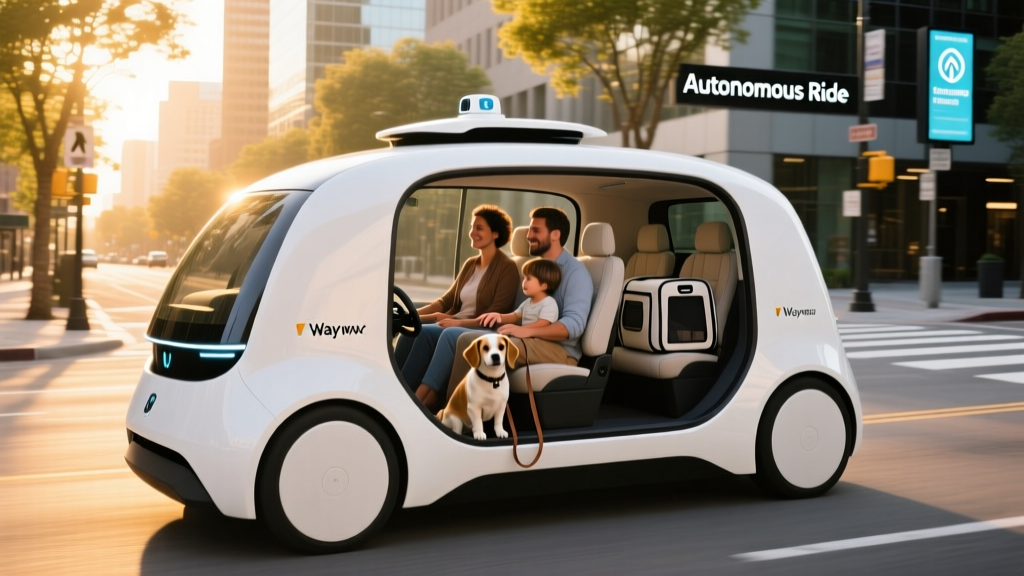
If you've ever wondered, "Are dogs allowed in Waymo?" — the short answer is nuanced. Waymo One, the company's commercial robotaxi service, permits service animals as required by the Americans with Disabilities Act (ADA). However, pet dogs and other companion animals are not officially permitted under Waymo's current rider policies. Unlike Uber or Lyft, where individual drivers may exercise discretion, a Waymo vehicle has no human driver to grant an exception.
This distinction matters because robotaxis operate under a different framework than traditional rideshare. There's no one in the car to evaluate a well-behaved golden retriever versus an aggressive or anxious pet. The policies are hard-coded into the service terms you agree to when booking.
Understanding Waymo's Autonomy Level: SAE Level 4 Explained
Before diving deeper into rider policies, it's critical to understand what Waymo actually is — and isn't. Waymo One is a SAE Level 4 autonomous vehicle service. This is fundamentally different from the Level 2 driver-assist systems you might use in a Tesla (Autopilot/FSD Supervised), Ford (BlueCruise), or GM (Super Cruise).
| Level | Name | Who Drives? | Example |
|---|---|---|---|
| Level 0 | No Automation | Human | Basic car with no assist |
| Level 1 | Driver Assistance | Human | Adaptive cruise OR lane-keep |
| Level 2 | Partial Automation | Human (must supervise) | Tesla FSD Supervised, BlueCruise |
| Level 3 | Conditional Automation | System (human on standby) | Mercedes DRIVE PILOT (limited) |
| Level 4 | High Automation | System (no driver needed) | Waymo One, Zoox |
| Level 5 | Full Automation | System (anywhere, any condition) | Does not yet exist commercially |
Waymo's Level 4 status means the vehicle handles all driving tasks within its Operational Design Domain (ODD) — a defined geographic area, weather envelope, and road-type set. There is no steering wheel accessible to passengers and no expectation that you'll take over. This also means all rider policies, including the pet prohibition, are enforced through the app's terms of service rather than a driver's judgment call.
Where Can You Ride Waymo One Right Now?
Waymo One operates commercially in a growing but still limited set of metro areas. As of early 2026, confirmed live service cities include:
| City | Status | Approximate Service Area | Notes |
|---|---|---|---|
| Phoenix, AZ | Fully commercial | Metro Phoenix, ~225+ sq mi | Largest, longest-running market; airport service available |
| San Francisco, CA | Fully commercial | Most of SF proper | Dense urban environment; 24/7 operation |
| Los Angeles, CA | Fully commercial | Santa Monica, Hollywood, Downtown, expanding | Gradual geographic expansion ongoing |
| Austin, TX | Commercial (limited) | Central Austin, select corridors | Launched commercially in 2025 |
Waymo has announced plans to expand to additional cities, but announced markets should not be confused with live service. Always check the Waymo One app for your specific address before relying on the service for transit. Geofencing means the car cannot pick up or drop off outside its approved zone — even if you're only a mile beyond the boundary.
How to Use Waymo One and What It Costs vs. Uber and Lyft
Booking a Waymo is straightforward if you're in a service area: download the Waymo One app, set your pickup and dropoff, and confirm. The vehicle arrives without a driver, you unlock it via the app, and it handles the entire trip. Tipping is not expected (there's no driver to tip), though the app does offer an option.
| Factor | Waymo One | UberX | Lyft Standard |
|---|---|---|---|
| Base fare (typical 5-mi trip) | $12–$18 | $10–$16 | $10–$15 |
| Surge/peak pricing | Minimal or none | Frequent, can 2–3x | Frequent, can 2–3x |
| Tipping | Optional, not expected | Expected (~15–20%) | Expected (~15–20%) |
| Wait time charges | Standard policy | After 2 min | After 2 min |
| Pet fee option | N/A (pets not allowed) | Uber Pet (~$3–$5 extra) | Varies by driver |
In practice, Waymo's pricing is competitive with UberX or Lyft Standard on standard trips, and it often wins during peak hours when human-driven rideshare surges dramatically. The absence of surge pricing in most Waymo markets is a significant advantage for budget-conscious riders — though availability can be limited during high-demand windows, meaning longer wait times rather than higher fares.
Waymo's Safety Record: What the Data Actually Shows
Safety is the most scrutinized aspect of robotaxi operations. Waymo has published and submitted substantial data to regulators. Here's what the numbers show:
- Total autonomous miles driven: Over 30 million fully driverless miles across all markets
- Injury-causing crash rate: Approximately 85% lower than human benchmarks in comparable urban environments, per NHTSA-referenced data and Waymo's published safety reports
- Police-reported crashes: Lower rate per million miles than human drivers in Phoenix and San Francisco
- Contact rate: Most minor incidents involve the Waymo vehicle being rear-ended or side-swiped by human drivers, not the robotaxi initiating contact
That said, Waymo has not been incident-free. Publicly reported events include low-speed collisions with pedestrians (typically resulting in minor injuries), encounters with downed power lines, and temporary service suspensions following software-related recalls. The National Highway Traffic Safety Administration (NHTSA) and state regulators like the California DMV and the California Public Utilities Commission (CPUC) require detailed incident reporting, which provides more transparency than exists for human drivers.
The critical context: Waymo's safety data reflects operation in geofenced urban areas at moderate speeds. The vehicle is not operating on rural highways or in severe weather, which skews comparison with the full spectrum of human driving conditions.
The Technology Stack: How Waymo Sees the World
Waymo's vehicles — currently the 6th-generation hardware suite integrated into the Zeekr RT and previously the Jaguar I-PACE — use a multi-sensor approach that stands in contrast to Tesla's camera-only strategy:
- LiDAR: Multiple roof- and body-mounted LiDAR units generate a real-time 3D point cloud, accurate to centimeter resolution at ranges exceeding 200 meters. This provides depth perception independent of lighting conditions.
- Cameras: A suite of high-resolution cameras covers 360 degrees, handling lane-line detection, traffic-sign recognition, and signal-state classification (red/yellow/green, pedestrian walk/don't walk).
- Radar: Imaging radar supplements LiDAR for velocity detection of moving objects, especially useful for tracking other vehicles at intersections.
- Audio detection: External microphones detect emergency vehicle sirens, prompting the vehicle to pull over or yield.
- HD Mapping: Waymo pre-maps every road in its service area at lane-level detail. The vehicle constantly compares its live sensor data against this map, providing a redundant positioning layer beyond GPS.
This sensor redundancy is why Waymo can operate without a human driver. If one sensor modality is degraded — for example, camera performance in direct sun glare — LiDAR and radar compensate. This is a fundamentally different architecture than the vision-only approach used by Tesla's FSD Supervised (a Level 2 system that still requires driver attention).
Regulatory Oversight: Who Approves Robotaxi Operations?
Robotaxi deployment in the United States involves overlapping layers of regulation:
- Federal (NHTSA): Sets vehicle safety standards (FMVSS). NHTSA has granted Waymo and other robotaxi operators exemptions from certain requirements, such as the need for a steering wheel or mirrors, under specific conditions. NHTSA also investigates safety defects and can order recalls.
- State DMVs: In California, the DMV issues autonomous vehicle testing and deployment permits. Companies must report disengagement data and collision reports. Similar frameworks exist in Arizona and Texas, though Arizona's approach is notably more permissive.
- State Public Utility Commissions: In California, the CPUC regulates robotaxis as passenger carriers, setting requirements for insurance, accessibility, and rider protections. Waymo holds a TCP (Transportation Charter Party) carrier permit.
- Local governments: Cities can impose operational restrictions, including geofencing, speed limits, and requirements for coordination with first responders. San Francisco's Board of Supervisors has at times pushed for tighter restrictions on robotaxi operations.
The regulatory landscape is evolving rapidly. As of 2026, there is no unified federal framework for autonomous vehicle deployment — each state sets its own rules, creating a patchwork that limits how quickly services like Waymo can expand nationally.
Current Limitations: Where Waymo Cannot Go
Despite impressive capabilities, Waymo's Level 4 system has hard boundaries that riders should understand before relying on the service:
- Geofencing: The vehicle cannot operate outside its pre-mapped and approved zone. If your destination falls outside the boundary, the app simply won't let you book.
- Weather constraints: Heavy rain, fog, and snow degrade sensor performance. Waymo may suspend service or restrict operations during severe weather events. Phoenix's dry climate is an advantage; San Francisco's fog can trigger operational adjustments.
- Construction zones: Major, unmapped road construction can confuse the system. While Waymo updates maps frequently, sudden lane closures or temporary traffic patterns may cause the vehicle to take a conservative route or pull over safely and end the trip.
- Emergency scenarios: Waymo vehicles are programmed to yield to emergency vehicles and pull over when sirens are detected. However, they cannot interpret hand signals from police officers directing traffic — a known edge case that may cause the vehicle to stop and wait.
- Airport and highway access: Some highway segments are included in Waymo's ODD (particularly in Phoenix), but freeway driving in dense urban areas like San Francisco remains limited. Airport service has been rolled out gradually (Phoenix Sky Harbor is active; SFO access has been in testing phases).
- No pet animals: As noted, companion animals are not permitted. Only ADA-defined service animals may ride.
- Child seats: Waymo vehicles do not provide child safety seats, and children under a certain age/height may not ride without one. Check the app for current age restrictions.
Service Animals vs. Pets: What ADA Requires
Under the Americans with Disabilities Act, Waymo — like any public accommodation — must permit service animals that are individually trained to perform tasks for a person with a disability. This includes guide dogs for the visually impaired, hearing dogs, mobility-assistance dogs, and psychiatric service dogs trained for specific tasks.
Key distinctions:
- Service animal: A dog (or in rare cases, a miniature horse) trained to perform a specific task related to the handler's disability. No documentation, vest, or certification is legally required — though the animal must be under control.
- Emotional support animal (ESA): Provides comfort by its presence but is not trained for a specific disability-related task. ESAs do not have ADA public-access rights and are not guaranteed entry to a Waymo.
- Pet: A companion animal with no service training. Not permitted in Waymo vehicles.
If you rely on a service animal, you can book a Waymo One ride with confidence. The vehicle's interior is designed to accommodate a service animal at your feet. For pet owners, the practical workaround is to use Uber Pet or a standard Lyft ride where drivers can accept or decline pet requests.
Frequently Asked Questions
Can I bring my small dog in a carrier in a Waymo?
No. Waymo's policy does not distinguish between dogs in carriers and loose dogs. Only ADA-defined service animals are permitted, regardless of size or containment method.
Does Waymo charge a cleaning fee if a service animal sheds?
Waymo does not charge cleaning fees related to service animals. ADA protections prohibit surcharges or fees specifically tied to a service animal's presence.
What happens if I bring a pet and the Waymo detects it?
Waymo vehicles have interior cameras for safety and security monitoring. If a rider is found to have violated the pet policy, the trip may be flagged, and the account could face warnings or suspension. You may also be charged a cleaning fee for any mess left behind.
Are there robotaxi services that allow pets?
As of 2026, no major Level 4 robotaxi service (Waymo, Zoox, Cruise's successor operations) has a pet-friendly option. Traditional rideshare with a human driver remains the best option — Uber Pet specifically caters to riders with companion animals.
Is Waymo truly self-driving, or is there a remote operator?
Waymo One vehicles are truly driverless — there is no human in the car and no remote driver controlling the vehicle in real time. However, Waymo employs remote assistance (sometimes called "teleoperations" or "fleet response"). If the vehicle encounters an ambiguous situation, it can request guidance from a remote agent who may confirm a path or suggest a maneuver. The remote agent does not steer or brake the car directly; they provide high-level input that the vehicle's system then executes within its safety parameters.
How does Waymo compare to Uber for airport trips?
In Phoenix, Waymo One serves Sky Harbor International Airport and is often cheaper than UberX during peak travel hours due to the absence of surge pricing. In San Francisco and Los Angeles, airport service availability varies — check the app for your specific terminal. For airport trips with a pet, Uber Pet or a traditional taxi remains necessary.