Amazon's Zoox has been building toward a commercial driverless future longer than most automakers have been serious about electrification. The Las Vegas market — where Zoox first tested its purpose-built robotaxi on public roads — remains one of the company's most important proving grounds. If you've searched for "Amazon Zoox Las Vegas" wondering whether you can actually hail one, what it costs, or how safe the technology really is, this guide breaks down the operational reality as of early 2026.
Zoox stands apart from Tesla's Full Self-Driving (Supervised) and GM's Super Cruise in one critical way: it operates at SAE Level 4, meaning no human driver is present, no steering wheel exists, and the vehicle handles all driving tasks within its approved operational design domain (ODD). This isn't driver-assist. It's driverless — within strict geographic and environmental boundaries.
Zoox robotaxis operate at SAE Level 4 within their geofenced service area. The vehicle performs all driving tasks without human intervention under defined conditions (mapped urban streets, fair weather, speed limits ≤45 mph). No driver backup is required or possible — there is no steering wheel, no pedals, and no driver's seat. This is fundamentally different from Level 2 systems like Tesla Autopilot or Ford BlueCruise, which require continuous driver supervision.
Where Can You Use Zoox in Las Vegas Right Now?
Zoox launched its commercial rider-hail service in Las Vegas in mid-2025 after years of testing on the city's grid. The service area is geofenced — meaning the vehicles will only operate within a digitally mapped boundary approved by Nevada regulators. As of early 2026, the operational zone covers:
- The Las Vegas Strip corridor — from Mandalay Bay north to the Stratosphere, including major hotel-casino pickup/drop-off points
- Downtown Las Vegas — the Fremont Street area and surrounding blocks
- Convention Center district — Las Vegas Convention Center and adjacent hotels
- Select suburban connectors — portions of Paradise Road, Las Vegas Boulevard South, and Sahara Avenue linking key destinations
| City | Status | Service Area | Hours |
|---|---|---|---|
| Las Vegas, NV | Commercial service (live) | Strip, Downtown, Convention Center (~12 sq mi geofence) | ~6 AM – 1 AM daily |
| San Francisco, CA | Commercial service (live) | SoMa, Mission, Financial District, expanding | ~6 AM – midnight daily |
| Foster City, CA | Testing / employee rides | Limited suburban zone | Testing hours |
| Other U.S. cities | Announced / planned | TBD — regulatory approvals pending | N/A |
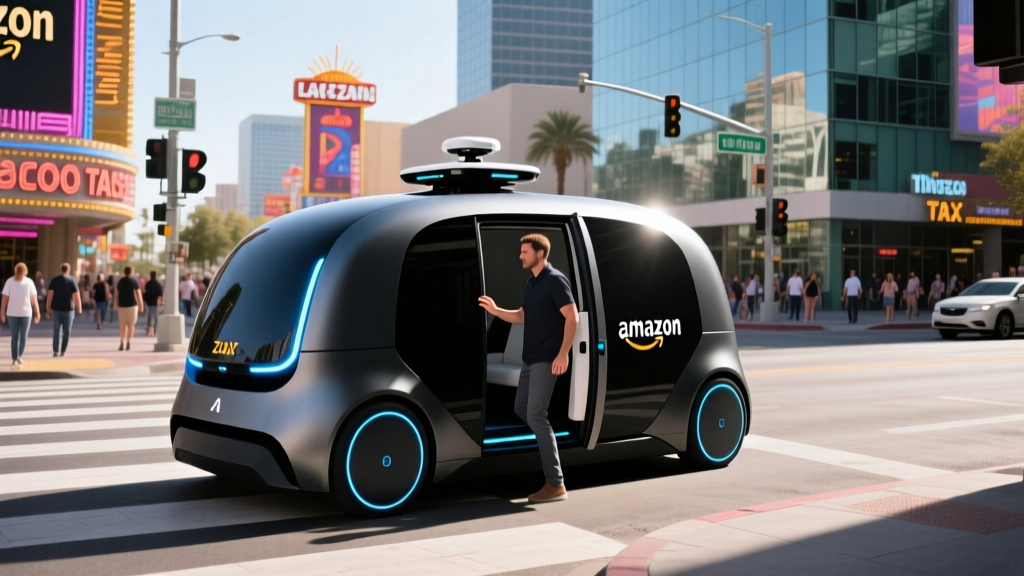
How to hail a ride: Download the Zoox app (iOS/Android), create an account, set your pickup and drop-off within the geofence, and confirm. The vehicle arrives autonomously — no driver greets you. Doors unlock via the app when the vehicle arrives at your pinpointed location. The interior features two forward-facing and two rear-facing seats in a carriage-style layout, with no driver compartment.
Zoox Pricing vs. Uber and Lyft in Las Vegas
Zoox entered the Las Vegas market with aggressive introductory pricing to build rider adoption, subsidized by Amazon's deep pockets. Here's how typical fares compare as of early 2026:
| Service | Typical Fare | Surge Pricing? | Wait Time |
|---|---|---|---|
| Zoox | $8 – $14 (promo period) | No dynamic surge (capped) | 5–12 min |
| UberX | $14 – $22 | Yes, can 2–3x | 3–8 min |
| Lyft Standard | $13 – $20 | Yes, can 2–3x | 3–8 min |
| Waymo (if available) | $12 – $18 | Limited surge | 4–10 min |
Zoox's pricing advantage is real but temporary. Amazon has historically subsidized early-market pricing to drive adoption — similar to how ride-hailing platforms burned cash in their early years. Expect fares to normalize upward as the service matures and fleet density increases. The lack of dynamic surge pricing is a genuine advantage during peak Strip hours (Friday/Saturday nights, major conventions), when Uber and Lyft fares can triple.
How Safe Are Zoox Robotaxis? The Real Data
- Total autonomous miles driven (all markets): ~3.5+ million miles
- At-fault collisions: Zero reported at-fatal incidents as of publication
- Contact incidents: Minor low-speed contacts reported during testing phase (pre-commercial), consistent with industry averages for urban autonomous operations
- Disengagement rate: Zoox does not publish a public disengagement metric in the same format as California DMV reports; the company states its remote-assistance intervention rate has decreased year-over-year
- NHTSA Standing General Order: Zoox is subject to mandatory crash reporting for any Level 4 incident — review filings at nhtsa.gov
Context matters enormously here. Zoox's Las Vegas geofence covers relatively structured urban environments with wide roads, predictable traffic patterns, and low precipitation — an ideal operational design domain. The vehicle's top speed is electronically limited to 75 mph, though it typically operates at or below 45 mph within its service zone.
For comparison, IIHS data consistently shows that human drivers in urban environments average roughly 1 reported collision per 500,000 miles driven, with at-fault rates varying by city. Zoox's safety record through early 2026 suggests performance at or above human baselines within its ODD, though the sample size remains smaller than Waymo's multi-city, multi-million-mile dataset.
The critical nuance: robotaxi safety data reflects performance within approved geofences under approved conditions. Extrapolating these numbers to all driving scenarios — rural highways, unmapped roads, severe weather — would be misleading. Zoox's safety case is specific to its operational domain.
The Technology Stack: Lidar, Cameras, and Geofencing
Zoox's purpose-built vehicle (internally called the "Gen 5" platform) was designed from the ground up as a robotaxi — not a retrofitted production car. This gives it sensor and compute advantages that matter in dense urban environments:
Zoox Sensor & Compute Architecture
| Lidar | Multiple solid-state lidar units providing 360° 3D point-cloud mapping, effective to ~150+ meters |
| Cameras | High-resolution camera array covering 360° field of view, multi-spectral for varying light conditions |
| Radar | Multiple radar units for velocity detection and adverse-weather object tracking |
| Compute | Custom onboard AI compute platform running Zoox's proprietary perception, prediction, and planning stack |
| HD Mapping | Centimeter-precision geofenced maps, continuously updated; vehicle will not operate outside mapped zone |
| Remote Assistance | Fleet operations center can provide high-level guidance (not remote driving) for edge-case resolution |
| Powertrain | All-electric, dual-motor AWD, ~75 mph top speed, battery pack sized for all-day urban duty cycles |
The most significant technology distinction between Zoox and Tesla's FSD (Supervised) is sensor philosophy. Tesla relies on a camera-only ("Tesla Vision") approach, arguing that neural networks can extract sufficient depth and velocity data from video. Zoox — like Waymo and Cruise — uses a redundant sensor stack combining lidar, radar, and cameras. In practice, the lidar provides an independent depth channel that doesn't degrade in the same failure modes as pure vision (e.g., direct sun glare, shadow-to-light transitions, occluded objects at night).
Zoox's geofencing is not optional or advisory — it's a hard operational boundary. The vehicle physically will not navigate outside its HD-mapped zone. If a rider requests a destination outside the geofence, the app rejects the request at the booking stage.
Regulatory Landscape: Who Approves Zoox Operations?
Robotaxi deployment in the United States requires a patchwork of state and local approvals. There is no single federal "robotaxi license." Here's how Zoox's regulatory chain works:
- Federal (NHTSA): Zoox received an exemption from certain Federal Motor Vehicle Safety Standards (FMVSS) because its purpose-built vehicle lacks a steering wheel, mirrors, and other driver-oriented controls. NHTSA grants these exemptions on a case-by-case basis. Zoox is also subject to NHTSA's Standing General Order requiring crash reporting for all ADS-equipped vehicles.
- State (Nevada): Nevada was one of the first states to pass autonomous vehicle legislation. The Nevada Department of Motor Vehicles issues testing and deployment permits. Zoox holds a commercial deployment permit for Clark County (Las Vegas metro).
- State (California): The California Public Utilities Commission (CPUC) and DMV jointly regulate commercial robotaxi service. Zoox holds a CPUC permit for paid rides in San Francisco.
- Local (City/County): Local jurisdictions can impose additional operating conditions — restricted hours, school-zone speed limits, construction-zone protocols, and first-responder interaction requirements.
This fragmented regulatory environment is the single largest bottleneck for robotaxi expansion. Each new city requires separate negotiations, permits, and compliance frameworks. This is why Zoox (and competitors) expand city-by-city rather than flipping a national switch.
Current Limitations: What Zoox Cannot Do
Understanding the limitations is as important as understanding the capabilities. Zoox robotaxis in Las Vegas face the following constraints as of early 2026:
Operational Limitations
- Weather restrictions: Zoox vehicles will reduce speed or pull over during heavy rain, dust storms (haboobs — a real Las Vegas concern), or flooding. The vehicle does not operate in snow or ice conditions.
- Geofence boundary: No service to Harry Reid International Airport (as of early 2026 — negotiations ongoing), no service to Henderson, Summerlin, or other suburbs outside the mapped zone.
- Construction zones: Major road construction can trigger route avoidance or, in some cases, remote-assistance intervention. The vehicle may stop and wait if it cannot safely resolve an unmapped detour.
- Pickup/drop-off precision: While the vehicle navigates to your location, certain hotel driveways, valet lanes, and private property areas are inaccessible. You may need to walk to a public curb for pickup.
- No highway driving: The vehicle does not enter freeways (I-15, US-95). All routing is surface-street only within the geofence.
- Passenger capacity: The carriage-style interior seats up to 4 passengers. No wheelchair-accessible vehicles in the current fleet (ADA compliance remains an industry-wide challenge for purpose-built robotaxis).
- Luggage/cargo: Limited interior cargo space — designed for personal items, not airport-run luggage loads.
- Edge cases: Unusual road events (parades, protests, emergency vehicle convoys, unmapped road closures) may trigger a safe-stop and remote-assistance resolution, adding delay.
Zoox vs. Waymo: How the Las Vegas Robotaxi Landscape Compares
Waymo (Alphabet) is Zoox's primary competitor in the U.S. robotaxi market and has a longer commercial operating history, primarily in Phoenix and San Francisco. As of early 2026, Waymo does not operate a commercial service in Las Vegas, giving Zoox a first-mover advantage in the market. However, Waymo's cumulative autonomous miles (tens of millions across multiple cities) dwarf Zoox's current dataset.
Zoox's differentiation lies in its purpose-built vehicle — designed symmetrically with no "front" or "driver's side" — and its Amazon backing, which provides logistics infrastructure, cloud compute (AWS), and capital depth. Waymo's advantage is operational maturity, a broader geofence in its active cities, and a more established safety dataset reviewed by regulators.
For Las Vegas riders in 2026, the practical reality is simple: Zoox is the only Level 4 robotaxi you can currently hail. If and when Waymo enters the market, competition will likely compress pricing and expand coverage for consumers.
Frequently Asked Questions
Is Amazon Zoox in Las Vegas truly self-driving, or is there a safety driver?
Zoox operates at SAE Level 4 — there is no human driver in the vehicle, no steering wheel, and no pedals. The vehicle handles all driving tasks within its approved geofence. This is fundamentally different from Tesla FSD (Supervised), which is SAE Level 2 and requires a licensed, attentive driver behind the wheel at all times.
How much does a Zoox ride cost compared to Uber or Lyft?
During its introductory period in Las Vegas, Zoox fares typically run $8–$14 for a Strip-to-Downtown trip (~5 miles), compared to $13–$22 for UberX or Lyft Standard. Zoox does not currently apply dynamic surge pricing, making it significantly cheaper during peak demand periods. Pricing is expected to increase as the introductory subsidy period ends.
Can I take a Zoox robotaxi to the Las Vegas airport?
As of early 2026, Zoox does not service Harry Reid International Airport. The geofence covers the Strip corridor, Downtown, and the Convention Center district. Airport service requires separate regulatory and infrastructure agreements that are reportedly under negotiation but not yet approved.
What happens if the Zoox vehicle encounters an emergency or unusual situation?
Zoox vehicles are designed to execute a "minimal risk condition" — essentially a controlled stop in a safe location — when they encounter scenarios outside their operational capability. A remote fleet-operations team can then provide high-level guidance (e.g., confirming a route around an obstacle) but does not remotely drive the vehicle. Emergency services can interact with the vehicle via external interfaces designed for first responders.
How does Zoox's safety record compare to human drivers?
Zoox reports zero at-fault fatalities across its cumulative autonomous miles as of Q1 2026. For context, human drivers in urban U.S. environments average approximately 1 collision per 500,000 miles (IIHS data). However, Zoox's sample size is smaller than Waymo's, and its operating domain is restricted to favorable urban conditions — direct comparison requires nuance. All Level 4 incidents are reported to NHTSA under the Standing General Order.
Does Zoox operate in any other cities besides Las Vegas?
Yes. Zoox also operates a commercial rider service in San Francisco, California. The company has tested in Foster City, CA, and has announced intentions to expand to additional U.S. cities, though each expansion requires separate state and local regulatory approvals. Las Vegas and San Francisco are the two live commercial markets as of early 2026.
Can I use Zoox in the rain or at night?
Zoox operates during nighttime hours (service typically runs until approximately 1 AM in Las Vegas). Light rain does not typically interrupt service, but heavy rain, dust storms, or flooded roads will trigger speed reductions or service pauses. The vehicle's lidar and radar sensors provide capability in low-light conditions that exceed human night vision, but extreme weather remains a hard limitation for all current Level 4 systems.
Sources: NHTSA Standing General Order — Crash Reporting, Zoox official site, IIHS. Regulatory and operational details are current as of early 2026 and subject to change. Verify service availability and pricing through the Zoox app before planning trips.