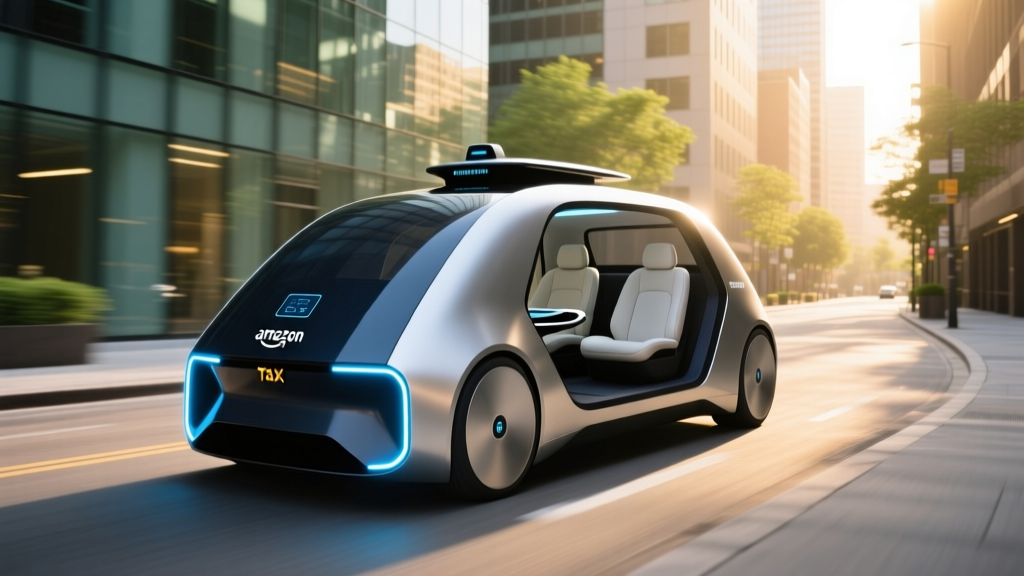
What Is the Amazon Zoox Car — And Is It Truly Self-Driving?
The Amazon Zoox car is a purpose-built, fully autonomous robotaxi designed and operated by Zoox, the self-driving technology company Amazon acquired in 2020 for roughly $1.2 billion. Unlike retrofitted ride-hail vehicles with a safety driver behind the wheel, the Zoox vehicle has no steering wheel, no pedals, and no driver's seat. It is engineered from the ground up as a passenger shuttle that operates without any human intervention inside the vehicle.
The Zoox robotaxi operates at SAE Level 4 — meaning the vehicle performs all driving tasks within its defined operational design domain (ODD) without any human supervision or fallback. This is fundamentally different from Level 2 driver-assist systems like Tesla Autopilot, Ford BlueCruise, or GM Super Cruise, which require an attentive human driver ready to take over at any moment. In a Zoox vehicle, there is no one to take over. The system is entirely responsible for driving within its geofenced service area.
Zoox was founded in 2014 in Foster City, California, and spent years developing its autonomous driving stack before unveiling its custom-built passenger vehicle in December 2020. After extensive testing on public roads — initially with safety drivers in modified Toyota Highlanders and later in the purpose-built Zoox vehicle — the company began offering limited rider experiences to employees and invited participants before expanding to broader public-facing services.
Where Can I Ride the Amazon Zoox Car Right Now?
As of early 2026, Zoox's commercial robotaxi service operates in select geofenced zones within two primary markets. The company has been methodical about expansion, prioritizing safety validation in each new area before opening access to additional riders.
| City | Status | Service Area Notes |
|---|---|---|
| Las Vegas, NV | Active — public rides | Initial commercial launch zone covering parts of the Las Vegas Strip corridor and surrounding downtown areas. Zoox received a Transportation Network Company (TNC) license from the Nevada Public Utilities Commission. |
| San Francisco, CA | Active — public rides | Operations centered on designated zones within San Francisco, building on years of mapping and testing in the city. California DMV and CPUC permits required. |
| Foster City, CA | Testing / limited access | Zoox headquarters area; used heavily for R&D and employee rides, not a full commercial zone. |
| Austin, TX | Testing phase | Zoox has been conducting mapping and validation drives; no announced date for public commercial service. |
To request a ride where service is active, users download the Zoox app (available on iOS and Android), create an account, and request a pickup within the geofenced zone. The experience is similar to hailing an Uber or Lyft, except the vehicle that arrives has no driver. Riders can select a destination within the service boundary, and the vehicle handles all routing, traffic negotiation, and drop-off autonomously.
Zoox Robotaxi Pricing vs. Uber and Lyft
During its initial commercial phases, Zoox has offered promotional and introductory pricing to build ridership and gather operational data. The long-term pricing model is expected to compete directly with traditional rideshare services, with the structural advantage of removing driver compensation from the cost equation.
| Service | Estimated Cost (3-mile trip) | Per-Mile Avg | Surge Pricing |
|---|---|---|---|
| Zoox (introductory) | ~$5–$8 (promotional) | ~$1.50–$2.50/mi | Not currently active |
| UberX | ~$10–$16 | ~$2.50–$4.50/mi | Yes (1.2x–3x+) |
| Lyft Standard | ~$9–$15 | ~$2.30–$4.20/mi | Yes (1.2x–3x+) |
| Waymo One | ~$10–$18 | ~$2.80–$5.00/mi | Yes (limited) |
The economic thesis of robotaxis is straightforward: removing the driver — who typically takes 60–80% of a rideshare fare — should allow operators to offer lower per-mile rates while still achieving profitability at scale. However, Zoox's current pricing reflects a market-entry strategy rather than a mature cost structure. The company's custom-built vehicle carries significant per-unit hardware cost (dense sensor suite, redundant compute, bespoke chassis), and fleet operations including remote monitoring, cleaning, and charging add overhead that takes time to optimize.
Zoox Sensor Stack and Autonomous Driving Technology
Zoox Perception & Compute Architecture
The Zoox vehicle uses a multi-modal sensor fusion approach — combining lidar, cameras, and radar — rather than a camera-only system like Tesla's FSD. This is the dominant architecture among Level 4 robotaxi operators (Waymo, Cruise, Motional) because it provides redundant depth perception and performs more reliably in challenging lighting conditions.
- Lidar: Roof-mounted and corner-positioned lidar units provide 360° high-resolution 3D point clouds for real-time object detection and distance measurement, independent of ambient light.
- Cameras: A multi-camera array covers overlapping fields of view around the entire vehicle for lane detection, traffic signal recognition, pedestrian classification, and signage reading.
- Radar: Forward and corner radar units supplement object tracking in rain, fog, and low-visibility conditions where lidar and cameras can degrade.
- Compute: Custom high-performance onboard computers process sensor data in real time, running Zoox's proprietary perception, prediction, and planning algorithms.
- HD Maps & Geofencing: Zoox relies on centimeter-accuracy pre-mapped routes within its operational design domain. The vehicle does not drive in unmapped areas.
The vehicle is also bidirectional — it can drive equally well in either direction, with identical sensor coverage on both ends. This symmetric design eliminates the need for three-point turns or backing up in tight urban environments.
The Zoox vehicle's battery is an electric powertrain system designed for all-day urban operation. While Zoox has not published detailed kWh capacity figures for the production passenger vehicle, the design prioritizes frequent opportunity charging at depot locations rather than maximum single-charge range. Urban robotaxi duty cycles involve lower average speeds, frequent stops, and moderate daily mileage (typically 100–200 miles), making a smaller battery with fast depot charging economically optimal compared to a long-range consumer EV.
Safety Record: What the Data Shows
As a newer commercial entrant compared to Waymo (which has logged over 30 million autonomous miles), Zoox's public safety dataset is smaller. Zoox reports having driven millions of autonomous miles across its test and operational fleet, including both the Toyota Highlander test mules and the purpose-built Zoox vehicle. Specific disengagement rates and incident counts are reported to state regulators (California DMV, Nevada authorities) as required by permit conditions.
Evaluating robotaxi safety requires looking at several data dimensions:
- Disengagement rate: The California DMV requires all autonomous vehicle permit holders to report the number of times a human safety driver (during testing) had to take control. Lower disengagement rates per 1,000 miles generally indicate system maturity, though direct comparison between companies is imperfect because test conditions and ODD complexity vary.
- Contact incidents: Both California and Nevada require reporting of any collision or contact event involving an autonomous vehicle. Zoox's public incident record has been limited relative to higher-volume operators like Cruise (which had its California permit suspended in late 2023 after a pedestrian-dragging incident in San Francisco).
- NHTSA Standing General Order: Under NHTSA's Standing General Order, all entities testing or deploying automated driving systems must report crashes involving Level 2 and above systems. Zoox is subject to this reporting requirement.
It's worth noting that robotaxi safety evaluation is still an evolving discipline. Miles-driven comparisons favor operators who have been running longer (Waymo, since 2009 as the Google Self-Driving Car Project). Zoox's approach has been more conservative — smaller fleet, tighter geofences, slower initial expansion — which limits exposure but also limits the volume of public safety data available for independent analysis.
Regulatory Landscape: Who Approves Zoox Operations?
Deploying a driverless vehicle on public roads in the United States involves navigating a patchwork of state and federal regulations. There is no single federal "robotaxi license" — instead, operators must secure approvals at multiple levels:
- Federal (NHTSA): The National Highway Traffic Safety Administration sets vehicle safety standards (FMVSS). Zoox's purpose-built vehicle, which lacks a steering wheel and mirrors, required an NHTSA exemption from certain FMVSS requirements. Zoox received a limited exemption to deploy up to 2,500 vehicles without standard manual driving controls — a critical regulatory milestone for the vehicle's legality on public roads.
- California (DMV + CPUC): In California, the DMV issues testing and deployment permits for autonomous vehicles. The California Public Utilities Commission (CPUC) regulates commercial passenger service (robotaxi fares, insurance, accessibility). Zoox holds both DMV driverless testing permits and CPUC authorization for limited commercial service.
- Nevada (PUCN + DMV): Nevada was one of the first states to legislate autonomous vehicle operations. Zoox obtained a Transportation Network Company license from the Nevada Public Utilities Commission and autonomous vehicle testing permits through the Nevada DMV, enabling its Las Vegas commercial operations.
This state-by-state framework means expansion is slow by design. Each new market requires separate regulatory engagement, insurance filings, and local government coordination. This is a significant operational constraint compared to traditional rideshare, which can onboard drivers in any city with minimal regulatory friction.
Current Limitations of the Zoox Robotaxi
Level 4 autonomy is powerful but bounded. The Zoox vehicle operates within strict constraints that define where, when, and how it can drive:
- Geofenced zones only: The Zoox vehicle will not drive outside its pre-mapped operational design domain. If you request a destination beyond the boundary, the app will not allow the trip.
- Weather restrictions: Heavy rain, flooding, dense fog, and snow can exceed the sensor system's reliable operating envelope. Zoox may suspend service or restrict operations during severe weather events — a limitation shared by all current lidar-camera robotaxi systems.
- No highway driving (in most zones): Current Zoox operations focus on urban and suburban surface streets. High-speed freeway driving adds complexity (merge scenarios, higher consequence of failure) that most Level 4 operators are still validating.
- Construction zones and road closures: While the system handles many temporary lane changes, major unplanned road alterations can force the vehicle to pull over and request remote assistance or reroute.
- Limited passenger capacity: The Zoox vehicle seats up to four passengers in a face-to-face configuration. It cannot accommodate wheelchair users in all configurations, and cargo space is limited compared to a standard sedan.
- No trunk/frunk for groceries or luggage: The passenger-centric design prioritizes cabin space over cargo, making airport runs with large luggage impractical.
- Remote assistance dependency: When the vehicle encounters an unresolvable scenario (edge case), it contacts a remote operations center. Resolution time varies, and passengers may experience delays during complex events.
These limitations are not unique to Zoox — Waymo, the most mature robotaxi operator in the US, shares many of the same constraints. The difference is one of degree: Waymo's longer operational history and larger fleet have allowed it to handle a broader set of edge cases and expand its geofenced areas more aggressively.
Zoox vs. Waymo: The Robotaxi Competitive Landscape
Zoox enters a market where Waymo (Alphabet/Google) is the clear incumbent, with commercial robotaxi service operating in Phoenix, San Francisco, Los Angeles, and expanding to additional cities. Understanding Zoox's positioning requires comparing it against this benchmark:
| Attribute | Zoox | Waymo One |
|---|---|---|
| Vehicle | Purpose-built (no steering wheel) | Jaguar I-PACE (retrofitted) |
| SAE Level | Level 4 | Level 4 |
| Active Cities (early 2026) | Las Vegas, San Francisco | Phoenix, SF, LA, Austin (expanding) |
| Autonomous Miles Logged | Millions (test + ops combined) | 30+ million driverless miles |
| Parent Company | Amazon | Alphabet (Google) |
| Vehicle Design | Symmetric, bidirectional, carriage-style | Conventional SUV form factor |
Zoox's purpose-built vehicle is a genuine differentiator in passenger experience — the face-to-face seating, large windows, and absence of driving controls create a "carriage" feel that a retrofitted Jaguar I-PACE cannot match. However, Waymo's multi-year head start in commercial operations, larger fleet, and broader city coverage give it a substantial advantage in reliability data, rider trust, and regulatory relationships.
Frequently Asked Questions
Can I buy the Amazon Zoox car for personal use?
No. The Zoox vehicle is not available for consumer purchase. It is a fleet-operated robotaxi — you can only ride in one by requesting a trip through the Zoox app in an active service city. Amazon/Zoox has not announced any plans to sell the vehicle to individuals.
Is the Zoox car truly self-driving, or is there a remote driver?
The Zoox vehicle is genuinely self-driving (SAE Level 4) within its geofenced area. There is no remote human "driving" the car via joystick or teleoperation in real time. However, remote operations staff can assist the vehicle's AI by confirming a safe path forward when it encounters an ambiguous scenario — similar to how an air traffic controller guides a plane that is still flying itself.
What happens if the Zoox robotaxi gets into an accident?
Zoox carries commercial insurance for its robotaxi operations as required by state regulators. In the event of a collision, the vehicle is designed to pull over safely, contact emergency services if needed, and notify Zoox's operations center. Passengers are not held liable for the vehicle's driving decisions.
How fast does the Zoox car go?
The Zoox vehicle has a top speed of approximately 75 mph, though in practice it operates well within posted speed limits in its urban geofenced zones. It is designed for city and suburban driving, not highway-speed travel.
Does Zoox operate in rain or at night?
Yes, Zoox operates at night and in light rain. However, severe weather conditions — heavy downpours, flooding, dense fog, or snow — can trigger service suspensions or route restrictions. The sensor suite (lidar, radar, cameras) is designed for robustness, but all current Level 4 systems have weather operating limits.
How does Zoox compare to Tesla's Full Self-Driving?
These are fundamentally different systems. Tesla FSD (Supervised) is an SAE Level 2 driver-assist feature — the human driver must remain attentive and is legally responsible for the vehicle at all times. Zoox is SAE Level 4 — there is no human driver, and the system bears full responsibility for driving within its operational domain. Tesla FSD can technically be used on any road; Zoox only operates in pre-mapped, regulator-approved zones.