If you've spent any time in highway traffic, you already know the drill: accelerate, brake, accelerate, brake. Adaptive cruise control with stop and go aims to eliminate that repetitive cycle by automatically managing your speed and following distance — including bringing the vehicle to a complete stop and resuming when traffic moves again. In electric vehicles, this feature benefits from precise electric motor torque and regenerative braking, making it smoother and more responsive than its internal-combustion predecessors.
But this is not self-driving. It's a Level 2 driver-assistance feature that demands your attention, your hands on or near the wheel, and your readiness to take over at any moment. Here's exactly what adaptive cruise control with stop and go does, how automakers implement it, what it costs, and where it falls short in real-world driving.
What Adaptive Cruise Control with Stop and Go Actually Does
Standard cruise control holds a set speed. Adaptive cruise control (ACC) adds a front-facing radar sensor — and in most modern systems, a forward camera — to detect vehicles ahead and automatically adjust your speed to maintain a preset following distance. The "stop and go" extension (sometimes called low-speed follow or traffic jam assist) allows the system to:
- Decelerate smoothly to a complete stop when the vehicle ahead halts
- Hold the car stationary using the brake system (typically for 2–5 seconds in basic systems, indefinitely in more advanced ones)
- Resume automatically when traffic moves, or resume with a tap of the accelerator or a steering-wheel button press after longer stops
- Maintain following distance through variable-speed traffic without driver throttle or brake input
Adaptive cruise control with stop and go, even when paired with lane-centering assist, is classified as SAE Level 2 automation. This means the system can control steering and acceleration/braking simultaneously, but the driver must continuously supervise, keep hands on or near the wheel, and be prepared to intervene immediately. You are the driver — the car is assisting. Only Level 4 systems like Waymo's robotaxi service operate without a human driver in defined conditions. For the full SAE framework, see NHTSA's automated vehicle safety page.
In electric vehicles, ACC with stop and go tends to feel more refined than in gas-powered cars. Electric motors deliver instant, linear torque, so acceleration from a stop is smooth and immediate rather than waiting for a transmission to downshift and an engine to spool up. Regenerative braking also allows the system to decelerate more progressively, recapturing energy in the process rather than relying solely on friction brakes.
How It Works: Sensors, Cameras, and Software
Modern ACC with stop and go systems rely on sensor fusion — combining data from multiple hardware inputs to build a real-time picture of the traffic environment:
| Component | Function | Typical Spec |
|---|---|---|
| Front radar | Measures distance and relative speed to vehicles ahead | 77 GHz millimeter-wave, ~150–200 m range |
| Forward camera | Identifies vehicle types, lane markings, stationary objects | Mono or stereo, mounted behind windshield |
| Ultrasonic sensors | Near-field detection at very low speeds | ~2–5 m range, bumper-mounted |
| ECU / ADAS processor | Fuses sensor data, calculates speed/braking commands | Dedicated ADAS chip (e.g., Mobileye EyeQ, NVIDIA Orin) |
| Steering torque sensor | Detects driver hands-on-wheel for supervision compliance | Capacitive or torque-based |
The radar does the heavy lifting for distance measurement because it works in rain, fog, and darkness where cameras struggle. The camera adds classification — distinguishing a car from a motorcycle or a stationary barrier. Together, they allow the system to react to cut-ins (a car merging into your lane ahead) with a typical response time of 0.5–1.5 seconds, depending on the system's programming and the speed differential.
Brand-by-Brand: What It's Called and Where You Get It
Every automaker brands their ADAS suite differently, and adaptive cruise control with stop and go may be standard on base trims or locked behind premium packages. Here's how major EV-relevant brands handle it for 2025–2026 model-year vehicles:
| Brand | ACC Feature Name | Full Suite Name | Availability |
|---|---|---|---|
| Tesla | Traffic-Aware Cruise Control | Autopilot (basic) / FSD Supervised | Standard on all models; FSD adds lane changes, city navigation |
| Ford | Intelligent Adaptive Cruise Control with Stop-and-Go | Ford Co-Pilot360 Assist+ | Included on most EV trims (Mustang Mach-E, F-150 Lightning); BlueCruise adds hands-free on mapped highways |
| GM (Chevrolet/Cadillac) | Super Cruise (hands-free) / Enhanced ACC | Super Cruise / Chevy Safety Assist | Super Cruise on mapped highways (~750,000 mi); Enhanced ACC standard on Equinox EV, Blazer EV upper trims |
| Hyundai/Kia | Smart Cruise Control with Stop & Go (SCC w/ S&G) | Highway Driving Assist (HDA) / HDA2 | Standard on Ioniq 5, Ioniq 6, EV6, EV9 upper trims; HDA2 adds lane-centering |
| BMW | Active Cruise Control with Stop & Go | Driving Assistant Professional | Optional on i4, iX; includes Highway Assistant (hands-free at ≤85 mph on select roads) |
| Mercedes-Benz | DISTRONIC with Stop-and-Go Assist | Driver Assistance Package | Available on EQE, EQS; DRIVE PILOT (Level 3) limited to NV/CA at ≤25 mph |
| Rivian | Adaptive Cruise Control | Driver+ / Highway Assist | Standard ACC on R1T/R1S; Highway Assist (lane-centering + ACC) included |
The key takeaway: basic adaptive cruise control with stop and go is now widely available as standard or low-cost equipment on mainstream EVs. The differentiator between brands is what gets layered on top — hands-free highway driving (Ford BlueCruise, GM Super Cruise), automated lane changes (Tesla FSD Supervised), or higher-speed hands-free operation (BMW Highway Assistant).
Real-World Capabilities and Limitations
- Does not steer (unless paired with a separate lane-centering feature — ACC alone only manages speed and following distance)
- Does not navigate intersections, respond to traffic signals, or handle stop signs
- Does not reliably detect stationary objects at highway speed, jaywalking pedestrians at night, or debris in the roadway
- Does not operate safely in heavy snow, dense fog, or when sensors/cameras are obstructed by dirt, ice, or rain
- Does not replace an attentive driver — you remain legally and operationally responsible for the vehicle
In real-world use on well-marked highways in clear weather, modern ACC with stop and go performs remarkably well. Here's what to expect — and where it breaks down:
Where It Excels
- Highway traffic jams: This is the ideal use case. The system smoothly handles stop-start traffic at 0–40 mph, reducing driver fatigue significantly on commutes.
- Long highway cruises: Maintaining a set following distance over hours of interstate driving, adjusting for slower traffic, without the constant micro-adjustments of manual driving.
- EV-specific smoothness: Regenerative braking integration means deceleration feels natural and recaptures energy — you'll often see higher MPGe when using ACC versus aggressive manual driving.
Where It Struggles
- Cut-ins at close range: If a car merges aggressively into a short gap ahead, the system may brake hard and late. Human anticipation is still faster in many merge scenarios.
- Faded or missing lane markings: When paired with lane-centering, the system depends on visible lane paint. Construction zones and rural roads often defeat it.
- Stationary objects: Radar can struggle to distinguish a stopped car from an overpass or bridge abutment at high speed. Most systems are programmed to prioritize moving targets, which means a stationary vehicle in your lane may not trigger braking at all above ~30 mph. This is a known limitation documented in IIHS research on ADAS.
- Weather interference: Heavy rain on the windshield can blind the forward camera. Snow and ice accumulation on the front radar (typically behind the grille or emblem) will disable the system entirely.
- Resume behavior inconsistency: After a full stop lasting more than a few seconds, some systems require a button press or pedal tap to resume. This varies by brand — Tesla resumes with a tap of the stalk, Ford requires a RES button press or accelerator tap after ~3 seconds, and GM Super Cruise may resume automatically depending on the hold duration.
Cost Breakdown: Purchase, Subscription, and Trim Pricing
The cost of adaptive cruise control with stop and go varies enormously depending on whether it's bundled as standard equipment, locked behind a trim level, or offered as a subscription upgrade:
| Brand / System | ACC Cost | Enhanced Suite Cost | Notes |
|---|---|---|---|
| Tesla Autopilot (TACC) | Included (standard) | FSD Supervised: $8,000 one-time or $99/month | Basic ACC is free; FSD adds Navigate on Autopilot, auto lane change, city street features |
| Ford Co-Pilot360 Assist+ | Included on Premium/Lariat+ trims | BlueCruise: $2,100 one-time or $75/month (after trial) | ACC standard on most EV trims; BlueCruise adds hands-free on ~130,000 mi of mapped highways |
| GM Super Cruise | Included on equipped trims | $2,200–$2,500 package add; $25/month after 3-yr trial | Hands-free on ~750,000 mi of roads; Ultra Cruise (next-gen) announced |
| Hyundai HDA2 | Included on SEL+ trims ($1,500–$3,000 above base) | No additional subscription | One-time purchase via trim selection; no recurring cost |
| BMW Driving Assistant Pro | $1,700–$2,500 option package | Highway Assistant included in package | Hands-free at ≤85 mph on divided highways; one-time cost |
| Rivian Driver+ | Included (standard on R1T/R1S) | No additional subscription currently | Highway Assist (ACC + lane-centering) standard; future features may require subscription |
The trend is clear: basic adaptive cruise control with stop and go is increasingly standard on EVs above $40,000. The monetization frontier has shifted to hands-free highway driving (BlueCruise, Super Cruise) and more advanced navigation-assisted features (FSD Supervised). If you only want ACC with stop and go for traffic management, you likely won't need to pay extra on most mainstream EVs — but always verify the trim-level spec sheet before purchasing.
EV-Specific Advantages: Why It's Better in an Electric Car
There's a reason ACC with stop and go feels noticeably better in an EV than in a gas car, and it comes down to powertrain physics:
Instant torque response. An electric motor delivers peak torque from 0 RPM. When ACC commands acceleration from a stop, the response is immediate — no turbo lag, no transmission gear-hunting, no torque-converter slip. This means the car pulls away from stops more confidently and maintains following gaps more precisely.
Regenerative braking integration. Most EV ADAS systems blend regenerative braking with friction braking during ACC deceleration. This means you're recapturing energy every time the system slows you down, rather than burning it as heat in the brake pads. In stop-and-go traffic, this can meaningfully improve your kWh/100mi efficiency. On a vehicle like the Hyundai Ioniq 5 (rated at 30 kWh/100mi combined per fueleconomy.gov), efficient ACC use in traffic can push real-world consumption below the EPA estimate.
One-pedal synergy. If you normally drive in a one-pedal or high-regen mode, ACC with stop and go feels like a natural extension of your driving style. The system essentially automates what you'd do manually — lift off to regen, press to accelerate — but with radar precision for following distance.
How It Compares Across Systems: Hands-On vs. Hands-Free
Not all adaptive cruise control with stop and go is created equal. The spectrum ranges from basic speed-and-distance management to hands-free highway systems that still require your eyes on the road:
- Basic ACC + stop/go (hands-on): Hyundai SCC, Rivian ACC, Tesla TACC. You must maintain physical contact with the steering wheel (or apply torque periodically). The car manages speed only — steering is yours unless lane-centering is active.
- ACC + lane-centering (hands-on, eyes-on): Toyota TSS 3.0, Honda Sensing, Hyundai HDA2. The car steers and manages speed, but you must keep hands on the wheel. Alerts escalate if you let go.
- Hands-free highway (eyes-on): Ford BlueCruise, GM Super Cruise, BMW Highway Assistant. On pre-mapped divided highways, you can remove your hands from the wheel entirely. An interior camera monitors your eye gaze to confirm you're watching the road. These systems disengage and require hands back on the wheel for off-ramps, construction zones, and unmapped roads.
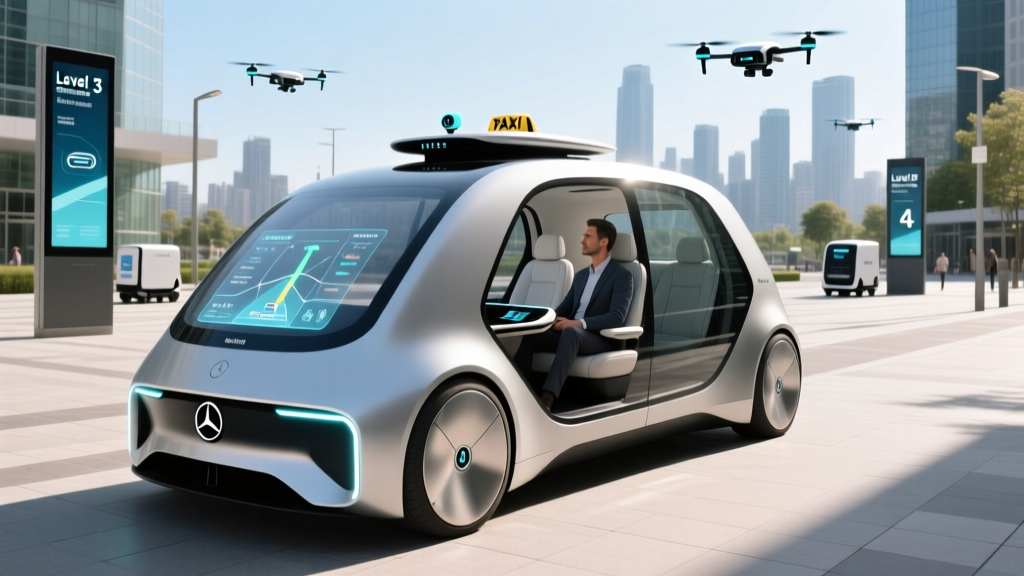
- Limited Level 3 (eyes-off, conditional): Mercedes DRIVE PILOT on the EQS sedan — approved in Nevada and California for speeds ≤25 mph in heavy traffic on mapped highways. The driver can look away from the road but must be ready to resume within ~10 seconds when prompted. This is currently the only consumer Level 3 system available in the US, and it is extremely limited in scope.
For the vast majority of EV buyers in 2026, the practical choice is between hands-on ACC (standard on most EVs) and hands-free highway systems (a $2,000–$2,500 premium or monthly subscription). Level 3 remains a niche offering available on a single luxury model in two states.
Is Adaptive Cruise Control with Stop and Go Worth It?
If your commute involves highway traffic, the answer is almost certainly yes — and you may not even need to pay extra for it. Basic ACC with stop and go is standard or low-cost on most EVs above $40,000, and it genuinely reduces fatigue on congested routes. The feature works best when you understand its boundaries: it's a speed-and-distance manager, not a chauffeur.
Where spending more makes sense is if you regularly drive long stretches of mapped interstate highways and want hands-free operation. Ford BlueCruise and GM Super Cruise have demonstrated strong reliability on divided highways, and the subscription model ($75–$99/month) lets you try it without a large upfront commitment.
What never makes sense: trusting any Level 2 system to drive itself. You are the failsafe. Every time.
Can adaptive cruise control with stop and go handle city streets?
Basic ACC with stop and go is designed for highway and arterial-road use — following a vehicle ahead at varying speeds and through stops. It will not navigate intersections, respond to traffic lights, or handle cross-traffic. Some advanced systems (Tesla FSD Supervised) attempt city-street navigation, but these remain Level 2 and require constant supervision with frequent interventions.
Does using adaptive cruise control reduce my EV's range?
In most cases, ACC with stop and go slightly improves efficiency compared to aggressive manual driving, because the system accelerates and decelerates more smoothly and relies more on regenerative braking. However, the system's following-distance setting matters: a shorter gap means harder braking events. Set the following distance to medium or long for the smoothest, most efficient operation.
What happens if the system can't detect the car ahead?
If the front radar is blocked (by snow, ice, or debris) or the camera is obscured (heavy rain on the windshield), the system will issue a visual and audible warning and disengage. You must resume full manual control immediately. This is why keeping sensors clean — especially the front radar behind the grille/emblem and the windshield camera area — is a basic EV ownership task.
Do I need FSD or Super Cruise just to get adaptive cruise control?
No. Tesla's basic Autopilot (Traffic-Aware Cruise Control) is standard on every Tesla. Ford's Intelligent ACC with Stop-and-Go is included on most EV trims without BlueCruise. GM offers Enhanced ACC on Equinox EV and Blazer EV without requiring Super Cruise. You only need to pay for the premium subscription or package if you want hands-free highway driving or advanced navigation-assisted features.
Is adaptive cruise control safe in heavy rain or snow?
Manufacturers explicitly advise against using ACC in heavy precipitation, snow, or ice. Rain can blind the forward camera; snow and ice can block the front radar. The system may also struggle with reduced tire traction, leading to longer stopping distances that exceed the system's programmed following gaps. In adverse weather, drive manually.