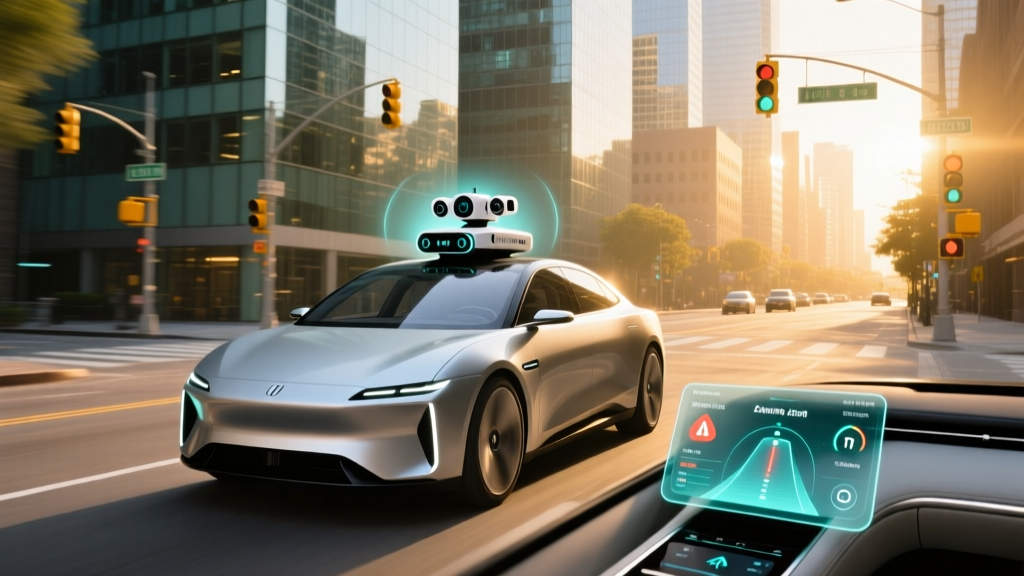
If you have driven a modern electric vehicle on the highway, you have likely engaged adaptive cruise control (ACC) and felt the car manage its own speed relative to the traffic ahead. Unlike old-school cruise control that locks you into a fixed speed, ACC uses forward-facing radar and cameras to continuously adjust your pace — slowing for a braking semi-truck, then accelerating back to your set speed when the lane clears. In 2026, nearly every mainstream EV sold in the US includes some form of adaptive cruise control, but the systems vary enormously in sophistication, cost, and real-world reliability.
This guide breaks down the sensor technology behind ACC, explains what it can and cannot do, compares how major EV brands package the feature, and clarifies the critical difference between driver-assist and true autonomy.
What Adaptive Cruise Control Actually Does
Adaptive cruise control is a longitudinal driver-assistance feature. It controls acceleration and braking to maintain a driver-selected following distance from the vehicle ahead, while respecting a maximum set speed. When paired with lane-centering assist — a lateral feature that steers within lane markings — the combination provides partial automation in both dimensions.
Here is the technical chain of events happening dozens of times per second when ACC is active:
- Perception: A forward-facing radar (typically 77 GHz millimeter-wave) measures the distance and relative speed of objects ahead. One or more forward cameras classify those objects (car, truck, pedestrian, cyclist) and read lane markings.
- Sensor fusion: The vehicle's ADAS computer merges radar and camera data to build a tracked-object list, filtering out noise like bridge abutments or guardrails.
- Decision: Algorithms calculate whether to maintain set speed, decelerate, or accelerate based on the lead vehicle's behavior and your selected following-distance gap (usually 3-5 settings).
- Actuation: The system commands the electric motor to modulate torque (EVs have an advantage here — instant, precise torque control) and applies friction braking when deceleration demands exceed what regen alone can provide.
In stop-and-go traffic, most 2026 EV systems include stop-and-go ACC, which can bring the vehicle to a complete stop and resume following after a brief pause (typically 2-3 seconds) without driver input. Longer stops require a tap of the accelerator or a steering-wheel button to resume.
Adaptive cruise control, even when combined with lane-centering, is classified as SAE Level 2 under the SAE J3016 framework. This means the system provides continuous lateral AND longitudinal control, but the human driver must remain fully engaged — eyes on the road, hands available to take over instantly. You are not a passenger. You are a supervisor. Only Level 4 systems (like Waymo's robotaxi service operating in geofenced areas) remove the driver from the loop entirely.
Sensor Hardware: Radar, Cameras, and the LiDAR Question
The quality of your adaptive cruise control experience is directly tied to the sensor suite your vehicle carries. Here is how the hardware breaks down across 2026 EV platforms:
| Sensor Type | Function in ACC | Strengths | Weaknesses |
|---|---|---|---|
| 77 GHz mmWave Radar | Range, relative speed of lead vehicles (up to ~200m) | Works in rain, fog, darkness; precise distance measurement | Poor object classification; struggles with stationary objects (overpass reflections) |
| Forward Camera (mono or stereo) | Object classification, lane-line detection, traffic sign recognition | Rich semantic understanding (reads signs, identifies pedestrians) | Degraded by glare, heavy rain, snow-covered lenses, direct sun |
| LiDAR (selected models) | High-resolution 3D point cloud of surroundings | Excellent stationary-object detection; precise spatial mapping | Expensive; limited range in heavy precipitation; not yet mainstream |
| Ultrasonic Sensors | Near-field obstacle detection (<5m) | Reliable at very low speeds for stop-and-go | Too short-range for highway ACC |
Tesla has moved to a camera-only approach ("Tesla Vision"), eliminating radar from Model 3, Model Y, and Cybertruck. This works well in clear conditions but has drawn criticism for phantom braking events — sudden, unexplained deceleration when the neural network misidentifies a shadow or overpass as an obstacle. The NHTSA has opened multiple investigations into Tesla Vision-related phantom braking.
Most other manufacturers — Hyundai/Kia, Ford, BMW, Mercedes-Benz, Rivian — retain radar as the primary distance sensor, supplementing with cameras. This redundancy generally produces fewer false-positive braking events.
Brand-by-Brand ACC Comparison: Names, Trims, and Pricing
Every automaker brands their ADAS suite differently, which creates confusion. Below is a breakdown of how major EV brands package adaptive cruise control in 2026 model-year vehicles.
| Brand | ACC Feature Name | ADAS Suite Name | Availability | Cost Structure |
|---|---|---|---|---|
| Tesla | Traffic-Aware Cruise Control | Autopilot (base) / FSD Supervised | Standard on all models | Included; FSD adds $8,000 or $99/mo subscription |
| Ford | Intelligent Adaptive Cruise Control | Ford Co-Pilot360 Assist+ | Standard on most EV trims (Mustang Mach-E, F-150 Lightning) | Included in vehicle price |
| Ford (hands-free) | BlueCruise | BlueCruise 1.5 | Select trims; hands-free on 130,000+ miles of divided highway | $2,100 one-time or $75/mo subscription |
| Hyundai / Kia | Smart Cruise Control w/ Stop & Go | Highway Driving Assist 2 (HDA2) | Standard on Ioniq 5, Ioniq 6, EV6, EV9 (most trims) | Included in vehicle price |
| GM (Chevy/Cadillac) | Adaptive Cruise Control | Super Cruise (hands-free) | ACC standard on most EVs; Super Cruise on select trims (Lyriq, Silverado EV, Blazer EV) | Super Cruise: included for 3 years, then ~$25/mo |
| BMW | Active Cruise Control w/ Stop & Go | Driving Assistant Professional | Optional on i4, iX; standard on higher trims | $1,700-$2,500 package add-on |
| Mercedes-Benz | DISTRONIC Adaptive Cruise | Driver Assistance Package | Standard on EQE, EQS; optional on EQB | Included or $1,950 package |
| Rivian | Adaptive Cruise Control | Driver+ | Standard on R1T and R1S | Included; hands-free highway on select roads via OTA updates |
A key distinction in 2026: basic adaptive cruise control is increasingly standard — included in the vehicle's MSRP at no extra charge. What costs extra is the hands-free layer that sits on top of ACC: systems like BlueCruise, Super Cruise, and Tesla FSD Supervised that permit eyes-off-the-road (but not attention-off-the-road) operation on mapped, divided highways.
Real-World Capabilities: Where ACC Excels
In its intended use case — highway and arterial-road driving in fair conditions — adaptive cruise control is genuinely excellent in 2026. Here is what modern systems handle well:
- Highway traffic pacing: Smoothly tracking a lead vehicle at 55-80 mph, with natural-feeling gap distances. EVs are particularly smooth here because electric motors allow infinitely variable torque modulation — no transmission downshifts or turbo lag.
- Stop-and-go commuting: Systems like Hyundai's HDA2 and GM's Super Cruise handle rush-hour crawl remarkably well, resuming from stops without driver intervention in most cases.
- Curve speed adaptation: Higher-end systems (BMW Driving Assistant Pro, Mercedes DISTRONIC) now use map data and camera input to slow the vehicle proactively before highway curves, then re-accelerate on exit.
- Speed sign recognition: Camera-based systems read posted speed limits and can suggest or automatically adjust the ACC set speed. This works reliably for standard overhead signs but can misread exit-ramp signs or temporary construction postings.
- Predictive efficiency: Some systems (Porsche Taycan, BMW iX) integrate navigation data to anticipate upcoming traffic, curves, or downhill sections, modulating speed to maximize regenerative braking and minimize energy waste.
Limitations and Edge Cases: What ACC Cannot Handle
ACC is not a substitute for an attentive driver. The following scenarios represent known failure modes that require immediate human intervention:
- Stationary objects: Radar-based ACC systems historically struggle with stopped vehicles, construction barriers, and disabled cars in the travel lane, especially at highway speeds. The radar filters out stationary returns to avoid braking for overpasses and bridges — but this means a stopped car can be missed.
- Cut-in scenarios: When a vehicle abruptly changes lanes into your gap at close range, ACC may not react quickly enough. Human braking response is still faster in many cut-in situations.
- Weather degradation: Heavy rain, snow, fog, and direct sun glare degrade camera performance. Snow or ice buildup on the radar sensor (typically behind the front emblem or lower bumper) can disable ACC entirely. Most systems will display a "sensor blocked" warning and disengage.
- Faded or missing lane markings: When ACC is paired with lane-centering, the lateral component fails on roads with worn, snow-covered, or non-existent lane lines. The longitudinal ACC continues working, but steering support drops out.
- Construction zones: Shifted lanes, temporary barriers, and irregular traffic patterns confuse both radar and camera systems. Every manufacturer explicitly warns against using ACC in construction zones.
- Phantom braking: The system brakes hard for no apparent reason — often triggered by radar reflections from adjacent-lane vehicles, overhead signs, or guardrails. This is most reported in Tesla Vision systems but occurs across brands.
- Motorcycles and bicycles: Smaller targets present a reduced radar cross-section. Detection is improving but remains less reliable than for cars and trucks.
Driver responsibility: Per IIHS research, drivers using ACC tend to pay less attention to the road ahead — a phenomenon called "automation complacency." You must actively monitor traffic and be prepared to brake or steer at any moment.
Cost Breakdown: What You Will Pay for ACC in 2026
The economics of adaptive cruise control have shifted. Basic ACC is now largely included in the sticker price of mainstream EVs. The cost question is really about the premium hands-free layer and subscription models.
| System | Base ACC Cost | Hands-Free Add-On | Ongoing Subscription | Notes |
|---|---|---|---|---|
| Tesla Autopilot | Included (all models) | FSD Supervised: $8,000 one-time | Or $99/month | FSD adds lane changes, traffic light control; still Level 2 |
| Ford BlueCruise | ACC included in Co-Pilot360 | $2,100 (3-year access) | $75/month after 3 years | Hands-free on 130,000+ mapped highway miles |
| GM Super Cruise | ACC standard on EVs | Included for 3 years on equipped trims | ~$25/month after free period | Hands-free on 750,000+ miles of compatible roads |
| Hyundai/Kia HDA2 | Included (most trims) | N/A (no hands-free offering in US as of 2026) | None | Robust ACC + lane center; hands-on required always |
| BMW Driving Assistant Pro | $1,700-$2,500 package | Highway Assistant (hands-off up to 85 mph in some markets) | None currently | US hands-off availability limited; check model/year |
| Mercedes DISTRONIC | Included or $1,950 pkg | Drive Pilot (Level 3, very limited) | $2,500/year (Drive Pilot, CA/NV only) | Drive Pilot is Level 3 at ≤40 mph in heavy traffic; extremely limited geo/conditions |
The subscription trend is real and worth factoring into your total cost of ownership. A Ford BlueCruise subscription at $75/month adds $4,500 over five years — a meaningful sum that does not appear on the Monroney sticker. GM's Super Cruise, by contrast, has been more generous with included trial periods, though the long-term pricing direction is toward subscriptions across the industry.
ACC vs. Full ADAS Suites: Understanding the Stack
Adaptive cruise control is one module within a larger ADAS stack. Understanding how it fits helps you evaluate what you are actually buying:
- ACC alone: Controls speed and following distance only. You steer. This is the baseline.
- ACC + Lane Centering: Speed control plus active steering within a detected lane. This is what most people experience as "partial automation." Still Level 2. Still hands-on (with exceptions below).
- ACC + Lane Centering + Hands-Free (mapped roads): Systems like Super Cruise and BlueCruise permit removing hands from the wheel on pre-mapped divided highways, but require continuous eye monitoring via an infrared driver-facing camera. You cannot look at your phone. This is still Level 2.
- Level 3 (Mercedes Drive Pilot): In very specific conditions — traffic jams under 40 mph on mapped freeways in California and Nevada — the car assumes driving responsibility and you may look away from the road. This is the only Level 3 system available to US consumers in 2026, and it costs $2,500/year with severe operational limitations.
- Level 4 (Waymo, Zoox): No consumer purchase option. These are robotaxi services operating in geofenced urban areas. There is no steering wheel to grab.
For most buyers, the relevant comparison is between standard ACC + lane centering (included, hands-on) and hands-free highway assist (extra cost, eyes-monitored). The hands-free layer reduces fatigue on long highway trips but does not make the car autonomous.
Which System Is Right for Your Driving?
- Your daily drive is mostly city/suburban with occasional highway use
- You prefer to stay actively engaged in driving
- You want to avoid subscription costs
- You buy a Hyundai, Kia, or base-trim Tesla where ACC is excellent and included
- You regularly drive 200+ miles on mapped divided highways
- You want reduced fatigue on long road trips (while still monitoring)
- You are willing to pay $25-$75/month ongoing or a $2,100+ upfront fee
- You buy a Ford, GM, or BMW EV with the hands-free option
- You want the broadest geographic coverage (not limited to pre-mapped highways)
- You accept that "Supervised" means you are still fully responsible
- You are comfortable with a vision-only sensor approach
- You understand FSD has not achieved its long-promised unsupervised capability
Frequently Asked Questions
Is adaptive cruise control the same as self-driving?
No. Adaptive cruise control is an SAE Level 2 driver-assist feature. It manages speed and following distance but requires the driver to remain fully engaged — monitoring traffic, road conditions, and ready to take over at any instant. Self-driving (Level 4) currently exists only in robotaxi services like Waymo, not in consumer vehicles.
Does adaptive cruise control work in rain and snow?
Partially. Radar-based ACC works in rain and light fog because millimeter-wave radar penetrates precipitation. However, heavy snow, ice buildup on the radar sensor, or obscured cameras will cause the system to disengage with a dashboard warning. You must resume full manual control in these conditions.
Why does my ACC sometimes brake hard for no reason?
This is called "phantom braking." It occurs when the radar or camera misidentifies a shadow, overhead sign, guardrail reflection, or adjacent-lane vehicle as an obstacle in your path. It is more common in camera-only systems (Tesla Vision) but occurs across brands. Always keep your foot near the brake pedal when ACC is active so you can override immediately.
Do I have to pay a monthly subscription for adaptive cruise control?
For basic ACC with stop-and-go: no. It is included in the purchase price of most 2026 EVs from Ford, Hyundai, Kia, Tesla, GM, and others. Subscriptions apply only to hands-free highway features layered on top of ACC — such as Ford BlueCruise ($75/month after trial), GM Super Cruise (~$25/month after trial), or Tesla FSD ($99/month).
Can ACC prevent rear-end collisions?
ACC reduces rear-end collision risk by maintaining a following gap and reacting to lead-vehicle deceleration faster than many drivers. However, it is not a collision-avoidance system. Automatic Emergency Braking (AEB) is the separate safety feature designed for crash mitigation. ACC's primary purpose is convenience, not safety — though the two systems share sensor hardware.
Which EV has the best adaptive cruise control in 2026?
For smoothness and reliability in hands-on mode, Hyundai/Kia's HDA2 and GM's Super Cruise (in hands-on mode outside mapped areas) consistently rank among the best in real-world testing. For hands-free highway driving, GM Super Cruise covers the most compatible road miles (750,000+) and has a strong driver-monitoring system. Tesla's Autopilot ACC is capable but draws more phantom-braking complaints than radar-equipped competitors.