Xiaomi's Lidar Strategy: Why the SU7 Stands Out in China's ADAS Race
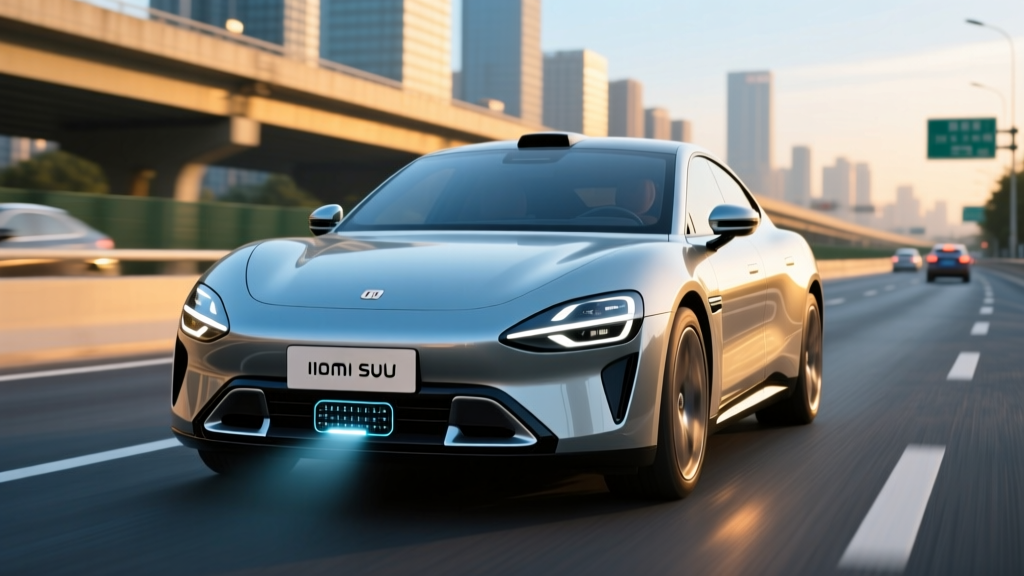
China's electric-vehicle market has become the world's most aggressive testing ground for advanced driver-assistance systems (ADAS), and Xiaomi — the smartphone giant turned automaker — has entered the fray with lidar-equipped smart driving hardware that rivals systems from XPeng, Huawei, and Li Auto. The Xiaomi SU7 sedan (launched in 2024) and the high-performance SU7 Ultra (2025) both offer roof-mounted lidar as part of Xiaomi's proprietary Xiaomi Pilot ADAS suite, positioning the company as a serious contender in a market where sensor hardware is a key differentiator.
For global EV shoppers and tech enthusiasts tracking how Chinese OEMs are pushing ADAS boundaries, understanding Xiaomi's lidar deployment — what it does, what it doesn't do, and how it stacks up — is essential. This guide breaks down the technical architecture, real-world performance envelope, pricing, and critical safety limitations of Xiaomi's smart driving system as of the 2026 model year.
Xiaomi Pilot, including its lidar-enhanced variants, is classified as SAE Level 2. This means the system can simultaneously manage steering and acceleration/braking under certain conditions, but the driver must remain fully engaged — hands on or near the wheel, eyes on the road, ready to take over at any moment. It is not self-driving. No consumer vehicle sold today offers SAE Level 4 or 5 autonomy. Only purpose-built robotaxi services like Waymo operate at Level 4 in geofenced areas.
How Xiaomi Pilot Works: Sensor Fusion with Lidar at the Core
Xiaomi's ADAS architecture relies on a multi-sensor fusion approach, combining lidar, cameras, and millimeter-wave radar to build a real-time 3D model of the vehicle's surroundings. Here is the hardware breakdown for the lidar-equipped trims:
| Sensor Type | Quantity | Specifications | Role |
|---|---|---|---|
| Lidar | 1 (roof-mounted) | AT128 semi-solid-state by Hesai; ~200m detection range at 10% reflectivity; 128 channels; 1.53M points/sec | High-resolution 3D point cloud for object detection, distance measurement, and scene reconstruction |
| Cameras | 11 total | Multi-megapixel (up to 8MP front); surround + forward-facing | Lane detection, traffic-sign recognition, object classification, pedestrian detection |
| Millimeter-Wave Radar | 3 units | Forward + rear-corner; ~160m range | All-weather velocity and distance sensing; complements lidar in rain/fog |
| Ultrasonic Sensors | 12 | Short-range (~5m) | Low-speed parking assist, close-proximity obstacle detection |
| Compute Platform | 2× NVIDIA DRIVE Orin X | 508 TOPS combined | Neural-network inference for perception, planning, and control |
The Hesai AT128 lidar is the centerpiece. Unlike mechanical spinning lidars, the AT128 uses a semi-solid-state scanning mechanism that is more compact, more durable, and lower-cost — critical for bringing lidar into vehicles priced under ¥300,000 (~$41,000 USD). It generates a dense point cloud that allows the system to detect stationary obstacles, irregularly shaped objects (like debris or overturned vehicles), and subtle elevation changes that cameras alone can struggle to identify reliably.
Xiaomi's software stack processes all sensor inputs through a BEV (Bird's Eye View) + Transformer neural-network architecture — the same general approach used by Tesla's FSD, XPeng's XNGP, and Huawei's ADS 3.0. The difference is that Xiaomi augments its vision pipeline with lidar-derived depth data, reducing reliance on learned depth estimation from cameras alone.
What Xiaomi Pilot Actually Does: Feature Breakdown
Xiaomi Pilot encompasses several driver-assist features bundled into a tiered system. The lidar-equipped variant — branded Xiaomi Pilot Max — unlocks the full feature set:
| Feature | Description | Pilot Pro (no lidar) | Pilot Max (lidar) |
|---|---|---|---|
| Adaptive Cruise Control (ACC) | Maintains set speed and following distance; stop-and-go capable | ✓ | ✓ |
| Lane Centering Assist (LCA) | Keeps vehicle centered in marked lane | ✓ | ✓ |
| Highway Navigate on Pilot (H-NOP) | On-ramp to off-ramp automated lane changes and speed adjustments on mapped highways | ✓ | ✓ |
| City Navigate on Pilot (C-NOP) | Point-to-point assisted driving on urban roads; handles intersections, turns, and traffic lights | ✗ | ✓ |
| Automated Parking Assist (APA+) | Detects parking spaces and autonomously parks (parallel, perpendicular, diagonal); remote parking via app | Basic APA | ✓ (enhanced) |
| Valet Parking Assist (AVP) | Vehicle drives itself to/from a memorized parking spot in a garage | ✗ | ✓ (mapped lots) |
The headline capability is City Navigate on Pilot (C-NOP) — Xiaomi's answer to XPeng's XNGP and Huawei's ADS. C-NOP uses lidar and HD map data (supplemented by real-time perception) to navigate complex urban environments: making unprotected left turns, yielding to pedestrians, responding to traffic signals, and handling lane merges. As of early 2026, C-NOP is available in over 200 Chinese cities, with Xiaomi expanding coverage via over-the-air (OTA) updates.
Real-World Limitations: What Xiaomi Pilot Cannot Do
- Driver supervision is mandatory at all times. The system will issue visual, audible, and haptic alerts if it detects driver inattention. Repeated non-response will trigger a controlled slowdown and stop.
- Heavy rain, snow, fog, and dust can degrade lidar and camera performance. The system may disengage or reduce functionality in adverse weather. Radar provides some redundancy but cannot fully compensate.
- Construction zones, temporary lane shifts, and unmapped road changes remain challenging. C-NOP may make incorrect decisions or request immediate driver takeover.
- Faded or missing lane markings reduce lane-keeping reliability, particularly on rural roads.
- Complex unprotected intersections with mixed traffic (e-bikes, pedestrians, irregular vehicle movements) may require driver intervention even when C-NOP is active.
- Tunnel and underground garage GPS loss can affect navigation-based features. AVP works only in pre-mapped facilities.
- System is not operational outside mainland China. Xiaomi Pilot relies on Chinese HD map data and regulatory approval; it does not function in other markets.
In real-world testing by Chinese automotive media, Xiaomi Pilot Max's C-NOP has demonstrated competent performance on well-marked urban arterials and ring roads, but like all current Level 2 systems, it still struggles with edge cases: delivery scooters darting from blind spots, irregularly shaped cargo on trucks, and roads where lane markings conflict (old paint under new paint). The lidar provides a measurable advantage in detecting stationary obstacles at distance — an area where pure-vision systems have historically had vulnerabilities — but it is not a panacea.
Which Xiaomi Models Include Lidar, and at What Cost?
Xiaomi has structured its ADAS offering around trim levels. Here is the current lineup and pricing as of the 2026 model year in China:
| Model / Trim | Lidar | ADAS Tier | China MSRP (¥) | Approx. USD |
|---|---|---|---|---|
| SU7 Standard | No | Pilot Pro (vision + radar) | ¥215,900 | ~$29,600 |
| SU7 Pro | Yes (1× AT128) | Pilot Max | ¥245,900 | ~$33,700 |
| SU7 Max | Yes (1× AT128) | Pilot Max | ¥299,900 | ~$41,100 |
| SU7 Ultra | Yes (1× AT128) | Pilot Max | ¥529,900 | ~$72,700 |
Cost structure: Unlike Tesla's FSD, which is sold as a $8,000 one-time purchase or $99/month subscription in the U.S., Xiaomi bundles Xiaomi Pilot Max into the vehicle price on trims that include lidar. There is currently no separate subscription fee for C-NOP or AVP features on lidar-equipped SU7 models — they are included with the vehicle purchase and updated via OTA. This is consistent with the approach taken by most Chinese OEMs (XPeng, Li Auto, NIO) who bundle ADAS hardware and software into trim pricing rather than charging aftermarket. The Pilot Pro tier (no lidar) is standard on the base SU7 and also carries no additional charge.
Xiaomi Pilot vs. Competing Chinese ADAS Systems
Xiaomi is far from the only player deploying lidar in the Chinese market. Here is how Xiaomi Pilot Max compares to its main rivals as of 2026:
| OEM | ADAS Brand | Lidar | Compute | City ADAS Coverage | Cost Model |
|---|---|---|---|---|---|
| Xiaomi | Xiaomi Pilot Max | 1× Hesai AT128 | 2× Orin X (508 TOPS) | 200+ cities | Included in trim price |
| XPeng | XNGP | 2× Hesai (P7+/G9) | 2× Orin X (508 TOPS) | Nationwide (mapless) | Included or ¥20,000 option |
| Huawei (AITO/Luxeed) | ADS 3.0 | 1–3× (varies) | Huawei MDC 810 | Nationwide (mapless) | Included or subscription |
| Li Auto | AD Max | 1× Hesai AT128 | 2× Orin X (508 TOPS) | 200+ cities | Included in Max trims |
| NIO | NIO Pilot / NOP+ | 1× Innovusion Falcon | 4× Orin X (1,016 TOPS) | Nationwide (mapless) | ¥380/month subscription |
| Tesla (China) | FSD (Supervised) | None (vision-only) | HW4.0 | Limited rollout in China | ¥64,000 one-time |
Key takeaways from this comparison:
- XPeng and Huawei lead in coverage, having moved to "mapless" city ADAS that does not rely on pre-built HD maps — enabling nationwide deployment. Xiaomi is still expanding its city coverage and relies partly on map data, though it has been progressively reducing this dependency via OTA updates.
- Xiaomi's pricing advantage is significant. The SU7 Pro at ¥245,900 (~$33,700) with lidar and full C-NOP included is one of the most affordable lidar-equipped ADAS vehicles in China. Competing trims from XPeng and Li Auto typically start ¥20,000–¥50,000 higher.
- Tesla's vision-only approach is the outlier. FSD (Supervised) does not use lidar, relying entirely on cameras and neural networks. Its rollout in China has been slower and more limited than domestic competitors, partly due to regulatory requirements around data localization and mapping.
- NIO is the only major player charging a recurring subscription for its NOP+ city driving feature. All others, including Xiaomi, bundle it into the vehicle price.
Is Xiaomi's Lidar Approach the Right One?
The "lidar vs. vision-only" debate remains one of the most contested questions in autonomous driving. Tesla's Elon Musk has famously called lidar a "crutch," arguing that if humans can drive using only vision (eyes), machines should be able to as well. The counterargument — championed by Xiaomi, XPeng, Huawei, Mobileye, and most of the industry — is that lidar provides a redundant, physics-based depth measurement that does not depend on learned inference and is less susceptible to adversarial lighting conditions (direct sun glare, shadows, darkness).
From a safety-engineering perspective, the redundancy argument is compelling. Lidar measures time-of-flight for laser pulses, providing centimeter-accurate distance data regardless of ambient light. This is particularly valuable for detecting stationary objects (stopped vehicles, debris, barriers) — a scenario where pure-vision systems have had documented failures in NHTSA incident reports.
However, lidar is not without its own weaknesses: performance degrades in heavy precipitation, the sensors add cost and complexity, and a single roof-mounted unit has blind spots close to the vehicle and at extreme angles. Xiaomi's fusion approach — combining lidar depth data with camera classification and radar velocity sensing — is the industry-consensus best practice for Level 2+ systems in 2026.
Frequently Asked Questions
Is Xiaomi Pilot self-driving?
No. Xiaomi Pilot is an SAE Level 2 driver-assistance system. The driver must remain attentive, keep hands on or near the steering wheel, and be prepared to take full control at any time. It is not autonomous driving. The system monitors driver engagement and will issue escalating warnings if inattention is detected.
Does Xiaomi sell cars outside of China?
As of 2026, Xiaomi automobiles are sold exclusively in mainland China. The company has announced plans to explore international markets, but no confirmed timeline or target countries have been published. Xiaomi Pilot's ADAS features rely on Chinese mapping data and regulatory approval and would require significant adaptation for other markets.
Can I add lidar to the base SU7 Standard after purchase?
No. The lidar sensor and associated wiring harness are factory-installed on the SU7 Pro, Max, and Ultra trims only. There is no aftermarket retrofit option. If lidar-enhanced Pilot Max is a priority, you must select a trim that includes it at the time of purchase.
How does Xiaomi's lidar compare to the lidar on a Waymo robotaxi?
Waymo's 6th-generation driver system uses multiple high-performance lidar units (custom-designed, likely 360° mechanical or semi-solid-state) with significantly greater range, resolution, and redundancy than any consumer vehicle — including Xiaomi's single roof-mounted Hesai AT128. Waymo operates at SAE Level 4 (no driver required) within geofenced areas, which requires a fundamentally different sensor and compute architecture. Consumer lidars like the AT128 are designed for cost-effective Level 2 driver assistance, not driverless operation.
Does Xiaomi charge a monthly subscription for its ADAS features?
No. As of 2026, Xiaomi includes Pilot Pro (base) and Pilot Max (lidar-equipped) features in the vehicle purchase price with no recurring subscription. OTA updates that expand city coverage and improve performance are provided at no additional cost. This could change in future model years, but Xiaomi has not announced any subscription plans.
What happens if the lidar sensor is damaged?
A roof-mounted lidar is exposed to potential damage from low-clearance obstacles, hail, or collisions. Replacement cost for the Hesai AT128 unit in China is estimated at ¥5,000–¥8,000 (~$685–$1,100 USD) including calibration. Xiaomi's vehicle warranty covers manufacturing defects but not physical damage; comprehensive insurance would typically cover incident-related replacement. Always confirm repair and calibration costs with an authorized Xiaomi service center.
Sources: Xiaomi Auto official specifications (xiaomi.com/ev); Hesai Technology AT128 product data (hesaitech.com); SAE International J3016 automation levels (sae.org).