Why EV Owners Are Still Asking Where to Put a Blind Spot Mirror
Modern electric vehicles are packed with driver-assistance technology. Radar-based blind spot monitoring (BSM), camera-based rearview systems, and even ultrasonic parking sensors come standard on most 2025–2026 EVs from Tesla, Hyundai, Ford, and Rivian. So why are buyers still searching for where to put a blind spot mirror?
The answer comes down to physics, cost, and the limits of Level 2 driver-assist systems. Stick-on convex mirrors cost under $10, require zero wiring, and provide a constant optical view that never glitches in rain or fog. For EV owners who tow (Rivian R1T, Ford F-150 Lightning), drive in heavy urban traffic, or simply want a redundant visual check beyond their car's electronic BSM, an aftermarket blind spot mirror remains a practical tool.
This guide covers the exact placement zones that maximize coverage, the trade-offs between optical mirrors and electronic BSM systems, and what your EV's ADAS can and cannot do when you're changing lanes.
Where to Put a Blind Spot Mirror: The Two Placement Zones
There are two accepted positions for a stick-on convex blind spot mirror on any side mirror assembly. Each serves a different purpose, and the right choice depends on your vehicle's mirror geometry and your typical driving environment.
Position 1: Outer Upper Corner (Most Common)
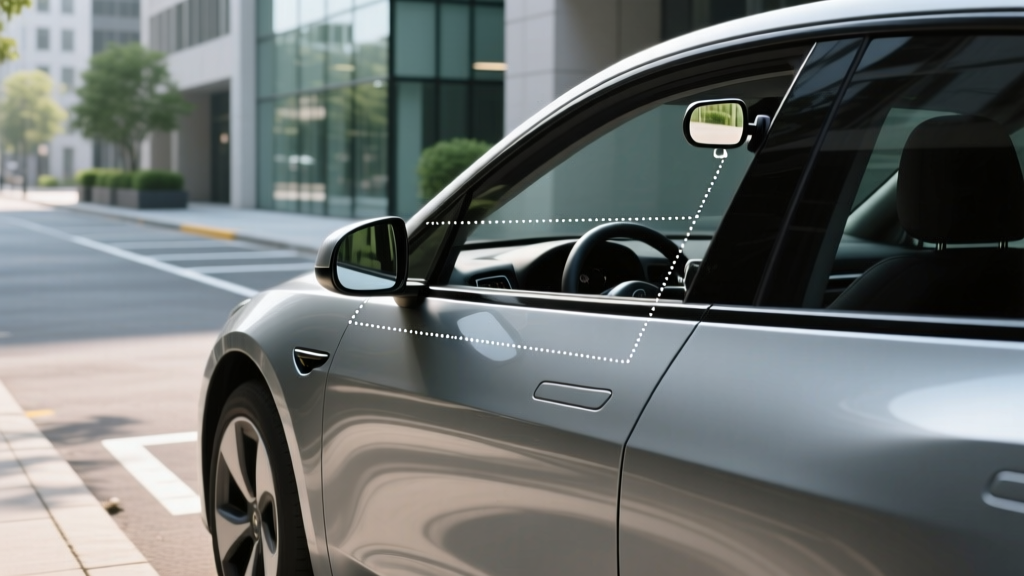
Placing the convex mirror in the upper outer corner of your side mirror is the most widely recommended position. Here's why:
- Preserves the main mirror's lower field — You retain an unobstructed view of the lane directly beside and behind you in the flat portion of the mirror.
- Widens the angle at the critical zone — The convex lens captures vehicles that are one full lane over and slightly behind — the classic blind spot that flat mirrors miss.
- Matches natural eye scan pattern — Drivers glance at the outer edge of the mirror first during a lane-change check, so the convex view is where your eyes land naturally.
This is the preferred position for most EVs with standard flat side mirrors, including the Tesla Model 3, Model Y, Chevrolet Equinox EV, and Hyundai Ioniq 5.
Position 2: Lower Outer Corner (Towing & Wide-Body Use)
The lower outer corner placement is favored by drivers who need to see:
- Trailers or towed loads behind a truck-based EV (Ford F-150 Lightning, Rivian R1T, Chevrolet Silverado EV)
- Curbs and obstacles during low-speed parking maneuvers
- Rear wheels when navigating tight spaces or drive-through chargers
The trade-off is that this position partially blocks the lower section of your main mirror, which is where you'd normally see vehicles directly alongside your rear doors. If you don't tow, the upper outer corner is almost always the better choice.
How Electronic Blind Spot Monitoring Works on Modern EVs
Before deciding whether you need a physical blind spot mirror, it's worth understanding what your EV's built-in blind spot monitoring system actually does — and how it works technically.
Most 2025–2026 EVs use one of two sensor approaches for BSM:
| Sensor Type | How It Works | Detection Range | Common EV Examples |
|---|---|---|---|
| Rear Radar (24 GHz or 77 GHz) | Short-range radar modules mounted behind the rear bumper detect metallic objects in adjacent lanes. Alerts via LED indicator in side mirror housing or A-pillar. | Typically 3–5 meters lateral, up to 15–20 meters rearward | Hyundai Ioniq 5/6, Kia EV6/EV9, Ford Mustang Mach-E, BMW iX, Volvo EX30/EX90 |
| Camera-Based (Surround-View) | Wide-angle cameras on side mirrors and rear fascia feed stitched video to the center display. Some systems overlay detected vehicles with bounding boxes. | Variable — depends on camera resolution and software processing | Tesla Model 3/Y (camera-only vision), Rivian R1S/R1T (surround cameras + radar), Lucid Air |
Radar-based BSM is generally more reliable in adverse weather — rain, fog, and snow don't affect 77 GHz radar the way they can degrade camera-based detection. Tesla's camera-only approach (used since the removal of radar sensors in 2021–2022) relies entirely on neural network processing of video feeds, which has improved significantly with software updates but can still struggle with heavy precipitation, direct sun glare, or lens obstruction from road grime.
What BSM Does
- Illuminates a warning icon (usually amber or red) in or near the side mirror when a vehicle is detected in the blind spot zone
- Some systems add an audible alert if you activate your turn signal while a vehicle is detected
- Advanced systems (Hyundai's Blind-Spot View Monitor, Genesis's BVM) display a live camera feed of the blind spot on the instrument cluster when the turn signal is engaged
- Rear Cross-Traffic Alert (RCTA), often bundled with BSM, warns of approaching vehicles when reversing out of a parking space
What BSM Does NOT Do
- BSM does not steer the vehicle or apply brakes to prevent a lane-change collision on most consumer EVs (exceptions: some Hyundai/Kia models with Blind-Spot Collision-Avoidance Assist can apply gentle brake intervention)
- BSM typically does not detect motorcycles, bicycles, or pedestrians reliably — the radar cross-section of a motorcycle is significantly smaller than a car
- BSM does not cover the "C-pillar blind zone" — vehicles directly behind your rear quarter panel at very close range can fall between the radar detection zone and the side mirror's field of view
- BSM does not replace the need for a physical over-the-shoulder head check before changing lanes
Blind Spot Mirror vs. EV Blind Spot Monitoring: Do You Need Both?
The honest answer depends on your specific EV, your driving habits, and what your vehicle's ADAS package includes. Here's a practical framework:
- Add a stick-on blind spot mirror if: Your EV lacks BSM entirely (base trims of some older Model 3 Standard Range vehicles, early Nissan Leaf models), you frequently tow a trailer, you drive in dense urban traffic with motorcycles and scooters, or you want a passive optical backup that can't fail electronically.
- Rely on electronic BSM alone if: Your EV has radar-based BSM with rear cross-traffic alert (most 2024+ mid-range and premium EVs), you don't tow, and you regularly clean your sensor/camera surfaces.
- Use both if: You drive a large EV with thick C-pillars (Rivian R1S, Cadillac Escalade IQ, GMC Hummer EV) where the physical blind zone is substantial enough that even electronic BSM leaves a gap at very close range.
One often-overlooked advantage of a convex mirror: it provides a continuous, real-time view without requiring a turn signal activation. Most electronic BSM systems only illuminate their warning indicator when a vehicle enters the detection zone — they don't give you a live visual of what's there. A convex mirror lets you scan the adjacent lane proactively, which is especially useful when planning a lane change in heavy, fast-moving highway traffic.
ADAS, Lane-Change Assist, and the SAE Level 2 Reality
Some EV owners assume that advanced driver-assistance features like Tesla's Autopilot, Ford's BlueCruise, or Hyundai's Highway Driving Assist (HDA2) handle blind spot checks automatically. It's critical to understand what these systems actually do — and what they don't.
All consumer EV driver-assist systems available in 2025–2026 — including Tesla Autopilot, Tesla FSD (Supervised), Ford BlueCruise, GM Super Cruise, Hyundai HDA2, and BMW Highway Assistant — are classified as SAE Level 2. This means the system can simultaneously control steering and acceleration/braking under specific conditions, but the driver must remain fully engaged, monitor the road at all times, and be prepared to take over immediately. These are not self-driving systems. The driver is legally and operationally responsible for every maneuver, including lane changes.
Here's how major EV ADAS systems handle lane changes and blind spot awareness:
| System | Brand | Auto Lane Change? | BSM Integration | Cost |
|---|---|---|---|---|
| Autopilot | Tesla | Driver-initiated only (confirm with stalk/button) | Camera-based BSM alerts on display; no mirror LED | Included on all new Teslas |
| FSD (Supervised) | Tesla | Can initiate lane changes; driver must confirm and monitor | Same camera-based detection; enhanced visualization | $8,000 one-time or $99/month subscription |
| BlueCruise | Ford | Hands-free on approved highways; lane change assist requires driver confirmation | Radar BSM with mirror LED + RCTA standard on most trims | $2,100 for 3 years, then $750/year or $75/month |
| Super Cruise | GM (Cadillac, Chevrolet) | Auto lane change on mapped highways (driver monitored via camera) | Radar BSM standard; Super Cruise uses LiDAR map data + sensors | $2,200 for 3 years, then $25/month |
| Highway Driving Assist 2 (HDA2) | Hyundai / Kia / Genesis | Driver-initiated with turn signal; auto lane change on some Genesis models | Radar BSM + Blind-Spot View Monitor (camera feed in cluster) on higher trims | Included on SEL/Limited and above trims |
| Highway Assistant | BMW | Hands-free up to 85 mph on approved roads; driver-confirmed lane change | Radar BSM standard; Active Blind Spot Detection on most trims | Included in Driving Assistance Professional Package (~$1,700) |
The key takeaway: even the most advanced Level 2 systems require driver confirmation for lane changes and rely on the driver to maintain situational awareness. A physical blind spot mirror provides an additional, technology-independent layer of awareness that complements — but never replaces — these systems.
Installation: Step-by-Step Blind Spot Mirror Placement
If you've decided to add a convex blind spot mirror, follow this process to get the placement right on your first attempt:
- Choose the right mirror type. Frameless circular convex mirrors (2–3 inch diameter) work best on modern EV side mirrors, which tend to be larger and flatter than older vehicle mirrors. Fan-shaped mirrors can also work on taller mirror housings like those on the Ford F-150 Lightning or Rivian R1T.
- Clean the side mirror surface thoroughly. Use isopropyl alcohol (70% or higher) and a lint-free cloth. Any residue from rain, car wash wax, or road film will weaken the adhesive bond.
- Test position before adhering. Use painter's tape to temporarily hold the convex mirror in the outer upper corner. Sit in the driver's seat in your normal position.
- Adjust your main side mirror first. Set the flat mirror to its normal position per SAE-recommended settings (angled outward enough that you can just barely see the side of your own vehicle). Then check whether the convex mirror fills in the zone that the flat mirror misses.
- Verify with a real-world test. Have a friend drive alongside you in an empty parking lot or quiet road. The vehicle should appear in your rearview mirror, then transition to the flat side mirror, then to the convex mirror, with no gap where it disappears entirely. If there's a gap, adjust the convex mirror's angle or reposition it slightly.
- Adhere permanently. Once satisfied with placement, peel the adhesive backing and press firmly for 30 seconds. Avoid washing the car or exposing the mirror to heavy rain for 24 hours to allow the adhesive to cure.
A note on heated side mirrors: Many EVs (Tesla Model Y, Hyundai Ioniq 5, Ford Mustang Mach-E) include heated side mirror glass. Stick-on convex mirrors will not interfere with the heating element, which is embedded behind the glass. However, in very cold weather (below 20°F / -7°C), the adhesive bond on the convex mirror can weaken over time. Consider a mirror with a 3M VHB (Very High Bond) adhesive pad rated for automotive exterior use if you live in a cold climate.
Safety Context: What Blind Spot Mirrors Can't Fix
A convex blind spot mirror is a useful tool, but it's important to understand its inherent limitations:
- Image distortion: Convex mirrors make objects appear smaller and farther away than they actually are. The familiar warning "objects in mirror are closer than they appear" applies to aftermarket convex mirrors just as it does to factory-installed convex sections. Always cross-reference with your flat mirror and a head check.
- Night driving: At night, the reduced size of vehicle reflections in a small convex mirror can make it harder to judge distance and speed. Headlights may appear as small, distant points of light.
- Rain and condensation: Unlike your main side mirrors (which may be heated and treated with hydrophobic coatings), a stick-on convex mirror typically lacks these features. Water droplets can severely degrade visibility in rain.
- Glare: In direct sunlight, the curved surface of a convex mirror can create glare hotspots that temporarily blind or distract. Positioning the mirror in the lower portion of the side mirror housing can reduce this issue.
According to NHTSA, lane-change and merge crashes account for approximately 9% of all reported crashes in the United States. Electronic BSM systems have been shown by the IIHS to reduce lane-change crash rates by roughly 14% when equipped — a meaningful but not total reduction. Adding a physical blind spot mirror as a supplementary tool, combined with proper mirror adjustment and consistent head checks, provides the most comprehensive approach to blind spot awareness.
Frequently Asked Questions
Does putting a blind spot mirror on my EV void the warranty?
No. A stick-on convex mirror applied to the exterior glass surface of your side mirror does not modify any electrical or mechanical system. It will not affect your EV's battery warranty, powertrain warranty, or ADAS sensor calibration. Simply remove it before any body-shop work that involves mirror replacement.
Can I put a blind spot mirror over my EV's BSM indicator light?
You should avoid this. Many EVs place the BSM warning LED in the side mirror glass itself (Hyundai, Kia, Ford) or in the A-pillar near the mirror base (Tesla). Covering the mirror-integrated LED with a stick-on mirror will block the visual alert. Check your owner's manual for the exact location of your BSM indicator and place the convex mirror so it doesn't overlap.
Is a blind spot mirror useful on a Tesla with camera-based BSM?
It can be. Tesla's camera-based blind spot detection displays warnings on the center touchscreen, which requires the driver to glance away from the road and toward the center console. A convex mirror on the side mirror provides a glance-friendly, eyes-forward visual reference that complements the screen-based alert. Some Tesla owners find the camera-only system less intuitive than the mirror-mounted LED indicators used by Hyundai, Ford, and others.
What size blind spot mirror should I use on an EV?
For most modern EVs with large, flat side mirror glass (Tesla Model Y, Hyundai Ioniq 5, BMW iX), a 2-inch to 3-inch circular convex mirror provides adequate coverage without blocking too much of the main mirror. For larger truck-style mirrors on the Ford F-150 Lightning or Rivian R1T, a 3-inch to 4-inch fan-shaped mirror can cover a wider zone.
Do I need blind spot mirrors on both sides?
The driver-side (left) mirror benefits most from a convex add-on, because the driver's natural blind spot on the left side is larger due to seating position offset. The passenger-side mirror on most vehicles is already slightly convex from the factory (which is why it carries the "objects are closer than they appear" warning). Adding a stick-on convex mirror to the passenger side is optional and most useful for drivers who frequently change lanes to the right in multi-lane highway traffic.