What Is a Blind Spot in a Vehicle?
A blind spot is any area around your vehicle that you cannot see through the mirrors or with direct peripheral vision. In most passenger cars and SUVs, the primary blind spots sit diagonally behind the B-pillars — roughly from the rear doors back to about one car-length behind the rear bumper, extending outward into adjacent lanes. Larger vehicles like the Rivian R1S or Ford F-150 Lightning have even wider blind zones due to thicker pillars and taller bodywork.
Blind spots are responsible for a significant share of lane-change collisions. The National Highway Traffic Safety Administration (NHTSA) attributes hundreds of fatalities and tens of thousands of injuries annually to lane-change and merge crashes where blind-spot visibility was a factor. That's why nearly every EV sold in the US for the 2026 model year includes some form of blind-spot monitoring (BSM) as standard or widely available equipment.
Blind-spot monitoring is classified as SAE Level 0 (warning only) or Level 1 (active intervention like blind-spot steering assist). The driver remains fully responsible for lane-change decisions at all times. This is not autonomous or self-driving technology.
How Blind-Spot Monitoring Works: Sensors, Radar, and Cameras
Modern blind-spot monitoring systems rely on one or more of three sensor types, typically mounted behind the rear bumper fascia or integrated into the taillight housings:
| Sensor Type | How It Works | Detection Range | Common In |
|---|---|---|---|
| Short-range radar (24 GHz or 77 GHz) | Emits radio waves and measures reflections to detect vehicles in adjacent lanes | Up to ~30 meters rearward, ~5 m lateral | Tesla, Hyundai, Ford, BMW, most OEMs |
| Ultrasonic sensors | High-frequency sound pulses detect nearby objects at low speed | ~3–5 meters, low-speed only | Parking assist (supplemental, not primary BSM) |
| Camera-based systems | Rear-corner cameras with computer vision classify vehicles and cyclists | Up to ~50 meters rearward (depending on resolution) | Genesis, Honda (LaneWatch legacy), some Mercedes-Benz |
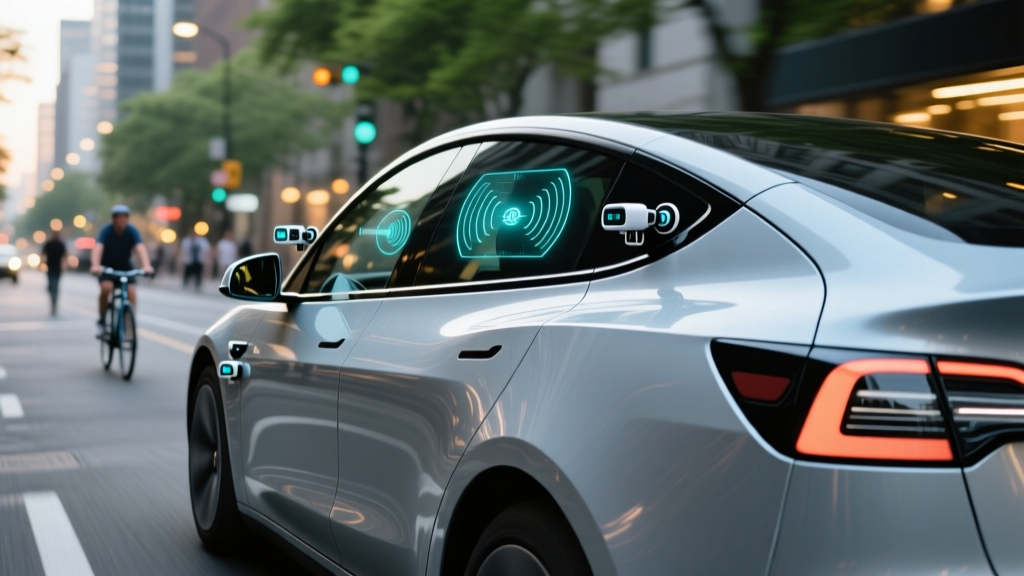
Most 2026 EVs use 77 GHz radar as the primary sensor because it offers better resolution and range than legacy 24 GHz units, and unlike cameras, it is unaffected by rain, fog, or low light. Tesla's vision-only approach uses its suite of external cameras processed through its neural network, trading radar's all-weather reliability for a software-centric architecture.
When a vehicle is detected in the monitored zone, the system triggers a visual indicator — typically an LED icon embedded in or near the side mirror. If the driver activates the turn signal while a vehicle is present, the warning escalates to a flashing icon plus an audible chime. Some systems add haptic feedback (a steering-wheel vibration) or active steering intervention to nudge the car back into its lane.
Blind-Spot Features Across EV Brands: What Each System Does
Every automaker brands its blind-spot system differently, and feature depth varies significantly by trim. Here's how the major EV manufacturers handle it for 2026:
| Brand | Feature Name | Standard / Optional | Active Steering Assist? | Cost |
|---|---|---|---|---|
| Tesla | Blind Spot Camera / Blind Spot Collision Warning | Standard on all models | Yes (lane departure avoidance) | Included |
| Hyundai / Kia | Blind-Spot Collision-Avoidance Assist (BCA) | Standard on SEL and above (Ioniq 5, EV6) | Yes — active steering correction | Included in trim |
| Ford | BLIS (Blind Spot Information System) with Cross-Traffic Alert | Standard on most 2026 Mustang Mach-E, F-150 Lightning trims | No (alert only on base; active on higher trims) | Included |
| BMW | Active Blind Spot Detection | Standard on i4, iX (2026) | Yes — steering torque intervention | Included |
| Rivian | Blind Spot Warning | Standard on R1T and R1S (2026) | No (warning only) | Included |
| Mercedes-Benz | Active Blind Spot Assist | Standard on EQE, EQS (2026) | Yes — single-sided braking intervention | Included |
A key distinction: warning-only systems (SAE Level 0) flash a light or chime but take no physical action. Active intervention systems (SAE Level 1) can apply light steering torque or differential braking to resist a lane change if a vehicle is detected. Hyundai's BCA and BMW's Active Blind Spot Detection are examples of the latter.
Blind-Spot Monitoring vs. Full ADAS Suites: Where It Fits
Blind-spot monitoring is a standalone safety feature — it does not require you to purchase a full driver-assistance suite like Tesla's Full Self-Driving (Supervised), Ford's BlueCruise, or GM's Super Cruise. Those Level 2 systems bundle adaptive cruise control, lane-centering, and sometimes automated lane changes into a highway-driving package. BSM operates independently and is almost always included in the vehicle's base safety equipment.
However, BSM does integrate with broader ADAS in meaningful ways. For instance, when Tesla's Autopilot or Ford's BlueCruise initiates an automatic lane change, the blind-spot radar feeds data into the lane-change decision logic. If a vehicle is detected in the target lane, the system will delay or cancel the maneuver. This integration is part of what distinguishes a well-calibrated Level 2 system from a collection of disconnected features.
- It does not steer the car for you. Active intervention systems only resist a lane change — they will not autonomously change lanes.
- It does not replace mirror checks. You must still perform a shoulder check. The system is a supplement, not a substitute.
- It does not detect all objects. Most systems are calibrated for vehicles and may miss motorcycles, bicycles, or pedestrians in the blind zone.
- It does not work at all speeds equally. Some systems deactivate below ~20 mph; others (especially camera-based) may struggle in heavy rain or when the sensor surface is obstructed by dirt or ice.
Real-World Limitations: When Blind-Spot Systems Struggle
In extensive real-world testing across multiple EVs, blind-spot monitoring performs reliably in clear conditions at highway speeds — but several edge cases consistently trip up even the best systems:
Fast-approaching vehicles: If a car is approaching rapidly from far behind (e.g., closing at 30+ mph differential), some radar-based systems may not trigger the warning until the vehicle is already in the blind zone. This "late alert" window can be as short as 1–2 seconds — enough to startle but not enough to prevent a bad decision if you've already begun the lane change.
Motorcycles and bicycles: The smaller radar cross-section of a motorcycle means detection is less consistent. The Insurance Institute for Highway Safety (IIHS) has noted that BSM systems are not validated for two-wheeled targets across all manufacturers. If you ride in urban areas with bike lanes, do not rely on BSM to catch cyclists.
Sensor obstruction: Heavy rain, snow buildup on the rear bumper, or even a dirty sensor surface can degrade radar performance. Tesla's camera-based system can be affected by water droplets on the fender cameras or direct sun glare at certain angles. Most EVs will display a "sensor blocked" warning on the instrument cluster when this occurs.
Curved roads and guardrails: On tight highway curves, radar can reflect off guardrails or concrete barriers, producing false positives. This is less common with 2026-generation 77 GHz systems than with older 24 GHz units, but it still occurs — especially on left-hand curves where the sensor's field of view intersects the median barrier.
Towing: If you're towing with an F-150 Lightning or Rivian R1T, the trailer extends well beyond the normal blind-spot zone. Most systems do not dynamically extend their detection field to account for trailer length, meaning vehicles alongside the trailer may go undetected. Ford offers a trailer-tow camera option on the Lightning to partially mitigate this.
Cost Breakdown: What You'll Pay for Blind-Spot Monitoring
Unlike full ADAS suites that may require subscriptions, blind-spot monitoring is almost universally included in the vehicle's purchase price. Here's the cost picture for 2026 EVs:
| Cost Category | Typical Range | Notes |
|---|---|---|
| Included in base price | $0 additional | Most 2026 EVs include BSM as standard or on mid-level trims (SEL, Premium, etc.) |
| Part of an option package | $500–$2,000 (bundled) | On base trims of some models, BSM is bundled in a "Convenience" or "Driver Assistance" package |
| Aftermarket add-on | $200–$600 installed | Third-party BSM kits (radar-based) exist but lack integration with vehicle steering/braking |
| Subscription required? | No | No major OEM charges a subscription for BSM specifically (unlike FSD or Super Cruise) |
The bottom line: if you're buying a 2026 EV at or above the mid-trim level, blind-spot monitoring is almost certainly included. On base trims — such as a base Tesla Model 3 or a base Hyundai Ioniq 5 SE — check the spec sheet carefully, as it's usually still standard but packaging can shift model year to model year.
Blind-Spot Monitoring and the Path Toward Higher Automation
While BSM itself is a Level 0–1 feature, it serves as a foundational sensor input for Level 2 systems. When you engage lane-centering on a highway, the blind-spot radar data helps the ADAS controller decide whether an adjacent lane is clear before allowing a driver-initiated or system-suggested lane change.
Looking ahead, NHTSA and the IIHS are pushing for more robust BSM standards, including mandatory motorcycle detection and rear cross-traffic alert integration. For 2026, the trend is clear: BSM is becoming table-stakes equipment, much like backup cameras became after the 2018 federal mandate.
Frequently Asked Questions
What exactly is a blind spot in a car?
A blind spot is the area alongside and slightly behind your vehicle that is not visible through the rearview mirror, side mirrors, or peripheral vision. In most EVs, this zone extends from roughly the B-pillar back about 15–20 feet into the adjacent lane. Blind-spot monitoring systems use radar or cameras to detect vehicles in this zone and alert the driver.
Is blind-spot monitoring the same as self-driving?
No. Blind-spot monitoring is an SAE Level 0 or Level 1 driver-assistance feature. It warns you of vehicles you may not see — or, in active systems, provides light steering resistance to discourage an unsafe lane change. The driver is always fully responsible for the vehicle. Self-driving (Level 4) is only currently available in limited robotaxi services like Waymo, not in consumer vehicles.
Does every 2026 EV have blind-spot monitoring?
Nearly all 2026 EVs include blind-spot monitoring on mid-level trims and above. Some base trims may require an option package. Tesla includes it standard across all models. Always verify on the specific trim's spec sheet before purchasing.
Can blind-spot monitoring detect motorcycles and bicycles?
Not reliably. Most BSM systems are calibrated primarily for passenger vehicles and trucks. Motorcycles have a smaller radar cross-section and may not trigger consistent warnings. Bicycles and pedestrians are generally not detected. Always perform a physical shoulder check, especially in urban environments.
Do I need to pay a subscription for blind-spot monitoring?
No. Unlike advanced ADAS suites such as Tesla's FSD (Supervised) or GM's Super Cruise, blind-spot monitoring does not require a subscription. It is included in the vehicle's purchase price, either as standard equipment or as part of an option package depending on the trim.
What should I do if my blind-spot system shows a 'sensor blocked' warning?
Clean the rear bumper area where the radar sensors are housed (usually behind the bumper fascia near the corners). For camera-based systems like Tesla's, wipe the fender and rear-quarter cameras. If the warning persists after cleaning, the sensor may need recalibration at a service center — a common need after bumper repairs or paintwork.