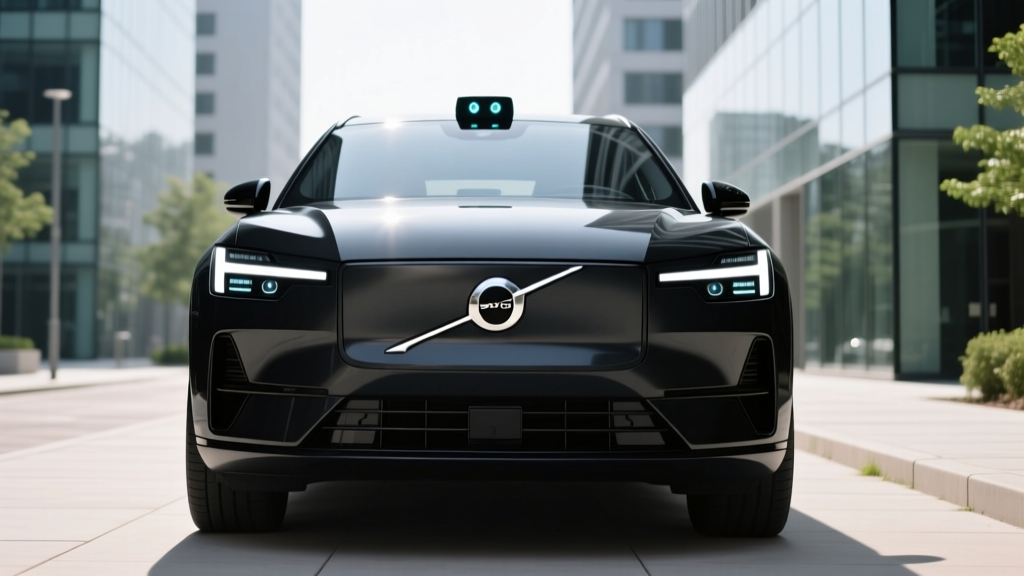
The Volvo EX90 is one of the first production vehicles to ship with a roof-mounted LiDAR sensor as standard equipment, a move that sets it apart from nearly every other luxury electric SUV on the market. For buyers researching the EX90, understanding what that LiDAR actually does—and what it does not do—is critical before spending north of $80,000. This guide breaks down the hardware, the software stack, the SAE automation level, real-world limitations, and how Volvo's approach compares to Tesla's vision-only Autopilot/FSD and GM's Super Cruise.
What the EX90 LiDAR System Actually Does
The EX90 uses a Luminar Iris+ LiDAR unit mounted on the roof rail, just above the windshield. LiDAR (Light Detection and Ranging) fires hundreds of thousands of laser pulses per second and measures the time it takes for reflections to return, building a real-time 3D point cloud of the vehicle's surroundings. The Iris+ unit operates at a 1550 nm wavelength, which is eye-safe and allows higher power output than 905 nm units used in some competitor systems.
Volvo pairs the LiDAR with five additional radars, eight cameras, and ultrasonic sensors to create what it calls its "Safety Shield" perception stack. The LiDAR's primary role is long-range object detection: Volvo claims it can detect a dark tire on a dark highway at up to 250 meters (roughly 820 feet) and pedestrians at up to 180 meters. That range gives the onboard NVIDIA DRIVE Orin computer (254 TOPS of processing power) significantly more time to classify and react to obstacles than camera-only systems typically achieve in low-contrast or low-light scenarios.
| Sensor Type | Count | Primary Function | Range |
|---|---|---|---|
| LiDAR (Luminar Iris+) | 1 | Long-range 3D object detection | Up to 250 m |
| Radars | 5 | Cross-traffic, blind-spot, AEB | Up to 200 m |
| Cameras | 8 | Lane detection, sign reading, object classification | Up to 150 m |
| Ultrasonic sensors | 12 | Near-field parking, low-speed obstacle avoidance | Up to 10 m |
SAE Level 2: Not Self-Driving, and Volvo Is Clear About It
The EX90's Pilot Assist and all current advanced driver-assistance features are classified as SAE Level 2. This means the system can simultaneously control steering and speed, but the driver must remain fully engaged, monitor the road at all times, and be prepared to take over instantly. The EX90 is not a self-driving vehicle. No consumer vehicle sold in the U.S. in 2026 is. Level 4 driverless operation is currently limited to geofenced commercial robotaxi services like Waymo.
Volvo's current ADAS suite, branded Pilot Assist, handles adaptive cruise control, lane centering, and automatic emergency braking. The LiDAR sensor enhances these functions by providing richer environmental data, but it does not change the SAE level. Volvo has stated that future over-the-air updates may unlock more advanced capabilities—potentially including hands-off highway driving on limited-access roads—but as of the 2026 model year, the driver must keep hands on the wheel and eyes on the road.
This is an important distinction for buyers coming from Tesla marketing: Volvo deliberately avoids terms like "Full Self-Driving" and instead frames LiDAR as a safety redundancy layer. The bet is that more accurate perception data reduces the frequency and severity of edge-case failures that plague camera-only systems.
Real-World Capabilities and Hard Limitations
- Weather degradation: Heavy rain, snow, and fog scatter laser pulses, reducing effective LiDAR range. In moderate-to-heavy precipitation, expect range to drop 30-50%. The system may alert the driver that sensors are impaired and request increased vigilance.
- Dirty sensor: Road grime, ice, or bug splatter on the roof-mounted LiDAR dome can block returns. Volvo includes a cleaning system, but in freezing rain or heavy salt spray, manual cleaning may be needed.
- Lane marking dependency: Pilot Assist lane centering still relies on visible lane markings. Faded, snow-covered, or absent lane lines on rural roads will cause the system to disengage or reduce functionality.
- Construction zones: Temporary lane shifts, orange barrels, and irregular road geometries can confuse the perception stack. Volvo explicitly instructs drivers to take full control in work zones.
- No autonomous navigation: The system does not navigate highway interchanges, make turns, or handle roundabouts without driver input. It is an assist system, not a chauffeur.
Where the LiDAR genuinely shines is in scenarios that challenge cameras: nighttime highway driving without overhead lighting, detecting debris or stalled vehicles at extended range, and distinguishing objects in high-glare conditions (such as direct sunrise or sunset). In controlled testing, LiDAR-equipped vehicles have demonstrated fewer phantom-braking events caused by shadow misinterpretation—a common complaint with camera-only ADAS.
Volvo also uses LiDAR data for its Core Computing Architecture, which processes sensor fusion onboard rather than relying on cloud connectivity. This means the system functions identically whether or not you have cellular coverage—a practical advantage on rural highways.
Which Trims Include LiDAR and What Does It Cost?
One of the most buyer-friendly decisions Volvo made with the EX90 is including the LiDAR sensor as standard equipment across all trims. There is no premium package required, no subscription to activate the hardware, and no tiered functionality based on trim level. Whether you choose the Twin Motor Core, Twin Motor Plus, or Twin Motor Ultra, the Luminar Iris+ unit is on the roof.
| Trim | MSRP | LiDAR Included | Pilot Assist Included |
|---|---|---|---|
| Twin Motor Core | ~$79,995 | Yes (standard) | Yes (standard) |
| Twin Motor Plus | ~$83,995 | Yes (standard) | Yes (standard) |
| Twin Motor Ultra | ~$88,995 | Yes (standard) | Yes (standard) |
| Twin Motor Performance Ultra | ~$92,995 | Yes (standard) | Yes (standard) |
Important cost note: While the hardware is included, Volvo has indicated that future advanced features—such as unsupervised highway driving or enhanced pilot functionality unlocked via OTA updates—may require a subscription or one-time purchase. As of early 2026, no such paid tier has been formally launched, and all currently available Pilot Assist features are included in the vehicle price. Buyers should monitor Volvo's announcement schedule, as this could change with future software releases.
The EX90 does not qualify for the §30D federal EV tax credit in most configurations due to the MSRP cap for SUVs ($80,000 limit). Only the base Twin Motor Core trim, at its starting MSRP, may be eligible—and even then, buyer income limits ($300,000 joint / $150,000 single) and battery critical-mineral sourcing requirements apply. Always verify current-year eligibility with a tax professional and the IRS before purchase.
EX90 LiDAR vs. Competing ADAS Systems
| Feature | Volvo EX90 (Pilot Assist) | Tesla Model X (FSD Supervised) | GM (Super Cruise) | Mercedes EQS (Drive Pilot) |
|---|---|---|---|---|
| LiDAR | Yes — 1x Luminar Iris+ (standard) | No — cameras only | No — cameras + radar + HD maps | Yes — 1x Valeo (on S-Class, limited EQS) |
| SAE Level | Level 2 | Level 2 | Level 2 (hands-off on mapped roads) | Level 3 (up to 40 mph, approved roads) |
| Hands-off driving | No (as of 2026 MY) | No (hands-on required) | Yes (on ~750,000 mi of mapped roads) | Yes (conditional, low-speed highway) |
| Cost to buyer | Included in MSRP | $8,000 one-time or $99/mo | Included on select trims; $25/mo after trial | ~$2,500 option + annual subscription |
| Night/low-light advantage | Strong (LiDAR independent of light) | Reduced (camera-dependent) | Moderate (IR camera for driver, HD maps) | Strong (LiDAR + HD maps) |
The most direct philosophical contrast is with Tesla. Elon Musk has famously dismissed LiDAR as a "crutch," betting entirely on neural-network-driven camera perception. Volvo has taken the opposite position: LiDAR provides a physics-based redundancy layer that does not depend on training data or lighting conditions. Neither approach has been conclusively proven superior in overall safety outcomes as of 2026, though IIHS testing has shown that multi-sensor systems tend to score better in edge-case scenarios like nighttime pedestrian detection.
GM's Super Cruise remains the most mature hands-off system available to U.S. consumers, covering over 750,000 miles of pre-mapped divided highways. Volvo has not yet matched this hands-off capability, but the EX90's sensor hardware is arguably more capable for future expansion—it simply hasn't been software-unlocked yet.
Mercedes-Benz offers the only SAE Level 3 system available in the U.S. with its Drive Pilot, but it is limited to speeds under 40 mph on specific approved highways in Nevada and California, and it carries a significant price premium. The EX90's Level 2 system is less ambitious in legal classification but more broadly usable in everyday conditions.
The Safety Case: What LiDAR Changes (and Doesn't)
Volvo's core argument for LiDAR is not about convenience or autonomy—it's about crash avoidance. The company has cited internal research suggesting that adding LiDAR could reduce serious accidents by up to 20% and fatal single-vehicle run-off-road crashes by up to 9%. These figures come from Volvo's own accident research database, which has tracked real-world crashes involving Volvo vehicles since the 1970s.
The mechanism is straightforward: earlier detection means earlier braking or steering intervention. At 70 mph, a vehicle covers roughly 103 feet per second. Detecting a stalled car at 250 meters instead of 120 meters gives the system approximately 4 additional seconds to react—a margin that can be the difference between a controlled deceleration and a collision.
However, LiDAR does not solve every ADAS problem. It cannot read traffic signs (that's the cameras' job), it cannot interpret traffic-light states, and it has lower resolution than cameras for classifying fine details like whether a pedestrian is facing the road or turned away. The EX90's system works because it fuses LiDAR data with camera and radar inputs—not because LiDAR replaces them.
Volvo EX90 LiDAR: Frequently Asked Questions
Can the EX90 drive itself on the highway?
No. The EX90's Pilot Assist is an SAE Level 2 driver-assistance system. It can manage speed, following distance, and lane centering, but you must keep your hands on the steering wheel and your eyes on the road at all times. Volvo has not enabled hands-off or eyes-off driving on any public road as of the 2026 model year.
Does LiDAR work in rain and snow?
LiDAR performance degrades in precipitation. Light rain has minimal impact, but moderate-to-heavy rain, snow, or fog scatters laser pulses and reduces effective range by 30-50%. The system will alert you if sensor performance is compromised and may limit certain functions. The roof-mounted LiDAR dome includes a cleaning system, but ice buildup or heavy road salt may require manual attention.
Do I have to pay a subscription for the LiDAR features?
Not currently. The LiDAR hardware and all available Pilot Assist features are included in the EX90's purchase price across every trim. Volvo has not announced a paid subscription tier for advanced ADAS features as of early 2026, though future OTA-unlocked capabilities could carry a cost.
Is the LiDAR sensor covered under warranty?
Yes. The LiDAR unit is covered under Volvo's standard new-vehicle limited warranty (4 years / 50,000 miles). Because it is integrated into the vehicle's safety architecture, repairs or replacements would be handled through authorized Volvo service centers. Replacement cost out of warranty has not been publicly disclosed but is expected to be significant given the sensor's complexity.
How does EX90 LiDAR compare to Tesla's camera-only approach?
Tesla relies exclusively on cameras and neural networks (Tesla Vision), arguing that LiDAR is unnecessary and that a sufficiently trained AI can match human vision. Volvo argues that LiDAR provides a physics-based measurement layer that does not depend on lighting or prior training data. Real-world outcomes remain debated; both systems are Level 2 and require full driver engagement. Independent testing from organizations like NHTSA and IIHS continues to evaluate comparative safety performance.
Will future software updates make the EX90 more autonomous?
Volvo has stated its intention to introduce more advanced driving features via over-the-air updates, potentially including hands-off highway driving on limited-access roads. However, no timeline or pricing for such features has been confirmed. The hardware is capable of supporting more advanced functions, but regulatory approval and software validation will determine when—or if—those capabilities reach customers.