The Evolution of Automated Parking Technology
Automated parking systems have transitioned from simple ultrasonic proximity warnings to sophisticated, semi-autonomous maneuvering suites. Modern Advanced Driver Assistance Systems (ADAS) can now navigate multi-story garages, pull into tight perpendicular spaces, and even exit parking spots while the driver stands safely outside the vehicle. According to the SAE International's J3016 standard, these remote parking features generally fall under Level 2 automation, meaning the system controls steering and acceleration, but the human driver must maintain continuous supervision and assume full liability.
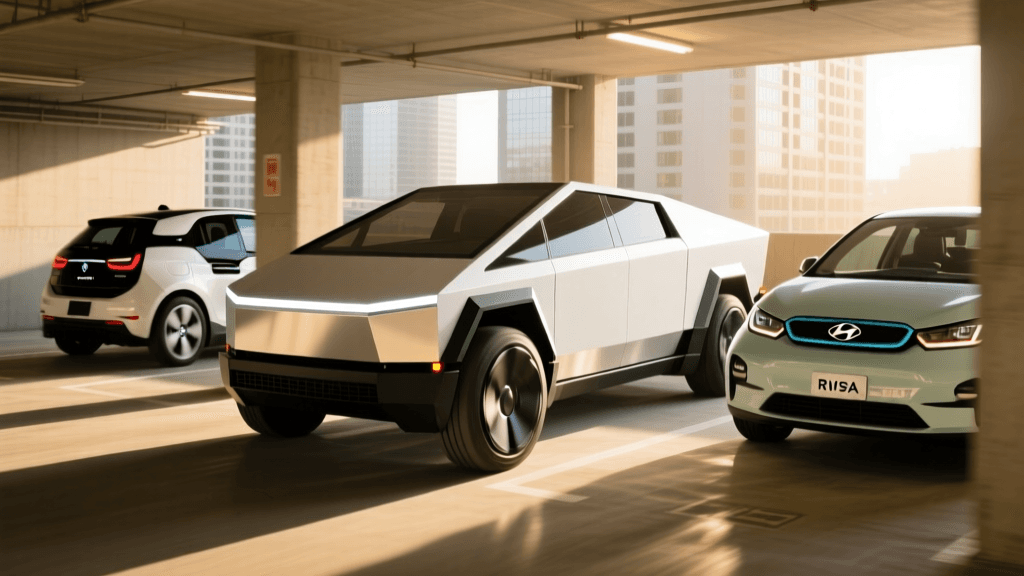
In this technology deep dive, we compare three distinct approaches to automated parking: Tesla's vision-based Smart Summon, BMW's sensor-fused Remote Parking Assistant, and Hyundai's Remote Smart Parking Assist (RSPA). We will examine the underlying sensor architectures, processing pipelines, real-world limitations, and the practical costs associated with each ecosystem.
Under the Hood: Sensor Fusion and Algorithms
Traditional parking assist relies on ultrasonic transducers. These sensors emit high-frequency sound waves (typically 40 to 48 kHz) that bounce off nearby objects, calculating distance based on the time-of-flight. While highly effective for detecting solid obstacles within a 2.5 to 5-meter radius, ultrasonic sensors struggle with low curbs, thin poles, and glass surfaces.
To overcome these blind spots, modern automated parking systems utilize sensor fusion. This involves combining ultrasonic data with inputs from surround-view fisheye cameras (often 1 to 5 Megapixels with a 190-degree diagonal field of view) and radar. The vehicle's central computing unit uses simultaneous localization and mapping (SLAM) algorithms alongside wheel odometry and steering angle sensors to build a real-time 3D occupancy grid of the parking environment. The latency between sensor input and steering actuation must remain under 50 milliseconds to ensure smooth, safe maneuvering in dynamic environments.
Tesla Smart Summon: The Vision-Only Approach
Tesla's Smart Summon (and the newer 'Actually Smart Summon' update) represents a radical departure from industry norms by entirely eliminating ultrasonic sensors (USS) in favor of a pure vision-based neural network approach. Vehicles equipped with Hardware 3.0 or the newer Hardware 4.0 (featuring 5MP cameras and increased processing power) rely on an 'occupancy network' to map the 3D space around the car.
How it Works: Using the Tesla mobile app, the driver can set a pin on a GPS map or simply command the car to come to their current location. The vehicle's cameras identify drivable space, curbs, and obstacles. The HW4 processor runs deep neural networks to estimate depth and object permanence, compensating for the lack of physical distance sensors.
Practical Realities: Smart Summon is best suited for large, flat, and relatively empty parking lots. Because it relies on visual contrast, it can struggle with poorly painted parking lines, heavy rain, or direct sun glare blinding the cameras. The system requires a strong cellular connection and Bluetooth proximity (within roughly 150 feet) to initialize, which can take 10 to 20 seconds as the car 'wakes' and maps its immediate surroundings. Tesla's Smart Summon is bundled with the Enhanced Autopilot package ($6,000) or Full Self-Driving capability ($8,000).
BMW Remote Parking Assistant: Sensor Fusion Mastery
BMW's Remote Parking Assistant, available within the Parking Assistant Professional package, utilizes a robust sensor fusion architecture. It combines 12 ultrasonic sensors with four surround-view cameras and advanced processing via the iDrive 8 or iDrive 8.5 operating systems.
How it Works: BMW's system excels in tight, structured environments like narrow home garages or tight urban parking spaces. The driver can exit the vehicle and use the BMW Display Key fob or the My BMW smartphone app to command the car to pull straight in or reverse out. Furthermore, BMW includes a 'Reversing Assistant' that records the GPS and steering telemetry of the last 50 meters of forward travel (at speeds under 22 mph). If you drive down a narrow, dead-end alley, the car can automatically steer itself in reverse exactly along the path you just drove.
Practical Realities: BMW's system is highly deterministic and reliable. The physical ultrasonic sensors provide immediate, millimeter-accurate feedback for close-proximity obstacles, while the cameras handle line detection. The remote control function requires the driver to remain within Bluetooth range (typically 15 to 20 feet) and keep their finger pressed on the key fob button or app screen as a dead-man's switch. The Parking Assistant Professional package typically costs between $400 and $800 depending on the specific BMW model.
Hyundai RSPA: Accessible Remote Maneuvering
Hyundai and Kia offer the Remote Smart Parking Assist (RSPA), a feature designed primarily for convenience in tight perpendicular parking scenarios. Unlike the complex mapping of Tesla or the 50-meter memory of BMW, RSPA is highly focused on linear and basic steering extraction.
How it Works: RSPA is operated exclusively via the vehicle's smart key fob. By holding down the remote start button and then pressing the forward or reverse icons, the driver can move the vehicle in and out of a space. In older generations (like the early Hyundai Sonata), RSPA could only move the car in a perfectly straight line, requiring the space to be wide enough to open the doors. In newer EV platforms like the Ioniq 5 and Ioniq 6, RSPA has been upgraded to include automatic steering, allowing the car to angle itself into a spot and straighten out before the driver commands it to pull forward or backward.
Practical Realities: RSPA is incredibly user-friendly because it requires no smartphone apps, cellular connections, or complex menus. The RF signal from the key fob is highly reliable and immune to the Bluetooth pairing delays that plague app-based systems. However, its top speed is capped at roughly 2 mph, and it lacks the long-distance 'summon' capabilities of its rivals. RSPA is often included standard on top-tier 'Limited' trims or as part of a $1,000 to $1,500 technology package on mid-tier trims.
Feature Comparison Matrix
| Feature | Tesla Smart Summon | BMW Remote Parking | Hyundai RSPA |
|---|---|---|---|
| Sensor Architecture | Vision-only (8 cameras, AI Occupancy Network) | Sensor Fusion (12 Ultrasonic + 4 Cameras) | Ultrasonic + Basic Reverse Camera |
| Max Remote Distance | ~150 feet (GPS/Cellular assisted) | ~15-20 feet (Bluetooth/RF Dead-man switch) | ~15 feet (RF Key Fob) |
| Steering Capability | Full autonomous steering and pathfinding | Full steering + 50m Reversing Memory | Linear (Older) / Basic Steering (Newer EVs) |
| Control Interface | Tesla Mobile App | Display Key Fob / My BMW App | Smart Key Fob Only |
| Approx. Cost | $6,000 (EAP) or $8,000 (FSD) | $400 - $800 (Option Package) | Standard on Limited / ~$1,000 Tech Pkg |
Limitations, Safety, and Environmental Factors
While automated parking systems offer immense convenience, they are not infallible. The National Highway Traffic Safety Administration (NHTSA) consistently reminds consumers that Level 2 ADAS features require an attentive human driver who is prepared to intervene at a moment's notice. Liability in the event of a collision during an automated parking maneuver rests entirely on the vehicle owner, not the manufacturer.
Environmental factors severely impact system reliability. Heavy snow, ice, or mud can physically block ultrasonic sensors and camera lenses, rendering the systems inoperable or, worse, causing phantom braking. Furthermore, the Insurance Institute for Highway Safety (IIHS) notes that while crash avoidance technologies are improving, low-light conditions and high-contrast shadows can still confuse optical sensors, leading to misjudged distances.
App-based systems like Tesla's Summon and BMW's app-based remote parking are also subject to cellular latency. If you are in a subterranean concrete garage with poor 5G/LTE reception, the app may fail to establish a handshake with the vehicle, leaving you stranded while waiting for a network timeout.
Actionable Advice for Buyers and Owners
If you are considering a vehicle with advanced automated parking, follow these practical guidelines to maximize safety and utility:
- Test in a Controlled Environment: Before using Smart Summon or RSPA in a crowded grocery store lot, practice in an empty parking lot. Place soft obstacles (like empty cardboard boxes) to understand the vehicle's braking latency and sensor blind spots.
- Maintain Sensor Hygiene: Keep a microfiber cloth in your glovebox. Wiping down camera lenses and ultrasonic sensor nodes takes 30 seconds and prevents the system from disabling itself during winter or muddy conditions.
- Understand the Dead-Man's Switch: Never attempt to use remote parking apps while walking or distracted. Systems like BMW's require continuous physical pressure on a button; releasing it triggers an immediate emergency stop, which can cause whiplash for occupants if the vehicle is moving at its maximum parking speed.
- Evaluate Your Real Needs: If you simply need to pull out of a tight garage where you cannot open your doors, Hyundai's RSPA or BMW's Remote Parking is vastly superior, faster, and cheaper than paying a premium for Tesla's long-distance Smart Summon capabilities.
Conclusion
The 'best' automated parking system depends entirely on your use case. Tesla's Smart Summon pushes the boundaries of AI and vision-based pathfinding, offering a futuristic, long-distance valet experience, albeit with occasional beta-level quirks. BMW's Remote Parking Assistant provides the most reliable, sensor-fused precision for tight urban garages, backed by the incredibly useful Reversing Assistant. Meanwhile, Hyundai's RSPA offers a pragmatic, highly accessible, and app-free solution for everyday tight-spot extraction. As sensor resolutions increase and processing latencies drop, the line between driver assistance and true automated valet will continue to blur, but for now, keeping your eyes on the vehicle and your finger near the brake remains the ultimate safety protocol.