What the Tesla Blind Spot Camera Actually Does
Every current-production Tesla — Model 3, Model Y, Model S, and Model X — relies on an external camera array rather than radar or ultrasonic sensors to monitor adjacent lanes. When you activate a turn signal, the center touchscreen displays a live video feed from the side-repeater camera on the corresponding side of the vehicle, giving you a wide-angle view of the blind zone that mirrors alone cannot cover.
The system also provides passive blind spot monitoring: a visual indicator on the touchscreen (and, on 2026 models, an audible alert) warns you if a vehicle, cyclist, or large object is detected in the adjacent lane while you are driving above approximately 12 mph. This is part of Tesla's standard Basic Autopilot suite, which is included at no additional cost on every new Tesla.
Tesla's blind spot camera and all Autopilot/FSD features operate at SAE Level 2. This means the system can assist with steering, acceleration, and braking under specific conditions, but the driver must remain fully engaged — hands on the wheel, eyes on the road — at all times. The blind spot camera is an information and warning tool, not an autonomous lane-change system. You are responsible for every steering decision.
How It Works Technically: Cameras, Not Radar
Since late 2022, Tesla has operated on a Tesla Vision-only architecture, having removed radar and ultrasonic sensors (USS) from all new vehicles. The blind spot detection system relies on the following hardware:
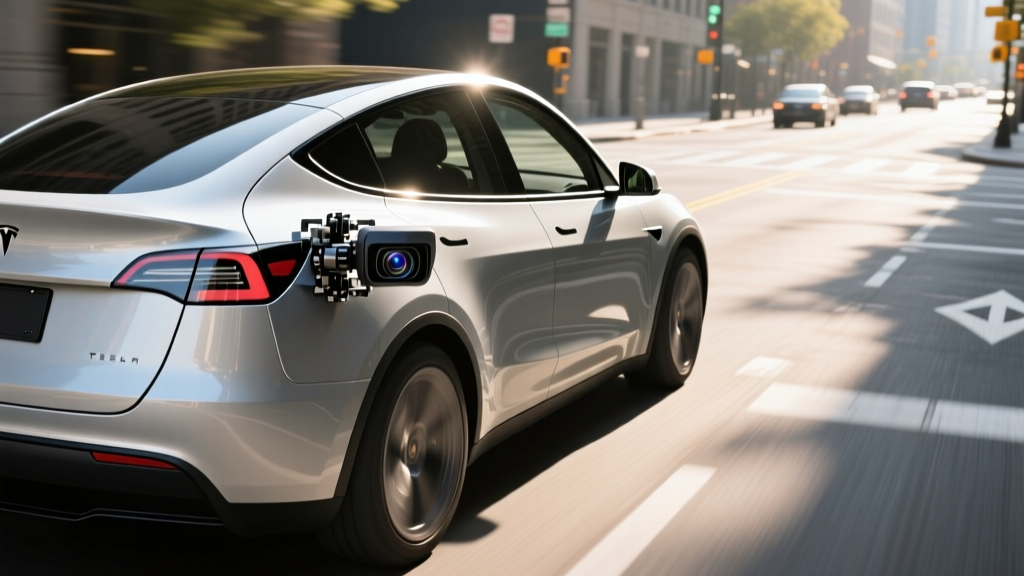
- Side-repeater cameras (one per side): Mounted on the front fenders, these provide a wide-angle view of the adjacent lanes rearward and to the side.
- Rear-view camera: Supplements the side repeaters for objects approaching quickly from behind.
- Neural network processing: Tesla's onboard FSD computer (Hardware 4 on 2026 models) runs vision-based object detection in real time, classifying vehicles, cyclists, and pedestrians.
When the turn signal is engaged, the system stitches relevant camera feeds and displays a picture-in-picture view on the 15.4-inch center touchscreen (Model 3/Model Y) or the 17-inch screen (Model S/Model X). The video feed includes dynamic overlays showing detected objects and estimated distance.
| Feature | Basic Autopilot (Standard) | FSD Supervised (Add-On) |
|---|---|---|
| Blind spot camera feed on turn signal | ✅ Included | ✅ Included |
| Blind spot collision warning (visual + audible) | ✅ Included | ✅ Included |
| Lane departure avoidance (steering correction) | ✅ Included | ✅ Included |
| Auto lane change (with confirmation) | ❌ Not available | ✅ Included |
| Blind spot camera feed while parked (Sentry/dashcam) | Limited (Sentry mode clips) | Limited (Sentry mode clips) |
Which Tesla Models and Trims Include It
The blind spot camera system is standard equipment on every 2026 Tesla — there is no trim level or package required. Whether you buy a base Model 3 RWD at approximately $38,990 MSRP or a Model S Plaid at roughly $89,990, the blind spot camera feed, collision warning, and lane departure avoidance are included as part of Basic Autopilot.
| Tesla Package | Cost | Blind Spot Camera | Auto Lane Change | Supervised City/Highway Steering |
|---|---|---|---|---|
| Basic Autopilot | Standard (included) | ✅ | ❌ | Limited (Traffic-Aware Cruise + Autosteer on highways) |
| Enhanced Autopilot | ~$6,000 one-time | ✅ | ✅ | Highway only |
| FSD (Supervised) | ~$8,000 one-time or $99/month | ✅ | ✅ | City streets + highway |
Note: As of 2026, Tesla has periodically restructured its Autopilot tiers. Enhanced Autopilot availability varies by market and model year. Verify current packaging on Tesla's official Autopilot page before purchasing.
Real-World Capabilities and Limitations
In daily driving, the Tesla blind spot camera performs well in clear conditions. The side-repeater cameras offer a wider field of view than a traditional mirror, and the live video feed is responsive, typically appearing within 0.5 seconds of turn signal activation. However, a vision-only system has inherent constraints that radar-based competitors do not share.
- Heavy rain, fog, or snow: Camera lenses can become obscured by water droplets, road grime, or ice. Tesla's system will display a "camera visibility reduced" warning and disable blind spot alerts when image quality degrades. Radar-based systems (used by Ford, Hyundai, and BMW) can see through precipitation more reliably.
- Direct sun glare: Low-angle sunlight at dawn or dusk can wash out the side-repeater camera feed temporarily, reducing detection confidence.
- Small or fast objects: Motorcycles, e-scooters, and fast-approaching cyclists may not trigger a warning quickly enough, particularly in dense urban traffic with partial occlusions.
- Nighttime on unlit roads: While the cameras have improved low-light performance on Hardware 4 vehicles, detection range drops significantly on roads without street lighting.
- Automatic intervention: The blind spot system warns — it does not autonomously steer you back into your lane unless Lane Departure Avoidance is active and detects you crossing a lane line without a signal.
The driver must always perform a physical head check before changing lanes. The camera feed supplements but does not replace mirror checks and shoulder checks.
How It Compares to Competing Blind Spot Systems
Most mainstream automakers use radar-based blind spot monitoring (BSM), typically with small radar modules mounted behind the rear bumper. Here is how Tesla's vision-only approach stacks up against key competitors in 2026:
| Vehicle | Sensor Type | Camera Feed on Signal | Standard or Add-On | Adverse Weather Reliability |
|---|---|---|---|---|
| Tesla Model Y / Model 3 | Camera (Tesla Vision) | ✅ Live video on screen | Standard | Reduced (rain, snow, glare) |
| Hyundai Ioniq 5 | Rear radar (BSD) | ✅ Camera feed on cluster | Standard (SEL and above) | High (radar penetrates weather) |
| Ford Mustang Mach-E | Rear radar (BLIS) | ❌ Indicator light in mirror only | Standard (Select and above) | High |
| BMW i4 | Rear radar + camera | ✅ Camera feed on iDrive | Standard (Driving Assistant) | High (redundant sensors) |
| Rivian R1S / R1T | Camera + radar fusion | ✅ Camera feed on screen | Standard | Moderate-High |
Tesla's advantage is the live video feed, which provides far more situational context than a small indicator light in a side mirror. Hyundai's Blind Spot View Monitor offers a similar camera feed displayed in the digital instrument cluster. Tesla's disadvantage is the lack of radar redundancy — when cameras are impaired, the system has no fallback sensor.
Cost Breakdown: What You Pay for Blind Spot Features
Because the blind spot camera is part of Basic Autopilot, you do not need to pay anything extra to get it. However, if you want the system to act on blind spot data — for example, by initiating an automatic lane change when the adjacent lane is clear — you need FSD (Supervised) or Enhanced Autopilot.
| Package | One-Time Purchase | Monthly Subscription | Blind Spot Camera Feed | Auto Lane Change |
|---|---|---|---|---|
| Basic Autopilot | $0 (included) | N/A | ✅ | ❌ |
| Enhanced Autopilot | ~$6,000 | Not always available | ✅ | ✅ |
| FSD (Supervised) | ~$8,000 | $99/month | ✅ | ✅ |
Pricing is subject to change. Tesla has adjusted FSD purchase and subscription prices multiple times. Always confirm current pricing on Tesla's FSD subscription page.
Safety Context: What the Data Shows
Tesla publishes quarterly safety reports, but these aggregate all Autopilot data and do not isolate blind spot camera effectiveness specifically. The National Highway Traffic Safety Administration (NHTSA) has investigated multiple Tesla crashes involving lane changes where the driver may have over-relied on Autopilot features.
Key safety realities for blind spot monitoring in any vehicle:
- Blind spot systems reduce but do not eliminate lane-change collisions. A 2023 IIHS study found that blind spot detection reduced lane-change crash rates by approximately 14%, but the benefit depends on driver behavior.
- Vision-only systems (Tesla) are more susceptible to environmental degradation than radar-based systems.
- Over-reliance on any blind spot system — treating it as a substitute for head checks — increases risk, particularly for motorcycles and cyclists that may be partially occluded.
Frequently Asked Questions
Does every Tesla have a blind spot camera?
Yes. Every 2026 Tesla Model 3, Model Y, Model S, and Model X includes side-repeater cameras and blind spot collision warning as part of the standard Basic Autopilot package. No trim upgrade or subscription is required for the camera feed and visual/audible warnings.
Is Tesla's blind spot camera self-driving?
No. The blind spot camera is a driver-assist feature operating at SAE Level 2. It provides visual and audible warnings and displays a camera feed, but it does not autonomously steer, brake, or change lanes without driver initiation. You must remain fully engaged and perform physical head checks before every lane change.
Does the blind spot camera work in rain and snow?
Performance degrades in heavy rain, snow, and fog. Water droplets and ice on the camera lens reduce image quality, and the system may display a "camera visibility reduced" alert and suppress warnings. This is the primary disadvantage of Tesla's vision-only approach compared to radar-based blind spot systems used by Hyundai, Ford, and BMW. Keeping camera lenses clean and using Tesla's camera heater feature (available in cold-weather settings) can help.
Can I get blind spot camera feed without paying for FSD?
Yes. The live camera feed on turn signal activation and the blind spot collision warning are both included in the free Basic Autopilot package. FSD (Supervised) is only required if you want the car to execute automatic lane changes based on blind spot data.
Does the Tesla blind spot camera detect cyclists?
Yes, the system is designed to detect cyclists and pedestrians in the blind zone. However, detection of small, fast-moving objects like e-scooters or motorcycles can be inconsistent, especially in complex urban environments with partial occlusions. Always perform a physical shoulder check in bike-lane-heavy areas.
How does Tesla's blind spot system compare to Hyundai's?
Hyundai's Blind Spot View Monitor (available on the Ioniq 5 SEL and above) uses rear radar for detection and displays a camera feed in the digital instrument cluster. Hyundai's radar-based detection is more reliable in adverse weather. Tesla's system provides a larger, more detailed video feed on the center touchscreen but lacks radar redundancy. Both systems are SAE Level 2 and require driver supervision.