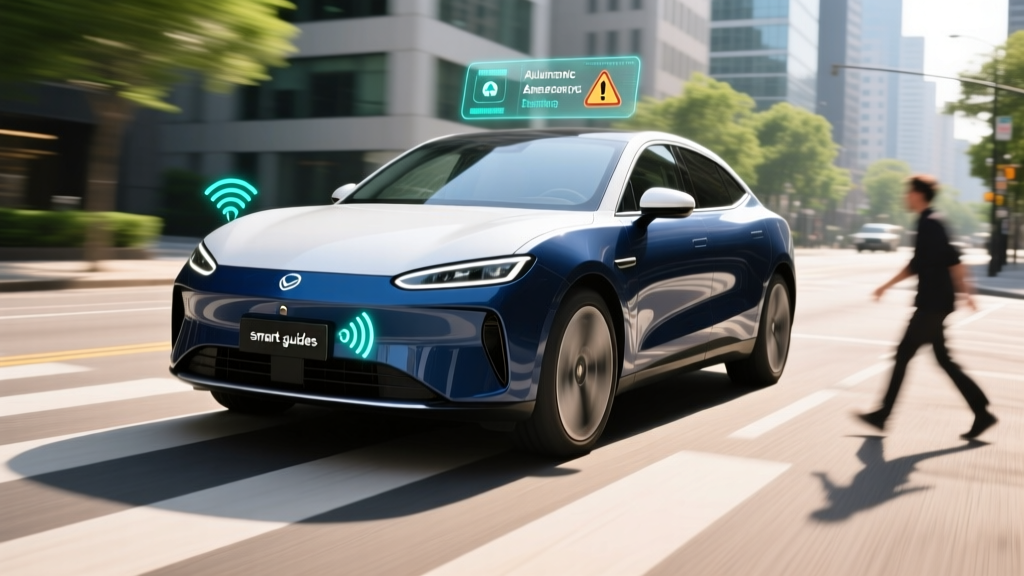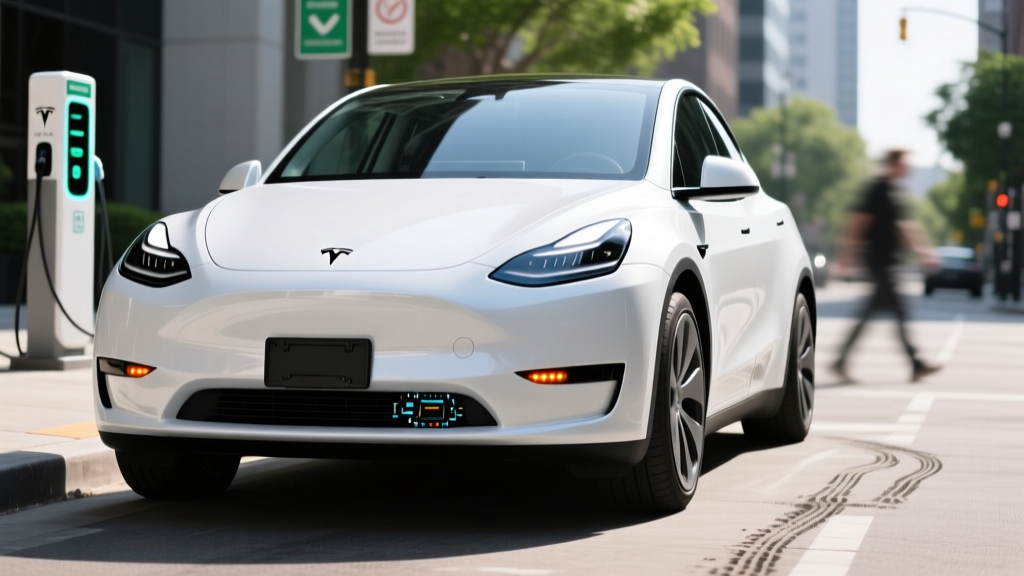
If you own or are shopping for a Tesla in 2026, Automatic Emergency Braking (AEB) is arguably the most consequential active-safety feature the car ships with. Unlike Autosteer or the Full Self-Driving (Supervised) stack, AEB isn't a convenience feature — it's a last-resort intervention designed to mitigate or prevent a forward collision when the driver fails to react in time. It's standard on every new Tesla, it's on by default every time you start the car, and unlike many ADAS functions, you cannot permanently disable it.
This guide breaks down how Tesla's AEB actually works on the current Hardware 4 (HW4) vision-only architecture, where it outperforms and underperforms legacy radar-based systems, how it stacks up against Euro NCAP and IIHS test protocols, and the real-world edge cases every owner should understand before trusting it.
What Tesla Automatic Emergency Braking Actually Does
Tesla Automatic Emergency Braking is a forward-collision mitigation system. It continuously monitors the path ahead using the vehicle's camera suite and, if it determines a collision with a vehicle, pedestrian, cyclist, or motorcycle is imminent and the driver has not responded, it applies the brakes automatically to reduce impact speed or avoid the collision entirely.
On current 2026 Model 3, Model Y, Model S, and Model X vehicles running HW4, the sensor suite consists of:
- 8 cameras (front main, front wide, front narrow, left/right forward-looking repeaters, left/right rear-looking repeaters, and a rear-view camera)
- No radar — Tesla removed the forward millimeter-wave radar starting with 2021-model-year vehicles and has not reintroduced it on consumer vehicles
- No ultrasonic sensors (USS) on newer builds — Tesla has migrated low-speed proximity detection to Tesla Vision as well
AEB operates across a wide speed range. Per Tesla's owner's manual, the system is designed to function at driving speeds above approximately 3 mph (5 km/h) and can engage at highway velocities. The system is not designed to bring the car to a complete stop from high speed in every scenario — its primary goal is to reduce collision severity.
SAE Automation Level: Level 2 (Partial Automation)
Tesla AEB, Autopilot, and FSD (Supervised) are all SAE Level 2 driver-assistance systems per the SAE J3016 taxonomy. This means the driver must remain fully engaged, monitor the road at all times, and be prepared to take over instantly. AEB is a reactive safety intervention, not an autonomous driving feature. The only Level 4 driverless services operating commercially in the U.S. as of 2026 are Waymo's robotaxi fleet in select cities.
Tesla Vision vs. Radar-Based AEB: The Trade-offs
Tesla's decision to abandon radar (and later ultrasonic sensors) in favor of a pure-vision approach remains one of the most debated engineering choices in the ADAS industry. Competitors like Mercedes-Benz, BMW, Hyundai/Kia, and Toyota still fuse camera data with forward-facing radar — and in some cases, lidar on higher-end models.
| Capability | Tesla Vision (HW4) | Camera + Radar Fusion (e.g., Toyota, Hyundai, BMW) |
|---|---|---|
| Object detection range | ~250m (front narrow camera) | ~200-300m (radar extends range) |
| Performance in heavy rain/fog | Degraded — cameras obscured | Radar partially compensates |
| Stationary object detection | Improved with HW4 neural nets | Strong — radar reflects off metal |
| False-positive rate | Low in clear conditions; phantom braking reported | Generally low; radar filtering mature |
| Low-light/night performance | Good with HW4 higher-res sensors | Excellent — radar unaffected by light |
| Cost per vehicle | Lower (cameras are cheap) | Higher (radar module ~$100-200) |
The practical implication: Tesla Vision AEB performs excellently in clear daylight and well-lit nighttime conditions, but its effectiveness degrades more sharply than radar-fused systems when camera lenses are obscured by heavy rain, snow buildup, road grime, or direct sun glare. Tesla's owner's manual explicitly warns that AEB may be limited or unavailable under these conditions.
Real-World Test Performance: IIHS and Euro NCAP
Independent crash-test agencies provide the most objective measure of AEB effectiveness. Here's where Tesla stands as of the latest available test cycles:
Euro NCAP (2023-2025 test protocols): The Tesla Model Y achieved a 97% score in Safety Assist, with AEB performing strongly in car-to-car, pedestrian, and cyclist scenarios. The Model 3 (refreshed Highland variant) scored similarly well. These are among the highest Safety Assist scores Euro NCAP has ever awarded.
IIHS (U.S.): Tesla vehicles have earned TOP SAFETY PICK+ ratings in multiple model years, which requires advanced or superior performance in front crash prevention evaluations. However, IIHS has periodically flagged Tesla's driver-monitoring system (steering-wheel torque detection) as less robust than camera-based attention monitoring used by GM's Super Cruise and Ford's BlueCruise.
You can review official ratings at iihs.org and euroncap.com.
Which Tesla Models Include AEB, and at What Cost?
Automatic Emergency Braking is standard equipment on every Tesla vehicle sold in the United States and most global markets. It is not gated behind a paywall, subscription, or trim level. Whether you buy a base Model 3 RWD at $38,990 MSRP or a Model S Plaid at $89,990, AEB is included and active by default.
| Feature | Included (Basic Autopilot) | Enhanced Autopilot ($6,000) | FSD Supervised ($8,000 or $99/mo) |
|---|---|---|---|
| Automatic Emergency Braking | ✅ Standard | ✅ Standard | ✅ Standard |
| Forward Collision Warning | ✅ Standard | ✅ Standard | ✅ Standard |
| Obstacle-Aware Acceleration | ✅ Standard | ✅ Standard | ✅ Standard |
| Autosteer (lane centering) | ✅ Standard | ✅ Standard | ✅ Standard |
| Auto Lane Change | ❌ | ✅ | ✅ |
| Navigate on Autopilot | ❌ | ✅ | ✅ |
| Traffic Light & Stop Sign Control | ❌ | ❌ | ✅ |
The key takeaway: you do not need to purchase Enhanced Autopilot or the FSD (Supervised) subscription to get AEB. It is a core active-safety feature that Tesla includes on every vehicle, consistent with NHTSA expectations and global regulatory requirements.
Known Limitations and Edge Cases
What Tesla AEB Does NOT Do
- It does not replace attentive driving. AEB is a last-resort system, not a primary collision-avoidance strategy.
- It does not detect all objects — particularly small, low-profile, or partially obscured obstacles.
- It does not function reliably when cameras are blocked by dirt, ice, snow, heavy rain, or sun glare.
- It does not guarantee a complete stop — it reduces speed to mitigate impact severity.
- It may not activate for cross-traffic, animals, or objects outside its forward detection cone.
- It does not operate below approximately 3 mph (parking-lot speeds).
Phantom Braking
One of the most widely reported issues with Tesla's vision-only AEB system is phantom braking — instances where the vehicle unexpectedly applies brakes with no apparent obstacle ahead. NHTSA opened a formal investigation into phantom braking on Tesla vehicles, and while Tesla has issued multiple over-the-air software updates to reduce false positives, owner reports indicate the issue has not been fully eliminated as of 2026.
Phantom braking tends to occur more frequently in scenarios involving:
- Overpasses and bridges casting shadows across the roadway
- Oncoming vehicles in adjacent lanes misidentified as in-path
- Roadside signs, guardrails, or barriers on sharp curves
- Sudden changes in road surface color or reflectivity
Cold-Weather and Adverse Conditions
In sub-freezing temperatures, camera lenses can accumulate ice or condensation, significantly impairing AEB performance. Tesla recommends clearing all camera surfaces before driving. Unlike radar, which operates through most precipitation, cameras require a clear optical path. On a winter road trip where road salt spray coats the windshield and front fascia cameras, AEB may display a warning that the feature is degraded or temporarily unavailable.
How Tesla AEB Compares to Competing Systems
Most mainstream EV competitors offer AEB as standard equipment, but the sensor architectures and real-world performance vary meaningfully:
| Manufacturer | Feature Name | Sensor Architecture | Standard on All Trims? |
|---|---|---|---|
| Tesla | Automatic Emergency Braking | Camera-only (HW4, 8 cameras) | Yes |
| Toyota (bZ4X, etc.) | Pre-Collision System (Toyota Safety Sense) | Camera + millimeter-wave radar | Yes |
| Hyundai/Kia (Ioniq 5, EV6) | Forward Collision-Avoidance Assist | Camera + radar | Yes |
| Ford (Mustang Mach-E, F-150 Lightning) | Pre-Collision Assist w/ AEB (Ford Co-Pilot360) | Camera + radar | Yes |
| BMW (i4, iX) | Frontal Collision Warning w/ City Braking | Camera + radar (lidar on some) | Yes |
| Mercedes-Benz (EQE, EQS) | Active Brake Assist | Camera + radar + lidar (DRIVE PILOT) | Yes |
The consensus among independent testers: radar-fused systems tend to exhibit fewer false positives in adverse weather and maintain more consistent performance in low-visibility conditions. Tesla's vision system compensates with more frequent over-the-air updates and a lower hardware cost structure, but the physics of camera-only sensing impose inherent limitations that software alone cannot fully overcome.
Configuring AEB Sensitivity: What Owners Should Know
Tesla allows drivers to adjust AEB sensitivity through the vehicle's touchscreen under Controls > Safety > Automatic Emergency Braking. The options are:
- Early — intervenes sooner, with greater following distance; higher risk of phantom braking
- Medium — default setting; balanced intervention timing
- Late — intervenes later, closer to the obstacle; lower false-positive rate but less margin
Tesla strongly recommends leaving AEB at the default Medium setting. Setting it to Late reduces your safety margin, particularly at highway speeds where every fraction of a second matters. Note that you can temporarily disable AEB for a single drive cycle via the touchscreen, but it will reactivate the next time you start the vehicle — Tesla does not permit permanent deactivation, consistent with NHTSA guidance on critical safety systems.
Frequently Asked Questions
Does Tesla AEB work at night?
Yes, but with caveats. HW4 cameras have improved low-light sensitivity compared to earlier hardware, and AEB functions on well-lit roads at night. However, on unlit rural roads with no streetlights, detection range is reduced compared to radar-fused systems, which are unaffected by ambient light.
Can Tesla AEB prevent all rear-end collisions?
No. AEB is designed to mitigate collisions, not guarantee avoidance. At high speeds, the system may reduce impact speed by 20-40 mph but may not bring the vehicle to a complete stop before contact. Following distance, road conditions, tire grip, and vehicle speed all affect outcomes.
Does AEB work on the Cybertruck?
Yes. The Cybertruck ships with HW4 and includes AEB as standard equipment, consistent with all current Tesla vehicles. However, the Cybertruck's angular stainless-steel body and camera placement differ from the Model 3/Y, and early owner reports suggest AEB calibration may vary. Tesla has issued OTA updates to refine Cybertruck-specific behavior.
Is Tesla AEB better than Toyota Safety Sense or Hyundai SmartSense?
In controlled Euro NCAP and IIHS testing, Tesla's AEB scores are competitive with or slightly ahead of Toyota and Hyundai systems. In real-world adverse weather, however, radar-fused systems from Toyota and Hyundai maintain more consistent performance. Neither approach is universally superior — the best system is one paired with an attentive driver.
Does buying FSD (Supervised) improve AEB performance?
No. AEB operates independently of the FSD stack and uses the same sensor inputs whether you have Basic Autopilot or FSD. Purchasing FSD does not enhance AEB functionality, detection range, or intervention timing.
What should I do if AEB activates unexpectedly (phantom braking)?
Apply the accelerator to override the braking intervention if it is safe to do so. After the event, you can report it to Tesla via the dashcam save function and the in-app feedback tool. Ensure your cameras are clean and unobstructed. If phantom braking recurs frequently, schedule a service appointment — a camera recalibration may be needed.