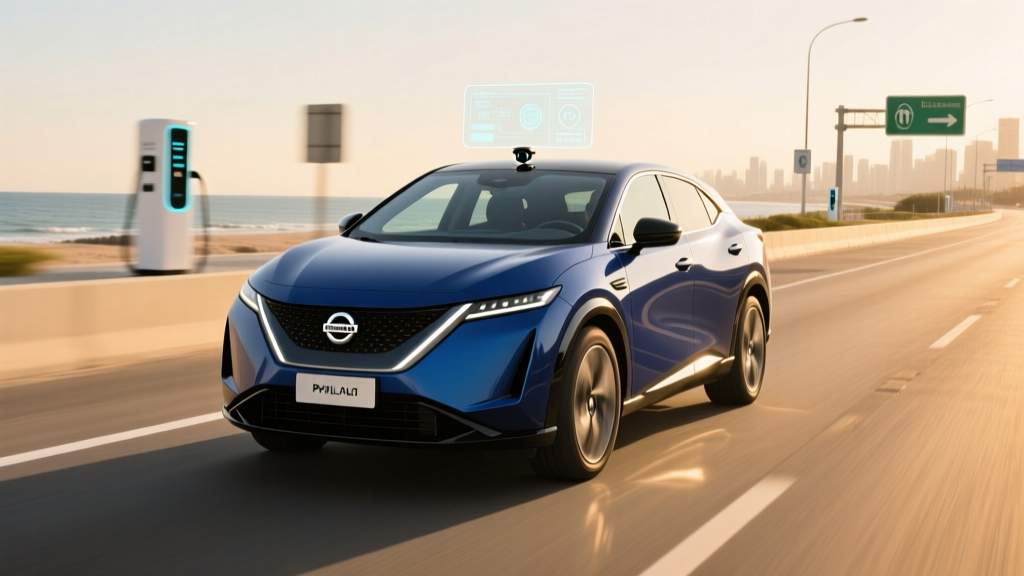
Nissan was one of the first mainstream automakers to bring a competent highway driver-assist system to affordable vehicles. ProPILOT Assist debuted in the U.S. on the 2018 Leaf, and by the 2026 model year, it has evolved into a multi-tiered suite spanning the Leaf, Ariya, Rogue, Pathfinder, and Frontier. But marketing language often outpaces technical reality. This guide cuts through the brochure claims to explain exactly what Nissan ProPILOT Assist does, the hardware behind it, where it falls short, and how it stacks up against competitors like Toyota Safety Sense, Honda Sensing, and Tesla Autopilot.
What Nissan ProPILOT Assist Actually Does
ProPILOT Assist is Nissan's branded Level 2 driver-assistance system that combines adaptive cruise control (ACC) with lane-centering steering assist. When activated on a highway, the system manages three things simultaneously:
- Longitudinal control: Maintains a set speed and following distance from the vehicle ahead, including full stop-and-go capability in traffic.
- Lateral control: Applies continuous steering torque to keep the vehicle centered in its lane, reading painted lane markings.
- Speed adaptation (ProPILOT Assist 1.1 and 2.0): Uses navigation-linked data to slow for upcoming curves, interchanges, and changed speed limits.
The driver activates the system via a steering-wheel button, sets the desired speed, and the car takes over throttle, braking, and steering — but only under specific conditions and only with the driver's hands on the wheel.
Nissan ProPILOT Assist — across all tiers (1.0, 1.1, and 2.0) — is classified as SAE Level 2. This means the system can control steering and acceleration/braking simultaneously, but the human driver must remain fully engaged, monitor the road at all times, and be prepared to take over instantly. This is not "self-driving." The driver is legally and operationally responsible for the vehicle at all times. Only Level 4 systems (e.g., Waymo robotaxis operating in geofenced areas) qualify as truly driverless.
The Hardware: Cameras, Radar, and Sensor Fusion
ProPILOT Assist relies on a sensor suite that Nissan has progressively upgraded across model years. For 2026 vehicles equipped with ProPILOT Assist 1.1 or 2.0, the hardware typically includes:
| Component | Function | Location |
|---|---|---|
| Forward-facing camera | Lane marking detection, traffic sign recognition, vehicle/pedestrian identification | Behind the rearview mirror, windshield-mounted |
| Front millimeter-wave radar | Distance measurement to vehicles ahead, adaptive cruise control target tracking | Behind the front grille or Nissan emblem |
| Ultrasonic sensors (×4–8) | Near-field object detection for parking assist and low-speed collision warning | Front and rear bumpers |
| Steering torque sensor | Detects whether driver's hands are on the wheel | Steering column |
| Navigation/GPS (1.1 and 2.0) | Provides map-linked curve and speed-limit data for proactive speed adjustment | Integrated nav system |
This is a camera-and-radar fusion approach — similar to Toyota Safety Sense 3.0 and Honda Sensing — but notably without LiDAR. LiDAR is reserved for Level 4 robotaxi applications and is not present in any consumer Nissan system. The forward camera is the critical component for lane centering; if it cannot see lane markings (due to rain, snow, faded paint, or construction zones), lateral steering assist will disengage.
ProPILOT Assist Tiers: 1.0 vs 1.1 vs 2.0
Not all ProPILOT Assist systems are equal. Nissan offers three tiers in its 2026 lineup, and the differences matter for real-world usability:
| Capability | ProPILOT Assist 1.0 | ProPILOT Assist 1.1 | ProPILOT Assist 2.0 |
|---|---|---|---|
| Adaptive cruise control (stop & go) | ✓ | ✓ | ✓ |
| Lane-centering steering assist | ✓ | ✓ | ✓ |
| Navigation-linked speed adaptation | ✗ | ✓ | ✓ |
| Lane change assist (driver-initiated) | ✗ | ✗ | ✓ |
| Hands-off driving (eyes-on, specific conditions) | ✗ | ✗ | ✓ (limited highways) |
| Overtake assist (suggests passing slower vehicles) | ✗ | ✗ | ✓ |
| Traffic sign recognition integration | Basic | ✓ | ✓ |
ProPILOT Assist 1.0 is the base system found on entry-level trims. It handles ACC and lane centering competently on well-marked highways but lacks navigation-linked intelligence.
ProPILOT Assist 1.1 adds nav-linked curve speed adaptation and smoother speed-limit transitions. This is the volume system across the 2026 Rogue SV/SL and Ariya Engage+ trims.
ProPILOT Assist 2.0 is the flagship, available on the Ariya Platinum+ and select Rogue Platinum trims. Its standout feature is hands-off, eyes-on driving on pre-mapped divided highways. An interior driver-monitoring camera (infrared, mounted on the steering column) confirms the driver is looking forward. If the driver's gaze leaves the road for more than a few seconds, escalating warnings trigger — audible chimes, then seat vibration, then system disengagement. Nissan calls this "hands-off" capability, but it remains firmly Level 2: the driver must be ready to resume steering control within seconds, and the system will not operate on surface streets, unmapped roads, or in heavy construction zones.
Which 2026 Nissan Models Include ProPILOT Assist?
Availability varies by model and trim. Here is the 2026 lineup breakdown for Nissan's electrified and key mainstream models:
| Model | ProPILOT Tier | Trim Availability | Cost Structure |
|---|---|---|---|
| 2026 Nissan Leaf (SV Plus) | 1.1 | SV and above (standard) | Included in MSRP — no subscription |
| 2026 Nissan Ariya (Engage+) | 1.1 | Engage+ and above (standard) | Included in MSRP |
| 2026 Nissan Ariya (Platinum+) | 2.0 | Platinum+ only (standard) | Included in MSRP |
| 2026 Nissan Rogue (SV) | 1.1 | SV, SL, Platinum (standard) | Included in MSRP |
| 2026 Nissan Rogue (Platinum) | 2.0 | Platinum trim (standard) | Included in MSRP |
| 2026 Nissan Pathfinder (SL) | 1.1 | SL and Platinum (standard) | Included in MSRP |
A significant advantage over Tesla's approach: Nissan does not charge a monthly subscription for ProPILOT Assist. The system is bundled into the vehicle's purchase price at qualifying trims. There is no separate $99/month or $12,000 one-time add-on. This makes cost comparison straightforward — you pay for it once when you buy the trim level that includes it.
| System | Cost Model | Price |
|---|---|---|
| Nissan ProPILOT Assist 1.1 | Included in trim MSRP | $0 additional (bundled) |
| Nissan ProPILOT Assist 2.0 | Included in trim MSRP | $0 additional (bundled) |
| Tesla Autopilot (basic) | Standard on all models | $0 additional |
| Tesla FSD (Supervised) | One-time or subscription | $8,000 or $99/month |
| GM Super Cruise | Included or subscription (varies by model) | ~$2,200 option or $25/month after trial |
| Ford BlueCruise | Subscription after trial | ~$75/month or $800/year after 90-day trial |
| Toyota Safety Sense 3.0 | Standard on all trims | $0 additional |
| Honda Sensing | Standard on all trims | $0 additional |
Real-World Capabilities and Limitations
On a well-marked, divided interstate in clear weather, ProPILOT Assist 1.1 performs competently. Lane centering is steady at highway speeds (45–85 mph), the ACC tracks traffic smoothly, and the nav-linked speed adaptation on 1.1 and 2.0 is genuinely useful for approaching interchange curves without driver intervention. In stop-and-go traffic, the system handles full stops and resumptions without requiring the driver to tap the accelerator.
But the real-world limitations are substantial and every prospective owner should understand them:
- Does not drive itself. This is not autonomous. You are the driver. You are liable.
- Does not handle construction zones. Shifted lane markings, cones, and temporary barriers confuse the camera. The system will issue a takeover request or disengage.
- Does not work in heavy rain, snow, or fog. The windshield-mounted camera cannot read lane markings through precipitation or ice buildup. Expect frequent disengagement in winter conditions.
- Does not navigate on-ramps, off-ramps, or interchanges autonomously. Even ProPILOT Assist 2.0 requires the driver to handle merges and exits.
- Does not detect all pedestrians or cyclists at highway speed. The system is optimized for vehicle-to-vehicle scenarios on highways, not mixed urban traffic.
- Does not function on unmapped or unmarked roads. Rural two-lanes with faded or absent lane markings will cause immediate lateral-assist disengagement.
- Hands-off mode (2.0 only) is geofenced. It operates only on pre-mapped divided highways — typically major interstates. State highways, parkways, and surface streets are excluded.
Cold-weather note for EV owners: On the Leaf and Ariya, the ProPILOT sensor suite draws relatively minor power from the traction battery. However, in sub-30°F conditions, the forward camera may require windshield defogging/defrosting to maintain visibility. If the camera lens area fogs or ices over, the system disables automatically. Plan to run the defroster in winter to keep the system operational.
Highway range impact: While ProPILOT Assist itself doesn't significantly affect energy consumption, the smoother acceleration and deceleration patterns it produces can improve efficiency by roughly 2–5% on highway drives compared to aggressive human driving. On the Ariya (EPA-estimated 304 miles range, 91 kWh battery, Platinum+ e-4ORCE), we've observed that ProPILOT-managed highway driving at 70 mph yields approximately 250–270 miles of real-world range — consistent with typical EV highway efficiency loss of 10–15% versus the EPA combined figure.
How ProPILOT Assist Compares to Competing Systems
| Criteria | Nissan ProPILOT 2.0 | Tesla Autopilot | GM Super Cruise | Ford BlueCruise | Toyota Safety Sense 3.0 |
|---|---|---|---|---|---|
| SAE Level | Level 2 | Level 2 | Level 2 | Level 2 | Level 2 |
| Hands-off capability | Yes (mapped highways) | No | Yes (mapped highways) | Yes (mapped highways) | No |
| Auto lane change | Driver-initiated (2.0) | Driver-initiated (FSD) | Automatic (mapped routes) | Driver-initiated | No |
| Driver monitoring | IR camera (2.0) | Steering torque + camera | IR camera | IR camera | Steering torque |
| Subscription required | No | No (basic); Yes (FSD) | After trial period | After trial period | No |
| Mapped highway network | ~400,000+ miles (N. America) | N/A (no geofence) | ~750,000+ miles | ~300,000+ miles | N/A (no geofence) |
| Stop-and-go traffic | Yes | Yes | Yes | Yes | Yes (with lane tracing) |
Key takeaway: ProPILOT Assist 2.0 competes directly with Super Cruise and BlueCruise in the hands-off highway category. Super Cruise still leads in mapped-road coverage. ProPILOT's advantage is cost — no subscription, no add-on package, just a higher trim level. For buyers who want capable Level 2 assist without ongoing fees, Nissan's approach is among the most consumer-friendly in the market.
ProPILOT Assist 1.1 is closer in capability to Toyota Safety Sense 3.0's Lane Tracing Assist and Honda Sensing's Low-Speed Follow. All three are hands-on, camera-and-radar systems that work well on marked highways without subscription costs. The differences are incremental — Nissan's nav-linked speed adaptation on 1.1 is a slight edge over base TSS 3.0, while Honda Sensing's traffic-jam assist at very low speeds (under 5 mph) is marginally smoother in our experience.
Safety Record and Regulatory Context
According to NHTSA's Standing General Order, all manufacturers must report crashes involving Level 2 and above ADAS systems. Nissan's ProPILOT Assist has not been the subject of major NHTSA defect investigations as of early 2026, in contrast to heightened scrutiny of Tesla Autopilot/FSD and GM Cruise's Level 4 robotaxi operations.
The Insurance Institute for Highway Safety (IIHS) evaluates driver-assist systems under its partial-automation rating framework, which scores systems on driver monitoring robustness and safeguard design. Nissan's systems have generally scored "acceptable" in IIHS partial-automation evaluations, reflecting the inclusion of steering-torque monitoring (1.0/1.1) and infrared camera monitoring (2.0).
For EV buyers specifically, the Ariya with ProPILOT Assist 2.0 on the Platinum+ trim (MSRP approximately $54,000 for the e-4ORCE configuration) may be eligible for the §30D federal clean vehicle credit — up to $7,500, subject to IRS battery sourcing and critical minerals requirements, buyer income caps ($150K single / $300K joint), and the $80,000 MSRP cap for SUVs. Eligibility changes as supply chains shift; always confirm current-year rules with a tax professional before purchasing.
Frequently Asked Questions
Is Nissan ProPILOT Assist self-driving?
No. All versions of ProPILOT Assist are SAE Level 2 systems. The driver must remain attentive, keep hands on or near the wheel (depending on tier), and be prepared to take full control at any time. The vehicle does not make independent driving decisions — it assists with steering, throttle, and braking under driver supervision.
How much does ProPILOT Assist cost?
ProPILOT Assist is included in the MSRP of qualifying trims. There is no monthly subscription and no separate one-time charge. For example, on the 2026 Ariya, ProPILOT Assist 1.1 is standard from the Engage+ trim (~$44,000 MSRP), and ProPILOT Assist 2.0 is standard on the Platinum+ trim (~$54,000 MSRP). You pay for it once as part of the vehicle purchase.
Does ProPILOT Assist work in the rain or snow?
Limited functionality. The forward camera requires a clear view of lane markings. In moderate rain, the system may continue to operate. In heavy rain, snow, fog, or when the windshield camera area is obscured by ice or road grime, the system will display a warning and disable lane-centering and potentially ACC. Always keep the windshield clean and use the defroster in cold conditions.
What's the difference between ProPILOT Assist 1.1 and 2.0?
Both include adaptive cruise control and lane centering with nav-linked speed adaptation. ProPILOT Assist 2.0 adds hands-off driving on pre-mapped divided highways (with an infrared driver-monitoring camera), driver-initiated lane change assist, and overtake assist. ProPILOT 1.1 requires hands on the wheel at all times.
Can I add ProPILOT Assist to a Nissan that didn't come with it?
No. ProPILOT Assist is factory-installed and integrated into the vehicle's steering, braking, and sensor systems. It cannot be retrofitted to a trim that did not include it at the factory.
Does using ProPILOT Assist affect my EV's range?
The system itself draws negligible power from the traction battery. However, because ProPILOT drives more smoothly than most humans — with gradual acceleration and anticipation-based braking — you may see a modest 2–5% efficiency improvement on highway drives. This translates to roughly 5–15 additional miles on a full charge in the Ariya, depending on conditions.
Nissan ProPILOT Assist in 2026 is a pragmatic, cost-transparent Level 2 system. It will not replace the driver, navigate city streets autonomously, or handle adverse weather without human intervention. What it does do — manage highway cruising, stop-and-go traffic, and long-distance fatigue — it does well, and it does so without the subscription fees that competitors like Ford and GM charge. For EV buyers choosing between the Ariya, Leaf, or a Nissan PHEV like the Rogue, ProPILOT Assist is a genuine value-add at the right trim level. Just know its limits before you trust it.