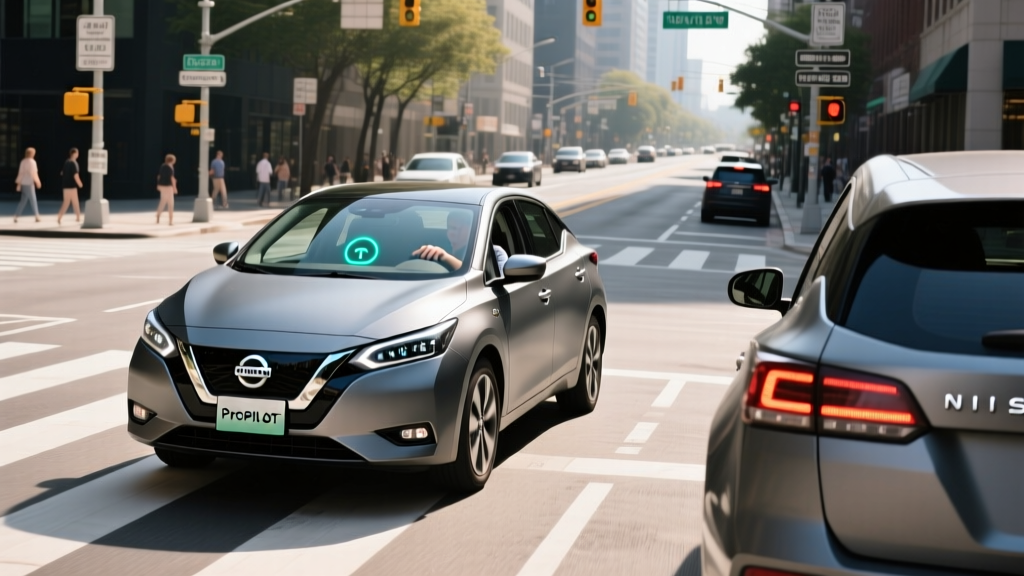
Nissan has offered some form of its ProPILOT driver-assistance suite for nearly a decade, but the system available on 2026 models bears little resemblance to the early lane-centering add-on that debuted in the Rogue. Today, Nissan ProPILOT spans a tiered lineup — from basic adaptive cruise with steering assist up to ProPILOT Assist 2.0, which adds hands-off, eyes-on highway driving on pre-mapped roads. For buyers evaluating a new Ariya, Leaf, Rogue, or Pathfinder, understanding exactly what each ProPILOT tier does (and critically, what it does not do) is essential before you pay for a trim you may not need.
This guide breaks down the sensor hardware, SAE automation classification, real-world behavior, model availability, and cost structure of Nissan ProPILOT in the 2026 model year.
What Nissan ProPILOT Actually Does
Nissan markets several tiers under the ProPILOT umbrella. The naming has shifted over the years, but for 2026, the hierarchy works like this:
- ProPILOT Assist (1.0): Combines adaptive cruise control (ACC) with lane-centering steering assist. The system keeps the vehicle centered in its lane and maintains a set following distance from traffic ahead. Hands on the wheel at all times.
- ProPILOT Assist 1.1: Adds navigation-linked speed adaptation — the car can slow for upcoming curves or reduced speed limits when route guidance is active. Still hands-on.
- ProPILOT Assist 2.0: The most advanced tier currently offered. Enables hands-off, eyes-on driving on divided highways that have been pre-mapped by Nissan. The driver must keep their eyes on the road, monitored by a driver-facing camera. If the system encounters a situation it cannot handle, it alerts the driver to take over.
All Nissan ProPILOT variants — including ProPILOT Assist 2.0 — are classified as SAE Level 2 driver-assistance systems. This means the vehicle can simultaneously control steering and acceleration/braking under certain conditions, but the human driver remains fully responsible for monitoring the environment and must be prepared to intervene instantly. This is not autonomous or self-driving operation. Only Level 4 systems (such as Waymo's geofenced robotaxi service) operate without a human driver in the loop.
Under the Hood: Sensor Hardware and How It Works
ProPILOT Assist relies on a sensor fusion approach — combining data from multiple hardware types to build a real-time picture of the road. The exact sensor count varies by model and trim, but the core architecture includes:
| Sensor Type | Function | Typical Count (2026 Models) |
|---|---|---|
| Forward-facing radar | Detects vehicles ahead for ACC; measures distance and relative speed | 1 (front bumper/grille) |
| Forward-facing camera | Reads lane markings, speed limit signs, traffic lights | 1 (behind windshield, near mirror) |
| Corner/surround radars | Monitors adjacent lanes for lane-change assist, blind-spot intervention | 2-4 (rear bumper corners) |
| Driver-monitoring camera | Confirms driver eye gaze for hands-off mode (ProPILOT 2.0 only) | 1 (steering column or dash) |
| Ultrasonic sensors | Low-speed parking assist and close-proximity obstacle detection | 8-12 (front/rear bumpers) |
ProPILOT Assist 2.0 also depends on HD map data — high-definition maps of divided highways that Nissan maintains and updates over-the-air. The hands-off feature only activates when the vehicle's GPS position matches a pre-mapped road segment and the system confirms sufficient lane-marking visibility.
Real-World Capabilities: Where ProPILOT Performs Well
On well-marked interstate highways in clear conditions, ProPILOT Assist 2.0 delivers a genuinely useful reduction in driver fatigue. On a 200-mile highway run, the system handles:
- Stop-and-go traffic management — accelerates, brakes, and resumes without driver pedal input, even down to a full stop
- Lane centering — smooth steering inputs that keep the vehicle centered, even through gentle curves
- Hands-off cruising (2.0 only) — on compatible divided highways, you can remove your hands from the wheel while keeping your eyes forward; the driver-monitoring camera will alert you if your gaze drifts too long
- Speed adaptation — slows for curves and speed-limit changes when navigation-linked mode is active
The lane-centering quality on the 2026 Ariya and Rogue is notably improved over earlier Nissan systems, which had a tendency to "ping-pong" between lane lines. The current generation holds a tighter, more natural line.
- Does not make lane changes autonomously (driver must initiate)
- Does not navigate highway exits or interchanges without driver takeover
- Does not function reliably in heavy rain, fog, snow, or when lane markings are faded/missing
- Does not detect construction-zone cones or temporary lane shifts consistently
- Does not operate on unmapped roads (ProPILOT 2.0 hands-off mode)
- Does not eliminate the need for the driver to remain fully attentive — you are legally and operationally responsible at all times
Model Availability: Which 2026 Nissans Offer ProPILOT
Nissan has made the base ProPILOT Assist (1.0 or 1.1) widely available, but the hands-off ProPILOT Assist 2.0 is restricted to higher trims and specific models. Here's the 2026 landscape:
| Model | ProPILOT Assist (1.0/1.1) | ProPILOT Assist 2.0 | Trim Requirement |
|---|---|---|---|
| Ariya (BEV) | Standard on Empower+ and above | Available on Evolve+ and above | Empower+ (~$48,590 MSRP) |
| Leaf (BEV) | Standard on SV Plus | Not available | SV Plus (~$37,500 MSRP) |
| Rogue (ICE/PHEV) | Standard on SV and above | Available on Platinum | SV (~$32,250 MSRP) |
| Pathfinder (ICE) | Standard on SL and above | Available on Platinum | SL (~$44,670 MSRP) |
| Sentra (ICE) | Standard on SV and above | Not available | SV (~$24,000 MSRP) |
Source: Nissan USA Ariya Features, NHTSA. MSRPs are approximate 2026 base figures before destination charges. Trim packaging is subject to mid-year changes — verify with your dealer.
Cost: One-Time Purchase, Subscription, or Included?
Nissan structures ProPILOT differently than some competitors. Here's how the cost works in 2026:
| Feature Tier | Cost Structure | Notes |
|---|---|---|
| ProPILOT Assist 1.0 / 1.1 | Included in trim price — no subscription | No recurring fee; functions as long as you own the vehicle |
| ProPILOT Assist 2.0 | Included in qualifying trim price — no subscription (as of 2026) | Requires higher trim purchase; HD map updates delivered OTA at no additional charge |
| NissanConnect services | Trial included, then ~$199-$399/year | OTA map updates and remote features require active subscription after trial period |
Unlike Tesla's Full Self-Driving (which can be purchased for $8,000 or subscribed at $99/month) or GM's Super Cruise (which requires a subscription after the initial trial), Nissan currently bundles ProPILOT into the vehicle purchase price with no separate monthly fee for the driving-assistance features themselves. This is a meaningful ownership-cost advantage over a 5-year horizon.
However, keep in mind that OTA map updates — essential for ProPILOT 2.0's hands-off highway coverage — flow through NissanConnect. If you let that subscription lapse after the trial period (typically 3 years), you may lose access to updated HD map data, effectively downgrading your 2.0 system back to hands-on-only mode.
How ProPILOT Compares to the Competition
Nissan ProPILOT exists in a crowded field. Here's how it stacks up against the major Level 2 competitors available in 2026:
| System | Hands-Off Mode? | Mapped Roads Required? | Cost Model | Coverage (approx.) |
|---|---|---|---|---|
| Nissan ProPILOT 2.0 | Yes (eyes-on) | Yes (HD maps) | Included in trim | ~520,000 miles of US divided highways |
| GM Super Cruise | Yes (eyes-on) | Yes (HD maps) | Subscription after trial (~$25/mo) | ~750,000+ miles |
| Ford BlueCruise 1.4 | Yes (eyes-on) | Yes (pre-qualified roads) | Subscription after trial (~$75/yr) | ~130,000+ miles |
| Tesla Autopilot / FSD Supervised | No (hands-on required) | No (any road) | $8,000 purchase or $99/mo (FSD) | All roads (no map restriction) |
| Hyundai/Kia HDA 2 | Limited (hands-off in specific zones) | Yes (navigation-linked) | Included in trim | Navigation-linked highways |
| Toyota TSS 3.0 / Teammate | No (hands-on) | No | Standard on most trims | All roads |
Nissan's hands-off coverage of approximately 520,000 miles of divided highways puts it between Ford and GM in geographic breadth. The key differentiator is cost: Nissan bundles ProPILOT 2.0 into the vehicle price, while GM and Ford charge ongoing subscriptions. Over a 5-year ownership period, that subscription savings can total $1,500–$4,500.
Real-World Limitations Every Buyer Should Know
After testing ProPILOT across multiple model years and road conditions, here are the practical constraints that spec sheets don't emphasize:
Weather Degradation
In moderate to heavy rain, the forward-facing camera struggles to resolve lane markings, and the system will issue a takeover request within seconds. In snow or fog, expect ProPILOT to disengage almost immediately. This is common to all camera-dependent Level 2 systems, not a Nissan-specific flaw, but it means your "hands-off highway" feature is effectively a clear-weather amenity.
Lane-Marking Dependency
ProPILOT 2.0 requires clearly visible, well-maintained lane markings. Rural highways with faded paint, construction zones with temporary striping, and roads where snow or sand has covered markings will all cause disengagement. Urban surface streets — even divided ones — generally are not mapped and will not activate hands-off mode.
Driver-Monitoring Strictness
The infrared driver-monitoring camera in ProPILOT 2.0 vehicles is more sensitive than some competitors. Sunglasses can interfere with eye detection, and looking at your center-stack display for more than a second or two will trigger a warning. Some drivers find this overly aggressive; others appreciate the safety redundancy. If you frequently wear polarized or dark sunglasses, test the system during your trial period.
Map Coverage Gaps
While Nissan claims roughly 520,000 miles of mapped divided highways, newly constructed roads, recently reconfigured interchanges, and rural highway segments may not yet be in the HD map database. When the system exits a mapped zone, it will alert you to resume hands-on driving — sometimes abruptly.
Frequently Asked Questions
Is Nissan ProPILOT truly self-driving?
No. Every version of Nissan ProPILOT, including ProPILOT Assist 2.0, is an SAE Level 2 system. The driver must remain fully attentive, monitor the road, and be prepared to take control at any moment. The "hands-off" designation in 2.0 refers only to steering-wheel contact — your eyes and attention must remain on the driving task. Legally and operationally, you are the driver.
How much does Nissan ProPILOT cost?
ProPILOT Assist 1.0/1.1 is included in the price of qualifying trims at no additional charge — there is no purchase add-on or subscription. ProPILOT Assist 2.0 is also included in the price of higher trims (e.g., Ariya Evolve+, Rogue Platinum), though you'll need to maintain a NissanConnect subscription after the trial period to continue receiving HD map updates. Nissan does not currently charge a separate monthly fee for the ProPILOT driving-assistance features themselves.
Which 2026 Nissan models offer ProPILOT Assist 2.0?
As of the 2026 model year, ProPILOT Assist 2.0 is available on the Ariya (Evolve+ trim and above) and the Rogue and Pathfinder (Platinum trims). The Leaf and Sentra do not offer 2.0. Availability and trim packaging can change — confirm with your dealer before purchasing.
What happens if I take my eyes off the road with ProPILOT 2.0?
The driver-monitoring camera tracks your eye gaze. If you look away from the road for more than a few seconds, the system will issue escalating alerts: first a visual warning on the instrument cluster, then an audible chime, then a more urgent alarm. If you do not respond, the system will gradually slow the vehicle, activate hazard lights, and eventually bring the car to a stop. This is a safety backstop, not a feature to exploit.
Can ProPILOT change lanes on its own?
No. ProPILOT Assist 2.0 does not perform autonomous lane changes. The driver must initiate any lane change by activating the turn signal and confirming the maneuver. Some competing systems (such as Tesla FSD Supervised and certain Hyundai HDA 2 implementations) offer lane-change-on-indicator, but Nissan has not introduced this feature in the 2026 model year.
Does ProPILOT work at night?
Yes, provided lane markings are visible and the road is within the HD map coverage area. The forward-facing camera uses infrared illumination to supplement ambient light, and the driver-monitoring camera operates in IR. Nighttime driving on well-lit, well-marked divided highways is generally reliable. Unlit rural roads with poor markings will cause disengagement.
For the latest safety ratings and crash-test performance of Nissan vehicles equipped with ProPILOT, consult IIHS and NHTSA. Federal tax credit eligibility for the Ariya and Leaf under IRS §30D depends on MSRP caps, buyer income limits, and battery-sourcing requirements — consult a tax professional for your specific situation.