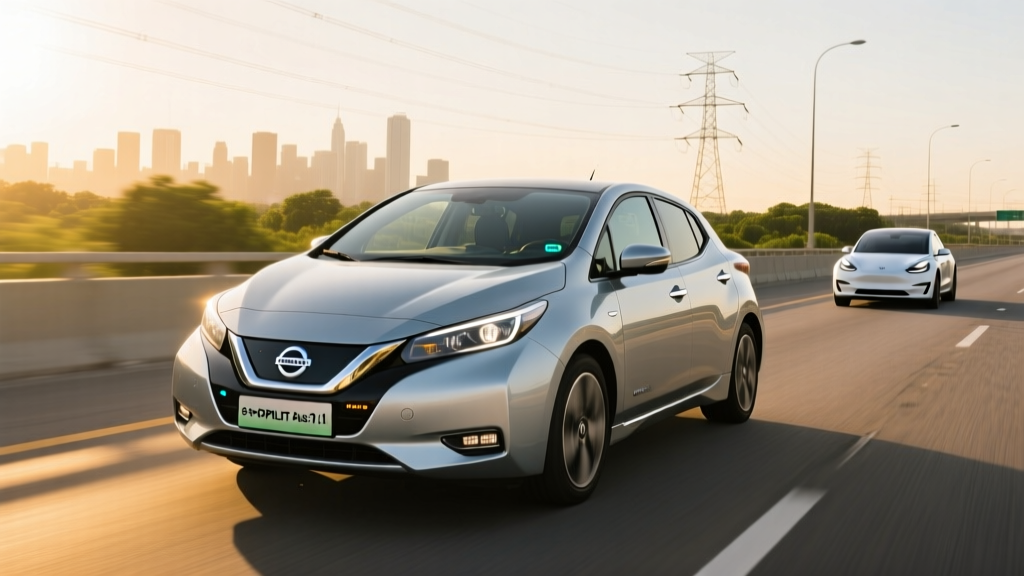
Nissan's ProPILOT Assist 1.1 sits in the middle tier of the brand's driver-assistance lineup — above the base ProPILOT Assist but below the hands-off, highway-only ProPILOT Assist 2.0 (available on the Ariya). For EV buyers looking at the Leaf or Ariya, or ICE shoppers considering the Rogue or Altima, understanding exactly what version 1.1 does, where it falls short, and how it compares to rivals like Toyota Safety Sense or Honda Sensing is essential before you sign the paperwork.
This guide breaks down the sensor hardware, real-world highway behavior, hard limitations, and model availability of ProPILOT Assist 1.1 as equipped on current Nissan vehicles.
What ProPILOT Assist 1.1 Actually Does
ProPILOT Assist 1.1 is a combined adaptive cruise control and lane-centering system. When activated, it manages two things simultaneously:
- Intelligent Cruise Control (ICC): Maintains a set speed and following distance from the vehicle ahead using a front-mounted millimeter-wave radar. It can bring the car to a complete stop and resume in traffic.
- Steering Assist: Uses a forward-facing monocular camera to read lane markings and applies small steering inputs to keep the vehicle centered in its lane.
The system is designed for highway and divided-road use. It does not navigate intersections, change lanes autonomously, read traffic lights, or handle unmapped roads. Think of it as a co-pilot that reduces fatigue on long drives — not a replacement for your attention.
ProPILOT Assist 1.1 is an SAE Level 2 driver-assistance system. The driver must remain fully engaged — hands on the steering wheel, eyes on the road — at all times. The system provides partial automation of steering and speed but does not assume driving responsibility. Only Level 4 services like Waymo operate without a human driver; no consumer Nissan system reaches that threshold.
Under the Hood: Sensors and Hardware
ProPILOT Assist 1.1 relies on a relatively straightforward sensor suite compared to the multi-layered arrays on premium competitors:
| Component | Type | Function |
|---|---|---|
| Front radar | Millimeter-wave (77 GHz) | Vehicle detection, following distance, ACC |
| Forward camera | Monocular windshield-mounted | Lane marking detection, steering assist |
| Steering torque sensor | Column-mounted | Hands-on detection |
| Wheel speed / ABS sensors | Standard ABS module | Vehicle speed, stop-and-go control |
Notably absent: there is no driver-facing camera for eye monitoring (unlike Ford's BlueCruise or GM's Super Cruise), no LiDAR, and no rear or side radar dedicated to the ProPILOT system. This hardware simplicity keeps cost down but directly limits capability in edge cases — more on that below.
Real-World Highway Performance
In sustained highway use across well-marked interstates, ProPILOT Assist 1.1 performs competently. The adaptive cruise control tracks lead vehicles smoothly, and braking intervention is progressive rather than abrupt. Lane centering holds the vehicle reasonably well on gentle curves typical of rural interstates.
Where the system shows its limitations:
- Lane-centering confidence on curves: On highway curves tighter than roughly 500-meter radius, the steering assist may disengage or request driver takeover. This is common on mountainous interstate segments.
- Faded or missing lane markings: Construction zones, older rural highways with worn paint, and roads where snow or gravel obscures markings will cause the steering assist to deactivate. The ICC continues working, but you're steering manually.
- Stop-and-go resume: After a full stop, the system can resume automatically within a few seconds. Beyond that window, you need to tap the resume button or press the accelerator — a minor but frequent annoyance in heavy congestion.
- Phantom braking: Like most radar-based ACC systems, ProPILOT 1.1 occasionally brakes for overhead signs, guardrails on sharp curves, or vehicles in adjacent lanes that the radar interprets as in-path. It's infrequent but worth anticipating.
- Change lanes or navigate exits autonomously
- Stop at red lights or stop signs without driver input
- Operate without clearly visible lane markings
- Function in heavy rain, fog, or snow that obscures the camera or radar
- Allow hands-off driving — the torque sensor requires periodic steering input
- Navigate city streets, parking lots, or unmapped roads
Which Nissan Models Include ProPILOT Assist 1.1?
Nissan has made ProPILOT Assist 1.1 increasingly standard across its lineup, but trim-level availability varies. Here's the current breakdown for key models:
| Model | ProPILOT 1.1 Availability | Standard or Optional | Starting MSRP (trim with 1.1) |
|---|---|---|---|
| Nissan Leaf (2025–2026) | SV Plus and above | Standard on SV Plus | ~$37,000 |
| Nissan Ariya | All trims (2.0 on higher trims) | Standard (1.1 on Engage; 2.0 on Evolve+ and above) | ~$40,000 |
| Nissan Rogue | SV and above | Standard on SV+ | ~$31,000 |
| Nissan Altima | SV and above | Standard on SV+ | ~$29,000 |
| Nissan Pathfinder | SV and above | Standard on SV+ | ~$40,000 |
ProPILOT Assist 1.1 is included in the vehicle's purchase price — there is no subscription fee or one-time activation cost. This is a significant advantage over systems that require monthly payments. Once you buy the car, the feature is yours for the life of the vehicle.
Note: The Ariya's higher trims (Evolve+, Empower+, and Platinum+) include ProPILOT Assist 2.0, which adds hands-off driving on divided highways under specific conditions, using a driver-monitoring camera and more detailed map data. That is a separate, more capable system.
How It Stacks Up Against Competitors
ProPILOT Assist 1.1 competes directly with several mainstream Level 2 systems. Here's how the core capabilities compare:
| Feature | Nissan ProPILOT 1.1 | Toyota Safety Sense 3.0 | Honda Sensing (2026) | Hyundai HDA |
|---|---|---|---|---|
| SAE Level | Level 2 | Level 2 | Level 2 | Level 2 |
| ACC + Lane Centering | Yes | Yes (LTA + DRCC) | Yes (LKAS + ACC) | Yes |
| Stop-and-Go | Yes | Yes | Yes | Yes |
| Speed Limit Assist | Limited (sign recognition) | Yes (RSA) | Yes (TSR) | Yes (navigation-linked) |
| Lane Change Assist | No | No (TSS 3.0) | No | Yes (HDA 2 on select trims) |
| Driver Monitoring Camera | No (torque sensor) | No | No | No (HDA 1) |
| Subscription Required | No | No | No | No |
| Included in Purchase | Yes | Yes | Yes | Yes (on equipped trims) |
Among mainstream competitors, Nissan's system is comparable in core capability but trails Hyundai's HDA 2 (available on the Ioniq 5 and Ioniq 6) which adds navigation-linked curve speed adjustment and lane-change assist on higher trims. Toyota's TSS 3.0 and Honda Sensing offer similar hands-on, lane-centering + ACC functionality without subscription fees.
Premium systems like Tesla's Autopilot (included on all models), Ford's BlueCruise (hands-off on mapped highways, subscription after trial), and GM's Super Cruise (hands-off, subscription-based) operate at a higher capability tier — but at higher cost and often with recurring fees.
Cost and Value: No Subscription, No Surprises
| Cost Factor | ProPILOT Assist 1.1 |
|---|---|
| Purchase price | Included in vehicle MSRP (on eligible trims) |
| Activation fee | None |
| Monthly subscription | None |
| Over-the-air updates | Limited (dealer updates primarily) |
| Hardware replacement (out of warranty) | Camera: ~$500–$800; Radar: ~$800–$1,200 (dealer estimates) |
The no-subscription model is one of ProPILOT 1.1's strongest value propositions. Compare this to Ford BlueCruise, which costs roughly $75/month or $800/year after the initial trial period, or Tesla's FSD at $8,000 one-time or $99/month. Over a five-year ownership period, that subscription gap can total $4,000–$6,000.
The trade-off is capability: ProPILOT 1.1 doesn't offer hands-off driving, automated lane changes, or navigation-linked features. You're paying less because the system does less — which, for many drivers who simply want highway fatigue reduction, is an acceptable trade.
Weather and Edge-Case Limitations
Every camera-and-radar-based ADAS system has environmental limits, and ProPILOT Assist 1.1 is no exception. Based on Nissan's official documentation and owner reports, expect degraded or disabled performance in these conditions:
- Heavy rain or standing water: Water spray obscures the windshield camera. The steering assist will disengage; ICC may continue but with reduced detection range.
- Snow and ice accumulation: Snow on the windshield near the camera or ice on the front radar emblem will disable the system entirely. Keep these areas clear.
- Direct sun glare: Low-angle sun hitting the camera can overwhelm the sensor, causing temporary lane-centering dropout. Polarized sunglasses don't affect the camera, but the sensor itself can wash out.
- Construction zones: Altered lane markings, temporary barriers, and shifted lanes confuse the camera. Nissan explicitly recommends disabling ProPILOT in work zones.
- Tunnel exits: Sudden light transitions can briefly blind the camera. Expect a 2–3 second gap in lane-centering confidence.
- Roads without lane markings: Rural two-lane roads without painted lines provide nothing for the camera to track. Steering assist will not activate.
For EV owners in cold climates — particularly Leaf and Ariya drivers — winter brings a compounding effect: reduced battery range and reduced ADAS availability. If your daily commute involves unplowed roads or heavy salt spray on the windshield, plan to drive manually more often than the system's marketing might suggest.
Safety Record and Driver Responsibility
Nissan's ProPILOT systems have not been subject to the same level of NHTSA scrutiny as Tesla's Autopilot/FSD, largely because the system is more conservative in its capability envelope. It doesn't claim hands-off operation, doesn't market itself as approaching autonomy, and requires steady torque input from the driver.
That said, the fundamental risk of any Level 2 system applies: automation complacency. When a system handles steering and speed competently for long stretches, human attention naturally drifts. Nissan's torque-based hands-on detection is less robust than camera-based eye monitoring (used by Ford BlueCruise and GM Super Cruise) — a driver can satisfy the torque sensor with minimal steering input while looking away from the road.
The bottom line: ProPILOT Assist 1.1 is a tool that reduces physical fatigue on long highway drives. It is not a substitute for an attentive driver, and treating it as one creates real safety risk. Per IIHS research on driver-assistance systems, overreliance on Level 2 features correlates with increased distraction-related incidents.
Frequently Asked Questions
Is ProPILOT Assist 1.1 self-driving?
No. ProPILOT Assist 1.1 is an SAE Level 2 system that requires the driver to keep hands on the wheel and eyes on the road at all times. It assists with steering and speed but does not drive the vehicle independently. Only Level 4 robotaxi services like Waymo operate without a human driver.
Can ProPILOT 1.1 change lanes on its own?
No. Lane changes are entirely the driver's responsibility. The system maintains your position within a single lane. If you want automated lane changes, you'd need to look at Nissan's ProPILOT Assist 2.0 (Ariya higher trims only), Tesla's FSD Supervised, or Hyundai's HDA 2.
Does ProPILOT 1.1 work at night?
Yes, as long as lane markings are visible to the camera. Well-lit highways and roads with reflective lane paint work well. Unlit rural roads with faded markings will cause the steering assist to disengage, though the radar-based cruise control continues to function.
What happens if I take my hands off the wheel?
The system detects the absence of steering torque and issues escalating alerts: first a visual warning on the instrument cluster, then an audible chime, then a more urgent alert. If you continue to ignore the warnings, ProPILOT will gradually slow the vehicle, activate the hazard lights, and eventually bring the car to a stop. This is a safety fallback, not a routine feature.
Is ProPILOT 1.1 available on the base Nissan Leaf S?
No. The Leaf S trim does not include ProPILOT Assist 1.1. You need at minimum the SV Plus trim (~$37,000 MSRP) to get the feature. The base S trim includes standard cruise control and lane departure warning but not the combined ACC + steering assist.
How does ProPILOT 1.1 differ from ProPILOT 2.0?
ProPILOT 2.0 (available on Ariya Evolve+ and above) adds a driver-monitoring camera that enables hands-off driving on mapped divided highways at speeds up to approximately 80 mph, plus lane-change assist when the driver confirms the maneuver. Version 1.1 requires hands-on at all times and does not support automated lane changes. The hardware difference is primarily the inward-facing camera and higher-definition map data.