What the Mercedes Driver Assistance Package Actually Does
The Mercedes-Benz Driver Assistance Package is a bundled suite of advanced driver-assistance systems (ADAS) designed to reduce fatigue on highways and in stop-and-go traffic. For the 2026 model year, this package centers around Active Distance Assist DISTRONIC (adaptive cruise control with stop-and-go) and Active Steering Assist (lane-centering), supported by a network of sensors that monitor the vehicle's surroundings 360 degrees.
Unlike Tesla's Autopilot or Ford's BlueCruise, Mercedes markets this suite as a premium comfort feature rather than a pathway to autonomy. The system is engineered to keep the car centered in its lane, maintain a set following distance, and even execute lane changes when the driver confirms the maneuver with a turn signal (Active Lane Change Assist).
SAE Automation Level: Level 2
The Mercedes Driver Assistance Package operates at SAE Level 2. This means the vehicle can control steering and acceleration simultaneously, but the driver must remain fully engaged, keep hands on the wheel (or prove attentiveness via torque sensors), and be ready to take over instantly. It is not self-driving. Eyes-on, hands-on supervision is mandatory at all times.
Technical Architecture: How the Sensors Work
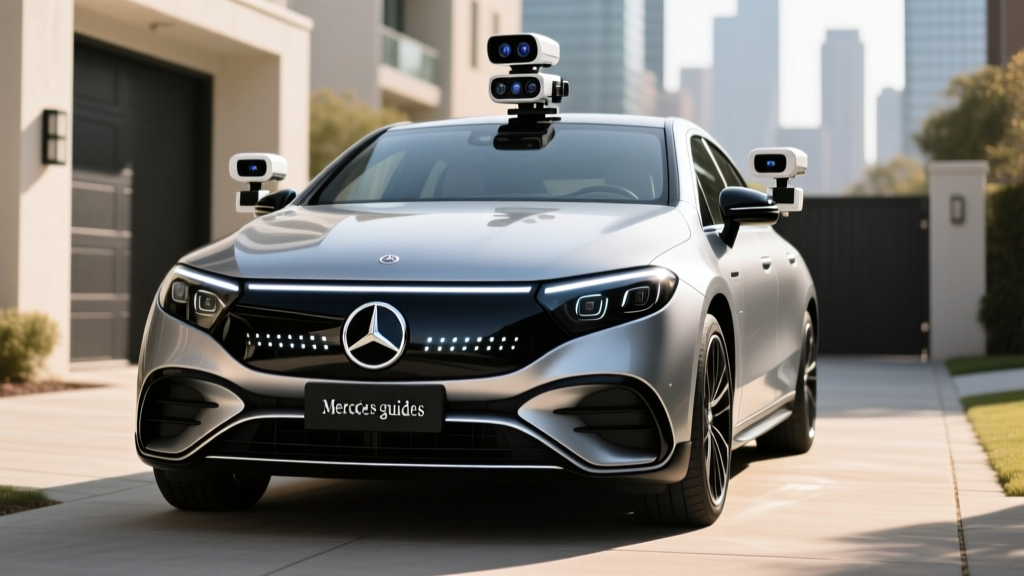
Mercedes-Benz utilizes a sensor fusion approach that combines multiple hardware types to build a real-time 3D model of the driving environment. For 2026 EQE, EQS, and updated C/E-Class models, the hardware stack typically includes:
- Long-range radar: Mounted behind the front grille, scanning up to 200+ meters ahead for vehicles and obstacles.
- Short/mid-range radar: Corner-mounted units that monitor blind spots and cross-traffic.
- Stereo multipurpose camera: Mounted behind the windshield, reading lane markings, traffic signs, and pedestrians.
- Ultrasonic sensors: For low-speed parking maneuvers and close-proximity object detection.
This redundancy is critical. If the camera is blinded by direct sun or heavy rain, the radar maintains distance-keeping. If lane markings fade on rural roads, the system can sometimes track the vehicle ahead—though this degrades capability and triggers warnings.
Feature Capability Breakdown
| Feature Name | Function | Speed Range | Driver Requirement |
|---|---|---|---|
| Active Distance Assist DISTRONIC | Maintains set speed and following gap; full stop & resume | 0–130 mph | Hands-on (torque sensor) |
| Active Steering Assist | Lane-centering on highways and marked roads | 0–130 mph | Hands-on; alerts if removed |
| Active Lane Change Assist | Executes lane change after driver signals | ~50–130 mph | Driver must initiate signal & confirm |
| Active Emergency Stop Assist | Brings car to safe stop if driver is unresponsive | All speeds | Automatic fallback |
| Route-Based Speed Adaptation | Slows for curves, roundabouts, toll plazas via map data | Varies | Supervisory |
| Active Brake Assist w/ Cross-Traffic | AEB for vehicles, pedestrians, crossing traffic | ~4–155 mph | Automatic intervention |
Which 2026 Models Include It — and at What Cost?
The Mercedes Driver Assistance Package is rarely standard on base trims. It is typically bundled into a mid-tier package or offered as a standalone option. Pricing varies by model line, but here's the 2026 landscape:
| Model Line (2026) | Package Name | Approx. Cost (MSRP Add) | Availability |
|---|---|---|---|
| C-Class / GLC | Driver Assistance Package | $1,950 – $2,250 | Optional on Premium; standard on Pinnacle |
| E-Class / GLE | Driver Assistance Package | $2,050 – $2,500 | Optional on Exclusive/Luxury; std on AMG Line Prestige |
| S-Class / EQS Sedan | Driver Assistance Package | $2,500 (often std on top trims) | Standard on most upper trims |
| EQE / EQB / EQA | Driver Assistance Package | $1,750 – $2,100 | Optional; bundled with Premium Plus trim |
Subscription note: Unlike Tesla's FSD ($8,000 purchase or ~$99/month subscription) or BMW's monthly heated-seat model, Mercedes does not currently charge a recurring subscription for the core Driver Assistance Package features in the US market. Once purchased with the vehicle, DISTRONIC and Active Steering Assist are yours for the life of the car. However, Mercedes has begun exploring subscription-based unlocks for certain post-purchase features (like rear-axle steering angles) via its Mercedes me connect store, so buyers should verify at point of sale.
Real-World Capabilities: Where It Excels
On well-marked interstate highways—think I-5, I-95, or I-10 in clear weather—the Mercedes Driver Assistance Package is among the smoothest Level 2 systems available. DISTRONIC's acceleration and braking calibration feels natural, avoiding the abrupt "rubber-banding" that plagues some competitors. The steering assist is gentle but firm, holding the car dead-center even through sweeping curves.
The Route-Based Speed Adaptation is a standout: approaching a sharp highway offramp or a toll plaza, the car preemptively decelerates using navigation map data, which feels intuitive and reduces driver workload.
In stop-and-go traffic, DISTRONIC handles full stops and resumes without driver input (within a few seconds). In longer stops, a tap of the accelerator or the resume button gets the car moving again.
⚠️ Real-World Limitations You Must Know
- Faded or missing lane markings: Active Steering Assist will disengage with an audible alert. Rural two-lane roads with worn paint are a common failure point.
- Heavy rain, fog, or direct sun glare: Camera-based lane-keeping degrades. Radar still functions for distance-keeping, but steering assist may drop out.
- Construction zones: Shifted lanes, orange barrels, and temporary markings confuse the system. Mercedes explicitly warns drivers to take over in work zones.
- Tight curves (radius < ~250m): The system may not hold the lane through sharp mountain highway bends at speed.
- Hands-off detection: Mercedes uses a torque-sensing steering wheel. You must apply slight rotational pressure periodically. Failing to do so triggers escalating warnings → hazard lights → Emergency Stop Assist bringing the car to a halt in-lane.
- Not a robotaxi: This system will not navigate intersections, obey stop signs autonomously, or handle unmapped roads. You are the driver.
Mercedes vs. Competing Level 2 Systems
How does the Mercedes Driver Assistance Package stack up against the best Level 2 suites from Tesla, Ford/GM, and Hyundai/Kia?
| System | Hands-Free? | Lane Change Assist | Cost Model | Smoothness Rating |
|---|---|---|---|---|
| Mercedes Driver Assistance Pkg | No (hands-on torque) | Yes (signal-initiated) | One-time ~$2,000–$2,500 | ★★★★★ |
| Tesla Autopilot / FSD (Supervised) | No (hands-on torque) | Yes (auto or signal) | $8,000 or $99/mo (FSD) | ★★★★☆ |
| Ford BlueCruise / GM Super Cruise | Yes (eyes-on, pre-mapped highways) | Yes (signal-initiated) | Subscription ~$25–$75/mo after trial | ★★★★☆ |
| Hyundai/Kia HDA2 | No (hands-on) | Yes (signal-initiated) | Included on SEL+ / SX trims | ★★★★☆ |
Key distinction: Ford BlueCruise and GM Super Cruise allow hands-free driving on pre-mapped divided highways (still eyes-on, monitored by infrared cameras). Mercedes does not offer hands-free Level 2 in the US for the 2026 model year outside of the DRIVE PILOT system, which is a separate, limited-availability Level 3 feature restricted to specific traffic-jam conditions in Nevada and California on the S-Class and EQS only.
Safety Data and IIHS Context
Mercedes-Benz vehicles equipped with the Driver Assistance Package consistently earn top marks from the IIHS and NHTSA. Active Brake Assist with cross-traffic detection is a major contributor to these ratings, frequently preventing or mitigating collisions that human reaction time alone would miss.
However, NHTSA has issued standing general orders requiring manufacturers to report crashes involving Level 2+ systems. Mercedes, like all OEMs, is subject to this reporting. Buyers should understand that ADAS reduces risk but does not eliminate it—complacency and over-reliance remain the primary danger with any Level 2 system.
Should You Pay for the Mercedes Driver Assistance Package?
Choose to add the package if:
- You commute 45+ minutes daily on divided highways.
- You frequently sit in stop-and-go congestion and want to reduce pedal fatigue.
- You value smooth, non-intrusive calibration over aggressive "tech-forward" behavior.
- You plan to keep the car 4+ years (the resale uplift partially offsets cost).
Skip it if:
- Your driving is mostly city errands and short suburban trips.
- You prefer full manual control and find lane-centering "fighty."
- You want hands-free capability—look at BlueCruise or Super Cruise instead.
Frequently Asked Questions
Is the Mercedes Driver Assistance Package self-driving?
No. It is an SAE Level 2 system. The car can steer, accelerate, and brake simultaneously, but you must remain the active driver—hands on the wheel, eyes on the road, ready to intervene at any moment. Calling it "self-driving" is inaccurate and dangerous.
How much does it cost?
For 2026, the package adds approximately $1,750–$2,500 to the vehicle MSRP depending on model. It is a one-time purchase, not a subscription, and is often bundled into upper trim levels (e.g., Pinnacle, AMG Line Prestige) where it is effectively included.
Can it change lanes by itself?
Active Lane Change Assist will execute a lane change, but only after the driver activates the turn signal and the system confirms the adjacent lane is clear. It does not change lanes autonomously without driver initiation.
Does it work in rain and snow?
Light rain: yes, with slightly reduced camera confidence. Heavy rain, snow, or fog: the camera may lose lane-marking visibility, causing Active Steering Assist to disengage. Radar-based DISTRONIC (distance-keeping) usually continues to function. Always reduce speed and increase following distance in adverse weather.
What's the difference between this and Mercedes DRIVE PILOT?
DRIVE PILOT is a Level 3 conditional automation system available only on 2026 S-Class and EQS in limited US jurisdictions (NV, CA). It allows the driver to legally disengage (watch a video, read) in traffic jams under 40 mph on suitable highways. It costs ~$5,000+ and requires specific road/weather conditions. The Driver Assistance Package is Level 2 and available on nearly all models—far more common but requires constant supervision.
Will it stop the car if I zone out?
Yes. If the torque sensor detects no steering input for an extended period, the system escalates: visual warning → audible chime → repeated chimes → hazard lights activate → Active Emergency Stop Assist gently brakes the car to a full stop in its lane and unlocks the doors. This is a safety fallback, not a convenience feature.