If You Searched "Medical Abbreviation AEB" — You Probably Mean Automatic Emergency Braking
Quick clarification: AEB isn't a standard medical abbreviation in clinical practice. If you encountered "AEB" on a vehicle window sticker, owner's manual, or insurance form, it stands for Automatic Emergency Braking — a foundational active-safety system now standard on nearly every new EV sold in the United States. This guide explains what AEB actually does on 2026 electric vehicles, how the sensor hardware works, what it cannot do, and how it fits into the broader ADAS (Advanced Driver Assistance Systems) stack.
AEB is classified as SAE Level 0 (momentary intervention) or Level 1 (driver support) per SAE International J3016. It does not steer, does not maintain lane position, and does not relieve the driver of any responsibility. AEB fires only in imminent-collision scenarios and returns full control to the driver immediately after.
What Automatic Emergency Braking Actually Does
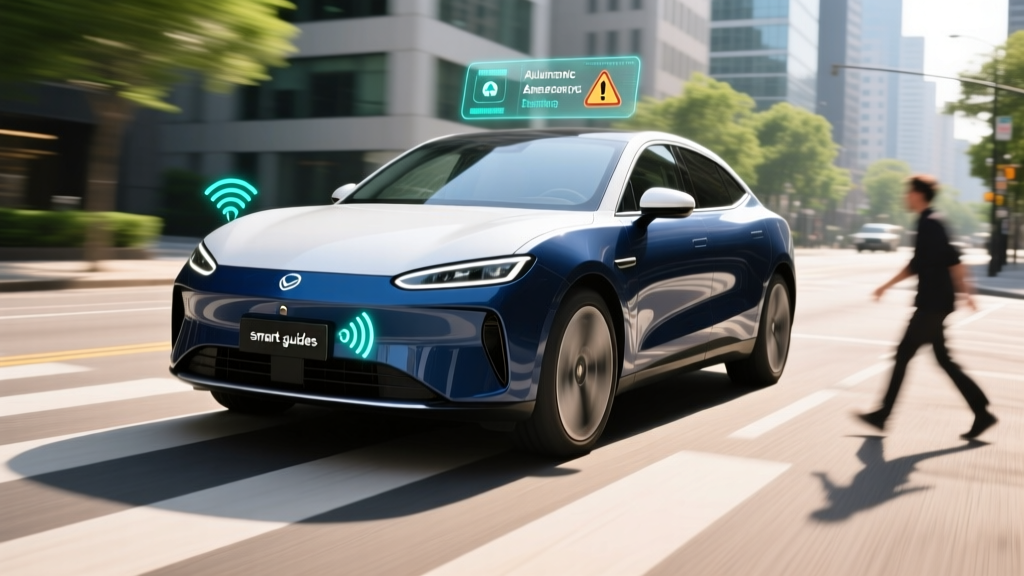
AEB is a forward-collision mitigation system. Its job is singular: detect an imminent crash with a vehicle, pedestrian, or cyclist ahead, warn the driver, and — if the driver does not react in time — apply the brakes autonomously to reduce impact speed or avoid the collision entirely.
The technical sequence runs in milliseconds:
- Detection: Forward-facing sensors (camera, radar, or both) classify objects in the vehicle's path.
- Time-to-collision calculation: The ADAS ECU computes relative speed and distance to determine TTC (time to collision).
- Alert phase: Visual and audible Forward Collision Warning (FCW) triggers, typically at ~2.7 seconds TTC.
- Pre-charge: Brake hydraulics pre-pressurize to reduce response latency.
- Autonomous braking: If TTC drops below ~1.5 seconds with no driver input, the system commands up to 1.0g of deceleration.
On modern EVs, AEB benefits from the inherent advantage of electric powertrains: regenerative braking can begin deceleration before friction brakes engage, shaving a few critical milliseconds off total stopping time.
How AEB Sensors Work on 2026 EVs
Not all AEB systems are built identically. Sensor suites vary by manufacturer and trim level, and this directly affects real-world performance.
| Brand / System Name | Primary Sensors | Pedestrian Detection | Cyclist Detection | Junction/Turn Assist |
|---|---|---|---|---|
| Tesla (Automatic Emergency Braking) | 8-camera vision (no radar on 2026 models) | Yes | Yes | Yes (camera-based) |
| Hyundai/Kia/Genesis (Forward Collision-Avoidance Assist) | Camera + front radar | Yes | Yes (SEL+ trims) | Yes (Limited/GT-Line) |
| Ford (Pre-Collision Assist with AEB) | Camera + radar (BlueCruise-equipped) | Yes | Yes | Yes (Lariat+) |
| GM/Chevrolet/Cadillac (Automatic Emergency Braking) | Camera + long-range radar | Yes | Yes (Super Cruise trims) | Yes (High Country/Sport) |
| Rivian (Forward Collision Warning + AEB) | Camera + radar + ultrasonic | Yes | Yes | Limited |
| BMW (Active Driving Assistant / AEB) | Camera + radar + ultrasonic | Yes | Yes | Yes (Driving Assistant Pro) |
| Mercedes-Benz (Active Brake Assist) | Camera + radar + LiDAR (S/EQS) | Yes | Yes | Yes |
Radar vs. vision-only trade-offs: Camera-only systems (Tesla) excel at object classification but can struggle in heavy rain, fog, or direct sun glare. Radar-assisted systems (Hyundai, Ford, GM, Rivian) maintain better performance in low-visibility conditions but rely on camera fusion for accurate pedestrian/cyclist classification. LiDAR-equipped vehicles (Mercedes S-Class, some Chinese-market EVs) offer the most robust depth mapping but add $1,000-$3,000 in hardware cost.
Brand Naming: AEB Goes by Many Names
Automakers rarely call the feature "AEB" in marketing. Here's how to find it on a window sticker or spec sheet:
| Manufacturer | Marketing Name | Standard on All Trims? | IIHS Credit |
|---|---|---|---|
| Tesla | Automatic Emergency Braking | Yes (all 2026 models) | Yes — "Superior" (Model Y, Model 3) |
| Hyundai / Kia | Forward Collision-Avoidance Assist (FCA/FCA-DA) | Standard on 2026 Ioniq 5, EV6, EV9 base trims | Yes — "Superior" |
| Ford | Pre-Collision Assist with Automatic Emergency Braking | Yes (all Mustang Mach-E, F-150 Lightning trims) | Yes — "Superior" |
| GM (Chevy/Cadillac) | Automatic Emergency Braking / Enhanced AEB | Yes (all 2026 Equinox EV, Blazer EV, Lyriq) | Yes — "Superior" |
| Rivian | Forward Collision Warning + AEB | Yes (R1S, R1T all trims) | Yes — "Superior" |
| BMW | Active Driving Assistant (Front Collision Warning + City Braking) | Yes (i4, iX, i7 all trims) | Yes — "Superior" |
| Mercedes-Benz | Active Brake Assist / Active Brake Assist with Cross-Traffic | Yes (EQE, EQS all trims) | Yes — "Superior" |
| Volvo/Polestar | City Safety with Autobrake | Yes (all 2026 EX30, EX90, Polestar 2/3/4) | Yes — "Superior" |
The good news for 2026 buyers: AEB is now essentially universal on new EVs at every price point. The NHTSA's 2024 final rule mandated AEB on all light vehicles by September 2029, and most EV manufacturers had already complied voluntarily years earlier to earn top IIHS ratings.
Real-World Limitations: What AEB Cannot Do
- Speed ceiling: Most AEB systems are rated for vehicle-to-vehicle collisions up to ~52-56 mph speed differential. Above that, the system may mitigate but not prevent a crash.
- Pedestrian detection at night: Camera-based pedestrian AEB degrades significantly in darkness without street lighting. IIHS nighttime pedestrian testing shows many systems earn "Basic" or no credit after dark.
- Weather interference: Heavy rain, snow accumulation on sensors, and dense fog can blind cameras and attenuate radar. The system may display a "sensor blocked" warning and disable AEB entirely.
- Stationary objects: AEB is generally tuned to ignore stationary objects (guardrails, parked cars, bridge abutments) to avoid false positives. It will NOT reliably brake for a stopped car if you're approaching at highway speed and the target is stationary.
- Intersection cross-traffic: Standard forward AEB does not monitor perpendicular traffic. Only systems with "Junction Turn Assist" or "Cross-Traffic Braking" address this scenario.
- Driver override: If you are actively accelerating or steering aggressively, most AEB systems interpret this as intentional and will not intervene.
- Does not replace attention: AEB is a last-resort safety net, not a driving substitute. The IIHS emphasizes that AEB reduces rear-end crashes by approximately 50% — significant, but far from elimination.
How AEB Fits Into the Full ADAS Stack (and What Costs Extra)
AEB is the baseline active-safety feature. Most EV buyers encounter it as part of a broader ADAS bundle. Here's how it relates to the systems that do cost extra:
| Feature Tier | What It Does | SAE Level | Typical Cost on 2026 EVs |
|---|---|---|---|
| AEB + FCW | Brakes automatically for imminent forward collisions | Level 0/1 | Standard (no extra cost) |
| Adaptive Cruise Control (ACC) | Maintains set speed and following distance | Level 1 | Standard on most EVs; mid-trim on some |
| Lane Centering + ACC (Autopilot, BlueCruise, etc.) | Steers + accelerates/brakes on highways | Level 2 | Standard to $2,000-$15,000 depending on brand |
| Hands-Free Highway (Super Cruise, BlueCruise 1.4, FSD Supervised) | Hands-off on mapped highways; eyes monitored | Level 2 | $2,100-$15,000 purchase or $99-$199/mo subscription |
Key point: You do not need to pay for Tesla FSD, Ford BlueCruise, or GM Super Cruise to get AEB. AEB comes standard on every trim of every 2026 EV listed above. The premium ADAS packages add hands-free lane centering and highway driving assistance — they do not upgrade AEB itself, because AEB is already operating at its regulatory ceiling.
AEB vs. Competing Active Safety: IIHS Test Performance
The Insurance Institute for Highway Safety runs standardized vehicle-to-vehicle and vehicle-to-pedestrian AEB tests at 12 mph, 25 mph, and (for top ratings) 37 mph. As of 2026, the IIHS requires a "Superior" rating in both daytime and nighttime pedestrian tests to earn its TOP SAFETY PICK+ designation.
EVs that earned "Superior" in both IIHS AEB evaluations for 2025-2026 include the Tesla Model Y, Hyundai Ioniq 5, Kia EV6, Ford Mustang Mach-E, Chevrolet Equinox EV, Rivian R1S, Volvo EX90, and BMW iX. This is a strong cohort — AEB performance on mainstream EVs has matured considerably since early-generation systems circa 2018-2020.
Frequently Asked Questions
Is AEB the same as "self-driving"?
No. AEB is SAE Level 0/1 — it intervenes only in emergency braking scenarios and does not control steering, acceleration, or lane position. It is not autonomous driving. Even full ADAS suites like Tesla FSD (Supervised), Ford BlueCruise, and GM Super Cruise are SAE Level 2, meaning the driver must remain engaged and responsible at all times. True self-driving (SAE Level 4) exists only in geofenced robotaxi services like Waymo, not in consumer vehicles.
Does AEB work at highway speeds?
Partially. Most AEB systems are effective at reducing collision severity at highway speeds (65-80 mph) but are not guaranteed to fully prevent a collision at high speed differentials. IIHS tests at 37 mph represent moderate-speed scenarios. For high-speed rear-end prevention, maintaining adequate following distance remains essential.
Can I turn AEB off?
Most vehicles allow you to disable AEB through the infotainment settings menu. However, the system resets to ON every time you restart the vehicle — a deliberate design choice by regulators and automakers. Disabling AEB is not recommended and may affect IIHS safety ratings and insurance discounts.
Does AEB increase my EV insurance premium?
Generally the opposite. Vehicles with standard AEB often qualify for insurance discounts of 5-10% on collision coverage, because AEB demonstrably reduces rear-end crash frequency. Check with your insurer — some require the vehicle's VIN to confirm AEB equipment.
What's the difference between AEB and regenerative braking?
Regenerative braking slows the vehicle when you lift off the accelerator, recovering kinetic energy into the battery. AEB is a separate safety system that commands full friction braking (sometimes supplemented by regen) only when an imminent collision is detected. They operate independently, though AEB can leverage the EV's regenerative system for faster initial deceleration.
I'm a medical professional — is there an actual medical abbreviation AEB?
"AEB" is not a standard abbreviation in major medical references (such as the AMA's preferred abbreviation list or Stedman's Medical Dictionary). You may encounter it informally in clinical notes for "above elbow bandage" or "acute exacerbation of bronchitis," but these are non-standard. If you saw "AEB" on a form related to vehicle insurance, fleet safety, or medical transport, it almost certainly refers to Automatic Emergency Braking.