Genesis positions the GV70 as a luxury compact SUV that rivals the BMW X3, Audi Q5, and Mercedes-Benz GLC — and a significant part of that premium pitch is its driver-assistance suite. For 2026, the Genesis GV70 advanced driver assistance features center on Highway Driving Assist II (HDA II), a comprehensive Level 2 system bundled under the Genesis Active Safety Control umbrella. Unlike some competitors that charge monthly subscriptions for adaptive cruise or lane-centering, Genesis includes its core ADAS hardware standard across every GV70 trim, whether you choose the turbocharged gas powertrain or the Electrified GV70.
But what does HDA II actually do on the highway? How does it compare to Tesla Autopilot, BMW's Driving Assistant Professional, or Ford BlueCruise? And critically — what are its real-world limitations in rain, construction zones, and faded lane markings? This guide breaks down the sensor hardware, SAE automation level, trim availability, cost structure, and the practical edge cases every GV70 buyer or owner should understand.
What Genesis GV70 Advanced Driver Assistance Features Actually Do
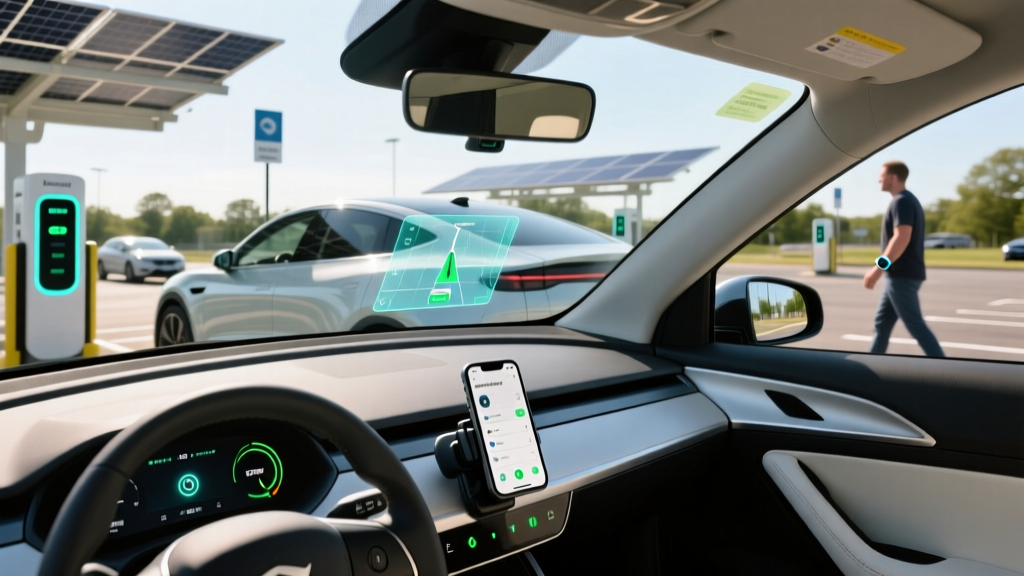
The 2026 GV70's ADAS suite is branded as Genesis Active Safety Control, with the flagship feature being Highway Driving Assist II (HDA II). HDA II combines adaptive cruise control with stop-and-go capability, lane-centering steering assist, and GPS-linked speed adjustment into a single integrated system. When activated on compatible highways, HDA II maintains your set following distance from the vehicle ahead, keeps the GV70 centered in its lane, and can automatically reduce speed for upcoming curves or toll plazas based on navigation data.
Beyond HDA II, the full Genesis Active Safety Control suite on the 2026 GV70 includes:
- Forward Collision-Avoidance Assist (FCA) with pedestrian, cyclist, and junction-turning detection
- Blind-Spot Collision-Avoidance Assist (BCA) with active steering intervention
- Rear Cross-Traffic Collision-Avoidance Assist (RCCA)
- Lane Keeping Assist (LKA) and Lane Following Assist (LFA)
- Navigation-Based Smart Cruise Control (NSCC) with curve and toll-gate deceleration
- Intelligent Speed Limit Assist (ISLA) using camera-recognized and GPS-mapped speed limits
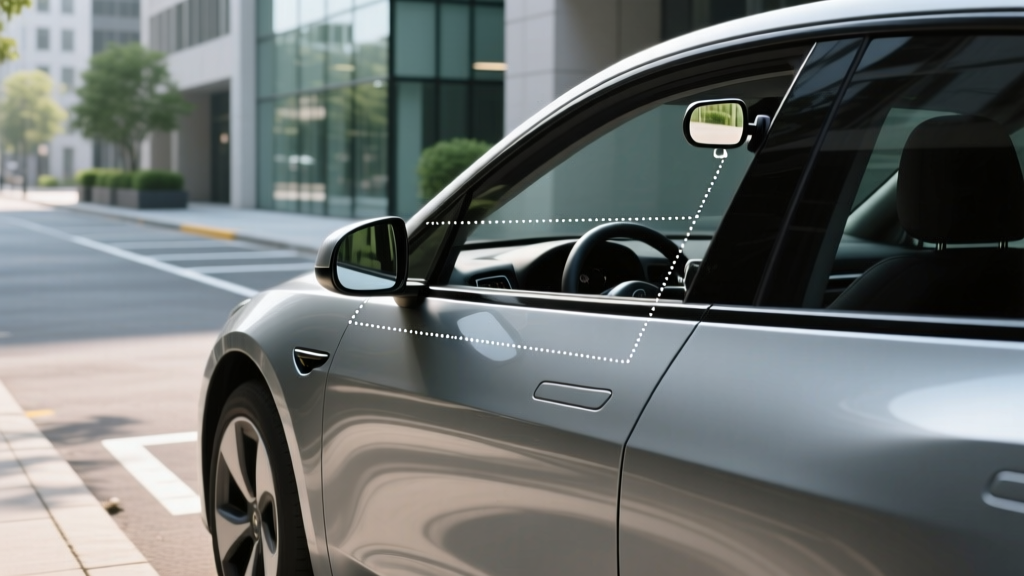
- Safe Exit Assist preventing door opening into approaching traffic
- Remote Smart Parking Assist (RSPA) for automated tight-space parking maneuvers
- Surround View Monitor with 3D perspective and blind-spot camera overlay
- Driver Attention Warning (DAW) monitoring steering input patterns and time driven
| Feature | Function | Activation | Operational Speed |
|---|---|---|---|
| HDA II (Highway Driving Assist) | Adaptive cruise + lane centering + GPS-linked speed | Steering wheel button | 0–124 mph (where legal) |
| FCA (Forward Collision-Avoidance) | AEB with pedestrian/cyclist/junction detection | Always active | 5–124 mph |
| BCA (Blind-Spot Collision-Avoidance) | Active steering correction during lane change | Always active | 19–124 mph |
| LFA (Lane Following Assist) | Lane centering without cruise control | Button on steering wheel | 0–124 mph |
| NSCC (Navigation-Based Smart Cruise) | Auto-deceleration for curves and tolls | With cruise active + nav route set | Any cruise speed |
| RSPA (Remote Smart Parking) | Automated in/out parking from outside vehicle | Smart key button hold | Under 2 mph |
| ISLA (Intelligent Speed Limit Assist) | Displays and optionally adapts to posted limits | Always monitoring | All speeds |
Under the Hood: Sensor Hardware and Technical Architecture
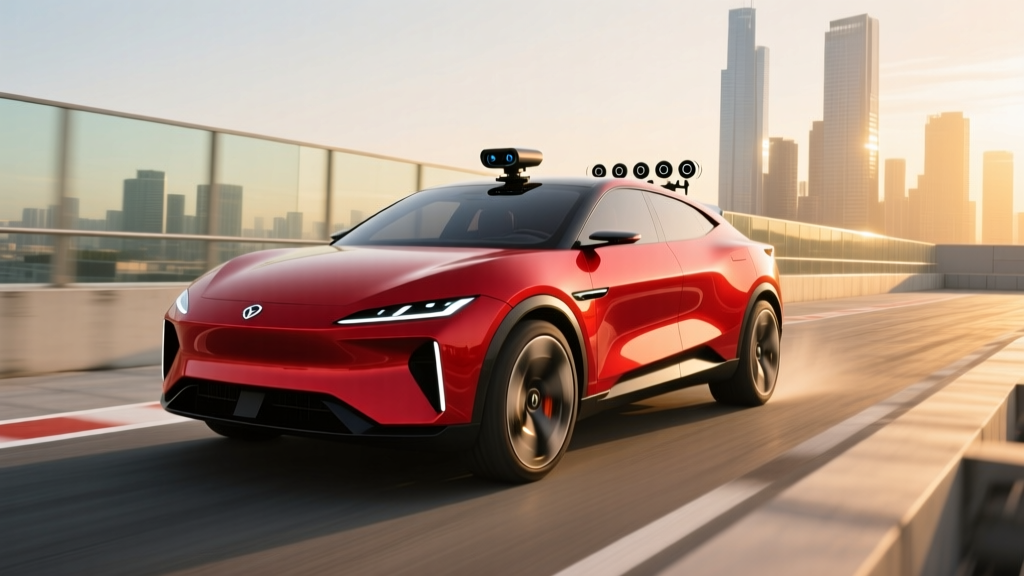
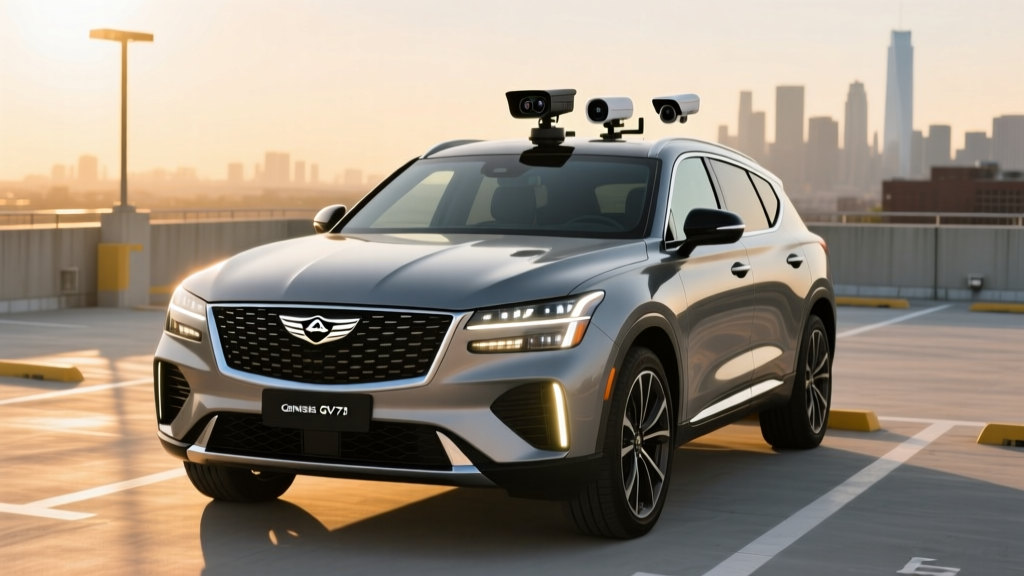
The 2026 GV70 relies on a multi-sensor fusion approach — the same architecture used by most Tier 1 automakers. Genesis does not publish a detailed sensor manifest for each model year, but based on the Hyundai Motor Group's fourth-generation ADAS platform (shared with the Genesis GV60, GV80, and Hyundai Ioniq 5/6), the GV70's hardware stack includes:
- 1 forward-facing radar (long-range, mounted behind the front grille) for adaptive cruise and forward collision detection at distances up to ~200 meters
- 1 forward-facing camera (mounted behind the windshield near the rearview mirror) for lane-line detection, traffic-sign recognition, and pedestrian/cyclist classification
- 4 corner radars (short/mid-range, mounted behind each bumper corner) for blind-spot monitoring, rear cross-traffic, and lane-change assist
- 4 surround-view cameras (front, rear, and under each side mirror) for the 360° monitor and parking assist
- 12 ultrasonic sensors (6 front, 6 rear) for low-speed obstacle detection during parking
This sensor suite feeds into a central ADAS domain controller that processes radar returns, camera image classification, and GPS/map data in real time. The system uses sensor fusion — cross-referencing radar distance data with camera object classification — to reduce false positives (such as phantom braking for overhead signs) and improve detection reliability in conditions where one sensor type may struggle.
Notably, the 2026 GV70 does not include lidar, which distinguishes it from vehicles like the Volvo EX90 or certain Mercedes-Benz S-Class configurations that use lidar for higher-fidelity 3D mapping. Genesis's camera-and-radar approach is cost-effective and proven, but it carries inherent limitations in low-visibility conditions that we address below.
SAE Automation Level: Level 2, Not Self-Driving
The 2026 Genesis GV70's HDA II and all Genesis Active Safety Control features operate at SAE Level 2. This means the system can simultaneously control steering and acceleration/braking under specific conditions, but the driver must remain fully engaged — hands on or near the wheel, eyes on the road, and ready to take over at any moment. The system does not make the GV70 autonomous. You are the driver, legally and operationally, at all times.
The SAE J3016 standard defines six levels of driving automation (0–5). Level 2 systems like HDA II, Tesla Autopilot, BMW Driving Assistant Professional, and Ford BlueCruise all share the same fundamental requirement: continuous driver supervision. The GV70 enforces this through a torque-sensing steering wheel that detects whether you're applying light steering input. If the system detects no hands-on-wheel input for a sustained period, it issues escalating visual, audible, and haptic warnings before eventually disengaging and bringing the vehicle to a controlled stop with hazard lights activated.
This is fundamentally different from SAE Level 4 systems like Waymo's driverless robotaxi service, which operate without any human driver in specific geofenced areas. No consumer vehicle sold in 2026 — including those marketed with "Full Self-Driving" branding — achieves Level 3 or above for general use. Mercedes-Benz has received limited Level 3 approval (Drive Pilot) in Nevada and California, but only at speeds below 40 mph in heavy traffic on specific highways, and only on the S-Class and EQS sedan. The GV70 does not offer Level 3 capability.
Trim Availability and Cost: What's Standard vs. Optional
One of Genesis's strongest value propositions is that the full Genesis Active Safety Control suite — including HDA II — comes standard on every 2026 GV70 trim. There is no subscription fee, no premium package required, and no feature locked behind a monthly payment. This stands in sharp contrast to competitors like BMW (which charges ~$1,700 for the Driving Assistant Professional package on the X3) or Tesla (which sells FSD as a $8,000 one-time purchase or $99/month subscription).
| Trim | Powertrain | MSRP (approx.) | HDA II | Full Active Safety Control | Subscription Required |
|---|---|---|---|---|---|
| 2.5T Standard | 2.5L Turbo I4, 300 hp | $47,550 | Standard | Standard | No |
| 2.5T Advanced | 2.5L Turbo I4, 300 hp | $52,150 | Standard | Standard | No |
| 2.5T Prestige | 2.5L Turbo I4, 300 hp | $57,050 | Standard | Standard | No |
| 3.5T Sport | 3.5L Twin-Turbo V6, 375 hp | $57,350 | Standard | Standard | No |
| 3.5T Sport Prestige | 3.5L Twin-Turbo V6, 375 hp | $63,550 | Standard | Standard | No |
| Electrified GV70 | Dual-motor BEV, 429 hp | $68,450 | Standard | Standard | No |
Genesis also includes Remote Smart Parking Assist (RSPA) on Prestige-level trims and above, allowing you to move the GV70 in and out of tight parking spaces using the smart key fob while standing outside the vehicle. This feature is particularly useful in narrow garage situations and is a genuine differentiator at this price point.
For buyers considering the Electrified GV70 (the all-electric variant with dual motors, 429 hp, and an EPA-estimated 236 miles of range from its 77.4 kWh battery), the ADAS suite is identical to the gas models. The Electrified GV70 also qualifies for evaluation under the IRS §30D federal tax credit, though eligibility depends on current-year MSRP caps, buyer income limits, and battery-component/critical-mineral sourcing requirements — consult a tax professional before relying on credit estimates.
Real-World Capabilities and Limitations
HDA II is designed for divided highways with clear lane markings. It is not designed for, and may perform unpredictably in: city streets with cross traffic, construction zones with shifted or temporary lane markings, unpaved roads, heavy rain/snow/fog, or roads with faded/missing lane lines. The driver must be prepared to take immediate control in all of these scenarios.
In real-world highway driving, HDA II performs competently for its class. Lane centering is steady on well-marked interstates, and the adaptive cruise component handles cut-in traffic smoothly — the GV70's long-range radar detects merging vehicles early and modulates braking progressively rather than abruptly. The GPS-linked curve deceleration (NSCC) is a genuinely useful feature: when your navigation route is active, the system will ease off speed before an upcoming highway curve or toll plaza, then resume your set speed afterward. This reduces the "surprise braking" effect that older ACC systems exhibited when encountering curves at full speed.
However, several real-world limitations are worth understanding before you rely on the system:
- Faded or missing lane markings: The forward camera relies on visible painted lines. On older state highways or rural roads with worn markings, lane-centering assist may disengage without much warning. The system will alert you, but the transition can feel abrupt if you've relaxed your attention.
- Construction zones: Temporary lane shifts, orange barrels, and contradictory lane markings (old lines still visible alongside new temporary lines) can confuse the camera. HDA II does not have the contextual understanding to resolve these conflicts — you must take over.
- Heavy precipitation: Rain, snow, and fog degrade both camera visibility and radar performance. In moderate-to-heavy rain, expect more frequent disengagement requests. The system may also reduce its maximum steering torque in slippery conditions.
- Hands-off detection sensitivity: The torque-sensing steering wheel requires periodic light input. On long, straight highway stretches where the system is doing most of the steering, you may receive "hands on wheel" alerts even if your hands are resting lightly on the rim. This is less intrusive than some competitors (GM's Super Cruise uses a camera-based eye-tracking system that allows true hands-free operation on mapped highways), but it also means you cannot legally or safely remove your hands entirely.
- Lane-change assist: HDA II can assist with lane changes when you activate the turn signal — the system will check blind-spot sensors and execute the lane change if clear. However, it will not initiate lane changes on its own (unlike Tesla's FSD Supervised, which attempts automatic lane changes). You remain the decision-maker for every lane change.
- Stop-and-go traffic: HDA II handles highway congestion well, including full stops and automatic resume within a few seconds. If the vehicle ahead stops for longer than ~3 seconds, you'll need to tap the accelerator or press the resume button to re-engage — a common ACC behavior across the industry.
How Genesis HDA II Compares to Competing ADAS Systems
| System | Vehicle | SAE Level | Hands-Free? | Lane-Change Assist | Cost |
|---|---|---|---|---|---|
| Genesis HDA II | GV70 | Level 2 | No (torque sensing) | Signal-initiated | Standard (included) |
| BMW Driving Assistant Professional | X3 | Level 2 | No (capacitive sensing) | Signal-initiated | ~$1,700 option package |
| Mercedes-Benz Active Distance Assist DISTRONIC + Active Steering Assist | GLC | Level 2 | No (torque sensing) | Signal-initiated | ~$1,950 in Driver Assistance Package |
| Audi Adaptive Cruise + Lane Guidance | Q5 | Level 2 | No (capacitive sensing) | Signal-initiated | ~$2,000 in Convenience Package |
| Ford BlueCruise (1.4) | Mustang Mach-E | Level 2 | Yes (on mapped highways, eye monitoring) | Lane-change assist | $2,100 one-time or $75/month |
| GM Super Cruise | Cadillac Lyriq | Level 2 | Yes (on mapped highways, eye tracking) | Auto lane-change | $2,500 one-time, 3 years included |
| Tesla Autopilot / FSD Supervised | Model Y | Level 2 | No (torque sensing) | Auto lane-change (FSD) | Autopilot: standard / FSD: $8,000 or $99/mo |
The Genesis HDA II system occupies a strong value position: it delivers functionality comparable to the German competitors' paid packages, but includes it standard. Where it falls short is in hands-free capability. Ford BlueCruise and GM Super Cruise both allow true hands-free driving on pre-mapped divided highways (over 400,000 and 750,000 miles of compatible roads, respectively), using driver-monitoring cameras to ensure your eyes remain on the road. Genesis does not currently offer a hands-free system, and has not announced one for the GV70.
If hands-free highway driving is a priority, Super Cruise and BlueCruise offer a meaningfully different experience — you can relax your arms entirely on compatible roads while the car handles steering, throttle, and braking. The trade-off is cost (both require a significant premium over the vehicle's base price) and geographic limitation (hands-free only works on pre-mapped highways; hands-on is required everywhere else).
Compared to Tesla's Autopilot (standard on the Model Y), Genesis HDA II offers comparable adaptive cruise and lane-centering quality but lacks Tesla's more aggressive automatic lane-change and navigation-on-autopilot features. Tesla's FSD Supervised adds traffic-light and stop-sign recognition, automatic city-street turns, and more proactive lane management — but at $8,000 or $99/month, and it remains a Level 2 system requiring full driver attention despite its ambitious branding.
Safety Context: What the Data Shows
The 2026 Genesis GV70 has earned strong safety ratings from both the NHTSA and the IIHS, with the latter historically naming the GV70 a Top Safety Pick+ when equipped with specific headlight configurations. The Active Safety Control suite's forward collision-avoidance system has consistently performed well in IIHS's vehicle-to-vehicle and vehicle-to-pedestrian tests.
However, it's important to contextualize what ADAS features do and do not contribute to safety:
- What they do: Reduce rear-end collisions (adaptive cruise maintains following distance), mitigate lane-departure crashes (lane-keeping assist), and protect vulnerable road users (FCA pedestrian/cyclist detection). NHTSA data has consistently shown that automatic emergency braking reduces rear-end crashes by approximately 50%.
- What they do not do: Eliminate the need for driver attention, handle all weather and road conditions, or prevent every type of collision. Over-reliance on ADAS — treating Level 2 as "self-driving" — has been a contributing factor in numerous NHTSA-investigated incidents across all brands. The system is a safety net, not a replacement driver.
Genesis's Driver Attention Warning (DAW) adds a layer of monitoring by tracking steering-input patterns, time since last break, and other behavioral indicators. If the system detects signs of fatigue or inattention, it displays a "Take a Break" alert with a coffee-cup icon and audible chime. This is a useful supplement to the hands-on-wheel requirement, but it is not a substitute for the driver's own judgment about fatigue.
Frequently Asked Questions
Is the Genesis GV70 HDA II system self-driving?
No. HDA II is an SAE Level 2 driver-assistance system. It can simultaneously control steering and speed on compatible highways, but the driver must remain fully engaged — hands on or near the wheel, eyes on the road, ready to take over instantly. No consumer GV70 feature qualifies as autonomous or self-driving. Only SAE Level 4 services like Waymo operate without a human driver, and those are limited to specific geofenced urban areas.
Do I need to pay a subscription for Genesis GV70 driver-assist features?
No. Unlike Tesla's FSD ($99/month or $8,000 one-time), Ford BlueCruise ($75/month after trial), or GM Super Cruise (subscription after the included trial period), Genesis includes the complete Active Safety Control suite — including HDA II — standard on every 2026 GV70 trim at no additional cost and with no ongoing subscription. The only Genesis connected service that may require a subscription after a trial period is Genesis Connected Services (remote start, navigation updates, stolen-vehicle tracking), which is separate from the ADAS hardware.
Can HDA II change lanes automatically?
HDA II will not initiate lane changes on its own. However, when you activate the turn signal, the system checks the blind-spot radar sensors and, if the adjacent lane is clear, will assist with the steering input to complete the lane change. You must initiate every lane change with the turn signal — the system does not make lane-change decisions autonomously.
Does HDA II work in rain and snow?
HDA II can operate in light rain and overcast conditions, but its performance degrades as precipitation increases. Heavy rain, snow, and fog reduce the forward camera's ability to detect lane markings and can attenuate radar returns. In these conditions, expect more frequent disengagement alerts and be prepared to take full manual control. Genesis recommends treating ADAS as a supplemental aid, not a primary driving system, in adverse weather.
Which Genesis GV70 trims include Highway Driving Assist II?
Every 2026 GV70 trim — from the base 2.5T Standard ($47,550) through the 3.5T Sport Prestige ($63,550) and the Electrified GV70 ($68,450) — includes HDA II and the full Genesis Active Safety Control suite as standard equipment. There is no trim-level gatekeeping for core ADAS features, which is a significant advantage over German competitors that typically require mid-to-high trims or expensive option packages for equivalent functionality.
How does the Electrified GV70's ADAS compare to the gas GV70?
Identically. The Electrified GV70 uses the same sensor hardware, ADAS domain controller, and software features as the turbocharged gas models. The only difference is that the Electrified GV70's regenerative braking system integrates with the adaptive cruise control — when HDA II decelerates, it can recapture energy through regen, slightly improving efficiency in stop-and-go highway traffic compared to the gas model's friction-brake-only deceleration.