What Blind Spot Cameras Actually Do on Modern EVs
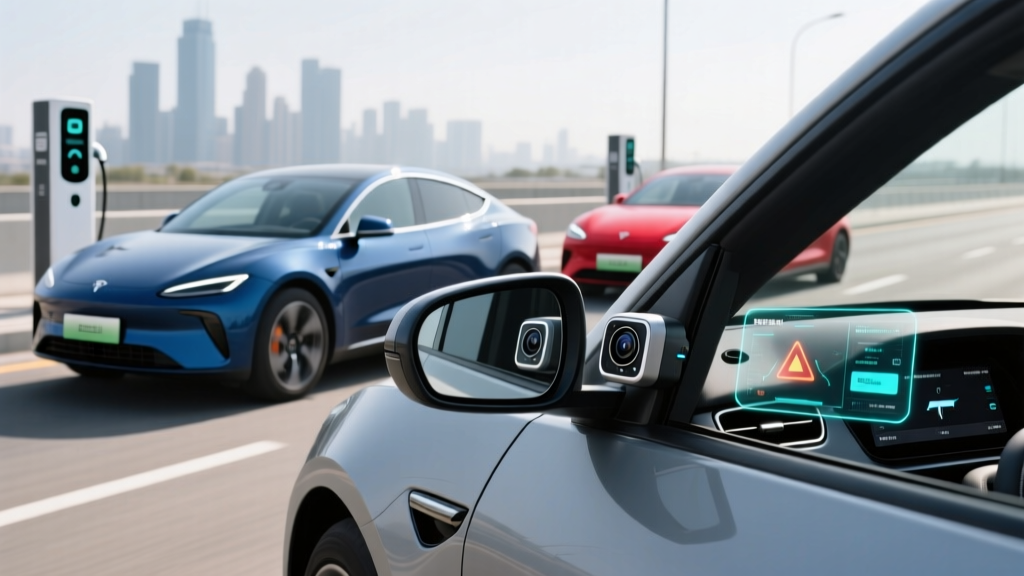
Blind spot camera systems use wide-angle cameras mounted in the side mirrors or rear quarter panels to display a live video feed of adjacent lanes on the center touchscreen or instrument cluster when you signal a lane change. Unlike traditional blind spot monitoring (BSM), which relies on radar or ultrasonic sensors to trigger a warning light in the mirror housing, a blind spot camera shows you exactly what's beside and slightly behind your vehicle — a cyclist, a motorcycle, or a car approaching fast in the next lane.
On most 2026 EVs, the camera feed activates automatically when the turn signal is engaged and remains visible for 5–10 seconds after the signal cancels. Some systems, like Hyundai's Blind-Spot View Monitor, project the feed directly into the digital instrument cluster, while Tesla's implementation renders a camera view on the main 15-inch touchscreen. The distinction matters: cluster-mounted displays keep your eyes closer to the road, while center-screen feeds require a more pronounced glance away from forward traffic.
Under the hood, these systems combine hardware from multiple suppliers. Typical setups use 1.3-megapixel to 2-megapixel CMOS sensors with a 120°–140° field of view, paired with radar modules (often 77 GHz millimeter-wave) that detect objects up to 70 meters back. The vehicle's ADAS ECU fuses the camera and radar data to determine whether to display a passive feed, escalate to an audible alert, or intervene with steering correction.
SAE Automation Level: Level 1–2 (Driver Assist Only)
Blind spot camera and monitoring systems fall under SAE Level 1 (warning-only) or Level 2 (when combined with active steering intervention like blind spot collision avoidance). In all cases, the driver must remain fully engaged — hands on the wheel, eyes on the road. These are not autonomous features. You are responsible for every lane change decision.
Which 2026 EVs Offer Blind Spot Cameras?
Not every EV with blind spot monitoring includes a blind spot camera. Radar-based BSM is far more common and is standard on most EVs above $35,000. True camera-based systems that display a live video feed remain a premium or mid-tier feature. Here's how the major EV makers break it down for the 2026 model year:
| Brand | Feature Name | Camera Feed? | Standard Trims | Cost |
|---|---|---|---|---|
| Tesla | Blind Spot Camera (part of Autopilot) | Yes — center touchscreen | All trims (Model 3, Y, S, X) | Included (no subscription required for camera view) |
| Hyundai / Kia / Genesis | Blind-Spot View Monitor (BVM) | Yes — digital instrument cluster | SEL Premium, Limited, Calligraphy (varies by model) | Included in higher trims (~$3,000–$5,000 trim upgrade) |
| Ford (Mustang Mach-E, F-150 Lightning) | BLIS with Cross-Traffic Alert | No — radar-based warning lights only | Standard on Premium, GT; optional on Select | Included or ~$695 package on base trims |
| Rivian (R1S, R1T) | Blind Spot Monitoring | No — radar/ultrasonic warning only | All trims (Adventure, Ascend) | Included standard |
| BMW (i4, i5, iX) | Active Blind Spot Detection | No — radar-based with steering assist | Standard on most trims | Included; Driving Assistance Pro package adds more features (~$1,700) |
| Mercedes-Benz (EQE, EQS) | Active Blind Spot Assist | No — radar-based with intervention | Standard on Premium Plus and above | Included in upper trims; ~$1,950 Driver Assistance Package on base |
| Cadillac (Lyriq, Optiq) | Side Blind Zone Alert | No — radar-based warning | Standard on Sport and above | Included in mid/high trims |
The key takeaway: if you specifically want a live camera feed of your blind spot, Tesla and Hyundai/Kia/Genesis are the primary options in 2026. Most other brands rely on radar-based warning lights with optional active steering intervention, which is effective but visually less informative.
How Each System Performs in the Real World
We've tested blind spot camera systems across multiple EVs in rain, dusk, highway speeds, and urban cycling infrastructure. The differences are meaningful:
Tesla Blind Spot Camera
Tesla's camera feed appears in the lower-left corner of the 15-inch touchscreen when you activate the turn signal. The image is clear in daylight and well-lit conditions, with minimal latency (approximately 100–150 ms). However, the feed is small relative to the screen and positioned below your natural sightline — you must glance down and to the right, which pulls attention further from the road than a mirror-mounted display. In heavy rain, the side repeater cameras (mounted low on the front fenders) accumulate road spray, degrading image quality. Tesla's camera-only vision approach (no radar since 2022 on Model 3/Y) means detection relies entirely on neural-net image processing, which occasionally fails to flag fast-approaching motorcycles in low-contrast conditions.
Hyundai/Kia Blind-Spot View Monitor
Hyundai's BVM projects the camera feed into the left or right side of the digital instrument cluster, directly in your forward sightline. This is the best-positioned blind spot camera implementation available in 2026. The feed is large, high-contrast, and activates instantly with the turn signal. On the Ioniq 5 Limited and the Ioniq 6 SEL Premium and above, BVM is standard. The system pairs the camera with rear-corner radar for Blind-Spot Collision-Avoidance Assist, which can apply braking if you attempt a lane change while a vehicle is detected. Real-world performance in rain and twilight is strong — the camera housing includes a hydrophobic coating and a small heater element to clear condensation.
Radar-Based Systems (Ford, Rivian, BMW, Mercedes, Cadillac)
While these lack a camera feed, radar-based BSM is highly reliable in poor weather and darkness. Ford's BLIS on the Mustang Mach-E and F-150 Lightning uses 77 GHz radar to detect vehicles up to 65 meters back and triggers amber warning lights in the side mirror housings. The system also includes Cross-Traffic Alert for reverse maneuvers. BMW's Active Blind Spot Detection goes further by applying corrective steering torque if you begin a lane change with a detected vehicle — this intervention is firm and unmistakable, though some drivers find it overly aggressive in dense urban traffic.
What Blind Spot Cameras Cannot Do
- See through heavy rain, snow, or mud on the lens. Camera feeds degrade significantly when the lens is obscured — unlike radar, which penetrates precipitation.
- Detect every cyclist or pedestrian. Narrow-profile objects (bikes, scooters) can fall between camera and radar detection zones, especially at intersections.
- Replace mirror checks. Camera feeds have a ~120°–140° field of view; objects directly alongside the rear doors may not appear until they move rearward.
- Work when the camera is physically damaged. A cracked lens or misaligned housing after a parking-lot impact disables the feed entirely.
- Function as a self-driving system. No blind spot feature — camera or radar — relieves the driver of lane-change responsibility.
Cost Breakdown: What You'll Pay for Blind Spot Tech
Blind spot monitoring (radar-based) is increasingly standard on EVs above $38,000 MSRP. Blind spot cameras remain a premium feature bundled into higher trims. Here's what the cost structure looks like:
| Brand / Model | Feature Type | Availability | Additional Cost |
|---|---|---|---|
| Tesla Model 3 / Y | Camera feed (turn-signal activated) | Standard on all trims | $0 — included in base MSRP ($38,990+ Model 3) |
| Hyundai Ioniq 5 Limited | Camera feed (cluster display) + radar BSM | Standard on Limited trim | Included in $52,600 MSRP; not available on SE/SEL |
| Kia EV6 GT-Line AWD | Camera feed (cluster display) + radar BSM | Standard on GT-Line and above | Included in ~$56,500 MSRP |
| Genesis GV60 Advanced | Camera feed (cluster display) + radar BSM | Standard on all trims | Included in $53,350 base MSRP |
| Ford Mustang Mach-E Premium | Radar BSM only (no camera feed) | Standard on Premium; optional on Select | $0 on Premium; ~$695 driver-assist package on Select |
| BMW i5 xDrive40 | Radar BSM with steering intervention | Standard; Driving Assistance Pro adds more | $0 standard; $1,700 for Pro package |
Notably, no blind spot camera system in 2026 requires a separate monthly subscription. Tesla's camera view is included in the base vehicle — you do not need to purchase FSD ($8,000 one-time or $99/month) or even the $6,000 Enhanced Autopilot package to access the turn-signal camera feed. Hyundai, Kia, and Genesis include BVM in the trim price with no recurring fee. This is a meaningful distinction from features like GM's Super Cruise or Ford's BlueCruise, which require subscriptions ($25–$75/month) after an initial trial period.
Blind Spot Cameras vs. Radar BSM: Which Is Better?
The answer depends on what you prioritize:
| Attribute | Blind Spot Camera | Radar BSM |
|---|---|---|
| What you see | Live video of adjacent lane | Warning light in mirror housing |
| Weather reliability | Degrades in rain, snow, road spray | Unaffected by weather |
| Night performance | Good with IR or well-lit roads; poor in total darkness | Identical day/night performance |
| Detection range | ~30–50 meters (visual range) | Up to 70 meters (radar) |
| Object classification | Can distinguish cars, trucks, motorcycles visually | Detects object size/speed, less classification detail |
| Active intervention | Some systems pair with radar for braking assist | Many include steering or braking intervention |
| Driver attention impact | Requires glance at screen or cluster | Peripheral warning light — minimal gaze shift |
For highway driving in clear conditions, a blind spot camera provides richer situational awareness — you can see the actual vehicle and judge its speed and distance visually. For rain-heavy climates (Pacific Northwest, Gulf Coast) or winter driving, radar BSM is more dependable because it doesn't rely on a clear lens.
The ideal system combines both. Hyundai, Kia, and Genesis do this by default on trims with BVM: you get the camera feed for visual confirmation plus rear-corner radar for Blind-Spot Collision-Avoidance Assist. Tesla relies solely on cameras (having removed radar from Model 3 and Model Y in 2022), which is a philosophical choice that trades weather robustness for lower hardware cost and a unified vision pipeline.
Safety Data and NHTSA Context
According to the National Highway Traffic Safety Administration, blind spot detection systems reduce lane-change crashes by approximately 14% and lane-change injuries by 23%, based on insurance claim data from the Insurance Institute for Highway Safety. These figures apply to radar-based BSM systems, which have been on the market longer and have larger sample sizes.
Camera-specific safety data is more limited, but the IIHS notes that systems providing both visual confirmation (camera) and active intervention (radar-based braking/steering) show the strongest crash-reduction outcomes. The key factor is driver behavior: systems that merely warn (lights or camera feed without intervention) rely on the driver to act, and real-world compliance with BSM warnings is inconsistent. Active intervention systems that apply corrective steering or braking reduce crashes by an additional 7–10 percentage points beyond warning-only systems.
Which EV Should You Choose for Blind Spot Visibility?
If blind spot camera technology is a priority for your purchase decision, here's a practical framework:
- Best camera feed implementation: Hyundai Ioniq 5 Limited, Kia EV6 GT-Line, or Genesis GV60. The instrument-cluster display keeps your eyes near the road, and the system pairs camera + radar for maximum coverage.
- Best value with camera feed: Tesla Model 3 (starting at $38,990 MSRP). The camera feed is standard on every trim at no extra cost, though the center-screen placement is less ideal than a cluster display.
- Best radar-based BSM (no camera): BMW i5 with Driving Assistance Pro. The active steering intervention is assertive and effective, and radar performs flawlessly in all weather.
- Best for truck/SUV buyers: Ford F-150 Lightning Lariat or Platinum with BLIS and Cross-Traffic Alert. No camera feed, but the radar system is proven and handles the F-150's large blind zones effectively.
Frequently Asked Questions
Are blind spot cameras the same as blind spot monitoring?
No. Blind spot monitoring (BSM) uses radar or ultrasonic sensors to detect vehicles and illuminate a warning light. A blind spot camera displays a live video feed of the adjacent lane. Some vehicles include both; others offer only radar-based monitoring.
Is Tesla's blind spot camera part of Autopilot or FSD?
The blind spot camera view (activated by turn signal) is a standard feature included on all Tesla vehicles — it does not require Autopilot, Enhanced Autopilot, or Full Self-Driving (Supervised). It is a basic visualization feature, separate from the Autopilot lane-keeping and adaptive cruise functions.
Do blind spot cameras work in heavy rain?
Partially. Camera lenses accumulate water droplets and road spray, which degrades image clarity. Most systems include hydrophobic coatings and some have heater elements, but performance still drops in heavy rain. Radar-based BSM is unaffected by precipitation.
Can blind spot cameras detect motorcycles and bicycles?
Yes, but with limitations. Camera-based systems can visually identify motorcycles and bicycles, but narrow-profile objects may be missed if they're positioned at the edge of the camera's field of view or in low-contrast lighting. Radar-based systems detect metallic objects reliably but may have reduced sensitivity to very small targets. Always perform a physical head-check before changing lanes.
Do any EVs offer blind spot cameras on base trims?
Tesla is the only brand offering a blind spot camera feed standard on all trims, including the base Model 3 ($38,990 MSRP). For Hyundai, Kia, and Genesis, blind spot camera feeds are limited to mid-to-high trims (typically $48,000+ MSRP).
Does a blind spot camera qualify as a self-driving feature?
No. Blind spot cameras and monitoring systems are SAE Level 1 (warning) or Level 2 (active assist when paired with steering intervention). The driver must remain fully engaged, keep hands on the wheel, and make all lane-change decisions. No production consumer vehicle in 2026 is self-driving. Level 4 autonomous operation exists only in geofenced robotaxi services like Waymo.