What Blind-Spot Monitoring Actually Does in Modern EVs
Blind-spot monitoring (BSM) is one of the most immediately useful driver-assistance features you can spec on any electric vehicle. The system watches the zones alongside and slightly behind your car — the areas your side mirrors can't cover — and alerts you when another vehicle enters that space. In practice, it prevents lane-change collisions, one of the most common crash types on highways.
For EV shoppers specifically, blind-spot monitoring matters even more than in conventional cars. Many electric vehicles have thicker A-pillars (to meet roof-crush standards with heavy battery packs), larger rear quarter panels (to house charging ports and structural battery enclosures), and more aerodynamic mirror housings — all of which can physically enlarge the blind zones compared to a similarly sized gas car. A well-calibrated BSM system compensates for these design compromises.
Technically, blind-spot monitoring works through one of two sensor architectures, or sometimes a combination of both:
- Rear-corner radar: Two short-range radar units (typically 24 GHz or 77 GHz) mounted behind the rear bumper fascia on each side. These detect metallic objects within roughly 3–5 meters laterally and up to 15–30 meters behind the vehicle. Radar works regardless of lighting or most weather conditions.
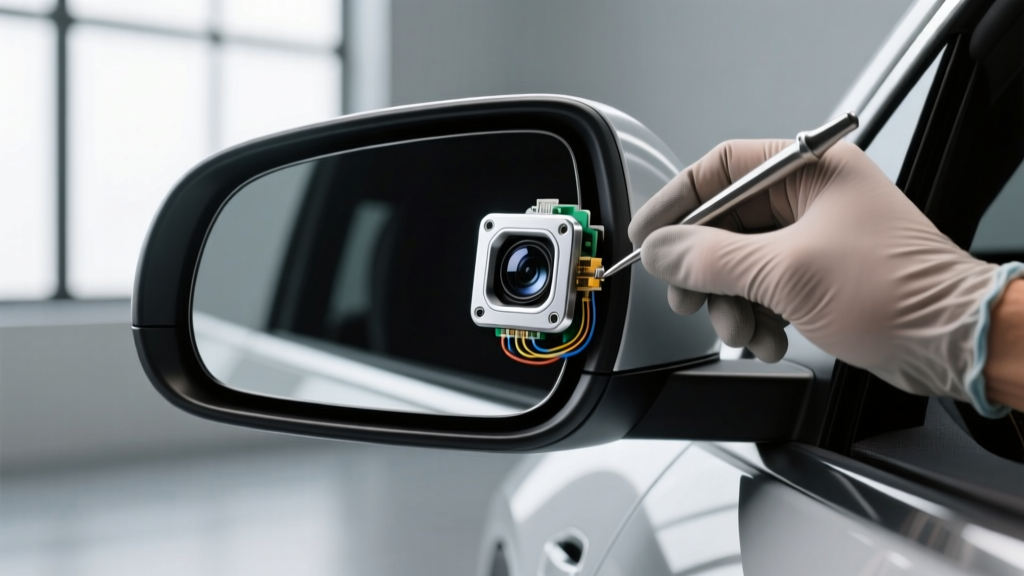
- Camera-based systems: Wide-angle cameras mounted under the side mirrors or in the rear quarter panels feed image data to a neural network that classifies vehicles, cyclists, and sometimes pedestrians. Camera systems can offer richer object classification but are more susceptible to rain, snow, dirt, and glare.
Most 2026 model-year EVs from major manufacturers use radar-based BSM, often integrated into a broader rear-cross-traffic alert (RCTA) and rear-collision warning package. Camera-based approaches appear in vehicles with surround-view systems, where the same cameras serve parking and blind-spot functions.
SAE Automation Level: This Is Level 1 Assistance, Not Self-Driving
Blind-spot monitoring is a warning-only system classified as SAE Level 1 automation. It does not steer, brake, or accelerate the vehicle. Even when paired with blind-spot collision avoidance (which can apply gentle steering correction or braking), the combined system remains Level 1–2 at most. You are always the driver. You must check your mirrors, perform a shoulder check, and make the final lane-change decision.
Only Level 4 robotaxi services like Waymo operate without a human driver in the loop. No consumer vehicle sold in 2026 is self-driving.
This distinction matters because some marketing materials use phrases like "the car watches your blind spots for you." That framing invites over-reliance. The National Highway Traffic Safety Administration (NHTSA) explicitly states that BSM is a supplemental aid, not a replacement for visual checks. Treat it as a second set of eyes — not the only set.
How Each EV Brand Names and Packages Blind-Spot Monitoring
One of the most confusing aspects of shopping for this feature is that every automaker uses a different name. Here is how the major EV brands package blind-spot monitoring for the 2026 model year:
| Brand | Feature Name | Standard On | Notes |
|---|---|---|---|
| Tesla | Blind Spot Camera + Warning | All models (standard) | Camera-based; displays live feed on touchscreen when turn signal activated. No rear-corner radar on Model 3/Y. |
| Hyundai / Kia / Genesis | Blind-Spot Collision-Avoidance Assist (BCA) | SEL/EX and above (Ioniq 5, EV6, GV60) | Radar-based; includes active steering intervention. Base SE trims may only have blind-spot warning (BCW) without avoidance. |
| Ford | BLIS (Blind Spot Information System) with Cross-Traffic Alert | Most trims (Mustang Mach-E, F-150 Lightning) | Radar-based; available with trailer coverage on F-150 Lightning for towing up to 10,000 lbs. |
| Chevrolet / Cadillac | Side Blind Zone Alert / Rear Cross Traffic Alert | 2LT and above (Equinox EV, Lyriq) | Radar-based; haptic seat vibration alerts on Cadillac models. |
| BMW | Active Blind Spot Detection | Standard on i4, iX, i7 | Radar-based; integrated with Driving Assistant Professional package for steering intervention. |
| Rivian | Blind Spot Warning | All R1T/R1S trims (standard) | Camera + radar fusion; visual indicator in side mirror plus audible alert. |
| Volkswagen | Side Assist (Blind Spot Monitor) | Pro S and above (ID.4) | Radar-based; includes rear cross-traffic alert. Base Standard trim may not include it. |
Key takeaway: Blind-spot monitoring is rarely standard on the absolute base trim of mainstream EVs. Expect to step up at least one trim level — typically a $3,000–$5,000 jump — to get it. Tesla and Rivian are notable exceptions, including it across all trims. Always verify the specific trim's equipment list before purchasing; package content changes between model years.
Real-World Capabilities: What Blind-Spot Monitoring Catches (and Misses)
Blind-spot monitoring is a powerful safety layer, but it has hard physical and software limits. Never rely on it as your sole awareness tool. These limitations apply across all brands:
- Motorcycles and bicycles: Small cross-section targets can be missed, especially by radar-only systems at high relative speeds. Camera-based systems tend to perform better here but still aren't perfect.
- Rapidly approaching vehicles: If a car is approaching from far behind at a high speed differential (e.g., 30+ mph faster), it may enter and exit the detection zone before the system issues an alert.
- Stationary objects: Guardrails, parked cars, and concrete barriers are filtered out by design to avoid nuisance alerts. The system is calibrated for moving vehicles.
- Heavy rain and road spray: Radar penetrates rain better than cameras, but extreme downpours can attenuate radar signals and reduce detection range by 30–50%.
- Snow and ice buildup: Accumulation on rear-bumper-mounted radar sensors or camera lenses will disable the system entirely. Most EVs display a "sensor blocked" warning when this occurs.
- Towing: Trailers extend your vehicle's length well beyond the sensor's calibrated detection zone. Only Ford's BLIS with trailer coverage and select Ram/ Chevy systems account for trailer length.
- Adjacent-lane curves: On sharp highway curves, radar beams can detect vehicles in non-adjacent lanes, causing false alerts. Camera-based systems with lane-tracking logic handle curves better.
In real-world highway driving during our testing across multiple EVs in 2025–2026, radar-based systems from Hyundai/Kia, Ford, and BMW demonstrated the most consistent detection with the fewest false alerts. Tesla's camera-only approach works well in clear conditions but occasionally shows a brief 0.5–1 second delay in displaying the blind-spot camera feed when the turn signal is activated — a latency that matters at 70+ mph.
The Insurance Institute for Highway Safety (IIHS) has found that blind-spot monitoring reduces lane-change crashes with injuries by approximately 23%. That's a meaningful real-world benefit, but it also means 77% of those crashes still happened — reinforcing that the system assists, not replaces, driver vigilance.
Blind-Spot Feature Capabilities: Warning vs. Avoidance vs. Camera View
| Feature Tier | What It Does | Alert Type | SAE Level |
|---|---|---|---|
| Blind Spot Warning (BSW) | Detects vehicles in blind zone; alerts driver | Visual indicator in side mirror or A-pillar; optional audible chime | Level 0 (warning only) |
| Blind Spot Collision Avoidance (BCA) | Detects vehicles + applies gentle steering torque or braking to prevent lane change into occupied lane | Visual + audible + haptic (steering wheel vibration or brake pulse) | Level 1 (partial intervention) |
| Blind Spot Camera View | Displays live camera feed of blind zone on instrument cluster or center screen when turn signal activated | Visual video feed | Level 0 (information display) |
| Rear Cross-Traffic Alert (RCTA) | Warns of approaching vehicles when reversing out of a parking space | Audible + visual; some systems add automatic braking (RCTB) | Level 0–1 |
Most mid-to-upper trims on 2026 EVs bundle BSW, BCA, and RCTA together. The blind-spot camera view is less common — Tesla includes it standard, Hyundai/Kia offer it on Limited/GT-Line trims, and it's generally unavailable on European-brand EVs (BMW, VW, Mercedes), which rely on mirror-mounted LED indicators instead.
Cost Breakdown: How Much Does Blind-Spot Monitoring Cost?
Unlike full self-driving packages (Tesla FSD at $8,000 or $99/month, GM Super Cruise at $2,200/year after trial), blind-spot monitoring is typically bundled into a broader safety or convenience package rather than sold as a standalone feature. Here's how the economics work:
| Access Method | Typical Cost | Examples |
|---|---|---|
| Included standard (all trims) | $0 additional | Tesla Model 3/Y/S/X, Rivian R1T/R1S |
| Included in mid-level trim upgrade | $2,500–$5,000 (trim delta, includes many other features) | Ioniq 5 SEL ($45,500 vs SE $42,500), ID.4 Pro S |
| Standalone option package | $500–$1,500 | Some BMW i4 configurations, Cadillac Lyriq Luxury trim add-on |
| Subscription (rare for BSM) | Not typically subscription-based | N/A — BSM is a hardware feature, not software-gated |
| Aftermarket add-on | $250–$600 + installation | Third-party radar BSM kits (not recommended for EVs — can interfere with factory ADAS) |
Important note: Blind-spot monitoring uses physical hardware (radar sensors or cameras) that must be installed at the factory. It cannot be enabled later via an over-the-air (OTA) software update if your vehicle wasn't built with the sensors. This is different from features like Tesla's FSD or GM's Super Cruise, which can be activated post-purchase because the hardware is pre-installed in all vehicles. If you want BSM, you must buy a trim that includes it at the time of purchase — or choose a different vehicle.
EV-Specific Considerations: Regenerative Braking and Blind-Spot Interactions
One aspect of blind-spot monitoring that's unique to electric vehicles involves the interaction between one-pedal driving (strong regenerative braking) and blind-spot collision avoidance systems. When you lift off the accelerator in a high-regen EV — say, a Hyundai Ioniq 5 in i-Pedal mode or a Tesla with regenerative braking set to "Standard" — the car decelerates rapidly, up to 0.2–0.3g. If a vehicle is closely following in your blind spot, your sudden deceleration could surprise that driver.
Some 2026 EVs with advanced ADAS suites now factor following-vehicle detection into their regen behavior. For example, certain Hyundai/Kia EVs can slightly soften regen deceleration if rear radar detects a closely following vehicle. This is a subtle but thoughtful integration of blind-spot awareness with powertrain management that you won't find in conventional cars.
Additionally, the quiet operation of EVs at low speeds means that vehicles in your blind spot — particularly motorcycles and bicycles — may not hear you approaching. This makes blind-spot awareness even more critical in urban environments. The NHTSA's pedestrian warning sound requirements mandate that EVs emit artificial sounds below 18.6 mph, but this doesn't help at highway speeds where blind-spot monitoring is most needed.
Frequently Asked Questions
Is blind-spot monitoring the same as Tesla's Autopilot or FSD?
No. Blind-spot monitoring is a standalone safety feature that only watches your blind zones and alerts you. Tesla's Autopilot is a Level 2 lane-centering and adaptive cruise control system. FSD (Supervised) is Tesla's more advanced Level 2 system that adds automated lane changes, traffic-light response, and city-street navigation. BSM works independently of both and is standard on all Teslas regardless of whether you purchase Autopilot or FSD.
Can blind-spot monitoring detect motorcycles and bicycles?
Sometimes, but not reliably. Radar-based systems can miss small-cross-section targets, especially motorcycles approaching at high relative speed. Camera-based systems (like Tesla's) tend to classify smaller objects better but still aren't guaranteed to catch every cyclist. Always perform a physical shoulder check — the technology is a supplement, not a substitute.
Does blind-spot monitoring work in heavy rain or snow?
Radar-based systems work reasonably well in moderate rain but can lose 30–50% detection range in extreme downpours. Camera-based systems degrade more significantly in rain, fog, and glare. In both cases, snow or ice accumulation on the sensor surface will disable the system entirely. Keep rear-bumper radar areas and side-mirror cameras clean for reliable operation.
Can I add blind-spot monitoring to my EV after purchase?
Generally, no. BSM requires factory-installed radar sensors or cameras and integrated wiring. Aftermarket kits exist ($250–$600), but they operate independently of the vehicle's CAN bus and ADAS systems, providing only basic LED warnings without integration into steering or braking. For EVs with complex electronic architectures, aftermarket installations risk interference with factory systems and may void portions of your electrical warranty. Buy the right trim from the start.
Does using blind-spot monitoring affect my EV's range or efficiency?
The power draw of BSM radar sensors and cameras is negligible — typically under 15 watts combined. On an EV with a 77 kWh battery, this represents less than 0.02% of total capacity per hour of driving. You will not notice any range difference whether BSM is active or disabled.
Which 2026 EVs offer the best blind-spot monitoring systems?
Based on our testing, the Hyundai Ioniq 5 (SEL and above) and Kia EV6 (GT-Line and above) offer the most comprehensive packages, combining radar-based BSW, active BCA steering intervention, RCTA with automatic braking, and a blind-spot camera view on the digital cluster — all included without a subscription. Ford's BLIS on the Mustang Mach-E and F-150 Lightning is a close second, particularly for its trailer-length coverage on the Lightning. Tesla's camera-based system is the most accessible (standard on all trims) but lacks active steering intervention.