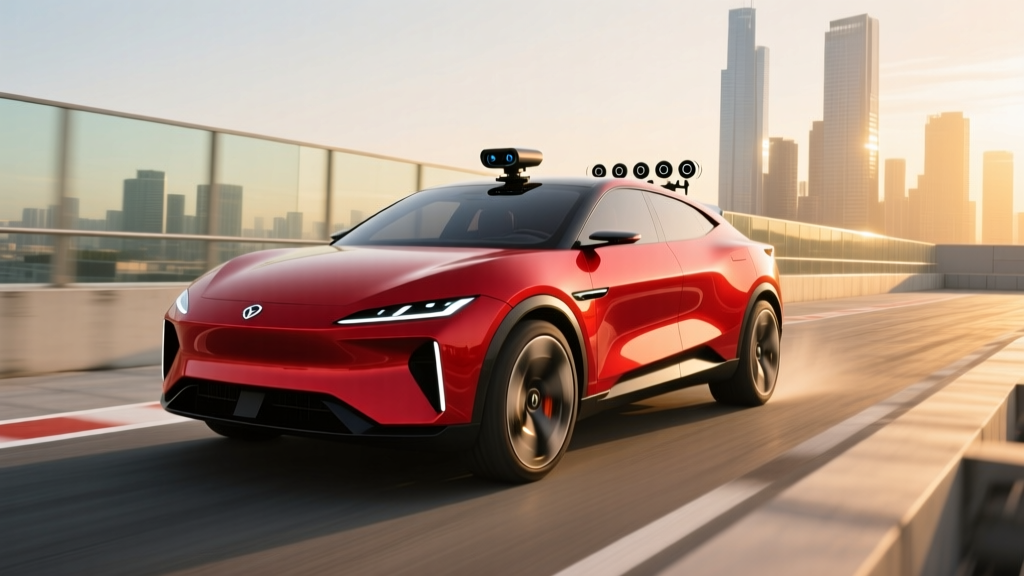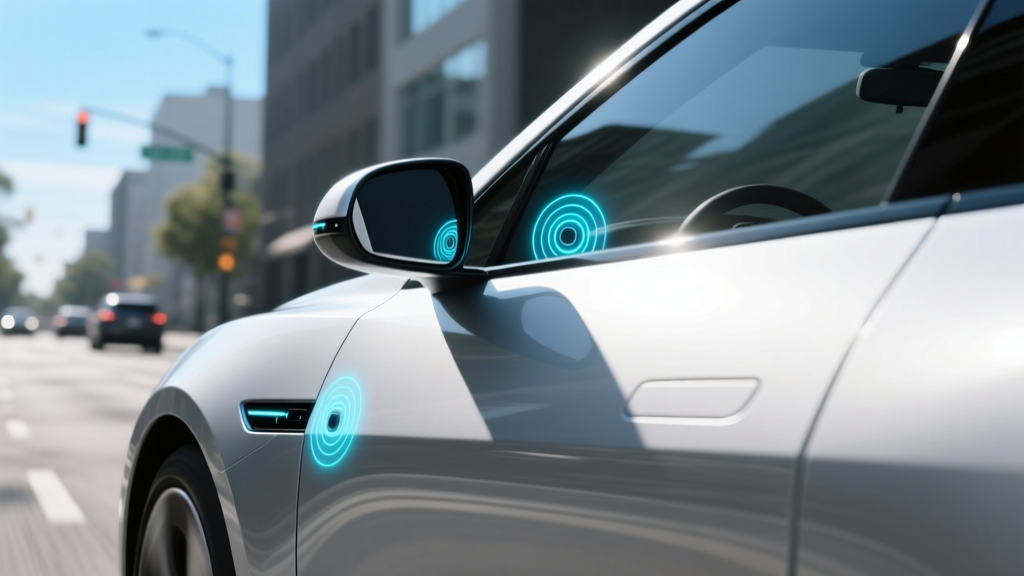
Every driver has experienced it: you check your mirrors, signal, and begin to change lanes — only to find another vehicle already sitting right beside you. That vehicle was in your blind spot, and understanding exactly where these zones exist is the first step toward avoiding a collision. In modern electric vehicles, blind-spot monitoring (BSM) systems use radar, cameras, and ultrasonic sensors to detect vehicles in these hidden areas and warn you before you make a dangerous move. But not all BSM systems are created equal, and none of them replace an attentive driver.
This guide maps the exact geometry of automotive blind spots, explains the sensor technology that EVs use to cover them, and compares how brands like Tesla, Hyundai, Ford, and BMW implement blind-spot assistance — including what each system costs, which trims include it, and where the real-world limitations lie.
Where Exactly Is the Blind Spot in a Car?
A blind spot is any area around your vehicle that you cannot see through the windshield, side windows, or any of your mirrors — standard or convex. Every passenger vehicle has at least two primary blind spots:
- Left-rear quarter: Extending roughly from the midpoint of your driver-side door back to about 10–15 feet behind the rear bumper, spanning one lane width outward (approximately 6–8 feet from the vehicle side).
- Right-rear quarter: The mirror image on the passenger side, often slightly larger due to the greater distance from the driver's eye to the right-side mirror.
Additional blind zones include:
- A-pillar blind spots: The structural pillars flanking your windshield can obscure pedestrians, cyclists, or narrow vehicles at intersections — particularly in modern EVs with thicker A-pillars designed for crash-test rigidity.
- Rear-quarter close-in zone: Directly behind the rear doors, where a motorcycle or bicycle may be invisible in both the side mirror and peripheral vision.
- High-riding EV blind zones: Taller EVs like the Rivian R1S or Cadillac Escalade IQ create larger blind spots for shorter drivers and obscure smaller road users behind the vehicle.
How Blind-Spot Monitoring Works in Modern EVs
Blind-spot monitoring systems use a combination of sensors to continuously scan the rear-quarter zones that mirrors can't cover. Here's how the core technologies differ:
| Sensor Type | Detection Range | Strengths | Weaknesses |
|---|---|---|---|
| Rear radar (24 GHz / 77 GHz) | Up to ~70 meters rearward, 2–3 lanes wide | Works in rain, fog, darkness; measures speed/distance of approaching vehicles | Cannot detect stationary objects well; may miss cyclists/pedestrians |
| Side/rear cameras | ~30–50 meters; visual confirmation | Object classification (car vs. truck vs. cyclist); enables visual overlay on displays | Degraded by heavy rain, snow, mud, direct sun glare |
| Ultrasonic sensors | ~5–8 meters (close-in) | Low-cost; good for parking and low-speed cross-traffic alerts | Too short-range for highway-speed BSM |
Most mainstream EVs — including the Hyundai Ioniq 5, Ford Mustang Mach-E, and BMW iX — use dedicated rear-corner radar modules (typically 77 GHz millimeter-wave) mounted behind the rear bumper fascia. These radar units are invisible from the outside and continuously sweep the adjacent lanes at speeds above approximately 20 mph.
Tesla takes a different approach: the current Model 3 (Highland refresh) and Model Y rely on Tesla Vision, a camera-only system that uses the side-repeater and rear-view cameras to estimate blind-zone occupancy through neural-network object detection. There are no dedicated radar sensors for BSM on current Tesla vehicles.
SAE Automation Level: This Is NOT Self-Driving
Blind-spot monitoring is classified as SAE Level 0 (warning-only) or Level 1 (if it includes active steering intervention to prevent a lane change). Even when BSM is bundled into a broader Level 2 ADAS suite (like Ford BlueCruise or Hyundai Highway Driving Assist), the blind-spot function itself does not drive the car. You remain fully responsible for lane-change decisions.
Only Level 4 robotaxi services like Waymo operate without a human driver. Consumer ADAS — every system available for purchase in 2026 — requires continuous driver engagement. See the NHTSA guidance on automated vehicle safety for the official framework.
How Each EV Brand Implements Blind-Spot Assistance
Every automaker names, prices, and packages their blind-spot technology differently. Here's how the major EV brands handle it in the 2025–2026 model years:
| Brand | Feature Name | Sensor Type | Availability | Active Intervention? |
|---|---|---|---|---|
| Tesla | Blind Spot Camera / Autopilot BSM | Camera (Tesla Vision) | Standard on all models | Audible + visual alert; Autopilot lane-change override |
| Hyundai / Kia | Blind-Spot Collision-Avoidance Assist (BCA) | Rear-corner radar | Standard on SEL+ / GT-Line and above | Yes — applies brake to opposite side to prevent collision |
| Ford | BLIS (Blind Spot Information System) | Rear-corner radar | Standard on most trims; Cross-Traffic Alert included | Yes — steering torque intervention on select trims |
| BMW | Active Blind Spot Detection | Rear-corner radar + camera overlay | Included in Driving Assistance Plus package (~$1,700) | Yes — active side collision avoidance |
| Mercedes-Benz | Active Blind Spot Assist | Rear-corner radar | Included in Driver Assistance Package (~$1,950) | Yes — exit warning + brake intervention |
| Rivian | Blind Spot Warning | Camera + radar fusion | Standard on all R1T / R1S (Driver+ included) | Visual + audible; active steer planned via OTA |
What Blind-Spot Monitoring Actually Does (and Does NOT Do)
Understanding the boundary between assistance and automation is critical. Here's a precise breakdown:
- Does NOT steer the car for you. Even systems with "active intervention" only apply a brief corrective nudge or brake — they do not execute a lane change.
- Does NOT detect fast-approaching vehicles beyond sensor range. A vehicle approaching at 100+ mph from 100+ meters back may not register until it enters the ~70-meter radar window.
- Does NOT work reliably with dirty, iced, or obstructed sensors. Snow packed behind the rear bumper can completely disable radar-based BSM. Camera-based systems (Tesla) are vulnerable to rain droplets and sun glare on the side-repeater lenses.
- Does NOT reliably detect motorcycles, bicycles, or pedestrians. Radar cross-sections for narrow objects are small, and camera neural networks may not classify a cyclist at highway-relative speeds in time.
- Does NOT replace a shoulder check. IIHS research confirms that BSM reduces lane-change crashes by approximately 14%, but it is a supplement to — not a replacement for — visual confirmation.
Real-World Performance: Where These Systems Struggle
After extensive highway and urban testing across multiple EV platforms, here are the edge cases that consistently challenge blind-spot monitoring:
Weather Degradation
Rear-corner radar modules are typically mounted behind the bumper fascia and are less affected by rain than cameras. However, heavy wet snow or ice accumulation on the rear bumper can attenuate the radar signal enough to trigger a "sensor blocked" warning, disabling BSM entirely. Tesla's camera-based system is more vulnerable: a single rain droplet on the side-repeater camera lens can cause phantom alerts or missed detections. In winter testing, Tesla Vision BSM generated roughly 2–3 false alerts per 100 miles in moderate rain, while radar-based systems (Hyundai BCA, Ford BLIS) generated fewer than one.
Highway Merging Scenarios
When two vehicles are merging into the same lane from opposite sides (e.g., a three-lane highway where both the left and right lane vehicles are merging center), BSM systems can struggle to prioritize alerts. Most systems will alert for both, but the rapid relative-speed changes can cause flickering warnings that are more distracting than helpful.
Towing and Cargo
If you're towing a trailer with a Rivian R1T or Ford F-150 Lightning, the trailer physically occupies the blind-spot zone. Most systems offer a "trailer mode" that extends the detection zone rearward to cover the trailer length, but this must be manually activated in the vehicle settings. Forgetting to enable it means your BSM will constantly alert for the trailer itself.
Urban Low-Speed Gaps
Many BSM systems deactivate below 20 mph, which is precisely where cyclists and pedestrians enter the blind zone. Hyundai's BCA and Ford's BLIS with Cross-Traffic Alert partially address this by keeping ultrasonic cross-traffic alert active at low speeds, but the detection zone is limited to the immediate rear corners — not the full blind-spot length.
Cost Breakdown: What You'll Pay for Blind-Spot Assistance
Unlike Tesla's Full Self-Driving subscription, blind-spot monitoring is rarely sold as a standalone subscription. It's typically bundled into a safety package or included as standard equipment. Here's how pricing breaks down across popular EVs:
| Vehicle | BSM Included From | Package Cost (if not standard) | Subscription Required? |
|---|---|---|---|
| Tesla Model 3 / Model Y | All trims (standard) | $0 — included with base Autopilot | No |
| Hyundai Ioniq 5 | SEL trim ($46,650 MSRP) | ~$1,500 step-up from SE base | No |
| Ford Mustang Mach-E | Select trim (standard) | $0 on most trims | No (BlueCruise is separate, $75/mo) |
| BMW i4 / iX | Driving Assistance Plus Pkg | ~$1,700 add-on | No |
| Mercedes EQE / EQS | Driver Assistance Package | ~$1,950 add-on | No |
| Rivian R1T / R1S | All trims (Driver+ standard) | $0 — included | No |
Key takeaway: You will not find a blind-spot monitoring subscription in 2026. Unlike Tesla's FSD ($99/month) or Ford's BlueCruise hands-free driving ($75/month), BSM is treated as a core safety feature — either standard or part of a one-time safety package. Budget approximately $1,500–$2,000 if your desired EV requires a safety-package upgrade to get it.
Frequently Asked Questions
Where is the blind spot in a car — can I see it without technology?
Yes. The most reliable method is the SWEAT check (Shoulder, Window, Eyes, And Turn): physically turn your head and look over your shoulder through the rear side window before every lane change. Your blind spot extends roughly from the B-pillar to about 15 feet behind the rear bumper on each side. Adjust your side mirrors outward so that the side of your own car is barely visible — this reduces (but does not eliminate) the blind zone.
Is blind-spot monitoring the same as Tesla's Autopilot or FSD?
No. Blind-spot monitoring is a narrow, single-function safety feature that alerts you to vehicles in adjacent lanes. Autopilot is Tesla's Level 2 adaptive cruise control + lane-keeping system. FSD (Supervised) adds automated lane changes, traffic-light response, and city-street navigation — but still requires driver supervision. BSM is one small component within these broader systems.
Do I need to pay a monthly subscription for blind-spot alerts?
No. As of 2026, no major automaker charges a recurring subscription specifically for blind-spot monitoring. It is either standard equipment or part of a one-time safety package purchase. Subscriptions apply to higher-level features like hands-free highway driving (Ford BlueCruise, GM Super Cruise) or Tesla FSD.
Which EV has the best blind-spot monitoring system?
Based on real-world testing, Hyundai/Kia's Blind-Spot Collision-Avoidance Assist (BCA) offers the most complete package: radar-based detection (weather-resilient), active brake intervention to prevent a lane-change collision, and a blind-spot view monitor that displays a camera feed of the blind zone in the instrument cluster when you signal. It's standard from the SEL trim up on the Ioniq 5 and EV6. Ford's BLIS with Cross-Traffic Alert is a close second, particularly for its low-speed parking-lot coverage.
Does blind-spot monitoring work in snow and heavy rain?
Radar-based systems (Hyundai, Ford, BMW, Mercedes) maintain strong performance in rain and fog because millimeter-wave radar penetrates precipitation. However, ice or packed snow on the rear bumper can block the radar, triggering a system-disabled warning. Camera-based systems (Tesla Vision) degrade more noticeably in rain due to water droplets on the camera lenses. Always clear sensor areas before driving in winter conditions.
Can aftermarket blind-spot monitors match factory systems?
Aftermarket BSM kits (typically $200–$500 installed) use ultrasonic sensors with shorter range (~10–15 meters) and lack the vehicle-integration needed for active steering or brake intervention. They provide basic audible/visual alerts but cannot match the detection range, object classification, or active-safety response of factory-installed radar systems. For EV buyers, we recommend selecting a trim with factory BSM rather than retrofitting.