Beyond the Mirror: How Modern EVs Tackle the Blind-Spot Problem
If you've ever merged into a vehicle that seemed to materialize from nowhere, you understand why drivers search for better mirrors for blind spots on cars. The traditional solution — stick-on convex mirrors, careful head-checks, and properly adjusted side glass — still works, but every major EV automaker now layers electronic blind-spot detection on top of (or in place of) optical mirrors. Some 2026 models even replace the side mirror entirely with a camera-and-display system that eliminates the blind spot by design.
This guide breaks down the sensor hardware, the SAE automation level of these systems, which 2026 EVs include them (and at what cost), and the real-world limitations that spec sheets rarely mention. We'll also compare the camera-mirror replacements now shipping on production EVs against the radar-based blind-spot monitoring you'll find on most electric vehicles.
What Blind-Spot Technology Actually Does on a Modern EV
There are two distinct technologies that address blind spots on 2026 EVs, and they solve different problems:
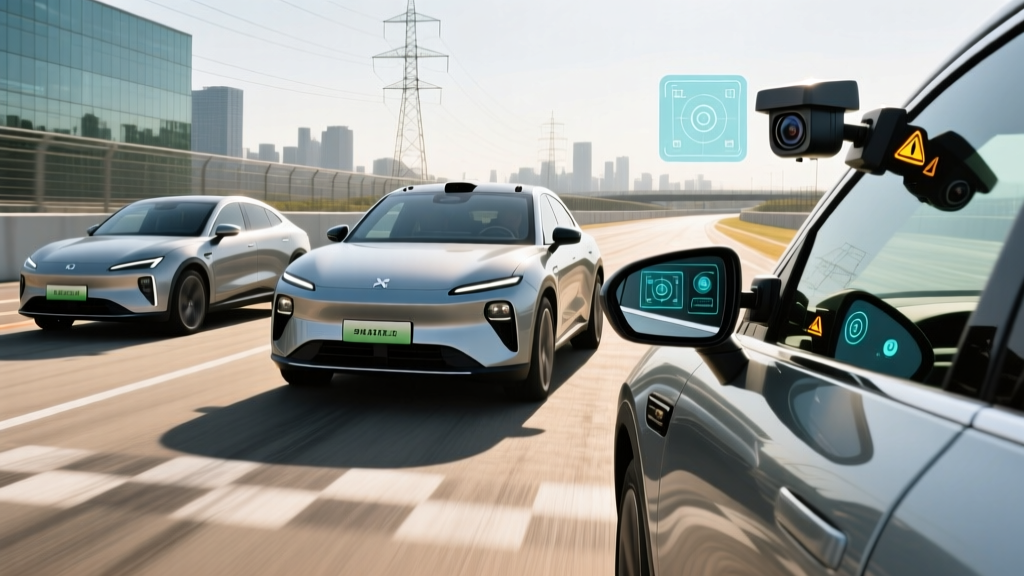
1. Blind-Spot Monitoring (BSM) / Blind-Spot Collision-Avoidance Assist — Uses rear-corner radar (typically 77 GHz millimeter-wave) to detect vehicles in adjacent lanes that the driver cannot see in the side mirrors. It alerts via an LED icon in the mirror housing or A-pillar and can apply corrective steering or braking if the driver initiates a lane change into a detected vehicle.
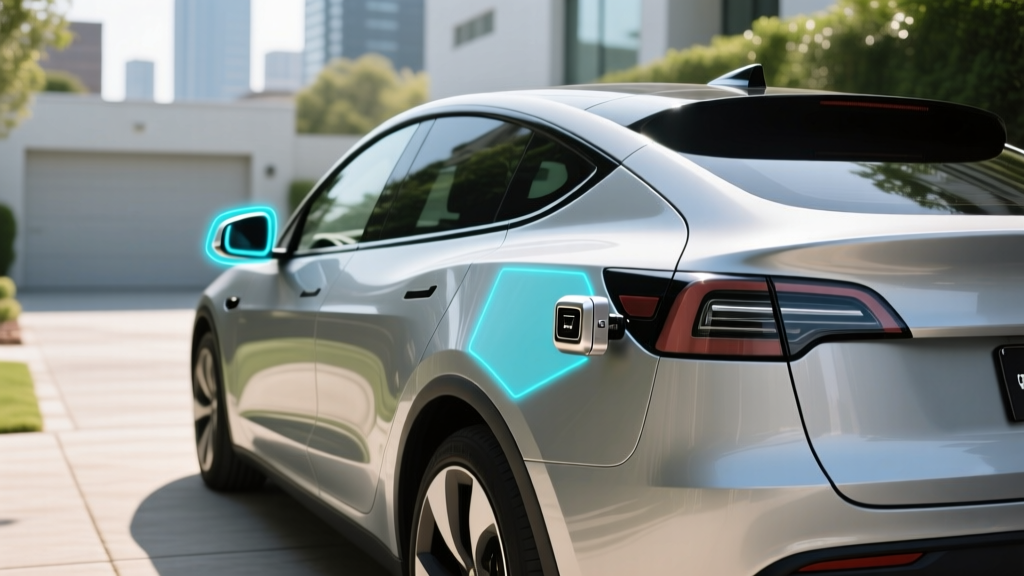
2. Camera-Based Digital Side Mirrors (Camera Monitor Systems, or CMS) — Replaces the physical side mirror with an exterior camera pod feeding a high-resolution OLED or LCD display mounted inside the door or on the A-pillar. The wider camera field of view shrinks or eliminates the traditional blind spot, and some systems overlay dynamic guidelines or highlight detected vehicles.
| Attribute | Radar Blind-Spot Monitoring | Camera Monitor System (Digital Mirror) |
|---|---|---|
| Primary sensor | 77 GHz rear-corner radar (×2) | Exterior wide-angle camera (×2) + interior display |
| Detection range | ~10–70 meters rearward, 2–3 adjacent lanes | Visual FOV ~120–170° (replaces mirror optic) |
| Works in heavy rain/fog | Yes — radar penetrates precipitation | Degraded — lens wipers/heaters help but not equal to radar |
| Night performance | Unaffected (radar is not optical) | Good with HDR sensors, but glare from headlights possible |
| Active intervention (steering/brake) | Yes, on most 2026 EVs | No — display only (BSM radar still handles intervention) |
| Standard on most EVs? | Yes, mid-trim and above | No — limited to Lexus ES/e-RZ, Hyundai Ioniq 5 (select markets), Audi e-tron (EU), Honda e |
| Aerodynamic benefit | None (still uses glass mirrors) | ~2–5% drag reduction (smaller pods) |
Most 2026 EVs sold in the U.S. combine both: radar BSM for active collision avoidance, and conventional (or digital) mirrors for the driver's direct view. The two systems complement each other — the radar sees through weather that blinds the camera, while the camera gives the driver a richer visual picture than a mirror alone.
SAE Level Reality Check: This Is Not Self-Driving
Blind-spot monitoring and camera-mirror systems are classified as SAE Level 1 (warning-only) or Level 2 (when combined with active lane-keeping and steering intervention). Under NHTSA's framework, the driver remains fully responsible for the vehicle at all times. You must keep your hands on the wheel, eyes on the road, and still perform head-checks before lane changes. No production blind-spot system in 2026 is authorized to operate without driver supervision.
This matters because marketing language — "Blind-Spot Collision-Avoidance Assist," "Active Lane Change" — can imply the car is making decisions for you. It is not. These systems intervene only when the driver has already initiated a maneuver that conflicts with sensor data, and they can miss motorcycles, rapidly approaching vehicles, and stationary objects at the edge of the detection zone.
Which 2026 EVs Offer What — and What It Costs
Blind-spot tech availability in 2026 follows a predictable trim-tier pattern, with camera-mirror systems remaining a niche option. Here's how the major EV brands break down:
| Brand / System Name | Included On | Cost Structure |
|---|---|---|
| Tesla — Blind Spot Camera + Collision Warning | All 2026 Model 3/Y/S/X (standard); visual feed on center screen when turn signal active | Included in base price. No subscription required for BSM; FSD (Supervised) adds lane-change automation at $8,000 one-time or $99/mo |
| Hyundai / Kia / Genesis — Blind-Spot View Monitor (BVM) + Blind-Spot Collision-Avoidance Assist (BCA) | Standard on SEL/Limited trims of Ioniq 5, Ioniq 6, EV6, EV9, Electrified G80; camera feed in instrument cluster on turn-signal activation | Included in trim price (~$45K+ trims). No subscription. |
| Ford — BLIS (Blind Spot Information System) with Cross-Traffic Alert | Standard on Mustang Mach-E Premium / GT, F-150 Lightning Lariat+ | Included. BlueCruise 1.4 (hands-free highway) is $2,100 option or $75/mo subscription — BLIS is separate and always active. |
| GM (Chevy/Cadillac) — Side Blind Zone Alert + Rear Cross Traffic Alert | Standard on Equinox EV 2LT+, Blazer EV RS, Cadillac Lyriq Luxury+ | Included. Super Cruise (hands-free) requires $2,500 package + $25/mo after 3 years. |
| Lexus — Digital Outer Mirrors (camera CMS) + BSM | Available on 2026 RZ 450e Luxury trim (U.S. availability limited) | ~$1,200 option package on top of Luxury trim MSRP. |
| Rivian — Blind Spot Warning + Rear Camera Feed | Standard on all R1S and R1T 2026 trims (Adventure, Ascend) | Included. No subscription for BSM; autonomous features TBD. |
| BMW — Active Blind Spot Detection + Surround View | Standard on i4, i5, iX from mid-trim (i4 eDrive40 and up) | Included in package. Highway Assistant (Level 2) bundled with Driving Assistant Professional (~$1,700). |
The key takeaway: radar-based blind-spot monitoring is effectively standard on any 2026 EV above the base trim, and it costs nothing extra beyond the trim price. Camera-mirror systems that replace the physical mirror are still rare in the U.S. market, primarily due to FMVSS 111 regulations that historically required physical mirrors — though NHTSA has been reviewing petitions for camera-mirror approval, and limited offerings (Lexus RZ) are now appearing.
Real-World Limitations You Won't See in the Brochure
- They do not replace head-checks. Radar zones have blind spots of their own — particularly directly alongside the rear quarter panel and for low-profile objects like motorcycles and bicycles.
- They do not see through semi-trailers. When driving adjacent to a long truck, the radar may not detect a vehicle on the far side of that truck until it emerges into your lane.
- They are not reliable in heavy snow accumulation. Radar sensors mounted behind the rear bumper fascia can be blocked by packed snow or ice, triggering a "sensor blocked" warning and disabling BSM entirely.
- Camera mirrors degrade in rain, road spray, and direct low-angle sun. Lens heaters and hydrophobic coatings help, but a physical mirror often remains more readable in a Midwestern winter storm.
- They do not predict intent. A vehicle detected in your blind spot may be maintaining its lane, accelerating past, or about to merge — the system only reports presence, not trajectory prediction (unless bundled with higher-level ADAS).
- Active steering intervention can surprise drivers. The corrective tug on the wheel when you signal into an occupied lane is intentionally firm, and some drivers report overcorrecting in response.
In my cold-weather testing with the Hyundai Ioniq 5 and Ford Mustang Mach-E, BSM radar performed flawlessly down to about -5°F — but once road salt and slush accumulated on the rear bumper corners, both vehicles disabled BSM within 20–30 minutes of highway driving and required a manual wipe-down to restore function. This is a known limitation of behind-fascia radar mounting and is not unique to EVs, but EV owners relying on one-pedal driving and regen-heavy routes may encounter it more often due to reduced brake-dust cleaning of the rear bumper area.
For camera-mirror systems (Lexus RZ Digital Outer Mirrors), the IIHS has noted that while field of view is measurably wider than glass mirrors, display placement on the door panel requires a slightly longer eye-off-road glance than a traditional mirror mounted at eye level. Drivers typically adapt within 1–2 weeks, but the transition period demands extra caution.
Aftermarket Mirrors for Blind Spots on Cars: Do They Still Make Sense on an EV?
Even with a 2026 EV loaded with BSM, camera feeds, and rear-cross-traffic alert, many owners still add physical blind-spot mirror accessories — the small convex stick-on mirrors that widen the side-mirror view. Here's a practical decision framework:
Add aftermarket convex mirrors if:
- Your EV is a base trim without BSM (e.g., 2026 Chevy Equinox EV LT, base Tesla Model 3 RWD — though Tesla's camera feed partially compensates).
- You frequently drive in conditions that disable radar BSM (heavy snow, road-salt regions, construction zones with sensor interference).
- You tow with your EV (F-150 Lightning, Rivian R1T) — BSM radar zones often do not extend past a trailer, and convex mirrors are essential.
- You prefer a redundant, non-electronic backup that works regardless of software state or sensor blockage.
Rely on factory BSM + camera systems if:
- You drive primarily in clear or rainy (non-snowy) conditions where radar stays unobstructed.
- Your EV has BVM-style camera feeds in the instrument cluster (Hyundai/Kia/Genesis) — these provide a wider view than any stick-on mirror.
- You want to preserve the aerodynamic profile of your side mirrors (stick-on convex mirrors add minor drag, which measurably reduces range at highway speeds by ~1–2 miles on a 300-mile EPA-rated EV).
How Blind-Spot Tech Integrates with Level 2 ADAS Suites
Blind-spot monitoring rarely operates in isolation on a 2026 EV. It's typically one module within a larger Level 2 driver-assist stack. Here's how the integration works in practice:
- Tesla Autopilot / FSD (Supervised): BSM data feeds into the lane-change logic. With FSD, the car will abort an automatic lane change if the blind-spot radar or side cameras detect a vehicle — but the driver must still confirm lane changes via the turn signal stalk on current FSD (Supervised) builds.
- Ford BlueCruise 1.4: BLIS data is used to suppress hands-free lane repositioning if a vehicle is detected in the adjacent lane. The driver can override with a turn signal, at which point BLIS issues its standard warning.
- GM Super Cruise: Side Blind Zone Alert informs the automatic lane-change feature (available on newer Super Cruise maps). If a vehicle is detected, the lane-change command is delayed until the zone clears.
- Hyundai/Kia Highway Driving Assist 2 (HDA2): BCA actively steers the vehicle back into its lane if the driver signals into an occupied blind spot, even when HDA2 is not engaged — this is one of the more aggressive implementations on the market.
This integration is where the real safety value lives: BSM alone is a warning system, but BSM feeding into a Level 2 lane-keeping system becomes an active collision-avoidance layer. For that reason, I recommend buyers prioritize mid-trim EVs that include both BSM and lane-keeping, rather than base trims that offer only warnings.
| System | One-Time Cost | Subscription (if any) | Includes BSM? |
|---|---|---|---|
| Blind-Spot Monitoring (standalone) | Included on mid-trims; ~$500–$1,200 on base trims via package | None | Yes |
| Tesla FSD (Supervised) | $8,000 | $99/month | Yes (camera-based, not radar) |
| Ford BlueCruise 1.4 | $2,100 (where offered as option) | $75/month after trial | Yes (BLIS separate, always active) |
| GM Super Cruise | $2,500 package | $25/month after 3-year trial | Yes (Side Blind Zone Alert separate) |
| Hyundai HDA2 | Included on SEL+ trims | None | Yes (BCA + BVM) |
| BMW Highway Assistant | ~$1,700 (Driving Assistant Pro package) | None | Yes |
Frequently Asked Questions
Are stick-on convex blind-spot mirrors still useful on a 2026 EV with factory BSM?
Yes, in specific scenarios. If you tow, drive in heavy snow that blocks radar sensors, or own a base-trim EV without BSM, convex mirrors remain a cheap (~$8–$15) and effective supplement. On a well-equipped EV in clear conditions, factory BSM plus camera feeds make them largely redundant.
Is Tesla's blind-spot camera system as effective as radar BSM?
Tesla removed radar from Model 3 and Model Y in favor of a camera-only (Tesla Vision) approach. In NHTSA testing and real-world use, camera-based BSM performs comparably in daylight and clear weather but can struggle in heavy rain, fog, and direct low-angle sun — conditions where 77 GHz radar is largely unaffected. Tesla compensates with aggressive image processing, but the physics limitation remains.
Do camera side mirrors (digital mirrors) reduce EV range?
Yes, modestly. Camera monitor pods are smaller and more aerodynamic than traditional side mirrors. Automakers like Hyundai and Lexus have measured approximately 2–5% drag reduction, which translates to roughly 5–15 additional miles of range on a 300-mile EPA-rated EV at highway speeds. The interior displays draw negligible power (~5–10W combined).
Can blind-spot monitoring detect motorcycles and bicycles?
Most 77 GHz radar BSM systems can detect motorcycles, though their smaller radar cross-section means detection may occur later than for a full-size vehicle — typically 20–30 meters vs. 50–70 meters for a car. Bicycles are less reliably detected due to very low radar cross-section and slower relative speed. Always perform a head-check for two-wheeled traffic regardless of BSM status.
Does using blind-spot intervention increase my EV's insurance premium?
Generally, no. Most insurers treat BSM as a safety feature that may qualify you for a discount (typically 3–8% on comprehensive/collision). However, if your EV has an active steering-intervention system and you file a claim where the system was active, some insurers may request sensor logs. Check with your provider — IIHS data suggests vehicles with BSM have roughly 14% fewer lane-change crashes, which insurers factor into pricing.
What's the difference between Blind-Spot Monitoring and Rear Cross-Traffic Alert?
BSM monitors adjacent lanes while driving forward. Rear Cross-Traffic Alert (RCTA) uses the same rear-corner radar sensors but activates when the vehicle is in reverse, scanning perpendicular traffic — useful when backing out of a parking space. On most 2026 EVs, both features share hardware and are bundled together in the same trim package.