What Blind Spot Detection Actually Does in Modern EVs
Blind spot detection (BSD) is a driver-assistance feature that monitors the lanes adjacent to your vehicle and alerts you when another car, truck, or cyclist occupies the zone your mirrors can't cover. In most 2026 electric vehicles, BSD activates above roughly 6–10 mph and uses either radar sensors, camera-based vision systems, or a fusion of both to track objects up to several car-lengths behind and beside you.
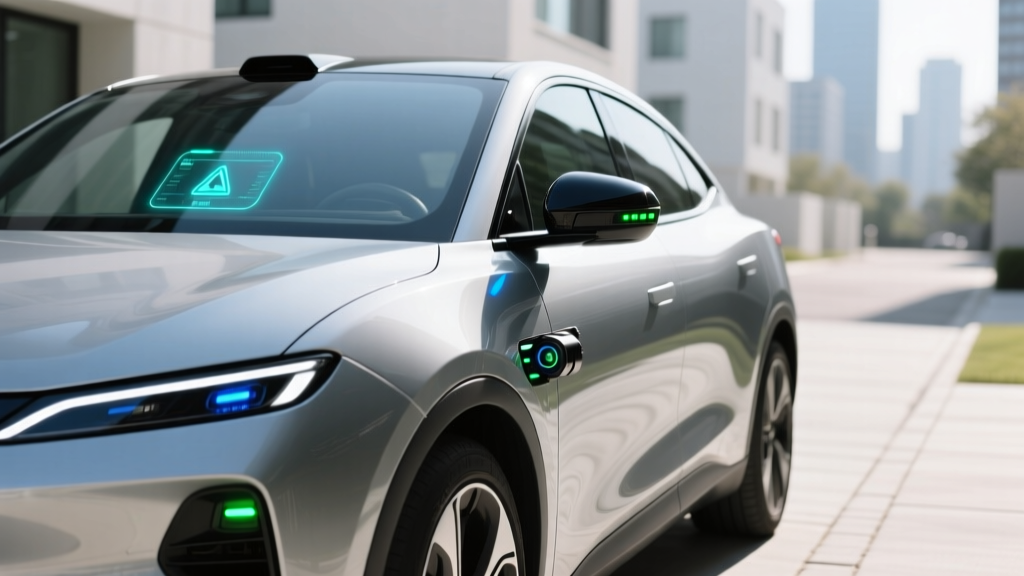
When a vehicle enters your blind zone, the system typically illuminates an amber icon in or near the side mirror. If you then activate your turn signal toward that occupied lane, the alert escalates — flashing lights, an audible chime, or in some EVs, a brief pulse of steering torque or brake intervention on the opposite side to nudge you back into your lane.
| Capability | Typical Implementation |
|---|---|
| Detection zone | Adjacent lanes, ~10 ft to 50+ ft behind rear bumper |
| Activation speed | 6–10 mph minimum (varies by brand) |
| Sensor type | 24 GHz / 77 GHz rear-corner radar or side-view cameras |
| Alert types | Mirror icon, audible chime, steering haptic, brake pulse |
| Active intervention | Some brands apply corrective steering or braking (BLA/RCTA) |
| Motorcycle/bicycle detection | Supported on most radar systems; less reliable on camera-only |
| Trailer mode | Extended zone on select trucks/SUVs (e.g., Ford F-150 Lightning, Rivian R1T) |
The underlying technology is straightforward but effective. Radar-based systems (used by Hyundai, Kia, Ford, BMW, and most legacy automakers) bounce millimeter-wave signals off nearby objects and measure the return time and Doppler shift to calculate distance and relative speed. Camera-based systems (favored by Tesla's Tesla Vision stack) rely on neural-network image processing from side-repeater and fender-mounted cameras to classify and track objects. Both approaches have trade-offs that affect real-world reliability — more on that below.
SAE Level 2: You're Still the Driver
SAE Automation Level: 2 (Partial Driving Automation)
Blind spot detection — including active blind spot assist that can steer or brake — is classified as SAE Level 1 or Level 2 driver assistance. The system can warn you and, in some implementations, apply momentary lateral or longitudinal corrections. However, the driver must remain fully engaged, hands on or near the wheel, eyes on the road, and responsible for all lane-change decisions at all times. No production vehicle sold in the U.S. in 2026 offers autonomous (Level 4+) blind spot management. The SAE J3016 standard is explicit: Level 2 systems require continuous driver supervision.
This matters because some marketing language — "blind spot assist," "lane change assist," "active monitoring" — can imply the car will handle the maneuver for you. It won't. Even Tesla's Full Self-Driving (Supervised), which can initiate lane changes on highways, requires the driver to confirm the maneuver and remain attentive. If you treat BSD as anything more than a sophisticated mirror supplement, you're increasing risk, not reducing it.
Brand-by-Brand Naming and Availability in 2026 EVs
Every major automaker calls their blind spot system something different, and availability varies significantly by trim. Here's how the major EV brands handle it in 2026:
| Brand | Feature Name | Sensor Type | Standard / Optional |
|---|---|---|---|
| Tesla (Model 3/Y/S/X) | Blind Spot Camera / Lane Change Assist | Camera (Tesla Vision) | Standard on all trims |
| Hyundai (Ioniq 5/6) | Blind-Spot Collision-Avoidance Assist (BCA) | Rear-corner radar | Standard on SEL and above |
| Kia (EV6/EV9) | Blind-Spot Collision-Avoidance Assist (BCA) | Rear-corner radar | Standard on most trims (S+) |
| Ford (Mustang Mach-E / F-150 Lightning) | BLIS (Blind Spot Information System) | Rear-corner radar | Standard on all trims |
| Chevrolet (Equinox EV / Blazer EV / Silverado EV) | Side Blind Zone Alert | Rear-corner radar | Standard on 2LT+ or RS |
| Rivian (R1S / R1T) | Blind Spot Warning | Radar + camera fusion | Standard on all trims |
| BMW (i4/i5/i7/iX) | Active Blind Spot Detection | Rear-corner radar | Standard on all trims |
| Mercedes-Benz (EQE/EQS/EQB) | Active Blind Spot Assist | Rear-corner radar | Standard on most trims |
| Volkswagen (ID.4/ID.7) | Side Assist | Rear-corner radar | Standard on Pro S and above |
| Lucid (Air) | Blind Spot Monitoring | Camera + radar | Standard on all trims |
A few observations from this landscape. Tesla is the outlier in using a camera-only approach since eliminating radar and ultrasonic sensors in 2022–2023. This means Tesla's blind spot alerts display on the central touchscreen (showing a rendering of detected vehicles) and via mirror icons, but the system's performance in heavy rain or low-light conditions has drawn mixed reviews from IIHS evaluations. Most other automakers stick with dedicated 77 GHz radar modules in the rear bumper corners — a sensor that works regardless of lighting and is largely unaffected by rain or fog.
Hyundai and Kia deserve credit for making active blind spot collision-avoidance (not just warning, but corrective steering/braking) standard on mid-level trims rather than locking it behind top-tier packages. Ford's BLIS is similarly generous, standard even on base Select trims of the Mach-E. Conversely, some luxury brands still bundle blind spot assist into optional driver-assistance packages that can add $1,500–$3,000 to the build.
Real-World Performance and Limitations
What Blind Spot Detection Does NOT Do
- Does not see through large vehicles: A semi-truck or box truck in the adjacent lane can occlude smaller vehicles behind it. Radar may detect the truck but miss the sedan drafting in its wake.
- Does not replace mirror checks: Detection zones have physical boundaries. A fast-approaching motorcycle or a vehicle at the extreme edge of the zone may not trigger an alert in time.
- Camera-only systems degrade in weather: Heavy rain, snow accumulation on camera housings, direct sun glare at low angles, and dirty lenses all reduce camera-based detection reliability. Radar systems are more robust in these conditions.
- Stationary objects may be ignored: Most BSD systems filter out stationary objects (guardrails, parked cars) to reduce false alerts. This is by design but means the system is optimized for moving traffic.
- Does not prevent all lane-change collisions: The NHTSA notes that ADAS features reduce but do not eliminate crash risk. Driver judgment remains primary.
- Cross-traffic alert is separate: Rear Cross-Traffic Alert (RCTA) activates in reverse and covers a different zone. Don't assume BSD is active when backing out of a parking space.
In real-world driving across a range of 2026 EVs, radar-based blind spot systems consistently outperform camera-only implementations in three specific scenarios: highway driving in rain, dusk/dawn low-contrast conditions, and detecting fast-approaching motorcycles. Tesla's camera-based system has improved substantially through over-the-air updates — the neural network's object classification is now quite good in clear conditions — but in a Pacific Northwest downpour or a Midwestern snow squall, radar-equipped EVs like the Hyundai Ioniq 5 or Ford Mach-E maintain more reliable detection.
One nuance EV owners should understand: regenerative braking behavior can interact with blind spot assist. If you lift off the accelerator in one-pedal driving mode and the car begins decelerating, the timing of a blind spot alert relative to your deceleration can feel different than in a gas car. This doesn't affect the system's accuracy, but it changes the driver's response window. Practice with BSD in low-stakes traffic before relying on it during aggressive highway merging.
Cost: What You'll Pay for Blind Spot Detection
| Brand / Model | Cost Structure | Price / Notes |
|---|---|---|
| Tesla (all models) | Included (standard) | $0 — BSD is part of base Autopilot; no subscription required for BSD specifically |
| Hyundai Ioniq 5/6 | Included (SEL trim+) | $0 — standard from SEL (~$45,500 MSRP); not on base SE |
| Kia EV6/EV9 | Included (S trim+) | $0 — standard from Wind trim (~$48,000 MSRP) |
| Ford Mach-E / Lightning | Included (all trims) | $0 — BLIS is standard equipment |
| Chevrolet Blazer EV / Equinox EV | Included or package | $0 on 2LT/RS; part of $1,495 Super Cruise package on some configs |
| BMW i4/i5/iX | Included (standard) | $0 — Active Blind Spot Detection is standard |
| Mercedes EQE/EQS | Included (standard) | $0 — Active Blind Spot Assist standard on most trims |
| Volkswagen ID.4 | Included (Pro S+) | $0 from Pro S (~$46,000 MSRP); not on base Pro |
| Tesla FSD (Supervised) | Subscription or purchase | $99/mo or $8,000 one-time — adds auto lane change with BSD integration, but BSD itself is free |
| GM Super Cruise | Subscription after trial | ~$25/mo after initial trial — BSD works without it; Super Cruise adds hands-free highway driving |
The good news: basic blind spot detection — the warning function that illuminates your mirror icon when a car is in your blind zone — is included at no extra cost on the vast majority of 2026 EVs from mid-trim levels up. You don't need to subscribe to anything or pay for a premium package to get this core safety function.
Where costs enter the picture is when you want active blind spot intervention bundled into a broader hands-free or advanced driver-assistance suite. GM's Super Cruise ($25/month after the trial period) and Ford's BlueCruise (similar subscription model, roughly $75/month or $800/year as of 2026) layer hands-free highway driving on top of the standard BSD hardware. Tesla's FSD (Supervised) at $99/month or $8,000 one-time adds automated lane changes that integrate with the blind spot camera system — but again, the blind spot monitoring itself is standard on every Tesla.
Bottom line for budget-conscious buyers: if your priority is blind spot warning and basic active assist, choose a mid-trim EV from Hyundai, Kia, or Ford and you'll pay nothing extra. Only pay a subscription if you want the broader hands-free driving features that use BSD as one component.
How EVs Compare: Radar vs. Camera Blind Spot Systems
The technical split between radar-based and camera-based blind spot detection is one of the more consequential hardware decisions in the EV market right now. Here's a functional comparison:
| Attribute | Radar-Based (Hyundai, Ford, BMW, Kia) | Camera-Based (Tesla Vision) |
|---|---|---|
| Performance in rain/fog | Excellent — millimeter-wave radar penetrates precipitation | Reduced — water on lens degrades image quality |
| Night / low-light | Unaffected — radar doesn't need light | Good with modern sensors, but headlight glare can confuse |
| Object classification | Basic (vehicle vs. non-vehicle); improving with AI | Excellent — neural nets classify cars, trucks, cyclists, pedestrians |
| Speed/distance accuracy | Very high — direct Doppler measurement | Inferred from image processing; slightly less precise |
| Hardware cost | ~$150–$300 per radar module | Marginal — cameras shared with Autopilot vision stack |
| False positive rate | Low for moving objects; guardrail filtering is mature | Low in good conditions; higher in edge cases (shadows, reflections) |
| Maintenance | Radar modules behind bumper fascia — rarely need cleaning | Camera lenses need periodic cleaning; snow/ice blocks view |
Neither approach is universally superior. Radar wins on reliability across weather conditions and provides more precise distance and speed data. Cameras win on object classification richness — Tesla's system can distinguish a cyclist from a pedestrian from a semi-truck, which enables more contextual alerts. The industry trend is toward sensor fusion (combining both), which is what Rivian, Lucid, and Mercedes-Benz use in their latest architectures.
Is Blind Spot Detection Worth It? The Safety Data
According to IIHS research, blind spot detection systems reduce lane-change crashes by approximately 14% and lane-change injuries by 23%. When combined with rear cross-traffic alert and active lane-keeping, the reduction in relevant crash types approaches 30%. These are meaningful numbers — not transformational like automatic emergency braking has been for rear-end collisions, but significant enough that IIHS now requires effective blind spot monitoring for its Top Safety Pick+ designation.
For EV buyers specifically, there's an additional consideration: electric vehicles are quieter than internal-combustion cars at low speeds. While this doesn't directly affect your blind spot detection, it means that vehicles approaching your blind zone may also be quiet (especially other EVs), reducing the auditory cues you might subconsciously rely on. A robust BSD system compensates for this lost sensory input.
My practical recommendation: treat blind spot detection as a mandatory feature, not a luxury add-on. In 2026, there's no reason to buy an EV above $35,000 that doesn't include it as standard equipment. If you're cross-shopping trims, prioritize BSD over cosmetic upgrades like larger wheels or premium paint — it's a feature you'll use on every single highway drive.
Frequently Asked Questions
Can blind spot detection detect motorcycles and bicycles?
Yes, on most radar-based systems. Motorcycles present a smaller radar cross-section but are still reliably detected by modern 77 GHz radar at typical highway distances. Camera-based systems like Tesla's also classify two-wheeled vehicles, though detection can be less consistent at the extreme edges of the camera's field of view. If you frequently ride in dense urban traffic with heavy cyclist presence, a radar-based system offers marginally better coverage.
Does blind spot detection work when towing a trailer?
It depends on the vehicle. Ford's F-150 Lightning and Rivian R1T offer trailer-mode extensions that widen and lengthen the detection zone to account for the trailer's width and length. Most passenger EVs (sedans, crossovers) do not have this feature because they aren't rated for significant towing. Check your owner's manual — if you tow regularly without a trailer-mode BSD extension, your detection zone may not cover vehicles alongside the trailer itself.
Will blind spot detection drain my EV's battery?
Negligibly. Rear-corner radar modules draw roughly 5–15 watts each when active. Camera-based systems use shared Autopilot/ADAS compute hardware that's already powered for other functions. Over a full driving day, BSD adds less than 0.1 kWh of energy consumption — effectively invisible against a 60–100 kWh traction battery.
Can I turn off blind spot detection if I find it annoying?
Yes. Every automaker allows you to disable BSD alerts through the infotainment settings. Some drivers find the mirror-icon flash or chime intrusive, especially in dense urban traffic where vehicles constantly enter and exit the blind zone. However, I'd recommend adjusting sensitivity (many systems offer "early" vs. "late" alert timing) before disabling entirely. The safety data strongly favors keeping it active.
Is Tesla's blind spot system worse than radar-based competitors?
Not categorically — but it has different failure modes. Tesla's camera-based system excels in clear conditions with its detailed object classification and on-screen visualization. Where it falls short relative to radar is in heavy precipitation, when camera lenses get dirty or obstructed, and in very low-angle sun conditions. For drivers in the Sun Belt or regions with mild weather, Tesla's system performs well. For those in the Pacific Northwest, Great Lakes, or Northeast, radar-based systems from Hyundai, Ford, or BMW offer more consistent all-weather reliability.