The Short Answer: No, Teslas Do Not Have Lidar
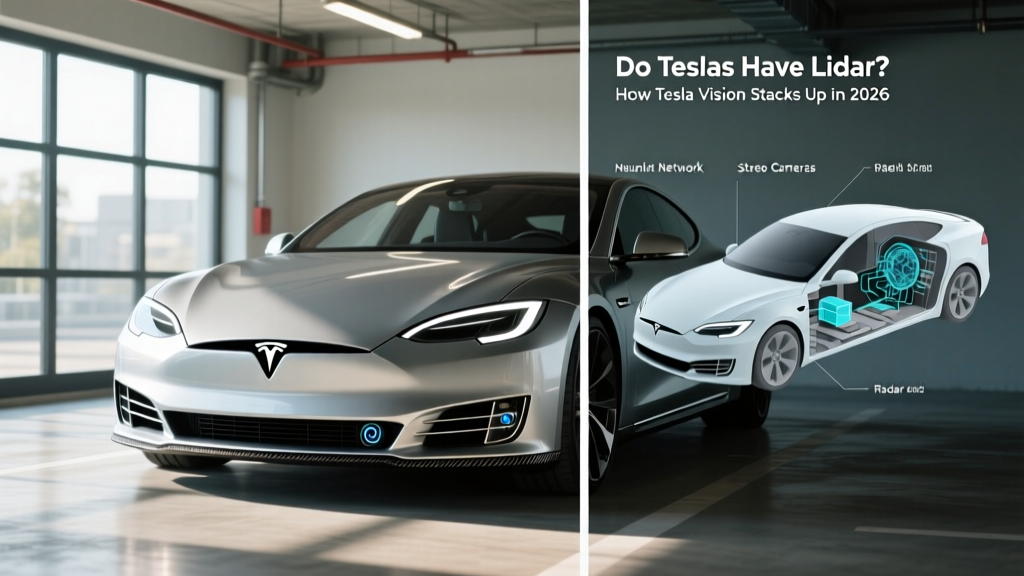
If you've been researching Tesla's Autopilot or Full Self-Driving (FSD) capability and wondering do Teslas have lidar, the answer is a definitive no. As of the 2026 model year, no Tesla vehicle — Model 3, Model Y, Model S, Model X, or Cybertruck — ships with lidar, radar, or ultrasonic sensors. Tesla relies exclusively on a camera-only perception architecture the company calls Tesla Vision.
This decision makes Tesla an outlier. Nearly every other automaker offering advanced driver-assistance systems (ADAS) — from Ford's BlueCruise to GM's Super Cruise to Mercedes-Benz's Drive Pilot — fuses cameras with radar, and in some cases lidar, to build a redundant picture of the vehicle's surroundings. Tesla's bet, championed by CEO Elon Musk since 2021, is that cameras paired with neural-network processing can match or exceed sensor fusion at lower cost.
Whether that bet has paid off is one of the most debated questions in the EV and autonomous-driving space. Let's break down what Tesla Vision actually does, what it costs, where it falls short, and how it compares to the competition.
Tesla's Autopilot and FSD (Supervised) are classified as SAE Level 2 driver-assistance systems. This means the vehicle can simultaneously control steering and acceleration/braking under certain conditions, but the driver must remain fully engaged — hands on the wheel (or applying sufficient torque), eyes on the road, and ready to take over instantly. Tesla is not a self-driving car. No consumer vehicle sold in the U.S. today is. Only Level 4 robotaxi services like Waymo operate without a driver in defined geofenced areas.
How Tesla Vision Works: Cameras and Neural Networks
Tesla's current hardware suite, known as Hardware 4 (HW4) or "AI4," equips 2026-model vehicles with up to eight external cameras providing a 360-degree view around the car. These cameras feed data to Tesla's onboard neural-network processor, which performs real-time object detection, lane identification, depth estimation, and path planning.
Here's how the system perceives the world without lidar or radar:
- Depth estimation via stereo vision: Multiple cameras with overlapping fields of view allow the neural network to estimate distance, similar to how human binocular vision works. Tesla has published research showing sub-meter accuracy at highway distances.
- Object classification: The neural network identifies vehicles, pedestrians, cyclists, traffic signs, lane markings, curbs, and obstacles — trained on billions of miles of fleet data.
- Occupancy networks: Rather than identifying discrete objects only, Tesla's occupancy network divides the world into a 3D voxel grid, flagging any occupied space — even if the system can't classify what's there. This helps detect unusual obstacles like fallen debris or partially visible barriers.
- End-to-end neural planning: In FSD v13 and later, Tesla moved toward end-to-end neural-network-driven path planning, reducing reliance on hand-coded rules for lane changes, merges, and intersection navigation.
What Was Removed and When
Tesla phased out sensors in stages:
- 2021: Radar removed from Model 3 and Model Y built for the North American market.
- 2022: Ultrasonic sensors (parking proximity) removed from all new production vehicles.
- 2023-present: All new Tesla vehicles ship with cameras only. HW4 vehicles feature higher-resolution cameras with improved low-light performance compared to the earlier HW3 suite.
Tesla replaced ultrasonic parking sensors with a vision-based "parking distance" feature rendered on the touchscreen, though owners widely report it is less precise than the ultrasonic system it replaced.
Autopilot vs. FSD (Supervised): What Each Feature Actually Does
Tesla's driver-assistance offerings are split into two tiers, and the naming causes significant confusion. Here's what you get at each level:
| Feature | Autopilot (Standard) | FSD Supervised (Upgrade) |
|---|---|---|
| Traffic-Aware Cruise Control | ✓ | ✓ |
| Autosteer (lane centering on highways) | ✓ (highway only) | ✓ (highway + city streets) |
| Auto Lane Change | ✗ | ✓ |
| Navigate on Autopilot (highway interchanges) | ✗ | ✓ |
| Traffic Light & Stop Sign Control | ✗ | ✓ |
| City Street Autosteer | ✗ | ✓ |
| Smart Summon (parking lot navigation) | ✗ | ✓ |
| Autopark (parallel/perpendicular) | ✗ | ✓ |
Autopilot comes standard on every new Tesla. It handles adaptive cruise control and lane centering on divided highways — essentially, it keeps you centered in your lane and maintains a gap to the car ahead. It will not change lanes, navigate interchanges, or handle city streets on its own.
FSD (Supervised) extends Autosteer to city streets, adds automated lane changes, handles highway on/off-ramps via Navigate on Autopilot, and responds to traffic lights and stop signs. As of early 2026, Tesla has shifted to a subscription-first model for FSD, though a one-time purchase option remains available in some configurations.
What FSD Costs in 2026
| Option | Cost | Notes |
|---|---|---|
| Autopilot (base) | Included | Standard on all new Teslas |
| FSD Supervised — Monthly Subscription | $99/month | Cancel anytime; no long-term commitment |
| FSD Supervised — One-Time Purchase | $8,000 | Transfers with the vehicle, not the owner |
Tesla has periodically adjusted FSD pricing. The one-time purchase price was reduced from its original $15,000 to $8,000, and the subscription dropped from $199 to $99/month. The subscription model is now the default path for most buyers. FSD is tied to the vehicle — if you sell the car, the FSD purchase transfers to the new owner, but a subscription does not.
Note: Tesla does not offer FSD as a standalone add-on after purchase on all configurations. Check Tesla's configurator at the time of order for current availability.
Which Tesla Models Include Autopilot and FSD?
Every Tesla sold in the 2026 model year — Model 3, Model Y, Model S, Model X, and Cybertruck — ships with the base Autopilot suite and HW4 hardware. FSD (Supervised) is available as an upgrade on all trims of every model. There is no trim-level restriction; even a base Model 3 can be optioned with FSD.
However, HW4 is now standard across the lineup. If you're buying a used Tesla from 2022 or earlier, verify whether it has HW3 or HW4, as this affects camera resolution and FSD performance. Tesla has offered HW3-to-HW4 upgrades for some vehicles, but availability and pricing vary.
Real-World Capabilities and Honest Limitations
Tesla's FSD (Supervised) has improved substantially since its early beta days. On well-marked highways in clear weather, the system handles lane keeping, adaptive cruise, and lane changes competently. City-street performance has progressed with the end-to-end neural-network approach in FSD v13+, showing smoother intersection handling and better unprotected-left-turn behavior.
But the camera-only architecture introduces specific limitations that lidar- or radar-equipped competitors handle differently:
- Heavy rain, fog, and snow: Cameras are optical sensors. When visibility drops, the system's perception degrades — sometimes abruptly. Lidar and radar penetrate precipitation far better. Expect Autopilot disengagements in heavy downpours or dense fog.
- Direct sun glare: Low-angle sunlight can saturate camera sensors, causing temporary blindness. Radar is immune to this.
- Faded or missing lane markings: Construction zones, rural roads, and recently repaved highways with incomplete striping challenge the vision system. Competitors using radar and HD maps handle these scenarios with more redundancy.
- Depth perception at range: Camera-based depth estimation is less precise than lidar at distances beyond ~200 meters, which matters for highway-speed emergency braking on stationary objects.
- Parking proximity: The vision-based parking-distance display is a rough approximation. Owners consistently report it's less reliable than the ultrasonic sensors Tesla removed.
- Phantom braking: Teslas have drawn NHTSA scrutiny for phantom-braking events — sudden, unexpected deceleration on highways with no obstacle present. This remains an ongoing concern documented in NHTSA complaint databases.
In cold weather, camera lenses can accumulate ice or condensation, requiring the driver to stop and clear them. Tesla's camera heaters mitigate this partially, but in freezing rain or heavy road-salt spray, visibility degrades faster than with enclosed radar units.
Tesla Vision vs. Lidar-Equipped Competitors
Tesla's camera-only approach is a philosophical and engineering bet. Here's how it compares to the major ADAS systems that use sensor fusion:
| System | Automaker | Sensors | SAE Level | Hands-Off? | Cost |
|---|---|---|---|---|---|
| Tesla FSD (Supervised) | Tesla | Cameras only | Level 2 | No | $99/mo or $8,000 |
| Super Cruise | GM (Cadillac, Chevy) | Cameras + radar + lidar + HD maps | Level 2 | Yes (eyes-on) | Included on select trims; $2,500 option |
| BlueCruise | Ford | Cameras + radar | Level 2 | Yes (eyes-on, monitored) | $2,100 or $75/mo subscription |
| Drive Pilot | Mercedes-Benz | Cameras + radar + lidar + HD maps | Level 3 (conditional) | Yes (in approved zones) | $2,500 option (limited availability) |
| ProPILOT Assist 2.0 | Nissan | Cameras + radar + HD maps | Level 2 | Yes (eyes-on, highway) | Included on select trims |
The key differentiator: GM's Super Cruise and Ford's BlueCruise both allow hands-free driving on pre-mapped divided highways, using driver-monitoring cameras to ensure the driver's eyes remain on the road. Tesla's Autopilot and FSD require steering-wheel torque (or a newer camera-based attention-monitoring system in HW4 vehicles), but do not permit hands-off operation.
Mercedes-Benz's Drive Pilot is the only SAE Level 3 system available in the U.S. (in limited states), meaning the automaker accepts liability when the system is engaged — but only below 40 mph on specific highways in approved conditions. Tesla has no Level 3 certification.
On raw feature breadth, FSD (Supervised) offers the most expansive coverage: it works on virtually any road, not just pre-mapped highways. But that breadth comes with more edge cases and a higher driver-attention burden. Super Cruise and BlueCruise are narrower in scope but more polished and confidence-inspiring within their operating domains.
Safety Data and Regulatory Context
Tesla publishes quarterly safety reports claiming approximately one crash per 4–6 million miles driven with Autopilot engaged, compared to the U.S. average of roughly one crash per 670,000 miles (per NHTSA data). However, these figures are not independently verified, and Tesla's methodology has drawn criticism for comparing highway Autopilot miles (inherently safer) against all U.S. driving miles (including urban and rural roads).
NHTSA has opened multiple investigations into Tesla's Autopilot and FSD systems, including:
- Crashes involving Teslas colliding with stationary emergency vehicles while Autopilot was engaged.
- Phantom braking complaints.
- FSD behavior at intersections and in low-visibility conditions.
Tesla has issued software updates in response to some NHTSA concerns, including additional driver-monitoring alerts and restrictions on FSD operation in certain conditions. For the latest safety data, check the NHTSA website and IIHS ratings for specific Tesla models.
The Bottom Line: Who Should (and Shouldn't) Choose Tesla's System
Choose Tesla Autopilot/FSD if:
- You want driver-assist that works on virtually any road, not just pre-mapped highways.
- You're comfortable acting as an active supervisor and intervening frequently.
- You value over-the-air updates that continuously add capability.
- You primarily drive in fair-weather, well-marked conditions.
Look at Super Cruise or BlueCruise instead if:
- You want hands-free highway driving with robust driver monitoring.
- You frequently drive in rain, fog, or snow where camera-only systems struggle.
- You prefer a system with redundant sensors (radar + lidar) for added safety margin.
- You want a system with a narrower but more polished operating domain.
Tesla's camera-only approach is a bold engineering choice that has produced impressive results in many scenarios. But the absence of lidar and radar means the system has a narrower safety margin in adverse conditions, and the driver-supervision burden is real and constant. If you're buying a Tesla in 2026, understand exactly what you're getting: a sophisticated Level 2 system that requires you to be the ultimate failsafe.
Frequently Asked Questions
Will Tesla ever add lidar to its vehicles?
Tesla has shown no indication of reversing its camera-only strategy. Elon Musk has repeatedly called lidar a "crutch" and argued that a vision-only approach, properly executed, is superior and more scalable. Unless Tesla's safety record forces a regulatory mandate, lidar is unlikely to appear on production Teslas.
Is Tesla FSD truly self-driving?
No. Tesla FSD (Supervised) is an SAE Level 2 driver-assistance system. The driver must remain engaged, monitor the road, and be prepared to take over at any moment. Tesla's own documentation and the "Supervised" label in the product name make this explicit. Only Level 4 robotaxi services like Waymo operate without a human driver.
How does Tesla handle parking without ultrasonic sensors?
Tesla replaced ultrasonic sensors with a vision-based parking-distance visualization on the touchscreen. The system estimates proximity to objects using camera data and neural-network processing. In practice, most owners find it less precise and less confidence-inspiring than traditional ultrasonic parking sensors, particularly for tight spaces and low obstacles like curbs or bollards.
Can I add FSD after buying my Tesla?
In most cases, yes. Tesla allows FSD (Supervised) to be added via the Tesla app after purchase, either as a subscription or one-time purchase, provided your vehicle has compatible hardware (HW3 or HW4). However, Tesla periodically changes the availability of post-purchase FSD upgrades, so check the app for your specific vehicle.
Does FSD transfer if I sell my Tesla?
A one-time FSD purchase is tied to the vehicle, not the owner. If you sell the car, the FSD capability transfers to the new owner. A monthly subscription does not transfer — it ends when you cancel. Tesla has occasionally offered limited-time FSD transfers to new Tesla purchases, but these promotions are not guaranteed.
Why do other automakers use lidar if Tesla says cameras are enough?
Lidar provides precise, direct distance measurements using laser pulses, independent of ambient light or weather conditions that impair cameras. Most automotive engineers consider sensor fusion — combining cameras, radar, and lidar — to be a more robust and redundant approach. Tesla's position is that its neural-network processing compensates for the lack of hardware redundancy, but this remains unproven at scale for full autonomy.