Where Are Car Blind Spots? The Geometry Every Driver Must Know
Every vehicle has blind spots — zones around the car where the driver cannot see other vehicles, cyclists, or pedestrians through mirrors or direct line of sight. Understanding exactly where these zones fall is critical for safe lane changes, merging, and low-speed maneuvers, and it's the foundation for how modern blind-spot monitoring (BSM) systems are engineered.
The primary blind spots on any passenger vehicle exist in three areas:
- Rear quarter panels (B-pillar and C-pillar zones): The most dangerous and well-known blind spots. On a typical midsize SUV like the Tesla Model Y or Hyundai Ioniq 5, these zones extend roughly 10–15 feet behind the driver's shoulder on each side, spanning from the rear of the front doors to about one car-length behind the rear bumper. A vehicle in an adjacent lane, positioned slightly behind you, can be completely invisible in both the side and rearview mirrors.
- A-pillar obstructions: The structural pillars flanking the windshield can block a 5–15 degree wedge of vision on each side, enough to hide a pedestrian or cyclist at intersections. Thicker A-pillars on modern vehicles (required for roof-crush safety standards) have made this worse over the past decade.
- Directly behind the vehicle: The rear blind zone extends 15–25 feet behind the bumper on most crossovers and SUVs, and up to 30+ feet on full-size trucks like the Ford F-150 Lightning or Rivian R1T. This is why rearview cameras became federally mandated for all new vehicles sold after May 2018 (NHTSA rear visibility rule).
Larger vehicles have proportionally larger blind spots. A three-row EV like the Kia EV9 has significantly wider rear-quarter blind zones than a compact hatchback like the Nissan Leaf. This is precisely why blind-spot monitoring has become one of the most valued ADAS features among EV buyers — the added mass and dimensions of battery-electric platforms make sensor-assisted detection not just convenient, but a genuine safety necessity.
How Blind-Spot Monitoring Works: Radar, Cameras, and Sensor Fusion
Blind-spot monitoring systems use one of two primary sensor technologies — or a combination of both — to detect vehicles entering the driver's blind zones.
Radar-Based BSM
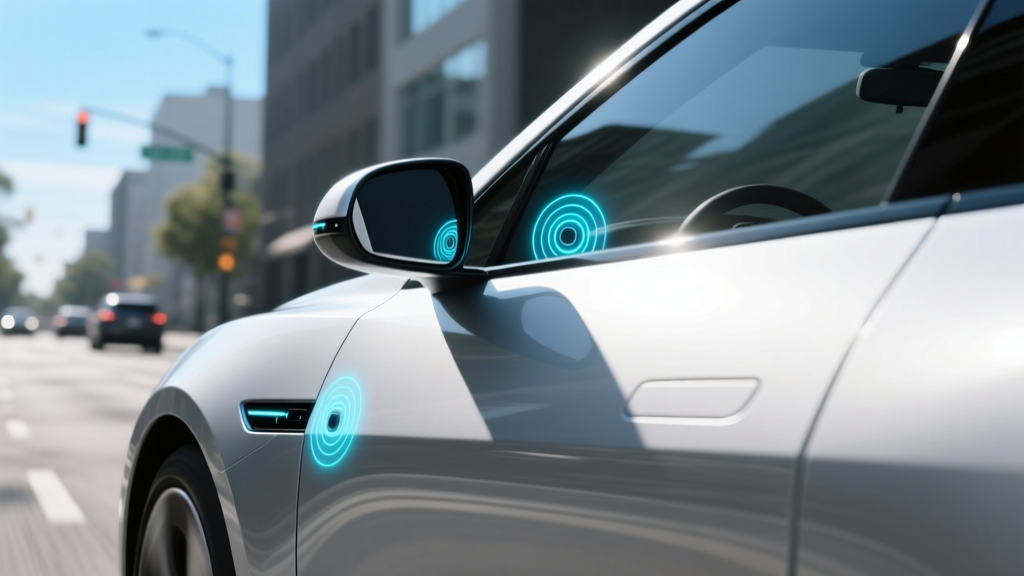
Most OEM blind-spot systems, including those on Tesla, Hyundai, Kia, Ford, and GM vehicles, rely on short-range 24 GHz or 77 GHz millimeter-wave radar modules mounted behind the rear bumper fascia or inside the rear quarter panels. These radar units emit electromagnetic waves that reflect off nearby objects, measuring distance, relative speed, and direction. A typical radar-based BSM covers a detection zone of approximately 10–15 feet to each side and 15–50 feet behind the rear bumper, activating at vehicle speeds above roughly 6–10 mph.
Camera-Based and Ultrasonic Approaches
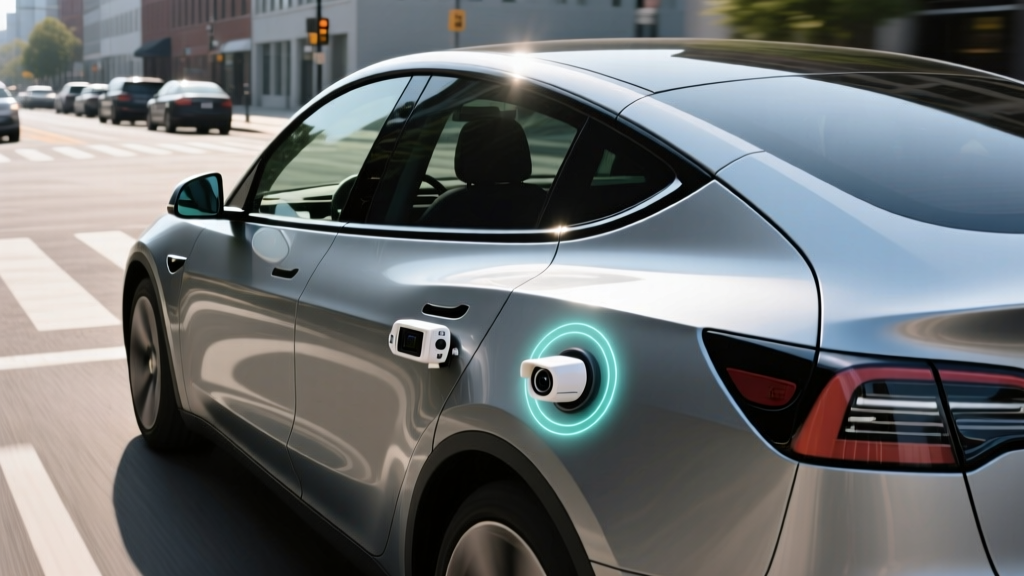
Some systems supplement radar with camera feeds. Hyundai's Blind-Spot View Monitor, for example, displays a live camera feed from a side-mounted camera in the digital instrument cluster when the turn signal is activated, giving the driver a direct visual of the blind zone. Tesla's camera-based visualization (part of its broader vision-only sensor suite since removing radar from Model 3 and Model Y in 2021–2022) uses its eight surround cameras to estimate nearby vehicle positions and render them on the central display.
Ultrasonic sensors, which operate at very short range (typically under 8 feet), are primarily used for parking assistance rather than highway-speed blind-spot detection, but they contribute to low-speed cross-traffic awareness.
⚙️ SAE Automation Level: Level 0–1 (Driver Support)
Blind-spot monitoring is classified as SAE Level 0 (warning-only) or Level 1 (when paired with active steering intervention like Blind-Spot Collision-Avoidance Assist). The driver remains fully responsible for all steering, braking, and lane-change decisions at all times. BSM does not constitute any form of automated driving — it is a warning and, at most, a momentary corrective nudge.
Feature Capability Breakdown: What BSM Actually Does
| Function | What It Does | Typical Activation Speed |
|---|---|---|
| Blind-Spot Warning (BSW) | Illuminates an LED indicator in the side mirror (or A-pillar) when a vehicle is detected in the blind zone | 6–10 mph+ |
| Blind-Spot Intervention / Collision-Avoidance | Applies brief corrective steering or differential braking if the driver attempts a lane change while a vehicle is detected | 20–25 mph+ |
| Rear Cross-Traffic Alert (RCTA) | Warns of approaching vehicles from either side when reversing out of a parking space | Reverse gear, under 5 mph |
| Blind-Spot Camera View | Displays live side-camera feed on the instrument cluster or center screen when turn signal is activated | Any speed (turn signal active) |
| Safe Exit Warning | Alerts occupants opening a door when a cyclist or vehicle is approaching from behind | Vehicle stationary |
Brand-by-Brand Naming and Availability in 2026 EVs
One of the most confusing aspects of ADAS shopping is that every automaker brands its blind-spot system differently. Here's how the major EV manufacturers handle BSM in current 2025–2026 model-year vehicles:
| Brand | Feature Name | Standard or Optional | Camera View Available? |
|---|---|---|---|
| Tesla (Model 3, Y, S, X) | Blind Spot Camera / Blind Spot Warning (under Autopilot suite) | Standard on all trims (camera-based, no radar) | Yes — on center display when turn signal activated |
| Hyundai (Ioniq 5, Ioniq 6) | Blind-Spot Collision-Avoidance Assist (BCA) + Blind-Spot View Monitor (BVM) | BCA standard on SEL and above; BVM on Limited | Yes — BVM shows in digital cluster with turn signal |
| Kia (EV6, EV9) | Blind-Spot Collision-Avoidance Assist + Safe Exit Assist | Standard on Wind trim and above | Yes — on cluster (EV9) or center screen (EV6) |
| Ford (Mustang Mach-E, F-150 Lightning) | BLIS (Blind Spot Information System) with Cross-Traffic Alert | Standard on Select trim and above (Mach-E); standard on XLT and above (Lightning) | No dedicated camera view |
| GM / Chevrolet (Equinox EV, Blazer EV, Silverado EV) | Side Blind Zone Alert + Rear Cross Traffic Alert | Standard on most trims (GM has been aggressive about standardizing ADAS) | No dedicated camera view; haptic seat alerts available |
| Rivian (R1S, R1T) | Blind Spot Warning + Rear Cross-Traffic Alert | Standard on all trims | Camera feed available in 360° surround view |
Cost note: Unlike full-speed adaptive cruise or lane-centering features that may require a subscription (e.g., Tesla's FSD at $99/month or GM's Super Cruise), blind-spot monitoring is a one-time included hardware feature on nearly every brand. You pay for it once as part of the trim level — there is no ongoing subscription for BSM itself.
Real-World Limitations: When Blind-Spot Systems Fail
⚠️ BSM Limitations Warning
Blind-spot monitoring is a supplement to, not a replacement for, proper mirror adjustment and over-the-shoulder checks. The following conditions degrade or defeat BSM performance:
- Heavy rain, snow, or ice accumulation on the rear bumper or quarter panels can block radar signals. In sustained freezing rain, radar-based BSM may disable entirely and display a "sensor blocked" warning.
- Motorcycles, bicycles, and pedestrians present smaller radar cross-sections and may not be reliably detected, especially at high relative speeds or at the far edge of the detection zone.
- Stationary objects (guardrails, parked cars, concrete barriers) are typically filtered out by the algorithm to reduce false alerts, meaning BSM will not warn about static hazards.
- Rapid lane changes by adjacent vehicles — if a car enters and exits your blind zone in under ~1 second, the system may not trigger a warning in time.
- Camera-based systems (like Tesla's vision-only approach) can be degraded by direct sun glare, lens dirt, fogging, or low-light conditions that radar-based systems handle more robustly.
- Trailer towing — the extended length of a trailer falls outside the calibrated detection zone on most factory BSM systems. Some trucks (Ford F-150 Lightning with trailer-tow package) offer extended blind-zone calibration, but it must be manually configured.
In IIHS testing, blind-spot monitoring systems have shown significant variation in detection range and response time across manufacturers. Radar-based systems from Hyundai, Kia, and GM consistently detect vehicles at greater distances and in heavier precipitation than camera-only approaches, though camera systems offer the advantage of providing a visual feed rather than just an indicator light.
Blind-Spot Monitoring vs. Full ADAS Suites: Where BSM Fits In
Blind-spot monitoring is frequently bundled into broader ADAS packages, and understanding how it relates to higher-level features prevents confusion when shopping for EVs.
BSM is a standalone, always-on safety feature that operates independently of lane-centering or adaptive cruise control. You do not need to engage Autopilot, BlueCruise, or any other highway-driving system for BSM to function. It activates automatically whenever the vehicle is above its minimum speed threshold.
However, in some ADAS suites, blind-spot data is integrated into lane-change assistance. For example:
- Tesla Autopilot (Level 2): When Autosteer is active, the system uses blind-spot camera data to inhibit automatic lane changes if a vehicle is detected. The driver must still initiate lane changes manually with the turn signal.
- GM Super Cruise (Level 2): On compatible mapped highways, Super Cruise can execute automatic lane changes, using blind-spot radar to confirm the adjacent lane is clear before initiating the maneuver. The driver must remain attentive (monitored via infrared eye-tracking camera on the steering column).
- Hyundai/Kia Highway Driving Assist 2 (Level 2): Includes lane-change assist that checks blind-spot radar before executing a driver-commanded lane change.
The key distinction: BSM alone warns you. When integrated into a Level 2 suite, it can also prevent a lane change or enable an assisted one. But in every case, the driver must remain engaged, hands on or near the wheel, eyes on the road.
Practical Tips: Maximizing BSM Effectiveness in Your EV
Based on real-world ownership and testing across multiple EV platforms, here are practical steps to get the most from your blind-spot system:
- Keep radar zones clean. On most EVs, the BSM radar modules are behind the rear bumper cover near the corners. Mud, snow buildup, and even thick road-salt residue can attenuate radar signals. Wipe these areas during winter washes.
- Don't disable BSM for "annoying" alerts. Some drivers turn off BSM because it triggers on guardrails or adjacent-lane traffic in curves. Instead, adjust sensitivity in vehicle settings (most systems offer a Normal/High sensitivity toggle) rather than disabling it entirely.
- Pair BSM with proper mirror adjustment. The SAE-recommended mirror setting — where you angle side mirrors outward until the side of your own car just disappears from view — minimizes the blind zone and gives BSM a complementary detection field rather than redundant coverage.
- Use the camera view when available. If your EV offers a blind-spot camera feed (Hyundai BVM, Tesla blind-spot camera, Rivian 360°), develop the habit of glancing at the display when changing lanes in dense traffic. A visual confirmation is faster and more informative than an LED indicator alone.
- Understand your vehicle's detection zone. Read your owner's manual for the specific lateral and longitudinal detection range. On the Kia EV9, for example, the BSM detection zone extends approximately 13 feet laterally and 50 feet rearward — larger than the EV6's zone due to the EV9's longer wheelbase and repositioned sensors.
Frequently Asked Questions
Where exactly are car blind spots on an EV versus a gas car?
The blind-spot geometry is essentially the same — it's determined by the vehicle's pillar design, mirror placement, and overall dimensions, not the powertrain. However, EVs tend to be slightly wider and heavier than comparable gas vehicles (due to battery packaging), which can marginally enlarge the rear-quarter blind zones. A Ford Mustang Mach-E, for instance, is roughly 2 inches wider than a similarly sized Ford Escape, slightly extending the lateral blind zone.
Is blind-spot monitoring the same as Tesla's Autopilot or FSD?
No. Blind-spot monitoring is a SAE Level 0–1 warning or intervention feature that operates independently. Tesla's Autopilot (standard) and Full Self-Driving Capability (optional, $99/month or $8,000 one-time) are SAE Level 2 combined lane-centering and adaptive cruise systems. BSM is a subset of sensor data that Autopilot may use, but BSM functions without Autopilot being engaged.
Does BSM work at low speeds in parking lots?
Standard blind-spot monitoring typically deactivates below 6–10 mph. However, Rear Cross-Traffic Alert (RCTA) — which uses the same radar sensors — is specifically designed for low-speed reversing and will detect vehicles approaching from the sides when backing out of a parking space. Many EVs also add front cross-traffic alert using front-corner radar or ultrasonic sensors.
Can aftermarket blind-spot systems match factory-installed ones?
Aftermarket BSM kits (typically $200–$500 installed) use simpler radar modules and LED indicators, but they lack the integration with the vehicle's CAN bus, turn signals, and stability control that factory systems have. Aftermarket units cannot provide active steering intervention or integrate with adaptive cruise. For EVs specifically, aftermarket installation is complicated by the lack of a traditional 12V accessory circuit in some architectures and the risk of interfering with high-voltage systems. Factory-equipped BSM is strongly preferred.
Which 2026 EVs include blind-spot monitoring on the base trim?
GM leads here — the Chevrolet Equinox EV includes Side Blind Zone Alert standard on the base LT trim (~$33,000 MSRP). Tesla includes blind-spot camera warnings on every Model 3 and Model Y regardless of trim. Most other brands require stepping up one trim level: Hyundai Ioniq 5 includes BCA from the SEL trim (~$44,000), and Kia EV6 includes it from the Wind trim (~$47,000). Always verify current-year trim specifications on the manufacturer's website, as packaging changes annually.