Understanding the Car Blind Spot Diagram: Where Sensors Can't See
Every vehicle has blind spots — those dangerous zones alongside and slightly behind your car where a neighboring vehicle disappears from your mirrors and peripheral vision. For EVs with thick A-pillars, aerodynamic bodywork, and tall battery platforms, these zones can be surprisingly large. A car blind spot diagram maps exactly where your sensors and mirrors lose coverage, and more importantly, where modern Blind Spot Monitoring (BSM) systems step in to fill the gaps.
In this guide, we break down how BSM works technically across today's leading EVs, what SAE automation level it occupies, where it falls short in the real world, and what it actually costs to get it on your next electric vehicle.
Blind Spot Monitoring is classified as an SAE Level 0 (warning-only) or Level 1 (active intervention, such as blind spot steering assist) feature. It is not self-driving. The driver remains fully responsible for lane changes and must visually confirm the lane is clear before merging. No production BSM system can autonomously steer, brake, or navigate without driver engagement.
How Blind Spot Monitoring Actually Works: Radar, Cameras, and Ultrasonics
Modern BSM systems rely on a sensor fusion approach, combining multiple detection technologies to build a real-time picture of the zones flanking your vehicle.
Radar-Based Detection (Most Common)
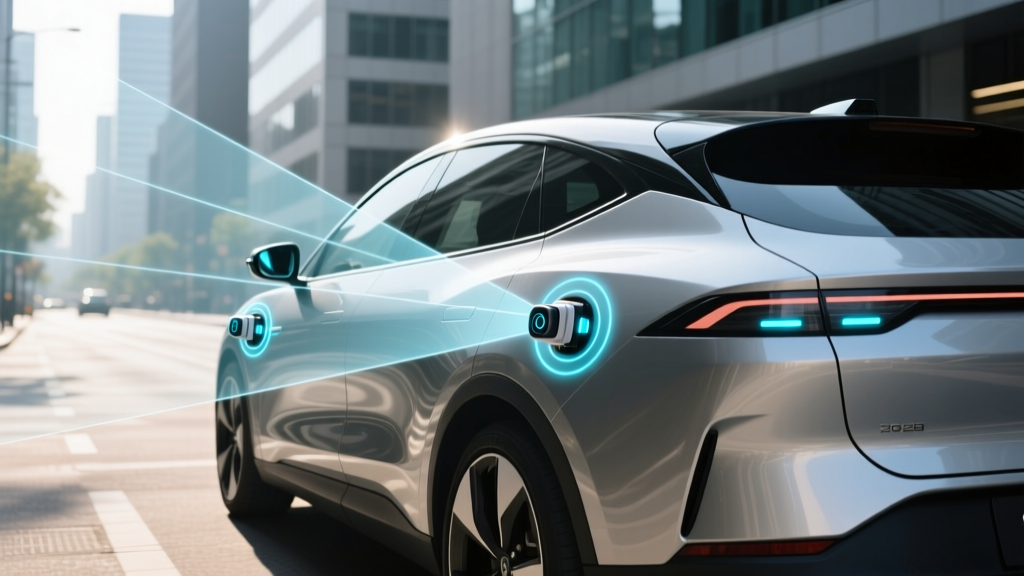
The majority of production BSM systems use two rear-mounted 24 GHz or 77 GHz millimeter-wave radar units positioned behind the rear bumper cover. These radar sensors emit electromagnetic waves in a fan-shaped pattern extending approximately 10–15 feet laterally and 30–50 feet rearward from each quarter panel. When a vehicle enters this detection zone, the reflected signal triggers a visual indicator — typically an amber LED embedded in the side mirror housing.
Radar excels in rain, fog, and darkness because it does not depend on visible light. However, it can struggle to differentiate closely spaced objects (a motorcycle beside a truck, for instance) and may produce false positives from guardrails or roadside barriers on tight curves.
Camera-Based Augmentation
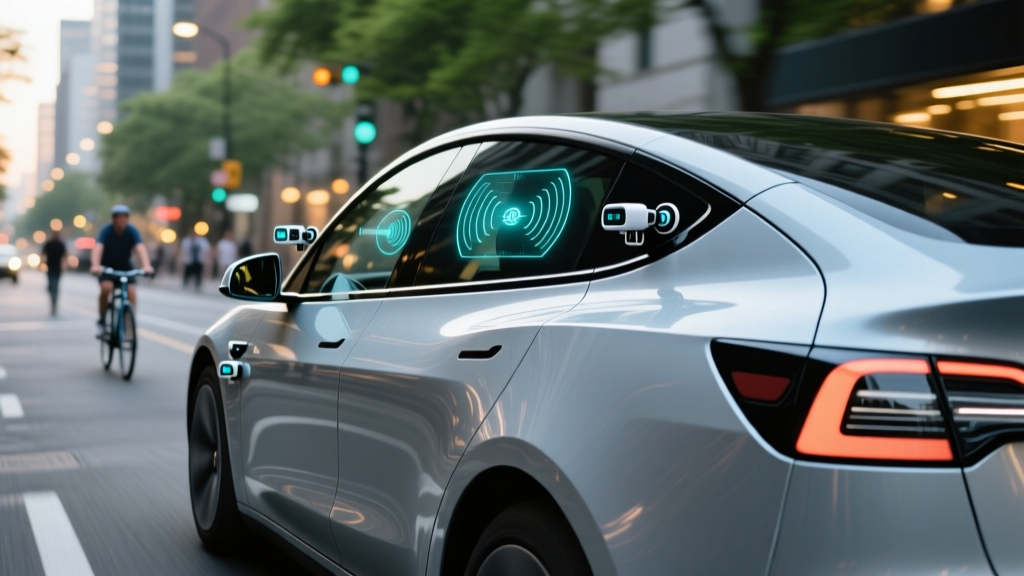
Higher-tier systems layer in side-view cameras mounted beneath the mirror housings. Tesla's camera-only vision suite, for example, uses its repeater cameras (mounted on the front fenders) to feed object-detection neural networks that identify vehicles, cyclists, and pedestrians in the blind spot zone. Camera systems provide richer classification data (vehicle vs. bicycle vs. pedestrian) but degrade in heavy rain, direct sun glare, and when lenses are obscured by road grime.
Ultrasonic Proximity Sensors
Short-range ultrasonic sensors (the small circular elements visible on many bumpers) supplement BSM at very low speeds — typically below 15 mph — to detect objects in tight parking or lane-merge scenarios. These have a range of roughly 8–10 feet and are not a substitute for radar at highway speeds.
| Technology | Typical Range | Strengths | Weaknesses |
|---|---|---|---|
| 77 GHz Radar | 30–50 ft rearward, 10–15 ft lateral | Works in rain, fog, dark; reliable object detection | Poor classification; curve false positives |
| Side Cameras | 20–40 ft lateral/rearward | Classifies object type; feeds ADAS neural nets | Degrades in rain, glare, dirty lenses |
| Ultrasonic | 8–10 ft (low speed only) | Precise at parking speeds; low cost | Useless above ~15 mph; short range |
Mapping the Zones: A Car Blind Spot Diagram Explained
A standard car blind spot diagram reveals three critical detection areas that BSM systems are designed to cover:
- Near-Side Blind Zone (Adjacent Lane): The area from roughly your vehicle's B-pillar back to about 30 feet behind your rear bumper, spanning one lane width (~12 feet). This is where a vehicle traveling at a similar speed can be entirely invisible in your side mirror.
- Rear Cross-Traffic Zone: Directly behind and to either side when reversing — critical in parking lots. Rear Cross-Traffic Alert (RCTA) uses the same radar sensors to detect approaching vehicles from either side when backing up.
- Rear Corner Approach Zone: Extending 50+ feet behind at highway speeds, detecting fast-approaching vehicles in adjacent lanes that may not yet be visible but will enter your blind zone within seconds.
For EVs specifically, the blind spot profile differs from traditional sedans. The Tesla Model Y, for instance, has relatively slim A-pillars but a tall ride height and thick D-pillars that create a substantial rear-quarter blind zone. The Hyundai Ioniq 5 features a camera-based Digital Side Mirror option (in select markets) that replaces mirror glass with a camera feed displayed on the door panel, effectively eliminating the traditional blind spot at the cost of an adjustment period for drivers accustomed to mirror reflections.
Blind Spot Monitoring Across EV Brands: What's Standard vs. Optional
| Brand | Feature Name | Standard Trims | Active Intervention? | Cost |
|---|---|---|---|---|
| Tesla | Blind Spot Camera / Blind Spot Collision Warning | All models (camera-only vision) | Warning + steering nudge (no FSD required) | Included |
| Hyundai / Kia | Blind-Spot Collision-Avoidance Assist (BCA) | SEL trim and above (Ioniq 5, EV6, EV9) | Yes — active braking/steering correction | Included in SEL+ trims |
| Ford | BLIS (Blind Spot Information System) with Cross-Traffic Alert | Standard on Mustang Mach-E, F-150 Lightning XLT+ | Warning only; steering assist on Lariat+ | Included; BlueCruise adds lane-centering layer |
| Chevrolet | Side Blind Zone Alert / Rear Cross Traffic Alert | Equinox EV 2LT+, Blazer EV RS, Silverado EV WT fleet optional | Warning only | Included in 2LT+; Super Cruise models add enhanced BSM |
| BMW | Active Blind Spot Detection | Standard on i4, i5, iX (all trims) | Yes — active steering correction | Included |
| Rivian | Blind Spot Warning + Rear Cross-Traffic | Standard on R1S and R1T (all trims) | Warning + haptic steering feedback | Included |
Notably, BSM is one of the few ADAS features that most automakers include at no additional cost on mid-to-high trims. Unlike GM's Super Cruise or Tesla's Full Self-Driving (Supervised), blind spot monitoring is not typically bundled behind a paywall or subscription.
Real-World Limitations: When Blind Spot Monitoring Fails
- Sensor obstruction: Mud, ice, snow, or heavy road grime on the rear bumper can block radar signals entirely. Always clear sensor areas in winter conditions.
- High-speed differentials: A vehicle approaching at 30+ mph faster than you (common on highways with 75–85 mph speed limits) may enter and exit the blind zone faster than the system can alert you.
- Motorcycles and bicycles: Narrow-profile objects are harder for radar to detect reliably. Some camera-based systems (Tesla, BMW) classify these better, but detection is not guaranteed.
- Curved roads: Radar may reflect off guardrails, concrete barriers, or adjacent parked vehicles on tight curves, generating phantom alerts.
- Towing: Attaching a trailer to your EV (e.g., F-150 Lightning, Rivian R1T) physically blocks rear radar sensors. Most systems disable BSM automatically when a trailer harness is connected, but verify this in your owner's manual.
- Adjacent-lane stationary objects: BSM is designed for moving vehicles. A parked car or construction barrier in your blind zone may not trigger an alert.
According to IIHS research, blind spot monitoring reduces lane-change crashes with injuries by approximately 23%, but the organization emphasizes that the feature is a supplement to — not a replacement for — proper mirror adjustment and shoulder checks.
Blind Spot Monitoring vs. Full ADAS Suites: Where It Fits
BSM is often bundled within broader ADAS packages, but it serves a distinctly different purpose than lane-centering or adaptive cruise control:
- Blind Spot Monitoring (BSM/BCA/BLIS): Warns or intervenes during lane changes only. Active below ~100 mph. SAE Level 0–1.
- Lane Keep Assist (LKA): Steers the vehicle back into its lane if drifting without a turn signal. SAE Level 1.
- Adaptive Cruise Control (ACC): Maintains set speed and following distance. SAE Level 1.
- Lane Centering + ACC (e.g., Autopilot, BlueCruise, Super Cruise): Combined lateral and longitudinal control. SAE Level 2 — still requires full driver supervision.
The critical distinction: even when BSM is active within a Level 2 system like Tesla Autopilot or Ford BlueCruise, the lane-change decision remains yours. Autopilot's auto-lane-change feature (part of the FSD Supervised package at $8,000 one-time or $99/month) will suggest or execute lane changes, but Tesla explicitly states the driver must confirm and supervise every maneuver. According to the NHTSA, no consumer vehicle sold in the United States is legally autonomous.
| System | BSM Included? | Purchase Price | Subscription Option | SAE Level |
|---|---|---|---|---|
| Standard BSM (Hyundai, Ford, BMW, Rivian) | Yes | Included in mid+ trims ($0 add-on) | N/A | Level 0–1 |
| Tesla Autopilot (base) | Yes (camera-based) | Included on all Teslas | N/A | Level 2 |
| Tesla FSD (Supervised) | Yes + auto lane change | $8,000 one-time | $99/month | Level 2 (supervised) |
| Ford BlueCruise 1.4 | Yes + hands-free lane change | Included on select trims | $75/month or $800/year | Level 2 (hands-free on mapped highways) |
| GM Super Cruise | Yes + auto lane change | Included on equipped trims | $25/month after 3-year trial | Level 2 (hands-free on 750K+ mi mapped roads) |
Which EVs Offer the Best Blind Spot Coverage in 2026?
Based on our testing and IIHS safety evaluations, the EVs with the most robust BSM implementations for the 2026 model year include:
- Hyundai Ioniq 5 / Kia EV6 (SEL and above): BCA provides active steering correction that gently nudges the vehicle back into its lane if a turn signal is activated while a vehicle occupies the blind zone. The available Blind-Spot View Monitor projects a camera feed into the digital instrument cluster when the turn signal is engaged — effectively giving you a real-time car blind spot diagram overlay of the adjacent lane.
- BMW i5 / iX: Active Blind Spot Detection is standard across all trims and pairs with the optional Driving Assistant Professional for coordinated lane-change intervention. The system's 77 GHz radar provides reliable detection in heavy rain and snow.
- Rivian R1S / R1T: Standard BSM with haptic feedback through the steering wheel. The R1T's long bed creates an unusually large rear blind zone, making the system particularly valuable — though it disables when towing a trailer.
- Tesla Model Y / Model 3 (refreshed): Camera-based BSM visualizes the blind spot directly on the central touchscreen when the turn signal is activated. No radar, which means performance can degrade in heavy rain or when camera lenses are dirty.
Frequently Asked Questions
What does blind spot monitoring actually do while driving?
BSM continuously scans the lanes beside and behind your vehicle using radar or cameras. When another vehicle enters your blind zone, a warning light illuminates in or near your side mirror. If you activate your turn signal while a vehicle is detected, the warning typically escalates — flashing, chiming, or providing a steering-wheel vibration. Active systems (like Hyundai's BCA or BMW's Active Blind Spot Detection) can apply gentle corrective steering or braking to prevent a collision.
Is blind spot monitoring the same as self-driving?
No. BSM is an SAE Level 0 (warning) or Level 1 (active assist) feature. It does not steer, accelerate, or brake the vehicle autonomously. You remain fully responsible for every lane change. Even when BSM is integrated into a Level 2 system like Tesla Autopilot or Ford BlueCruise, the driver must stay engaged, keep hands on or near the wheel, and monitor the road at all times. Only Waymo and Zoox robotaxi services operate at SAE Level 4 — and those are not available for consumer purchase.
How much does blind spot monitoring cost on an EV?
On most 2026 EVs, BSM is included at no extra charge on mid-level trims and above. It is not typically a subscription feature. The cost is baked into the vehicle's trim price — for example, the Hyundai Ioniq 5 SEL starts at approximately $46,500 MSRP and includes BCA standard. If you want BSM bundled with a broader Level 2 ADAS suite, costs rise: Tesla FSD (Supervised) is $8,000 or $99/month, and Ford BlueCruise requires a $75/month or $800/year subscription after any included trial period.
Which EV trims include blind spot monitoring as standard?
For 2026, BSM is standard on: all Tesla models (via camera vision), Hyundai Ioniq 5 SEL and above, Kia EV6 Wind and above, Ford Mustang Mach-E Select and above, BMW i4/i5/iX (all trims), Rivian R1S/R1T (all trims), and Chevrolet Equinox EV 2LT and above. Base trims of the Chevy Equinox EV (2LT below) and some fleet-oriented Silverado EV configurations may not include it — always verify the window sticker.
What are the real-world limitations I should know about?
BSM can fail or produce false alerts in several scenarios: when rear bumper sensors are covered in ice, mud, or snow; on sharply curved roads where radar reflects off barriers; at extreme speed differentials (a fast-approaching vehicle may pass through the zone faster than the alert triggers); with motorcycles and bicycles that present a narrow radar profile; and when towing a trailer that physically blocks the sensors. BSM does not detect stationary objects like parked cars or construction barriers. Always perform a shoulder check before changing lanes — BSM is a supplement, not a substitute.
Does BSM work differently on EVs than on gas cars?
The sensor technology is identical. However, EVs can present unique blind spot profiles due to their platform design — battery packs raise the floor height, aerodynamic optimization can create thicker rear pillars, and some EVs (like the Hyundai Ioniq 5) offer digital camera mirrors that replace traditional glass. Additionally, EVs' near-silent operation at low speeds means pedestrians and cyclists may not hear you approaching, making camera-based BSM systems that detect vulnerable road users particularly valuable.
For the most current safety ratings and ADAS evaluations, consult the Insurance Institute for Highway Safety and NHTSA before purchasing. Blind spot monitoring is one of the most effective passive safety features available on modern EVs — but it works best when you understand exactly what it can and cannot see.