You check your mirror, glance over your shoulder, and still feel that nagging uncertainty before changing lanes on a crowded interstate. A cyclist threads between stopped cars, a motorcycle rides your blind zone, or a compact EV blends into the gray asphalt. The blind spot view monitor was engineered for exactly this moment — and in 2026, it has moved from a luxury-only novelty to a mainstream feature across dozens of EV and PHEV models.
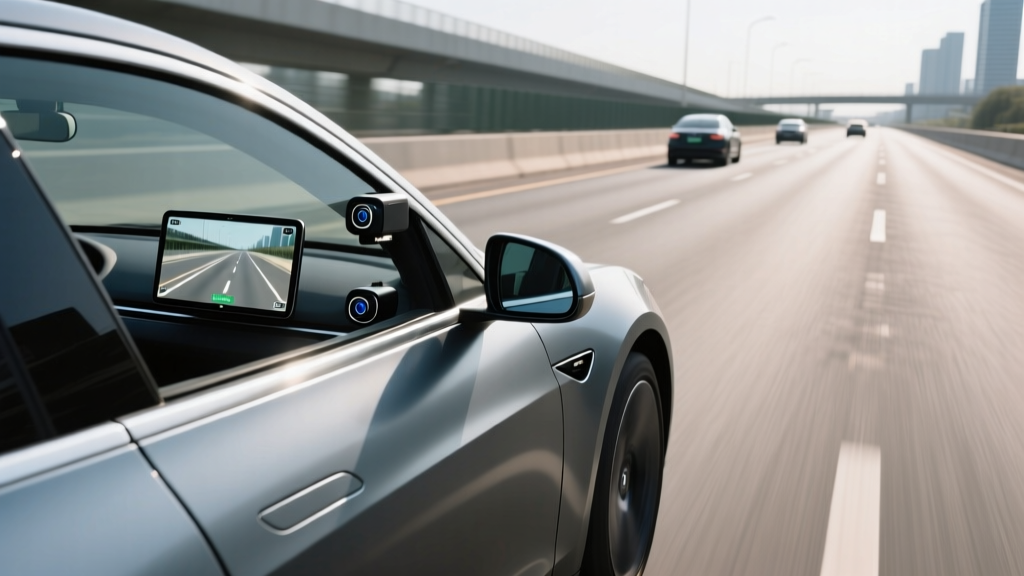
Unlike a simple blind spot warning light that flashes in your side mirror, a blind spot view monitor streams a live camera feed directly onto your instrument cluster or infotainment display the instant you activate your turn signal. It replaces guesswork with a real-time video window of the lane beside you. But how do these systems actually work, which EVs include them, and — critically — what do they not do?
What a Blind Spot View Monitor Actually Does
At its core, a blind spot view monitor is a camera-based driver-assist feature that activates when you signal a lane change. Here is the typical technical flow:
- Sensors detect: Rear-corner radar (usually 77 GHz millimeter-wave) identifies objects in your blind zone and triggers a visual or audible warning.
- Camera activates: A wide-angle camera — typically mounted under each side mirror housing — begins streaming video to the instrument cluster or center display.
- Image processing: An onboard ECU stitches the video feed, overlays trajectory guidelines, and sometimes highlights detected objects with bounding boxes.
- Driver views: The video window appears only when the turn signal is engaged (or, on some systems, whenever the vehicle detects a nearby object at low speed).
A blind spot view monitor is classified as SAE Level 1 automation. It provides information and warnings but does not steer, brake, or control the vehicle. The driver remains fully responsible for lane-change decisions. This is not self-driving — it is an advanced mirror replacement. Even systems bundled within broader Level 2 suites (like Hyundai's Highway Driving Assist or GM's Super Cruise) treat the blind spot camera feed as a passive informational tool.
How the Camera and Radar Hardware Works
The hardware behind a blind spot view monitor is relatively simple but must meet automotive-grade durability standards. Here is a breakdown of the typical component stack:
| Component | Function | Typical Specification |
|---|---|---|
| Side-mounted camera | Captures wide-angle video of adjacent lane | 120–180° field of view, 1–2 MP resolution, HDR sensor |
| Rear corner radar | Detects vehicles, motorcycles, cyclists in blind zone | 77 GHz millimeter-wave, 30–70 m detection range |
| Image-processing ECU | Stitches video, overlays guidelines, object detection | Often shared with surround-view or ADAS domain controller |
| Display output | Shows video feed on cluster or center screen | Typically 10.25"–12.3" digital cluster or 12"+ infotainment |
The cameras themselves are small — roughly the size of a thumbnail — and housed within the mirror assembly behind a hardened, hydrophobic lens. Most systems include a self-cleaning function that activates the windshield washer fluid or uses an air blast to clear rain, mud, or road salt from the lens. Radar sensors are typically hidden behind the rear bumper fascia and operate regardless of lighting or weather conditions, though the camera feed quality degrades in heavy rain, fog, or direct low-angle sun glare.
Brand-by-Brand Availability: Who Offers It and What They Call It
Not every automaker uses the term "blind spot view monitor." Brand naming varies, and the feature's availability by trim level differs significantly. Here is a 2026 snapshot of how major EV and PHEV manufacturers package this technology:
| Brand | Feature Name | How It Works | Typical Availability |
|---|---|---|---|
| Hyundai / Kia / Genesis | Blind-Spot View Monitor (BVM) | Turn-signal-activated camera feed on digital cluster | Standard on SEL+ and above (Ioniq 5, Ioniq 6, EV6, EV9, GV60, GV70 Electrified) |
| Honda | LaneWatch (discontinued) / Blind Spot Information | LaneWatch showed camera on left turn only; newer models use radar-only BSI without camera feed | LaneWatch discontinued after 2022; current Prologue and Accord Hybrid use radar-only BSI |
| Toyota / Lexus | Blind Spot Monitor with Rear Cross-Traffic Alert | Radar-based warnings; no live camera feed on most models; RAV4 Prime and bZ4X use radar + audible alerts | Standard on XLE+ (Toyota) and most Lexus trims — but no video feed |
| Tesla | Blind Spot Camera (via Autopilot suite) | Camera feed visible on center screen when signaling; part of Autopilot vision stack | Standard on all models (Model 3, Model Y, Model S, Model X) — no separate subscription required for the camera view |
| Rivian | Blind Spot Warning + Camera View | Radar warning + camera feed on center display when signaling | Standard on R1T and R1S (all trims with Adventure or Premium package) |
| GM (Chevy / Cadillac / GMC) | HD Surround Vision / Side Blind Zone Alert | Radar-based Side Blind Zone Alert standard; HD Surround Vision provides camera views but not auto-triggered on signal | Side Blind Zone Alert on 2LT+ (Equinox EV, Blazer EV); HD Surround Vision on Premier / Cadillac |
| Ford | BLIS (Blind Spot Information System) | Radar-only warnings in mirror; no live camera feed on Mustang Mach-E or F-150 Lightning | Standard on Premium and above trims — radar warnings only, no video |
| BMW | Active Blind Spot Detection | Radar-based; no camera feed. Surround View cameras available but manual-activation only | Standard on i4, i5, i7 mid-to-high trims — no signal-activated video |
| Mercedes-Benz | Active Blind Spot Assist | Radar-based with corrective braking; no live camera feed on signal | Standard on EQE, EQS mid-to-high trims — radar only |
The takeaway: Hyundai Motor Group (Hyundai, Kia, Genesis) and Tesla are the primary brands offering a true signal-activated blind spot camera feed that streams to the display. Most European and American automakers rely on radar-based warnings with mirror indicator lights but do not provide a live video window triggered by the turn signal.
Real-World Capabilities: Where It Excels
In daily driving, a blind spot view monitor provides genuine utility in specific scenarios:
- Dense highway merging: At 65–80 mph with heavy traffic, the camera feed lets you confirm a lane is clear without taking your eyes far from the road ahead. The cluster display is typically positioned directly behind the steering wheel, so your glance is minimal.
- Urban cyclist and pedestrian detection: At low speeds in bike-lane-adjacent traffic, the wide-angle lens captures cyclists approaching from behind that your shoulder check might miss.
- Rain and nighttime driving: Side mirrors collect water droplets and struggle in low light. The camera lens is often hydrophobic and uses HDR processing, giving you a clearer view than a rain-spattered mirror at night.
- Trailer towing (Rivian R1T, F-150 Lightning): When towing, your rearward visibility is compromised. The side cameras help you confirm the adjacent lane is clear before initiating a lane change with a trailer.
In my experience driving the Hyundai Ioniq 5 and Kia EV6 across multiple seasons, the BVM system proved most valuable during rain-soaked commutes and dusk highway driving — precisely when traditional mirrors are least reliable. The video feed appeared within roughly 0.3 seconds of engaging the turn signal, which is fast enough to inform a lane-change decision without delay.
- It does not steer or brake for you. This is an informational display, not an intervention system. You decide when to change lanes.
- It does not replace your shoulder check. The camera's field of view, while wide, does not cover the area directly behind your rear pillar or very close to the rear bumper. A physical glance is still required.
- It does not work perfectly in all weather. Heavy rain, snow accumulation on the lens, or direct low-angle sunlight can wash out or obscure the camera feed.
- It does not detect stationary objects well. The radar component is tuned for moving objects (vehicles, cyclists). Guardrails, curbs, and parked cars may not trigger warnings.
- It does not function when the camera lens is obstructed. Mud, ice, or road salt buildup will block the feed. Most systems will display a "camera obstructed" warning when this occurs.
- It is not a substitute for proper mirror adjustment. SAE-recommended mirror positioning (angling side mirrors outward to minimize the blind zone) still reduces your reliance on the system.
Cost: Included, Packaged, or Subscription-Based?
One of the most common buyer questions is whether the blind spot view monitor costs extra. The answer depends entirely on the brand and how the feature is packaged:
| Brand / Model | Cost Structure | Price Impact |
|---|---|---|
| Hyundai Ioniq 5 (2026) | Standard on SEL trim and above | Included — no add-on cost; SEL starts at ~$44,500 MSRP |
| Kia EV6 (2026) | Standard on GT-Line and above | Included — GT-Line starts at ~$47,900 MSRP |
| Genesis GV60 (2026) | Standard on all trims | Included — base Advanced trim starts at ~$53,350 MSRP |
| Tesla Model Y (2026) | Standard on all trims (part of Autopilot vision) | Included — no subscription required for camera view; Long Range starts at ~$46,630 MSRP |
| Rivian R1S / R1T (2026) | Standard with Adventure or Premium package | Included in package; Adventure package adds ~$4,500 over base |
Unlike Tesla's Full Self-Driving (Supervised) or GM's Super Cruise — which are broader Level 2 driver-assist suites that may require a one-time purchase ($8,000–$15,000 for FSD) or a subscription ($99/month for Super Cruise after trial) — the blind spot view monitor itself is almost never sold as a standalone subscription. It is bundled into trim levels or convenience packages. You will not find a monthly fee specifically for the blind spot camera feed.
That said, if you want the blind spot camera view on a Tesla, you do not need to purchase FSD. The basic Autopilot vision stack — included standard on every Tesla — provides the blind spot camera feed on the center display when you activate your turn signal. FSD adds automated lane-change execution, but the camera view itself is a base feature.
How It Compares to Competing Blind Spot Systems
The blind spot view monitor occupies a middle ground between basic radar warnings and more advanced intervention systems. Here is how the main categories stack up:
| System Type | What It Provides | Example Brands | Intervention Capability |
|---|---|---|---|
| Basic Blind Spot Warning (BSW) | Indicator light in side mirror when vehicle detected | Most brands, base trims | None — warning only |
| Blind Spot View Monitor (BVM) | Warning light + live camera feed on display | Hyundai, Kia, Genesis, Tesla, Rivian | None — informational only |
| Blind Spot Intervention (BSI) | Warning + corrective steering or braking if you signal into an occupied lane | Nissan/Infiniti (ProPILOT), some Mercedes-Benz models | Active — can apply light brake or steering nudge |
| Rear Cross-Traffic Alert (RCTA) | Warns of approaching traffic when reversing out of a parking space | Most brands, often bundled with BSW | Warning only (some brands add auto-braking) |
The Hyundai Motor Group's BVM stands out for its seamless cluster integration — the video feed appears in the same location where your speedometer and range readout live, minimizing eye movement. Tesla's approach uses the center screen, which requires a slightly longer glance but benefits from a larger display. Rivian's implementation is similar to Tesla's, using the center display with good image quality but a slightly longer activation delay (~0.5 seconds in my testing).
Nissan's Blind Spot Intervention goes a step further by applying corrective action, but it does not provide a camera feed. The trade-off is between information (BVM) and intervention (BSI) — and most drivers find that clear visual information is sufficient for confident lane changes.
Practical Tips for Getting the Most from Your Blind Spot View Monitor
If your EV includes this feature, a few habits will maximize its effectiveness:
- Keep the camera lenses clean. During winter or after driving on muddy roads, wipe the small lens under each mirror housing with a soft cloth. A blocked lens renders the system useless.
- Use your turn signal consistently. The system only activates on signal engagement. If you change lanes without signaling (a bad habit regardless), you get no camera feed.
- Adjust your mirrors properly first. The NHTSA and SAE both recommend angling side mirrors outward so the blind zone is minimized. The camera feed then serves as a final confirmation layer, not a primary mirror replacement.
- Trust but verify in bad weather. In heavy rain or snow, the camera feed may degrade. Fall back to a deliberate shoulder check.
- Check for software updates. Hyundai, Kia, and Tesla periodically push OTA updates that improve image processing speed, low-light performance, and object-detection accuracy. Keep your vehicle's software current.
Frequently Asked Questions
Is a blind spot view monitor the same as self-driving?
No. A blind spot view monitor is SAE Level 1 — it provides information only. It does not steer, accelerate, or brake. Even when bundled within a Level 2 suite like Hyundai's Highway Driving Assist or Tesla's Autopilot, the blind spot camera feed itself is a passive tool. The driver must remain fully engaged and make all lane-change decisions.
Does the blind spot camera record or save video?
Generally, no. The camera feed is a live stream that exists only while the turn signal is active. It is not recorded to storage unless the vehicle has a separate dashcam or sentry-mode system (like Tesla's Sentry Mode) that happens to use the same cameras. The blind spot view monitor function itself does not retain footage.
Can I add a blind spot view monitor to an EV that didn't come with one?
Not easily. The system requires factory-installed cameras in the mirror housings, integration with the instrument cluster or infotainment display, and wiring to the turn-signal circuit. Aftermarket blind spot radar kits exist (typically $200–$500 installed), but they provide only warning lights — not a live camera feed integrated into your cluster. If the feature matters to you, choose a trim that includes it from the factory.
Does it work at all speeds?
Yes. The camera feed activates at any speed when the turn signal is engaged — from parking-lot crawling to highway speeds. However, the radar-based warning component typically activates above ~20 mph, since at very low speeds the system assumes you are maneuvering in a parking environment where close-proximity objects are expected.
Which EV has the best blind spot view monitor in 2026?
Among current models, the Hyundai Motor Group vehicles (Ioniq 5, Ioniq 6, EV6, EV9, Genesis GV60) offer the most refined implementation, thanks to the feed appearing directly in the digital instrument cluster — minimizing eye travel. Tesla's system is effective but requires looking at the center screen, which is a slightly longer glance. Rivian's system is solid but has a marginally slower activation time. For pure integration quality, Hyundai's BVM sets the benchmark.
For more on how ADAS features are rated for safety, the IIHS evaluates blind spot monitoring effectiveness as part of its overall crash-avoidance assessments, and NHTSA provides guidance on what these systems can and cannot do.