What a Blind Spot Monitoring System for Your Car Actually Does
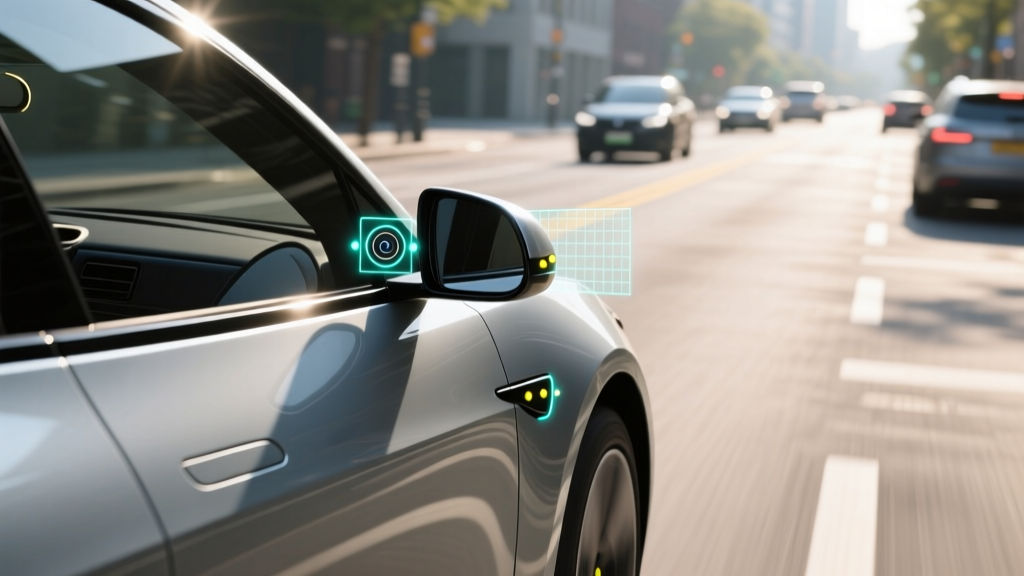
A blind spot monitoring (BSM) system uses sensors to detect vehicles traveling in adjacent lanes that fall outside the driver's natural field of vision — typically the zones just behind and beside your rear quarter panels. When a vehicle enters that zone, the system triggers a visual alert, usually an illuminated icon embedded in or near the side mirror. If you activate your turn signal while a vehicle is detected, the alert escalates to a flashing indicator and, in most modern implementations, an audible chime or steering-wheel haptic pulse.
In 2026, blind spot monitoring is no longer a luxury-only feature. The Insurance Institute for Highway Safety (IIHS) now requires effective BSM as part of its TOP SAFETY PICK criteria, and the National Highway Traffic Safety Administration (NHTSA) has finalized rulemaking mandating BSM on all new light vehicles sold in the U.S. by model year 2028. For EV buyers, the good news is that most electric vehicles already ship with BSM standard on mid-to-high trims — and several include it across the entire lineup.
Blind spot monitoring is classified as an SAE Level 1 driver-assistance feature. It provides warnings and, in some implementations, brief steering or braking interventions — but the driver remains fully responsible for lane-change decisions at all times. Even when paired with a Level 2 system like adaptive cruise + lane centering, BSM does not make the vehicle autonomous. You are the driver. Stay engaged.
How Blind Spot Detection Works: Radar, Cameras, and Ultrasonics
There are two dominant sensor architectures for BSM in production vehicles today, and the choice affects detection range, weather resilience, and cost.
Rear-Corner Radar (Most Common)
The majority of 2026 EVs — including Tesla, Hyundai/Kia, Ford, BMW, and Rivian — use 77 GHz millimeter-wave radar modules mounted behind the rear bumper fascia, one on each corner. These radar units emit electromagnetic waves and measure the reflected signal to determine the distance, speed, and angle of nearby objects.
Detection zone: Typically 3–5 meters laterally and up to 30–50 meters rearward. Some systems (BMW's Active Blind Spot Detection, Mercedes-Benz's Active Blind Spot Assist) extend the rearward detection zone to 60+ meters at highway speeds to catch fast-approaching vehicles.
Advantage: Radar penetrates rain, fog, snow, and darkness with minimal degradation. It works regardless of ambient lighting.
Limitation: Radar cannot classify object types (car vs. motorcycle vs. cyclist) as precisely as camera-based systems, though sensor-fusion algorithms in 2026 models have narrowed this gap significantly.
Camera-Based Systems
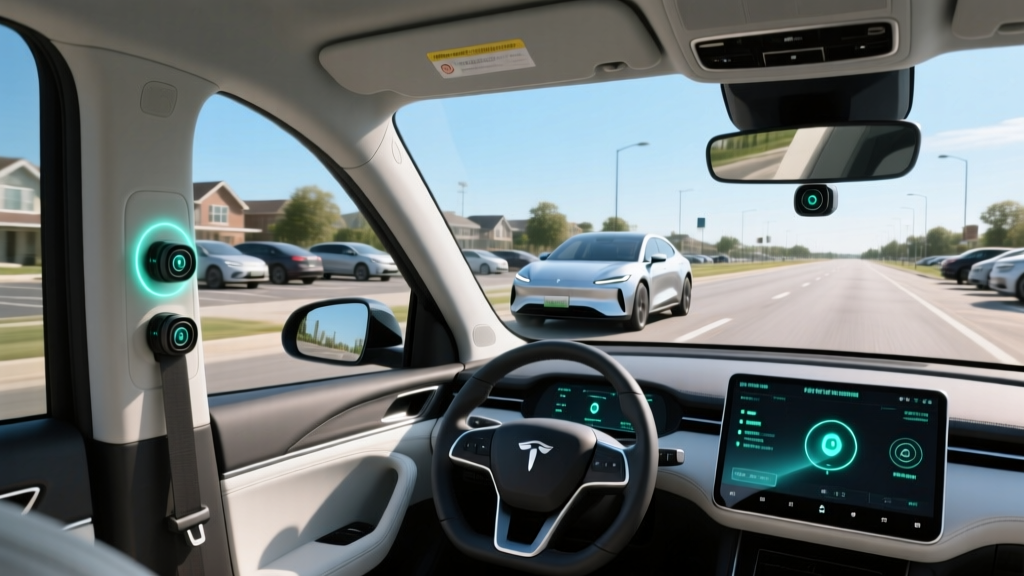
A smaller number of vehicles supplement or replace radar with wide-angle cameras mounted under the side mirrors or in the rear bumper. Tesla's vision-only approach (post-2022) uses its side-repeater and rear cameras to run neural-network object detection for blind spot alerts. The advantage is richer object classification; the trade-off is reduced performance in heavy rain, direct sun glare, or when camera lenses are obscured by road grime or ice.
Ultrasonic Sensors (Close-Range Supplement)
Ultrasonic sensors — the small circular transducers visible on many bumpers — operate at very short range (under 5 meters) and low speed. They're used primarily for parking assistance and may supplement BSM during low-speed lane changes in city traffic, but they are not the primary blind spot detection mechanism at highway speeds.
| Sensor Type | Typical Range | Weather Resilience | Object Classification | Used By |
|---|---|---|---|---|
| 77 GHz Radar | 30–60 m rearward | Excellent (rain, fog, night) | Good (improving with fusion) | Hyundai, Kia, Ford, BMW, Rivian, GM |
| Camera (Vision-Only) | 20–40 m rearward | Moderate (degraded by grime, glare) | Excellent (neural net classification) | Tesla |
| Ultrasonic (Supplement) | <5 m | Good (short range) | Limited | Most brands (parking + low-speed BSM) |
Brand-by-Brand: What It's Called and Which Trims Include It
Every automaker brands its blind spot monitoring system differently, and availability varies by trim. Here's how the major EV brands handle BSM in the 2026 model year.
| Brand | Feature Name | Standard On | Notes |
|---|---|---|---|
| Tesla | Blind Spot Camera / Collision Chime | All models (Model 3, Y, S, X, Cybertruck) | Vision-only; displays camera feed on screen when turn signal activated. No radar since HW4 transition. |
| Hyundai / Kia / Genesis | Blind-Spot Collision-Avoidance Assist (BCA) | SEL trim and above (Ioniq 5, Ioniq 6, EV6, EV9, GV60) | Includes active steering intervention — can apply brake to individual wheel to prevent lane-change collision. Base SE trims get warning-only BSW. |
| Ford | BLIS (Blind Spot Information System) with Cross-Traffic Alert | Standard on Mustang Mach-E (all trims), F-150 Lightning (XLT and above) | Includes trailer coverage on F-150 Lightning when towing. Cross-traffic alert activates in reverse. |
| GM (Chevrolet / Cadillac) | Side Blind Zone Alert / Rear Cross Traffic Alert | Standard on Cadillac Lyriq (all trims); Equinox EV 2LT and above | Haptic seat-pulse alert on Cadillac models — vibrates the driver's seat side instead of audible chime. |
| BMW | Active Blind Spot Detection | Standard on i4, i5, i7, iX (all trims) | Includes active steering correction at speeds above 12 mph. Part of Driving Assistant Professional package on lower trims of iX. |
| Rivian | Blind Spot Warning | Standard on R1T and R1S (all trims) | Camera + radar fusion; integrates with Highway Assist (Level 2 lane centering) for lane-change gating. |
| Volkswagen | Side Assist (Blind Spot Monitor) | Standard on ID.4 Pro and above; optional on base S trim | Rear radar; includes Rear Traffic Alert. |
Real-World Limitations: What Blind Spot Monitoring Cannot Do
BSM is one of the most effective ADAS features available — IIHS research indicates that BSM reduces lane-change crashes with injuries by approximately 23%. But it has defined limitations that every driver should understand before relying on it.
- Motorcycles and bicycles: Narrow-profile objects may not be detected consistently, especially by radar-only systems. Always perform a manual shoulder check.
- Stationary objects: BSM is designed to detect moving vehicles approaching from behind. Parked cars, guardrails, and road debris are not flagged.
- Rapid lane changes by other drivers: A vehicle that darts into your blind spot at high relative speed may not be detected in time for the system to alert you before you initiate a lane change.
- Camera obstruction (Tesla, camera-based systems): Heavy rain, snow buildup on camera housings, or direct low-angle sun can blind camera-based BSM. The system will display a "camera blocked" warning — do not assume it is still functioning.
- Curved roads: On tight-radius highway curves, radar detection zones may shift relative to adjacent lanes, causing brief false alerts or missed detections.
- Towing: Unless the system specifically supports trailer mode (e.g., Ford BLIS with trailer coverage), standard BSM detection zones do not account for the extended length of a trailer, and alerts may trigger prematurely for vehicles that are safely behind the trailer.
Bottom line: BSM is a supplement to — never a replacement for — mirror checks and over-the-shoulder visual confirmation before every lane change.
Cost Breakdown: Included, One-Time, or Subscription?
Unlike full-speed adaptive cruise or automated lane-change features (which some brands gate behind subscriptions), blind spot monitoring is overwhelmingly included in the vehicle's purchase price when available. Here's the cost landscape for 2026 EVs.
| Brand | Cost Model | Price / Trim Requirement |
|---|---|---|
| Tesla | Included (standard on all vehicles) | $0 additional — part of base Autopilot. No subscription required for BSM alerts. |
| Hyundai / Kia | Included (mid-trim and above) | ~$3,000–$4,000 trim step-up from base SE to SEL (which adds BCA). No subscription. |
| Ford | Included (standard on most trims) | Standard on Mach-E all trims; F-150 Lightning XLT ($59,995+) and above. |
| GM / Cadillac | Included (standard on Cadillac; mid-trim on Chevy) | Lyriq: all trims (from $58,590). Equinox EV: 2LT trim ($45,900+) and above. |
| BMW | Included or part of package | Standard on i4, i5, i7. On iX xDrive50, part of Driving Assistant Professional ($1,700 package if not standard on chosen trim). |
| Volkswagen | Included (Pro trim and above) | ID.4 Pro ($45,490+) includes Side Assist. Base S trim: not available standalone. |
Key takeaway: No major automaker currently charges a recurring subscription for blind spot monitoring alone. If BSM is available on your chosen EV, it is included in the purchase price of the qualifying trim. The cost is effectively the trim-step delta — typically $2,000 to $4,000 over the base model.
Blind Spot Monitoring vs. Active Lane-Change Assist: What's the Difference?
A common source of confusion is the distinction between passive blind spot warning (BSW) and active blind spot intervention (often branded as Blind Spot Collision-Avoidance Assist, Active Blind Spot Detection, or Side Assist with steering intervention).
Passive BSW: Alerts you visually (mirror icon) and/or audibly when a vehicle is detected in your blind spot. The system takes no action — it's entirely informational.
Active intervention (BCA, etc.): If you begin to change lanes while a vehicle is detected, the system can apply brief corrective steering torque or brake an individual rear wheel to nudge the vehicle back into its lane. Hyundai/Kia's BCA and BMW's Active Blind Spot Detection both include this capability. This is still SAE Level 1 — the intervention is momentary and the driver can override it at any time.
For EV buyers, active intervention is worth the trim upgrade if you frequently drive in dense highway traffic. The intervention is subtle — a gentle tug on the steering wheel — but it has been shown to prevent collisions that a visual-only alert might not stop in time, especially if the driver is momentarily distracted.
How BSM Integrates with Level 2 Driving Systems
Blind spot monitoring doesn't operate in isolation. In 2026 EVs, BSM is typically integrated into the vehicle's broader ADAS suite, and this integration matters for daily driving.
Lane-change gating (Level 2 systems): When adaptive cruise control and lane centering are active (e.g., Tesla Autopilot, Ford BlueCruise, GM Super Cruise, Hyundai Highway Drive Assist), the BSM system acts as a gate for automated or driver-initiated lane changes. If a vehicle is detected in the blind spot, the system will refuse to execute an auto-lane-change command (on systems that support it) or will issue an escalated alert if the driver signals a manual lane change.
Rear cross-traffic alert (RCTA): Most BSM systems also activate their rear radar when the vehicle is in reverse, scanning laterally for approaching vehicles, cyclists, or pedestrians when backing out of a parking space. This is standard on virtually all 2026 EVs equipped with BSM.
Safe exit assist: Hyundai, Kia, and Genesis extend BSM functionality to parked-vehicle scenarios. When the vehicle is parked and a rear passenger attempts to open a door while a cyclist or vehicle is approaching from behind, the system issues an alert and, on higher trims, can briefly lock the door via the electronic child-lock mechanism.
Frequently Asked Questions
Is blind spot monitoring the same as self-driving?
No. Blind spot monitoring is an SAE Level 1 driver-assistance feature. It provides warnings and, in some systems, brief corrective steering or braking inputs — but the driver must remain fully engaged and is responsible for all lane-change decisions. No production vehicle sold to consumers in 2026 is self-driving. Even Level 2 systems like Tesla FSD (Supervised), Ford BlueCruise, and GM Super Cruise require continuous driver attention. Only Level 4 robotaxi services like Waymo operate without a human driver, and those are limited to geofenced service areas.
Can I add blind spot monitoring to an EV that didn't come with it?
Factory-installed BSM is integrated into the vehicle's CAN bus, mirror assemblies, and ADAS controller. Aftermarket BSM kits exist (typically $200–$500 plus installation), but they use standalone radar modules with separate indicator LEDs and are not integrated into the vehicle's lane-centering or collision-avoidance systems. For safety and resale value, we strongly recommend choosing a trim that includes factory BSM rather than retrofitting.
Does Tesla's blind spot monitoring work without radar?
Yes. Tesla transitioned to a vision-only architecture (Tesla Vision) starting in 2022 and continuing through 2026. The side-repeater and rear cameras feed object-detection neural networks that identify vehicles in the blind spot. In our experience and per NHTSA's ADAS guidance, camera-based BSM performs comparably to radar in clear conditions but may be temporarily disabled in heavy precipitation, fog, or when camera lenses are obstructed. Tesla's system compensates by displaying the live camera feed on the touchscreen when the turn signal is activated, giving the driver a direct visual of the blind zone.
Which 2026 EVs include blind spot monitoring on every trim?
As of the 2026 model year, Tesla (all models), Cadillac Lyriq (all trims), BMW i4/i5/i7 (all trims), and Rivian R1T/R1S (all trims) include blind spot monitoring as standard equipment across their entire EV lineups. For Hyundai, Kia, Ford, GM (Chevrolet), and Volkswagen, BSM is standard on mid-to-high trims but may not be available on the base trim. Always verify the specific trim's equipment list before purchasing.
Does blind spot monitoring work when towing a trailer?
Standard BSM detection zones are calibrated for the vehicle's dimensions without a trailer. Ford's BLIS on the F-150 Lightning includes a trailer mode that extends the rear detection zone to account for trailer length — this is activated through the SYNC infotainment system when a trailer is connected. Other brands may not adjust detection zones for towing, which can result in false alerts for vehicles that are safely behind the trailer. If you tow regularly, confirm trailer-aware BSM support before purchasing.