What a Blind Spot Monitor Actually Does on Modern EVs
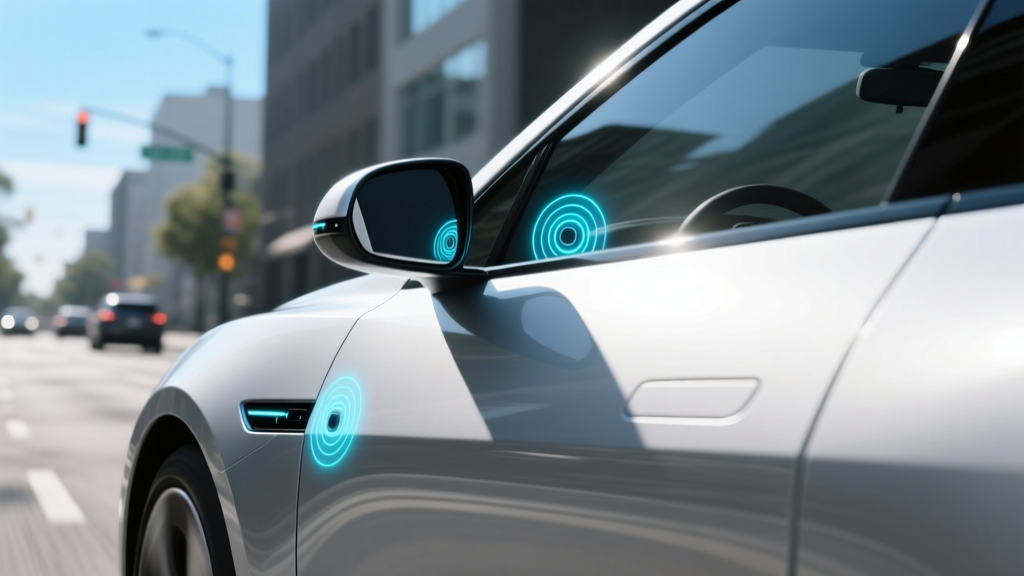
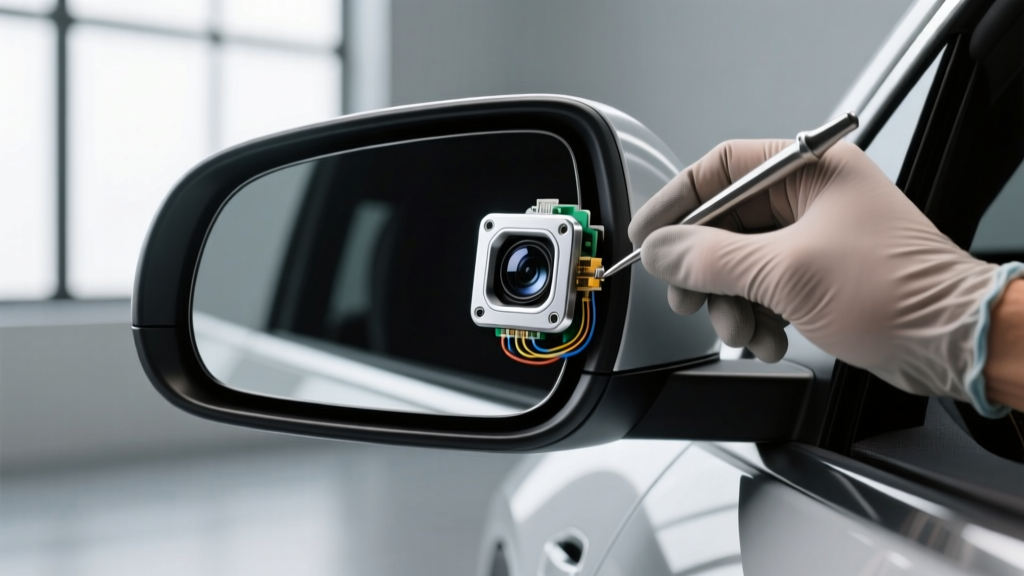
Blind spot monitoring (BSM) is a Level 0/1 driver-assistance feature that warns you when a vehicle occupies the lane beside you that your mirrors can't reveal. On most 2024–2026 EVs — the Hyundai Ioniq 5, Ford Mustang Mach-E, Tesla Model Y, Kia EV6, Chevrolet Equinox EV — the system uses two rear-corner 77 GHz radar sensors mounted behind the bumper fascia. A few brands (Subaru, some Toyota trims) supplement radar with side-facing cameras, but radar dominates because it works in rain, fog, and darkness where cameras fail.
When a vehicle enters the detection zone — typically 3–5 meters wide and up to 70 meters long behind the mirror line — the system lights an amber icon in the side mirror or A-pillar. If you signal a lane change, the warning escalates to flashing lights and an audible chime. Some EVs add rear cross-traffic alert (RCTA) using the same sensors, scanning laterally when reversing out of a parking space.
Why Blind Spot Monitor Repair Has Gotten More Expensive
Twenty years ago, a BSM fix meant swapping a $40 indicator bulb. On a 2026 EV, the radar module itself costs $280–$750 (OEM), and recalibration adds $150–$400 in labor because the sensor's aim must be verified against a reflector target at a precise distance. Three forces drive this:
- Packaging: Rear radars sit behind bumper covers to preserve styling and aerodynamics. A minor rear-corner tap that would have been a $300 bumper repair on a 2010 sedan now often damages the radar bracket, wiring harness, or sensor itself.
- Calibration sensitivity: A sensor tilted even 1–2 degrees off-axis will flag phantom vehicles or miss real ones. OEM procedures require a static calibration bay or a dynamic calibration drive at specified speeds.
- Software pairing: On Teslas and newer GM Ultium vehicles, the radar module is VIN-paired and must be initialized through the OEM diagnostic tool (e.g., GM's GDS2, Ford's FDRS). Independent shops without subscriptions can't complete the job.
Typical Blind Spot Monitor Repair Costs by EV Brand
Below are realistic out-of-warranty ranges compiled from dealer parts counters, independent EV shops, and collision centers for 2024–2026 models. Warranty coverage (typically 3 years/36,000 miles bumper-to-bumper, 5 years/60,000 miles on safety electronics for Hyundai/Kia) absorbs these costs when the failure isn't impact-related.
| EV / Brand | Radar Module (OEM) | Calibration Labor | Typical Total |
|---|---|---|---|
| Tesla Model 3/Y (2024–2026, camera-based BSM) | N/A (uses cameras) | $180–$260 (camera recal) | $180–$260* |
| Hyundai Ioniq 5 / Ioniq 6 | $340–$480 | $180–$280 | $520–$760 |
| Kia EV6 / EV9 | $360–$510 | $180–$280 | $540–$790 |
| Ford Mustang Mach-E / F-150 Lightning | $410–$620 | $200–$320 | $610–$940 |
| Chevrolet Equinox EV / Blazer EV | $380–$560 | $220–$360 | $600–$920 |
| Rivian R1S / R1T | $520–$750 | $250–$400 | $770–$1,150 |
| Volkswagen ID.4 | $360–$520 | $190–$300 | $550–$820 |
*Tesla removed ultrasonic and radar sensors from 2022+ Model 3/Y in favor of Tesla Vision (camera-only). Blind spot alerts derive from the side-repeater and fender cameras. Repair usually means camera replacement or recalibration after glass/bumper work, not a radar module swap.
Common Failure Modes That Trigger Blind Spot Monitor Repair
Before authorizing a repair, understand what actually failed. Technicians see the same handful of root causes repeatedly:
1. Impact damage to the rear corner
A parking-lot tap or curb strike deforms the bracket holding the radar module. Even if the sensor itself survives, a misaligned bracket throws off the detection zone. Many insurers now write "ADAS recalibration" as a line item on collision claims — push for it if your adjuster omits it.
2. Water intrusion
Seals around the radar housing degrade after 4–6 years, especially in salt-belt states. Moisture inside the radome (the plastic cover over the antenna) scatters the 77 GHz signal and triggers a "BSM unavailable" dash message. This is a replacement, not a repair — the module is sealed.
3. Wiring harness corrosion or chafing
The harness runs from the rear bumper into the trunk or liftgate area. Repeated liftgate cycles or a prior poorly-routed repair can pinch wires. A $40–$120 harness repair is far cheaper than a sensor swap, which is why diagnosis matters.
4. Software / module mismatch
After a 12V battery disconnect, OTA update, or module swap, the BSM controller can lose calibration or refuse to communicate with the ADAS gateway. A dealer-level scan tool reset usually resolves this in 15–30 minutes.
5. Aftermarket bumper or wrap interference
Metallic wraps, thick PPF, or non-OEM bumper covers with embedded metal mesh can attenuate radar. If BSM started failing right after body work, this is the first suspect.
Real-World Limitations: What BSM Cannot Detect
- Stationary objects: Guardrails, parked cars, and cyclists holding position are often filtered out to prevent nuisance alerts.
- Motorcycles and bicycles: Small radar cross-sections can slip through, especially below 20 mph relative speed.
- Heavy rain and wet snow: Water film on the radome scatters the signal; most systems auto-disable and display a warning.
- Sharp curves: On tight highway on-ramps (radius under ~150 m), the sensor's straight-line detection zone points off the road.
- Very fast overtakes: A vehicle closing at 30+ mph relative speed may appear in your blind zone for under a second — faster than the system's debounce window.
DIY vs. Dealer: What Owners Can (and Cannot) Safely Do
Safe for competent DIYers:
- Cleaning the radome area with isopropyl alcohol and a microfiber cloth.
- Inspecting the wiring harness connector for corrosion (dielectric grease, reseat).
- Verifying the BSM setting wasn't accidentally toggled off in the infotainment menu.
- Checking for an OTA or dealer-applied software TSB — Hyundai/Kia have issued several for phantom BSM alerts on 2022–2024 EVs.
Dealer- or specialist-required:
- Radar module replacement (VIN-pairing and calibration tool needed).
- Static calibration with OEM reflector targets.
- Dynamic calibration on vehicles that require a specific drive-cycle on a marked highway.
- Any repair under an active ADAS or bumper-to-bumper warranty.
Independent EV-focused shops with OEM tool subscriptions (Ford FDRS, GM GDS2, Hyundai GDS, Tesla Toolbox) are a legitimate middle ground — typically 25–40% cheaper than dealer labor while still performing valid calibrations. Verify they document calibration results; you'll want the printout for insurance and resale.
Brand-Specific BSM Naming and Availability on 2026 EVs
| Brand | Feature Name | Includes RCTA? | Standard On |
|---|---|---|---|
| Tesla | Blind Spot Camera / Warning | No (camera view only) | All trims (camera-based) |
| Hyundai | Blind-Spot Collision-Avoidance Assist (BCA) | Yes | SEL trim and up |
| Kia | Blind-Spot Collision-Avoidance Assist | Yes | Wind trim and up (EV6) |
| Ford | BLIS with Cross-Traffic Alert | Yes | Standard on Mach-E Select and up |
| Chevrolet | Side Blind Zone Alert | Yes (separate RCTA) | LT trim and up (Equinox EV) |
| Volkswagen | Side Assist | Yes | Pro S trim and up (ID.4) |
| Rivian | Blind Spot Warning | Yes | Standard on all trims |
Note: Tesla's approach is unique in 2026 — there is no dedicated radar for BSM. The visualization on the touchscreen shows detected vehicles, and the mirror chime still functions, but the underlying physics is vision-based neural inference rather than radar echo. That's why a "BSM repair" on a Tesla is usually a camera recalibration after windshield or fender-camera replacement.
Insurance, Warranty, and When to File a Claim
Most comprehensive auto policies cover ADAS sensor damage from non-collision events (hail, vandalism, falling branches) subject to your deductible. Collision coverage handles impact damage. Two practical rules:
- If the repair total exceeds your deductible by less than ~$400, pay out of pocket. A BSM claim can move you into a higher-premium tier for 3–5 years depending on your state and carrier.
- Insist on OEM or OEM-equivalent parts (e.g., Bosch, Continental, Valeo — the Tier 1 suppliers who build the radars for the automakers). Cheap aftermarket radar modules from Amazon often lack proper CAN bus handshaking and will throw persistent faults.
For warranty claims, document the failure with a dash-warning photo and the mileage. Hyundai and Kia have been notably receptive to BSM module replacements under the 5-year/60,000-mile electronics warranty when water intrusion is evident and no impact damage exists.
Frequently Asked Questions
Can I drive with a non-functional blind spot monitor?
Yes — BSM is a convenience/safety assist, not a legal requirement. The vehicle will pass inspection in all 50 states with the system disabled. Use traditional mirror-and-shoulder checks until repaired.
How long does a blind spot monitor repair take?
Module replacement plus calibration typically takes 1.5–3 hours at a dealer. If the shop is waiting on a backordered OEM part, turnaround can stretch to 1–2 weeks on less common EVs (Rivian, VW ID.4). Hyundai/Kia/Ford parts usually ship within 2–4 business days.
Does a windshield replacement affect BSM?
Not directly — BSM uses rear-corner radar or side cameras, not the forward-facing camera behind the windshield. However, if your EV integrates BSM alerts into a heads-up display, the HUD recalibration after windshield work is a separate procedure.
Is blind spot monitoring the same as Tesla Autopilot or Ford BlueCruise?
No. Autopilot and BlueCruise are SAE Level 2 lane-centering and adaptive-cruise systems that combine forward radar/cameras with steering and braking control. BSM is a simpler, rear-facing warning feature — Level 0 or Level 1 at most. None of these systems are self-driving.
Will an aftermarket bumper cover break my BSM?
Possibly. If the cover is thicker than OEM, uses different plastic density, or contains metallic paint flakes near the radar window, signal attenuation can push the sensor out of spec. Stick with OEM or OEM-certified replacements.
For official safety feature definitions and crash-test context, the NHTSA ADAS overview and IIHS advanced driver assistance page are reliable starting points. For brand-specific diagnostic procedures, consult your owner's manual supplement or the OEM service portal.