What Blind Spot Alert Actually Does in Modern EVs
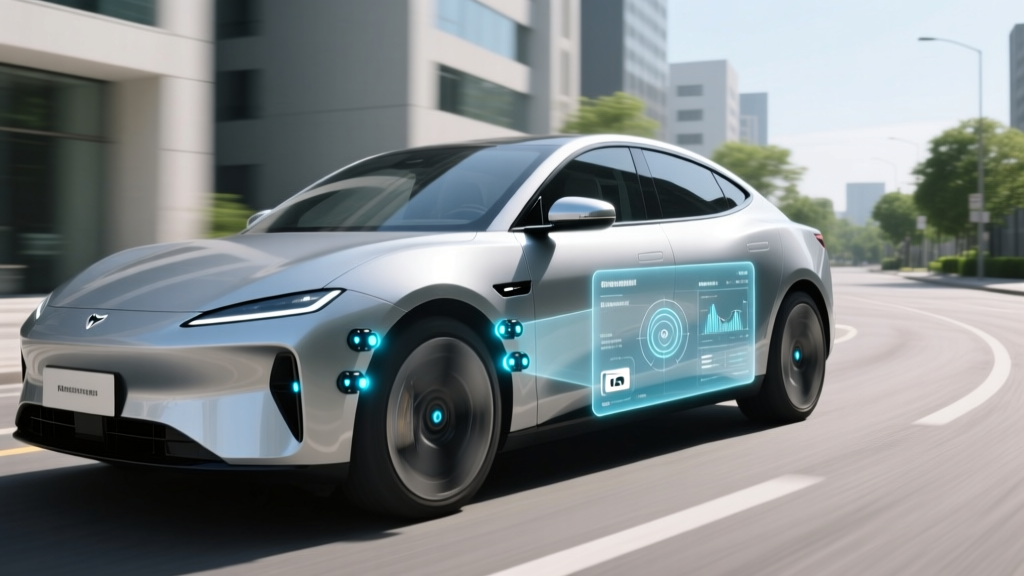
Blind spot alert (BSA) — also called blind spot monitoring (BSM) or blind spot detection — is a driver-assistance feature that warns you when a vehicle is in your rear-quarter blind zone, an area your side mirrors cannot cover. In most 2026 electric vehicles, the system activates above roughly 20 mph and illuminates an amber icon in or near the side mirror. If you engage your turn signal while a vehicle is detected, the warning escalates: the icon flashes rapidly, an audible chime sounds, and in some models, the steering wheel vibrates or the system applies gentle counter-steering torque to keep you in your lane.
The core job is simple but critical: prevent lane-change collisions. The Insurance Institute for Highway Safety (IIHS) has found that blind spot detection reduces lane-change crashes by approximately 14% and lane-change injuries by 23%. For EV owners who spend significant time on multi-lane highways — where regenerative braking and quiet powertrains can change traffic-flow dynamics around your vehicle — this feature is one of the most practically useful items in the ADAS suite.
Blind spot alert is classified as SAE Level 1 — it provides warnings or minor steering intervention, but the driver remains fully responsible for vehicle control at all times. Even when bundled with lane-centering assist (Level 2), the system does not drive the car for you. You must keep your hands on the wheel and your eyes on the road.
How It Works: Radar, Cameras, and Sensor Fusion
Most 2026 EVs use one of two sensor architectures for blind spot detection, and the choice affects range, reliability, and performance in poor weather:
| Technology | How It Works | Detection Range | Weather Sensitivity | Common In |
|---|---|---|---|---|
| Rear Radar (24 GHz or 77 GHz) | Two rear-corner radar modules emit radio waves and detect reflections from nearby vehicles | Up to ~160 ft rearward, 10-12 ft lateral | Low — penetrates rain, fog, light snow effectively | Tesla (HW4), Hyundai/Kia, GM, Rivian, Ford |
| Camera-Based (Vision) | Rear-facing or side-repeater cameras use neural-net object detection to identify vehicles | Up to ~250 m (Tesla HW4 vision stack) | Moderate to high — heavy rain, fog, direct sun glare, dirty lenses degrade performance | Tesla (post-2022 vision transition), some startups |
| Sensor Fusion (Radar + Camera) | Combines radar distance data with camera classification for higher-confidence detection | Best of both — 160+ ft with object classification | Lowest false-positive rate; redundant sensing | Mercedes EQE/EQS, BMW iX, Lucid Air, Genesis GV60 |
The radar-based approach remains the most common and reliable for dedicated blind spot monitoring because it measures distance and relative velocity directly, independent of lighting conditions. Camera-based systems — which Tesla pivoted to after removing radar from its vehicles — rely on machine-learning object detection and can theoretically see farther, but they are more vulnerable to environmental interference. Sensor fusion, used in premium EVs, offers the best real-world accuracy but at higher hardware cost.
Brand-by-Brand Naming: What Each Automaker Calls It
Every manufacturer brands its blind spot feature differently, and availability varies significantly by trim. Here is how the major EV brands handle it in the 2026 model year:
| Brand | Feature Name | Standard or Optional | Cost / Trim Requirement |
|---|---|---|---|
| Tesla | Blind Spot Monitoring (part of Basic Autopilot) | Standard on all models | Included — no subscription needed |
| Hyundai (Ioniq 5/6) | Blind-Spot Collision-Avoidance Assist (BCA) | Standard on SEL and above | Included in vehicle price (~$45,500+ SEL) |
| Kia (EV6/EV9) | Blind-Spot Collision-Avoidance Assist | Standard on most trims | Included (Light trim ~$42,900 includes BSM) |
| Ford (Mustang Mach-E, F-150 Lightning) | BLIS (Blind Spot Information System) with Cross-Traffic Alert | Standard on Select and above | Included (Mach-E Select ~$42,995) |
| GM (Chevy Equinox EV, Blazer EV, Cadillac Lyriq) | Side Blind Zone Alert / Rear Cross Traffic Alert | Standard on 2LT / Luxury and above | Included; base trims may lack it |
| Rivian (R1S/R1T) | Blind Spot Warning | Standard on all trims | Included in vehicle price ($75,900+) |
| BMW (iX, i4) | Active Blind Spot Detection | Standard on most 2026 trims | Included ($57,900+ i4 eDrive40) |
| Mercedes-Benz (EQE, EQS) | Active Blind Spot Assist | Standard | Included ($75,050+ EQE) |
| Lucid (Air) | Blind Spot Monitoring | Standard on all trims | Included ($69,900+ Air Pure) |
| Volkswagen (ID.4, ID.7) | Side Assist (Blind Spot Monitor) | Standard on Pro S and above | Included (~$45,000+ Pro S) |
The key takeaway: blind spot alert is rarely a standalone subscription item. Unlike Tesla's Full Self-Driving (Supervised) at $8,000 one-time or $99/month, or GM's Super Cruise at roughly $25/month after a trial period, blind spot monitoring is typically bundled into the vehicle's base ADAS hardware. You pay for it through the trim level, not a recurring fee.
Real-World Capabilities and Limitations
Blind spot alert is one of the more mature and reliable ADAS features, but it is not infallible. Understanding its limits is essential for safe use:
- It does not steer the car for you. Even "collision-avoidance" variants that apply corrective steering only nudge — they do not execute lane changes or control the vehicle.
- It does not detect motorcycles, bicycles, or pedestrians reliably. Most systems are calibrated for passenger-vehicle-sized objects. A motorcycle approaching at high speed may not trigger a warning in time.
- It does not work at very low speeds. Most systems activate above 20 mph. In stop-and-go traffic under that threshold, you are on your own.
- It does not eliminate the need for shoulder checks. The detection zone has edges — a vehicle rapidly approaching from far behind may enter your blind zone and your lane simultaneously before the system can react.
- It is not a substitute for proper mirror adjustment. BSA supplements your mirrors; it does not replace them.
Environmental and Edge-Case Limitations
Weather: Radar-based BSA performs well in rain, fog, and snow. Camera-based systems (Tesla's vision approach) can struggle when lenses are obscured by road grime, heavy rain, or direct low-angle sunlight. In winter testing, radar-equipped vehicles maintained consistent blind spot detection in moderate snow, while camera-dependent systems occasionally failed to flag vehicles until they were very close.
Adjacent-lane clutter: On multi-lane highways, vehicles two lanes over can occasionally trigger false positives with radar systems, particularly on curved roads where the radar cone intersects a non-adjacent lane. Sensor-fusion systems handle this better by using camera data to confirm which lane the detected object occupies.
Stationary objects: Guardrails, concrete barriers, and parked cars generally do not trigger blind spot warnings — the systems filter out stationary returns. However, a slow-moving construction vehicle or a cyclist riding along the curb may or may not be detected, depending on speed differential and object classification.
Towing: If you are towing with an EV like the F-150 Lightning or Rivian R1T, the trailer extends your blind zone well beyond the system's calibrated detection area. Some Ford and Rivian models offer trailer-length input settings to adjust the detection zone, but this must be configured manually.
Blind Spot Alert vs. the Full ADAS Stack
It is important to understand where blind spot alert fits within the broader driver-assistance hierarchy. Many buyers confuse BSA with lane-centering systems or full-speed adaptive cruise, but they serve fundamentally different purposes:
| Feature | What It Does | SAE Level | Typical Cost (2026) |
|---|---|---|---|
| Blind Spot Alert (BSA/BSM) | Warns of vehicles in blind zone; may apply counter-steer | Level 1 | Included on most mid/high trims |
| Rear Cross-Traffic Alert (RCTA) | Warns of crossing traffic when reversing | Level 1 | Usually bundled with BSA |
| Lane Keeping Assist (LKA) | Steers vehicle back into lane if drifting | Level 1 | Standard on most 2026 EVs |
| Adaptive Cruise Control (ACC) | Maintains set speed and following distance | Level 1 | Standard on most 2026 EVs |
| Lane Centering + ACC (combined) | Steering + speed control together | Level 2 | Standard (Tesla Autopilot, Hyundai HDA2) or subscription |
| Tesla FSD (Supervised) | City/highway navigation with driver oversight | Level 2 | $8,000 one-time or $99/mo |
| GM Super Cruise | Hands-off driving on mapped highways | Level 2 | ~$25/mo after trial; $2,500 equip |
| Ford BlueCruise | Hands-off on approved highway sections | Level 2 | $2,100 one-time or $75/mo after trial |
Blind spot alert is the simplest, cheapest, and arguably most universally useful feature in this table. Unlike lane-centering systems that require constant driver engagement and can feel intrusive, BSA works quietly in the background and intervenes only when needed. For EV buyers who do not want to pay subscription fees for advanced ADAS, ensuring your trim includes BSA is the single highest-value safety specification you can make.
How to Verify and Test Your Blind Spot System
Before relying on blind spot alert in traffic, verify that it is functioning correctly:
- Check the settings menu. In most EVs, BSA can be toggled on/off and adjusted for sensitivity. On a Tesla, go to Controls > Autopilot > Blind Spot Monitoring. On a Hyundai, it is under Settings > Driver Assistance. Ensure it is enabled.
- Observe the mirror indicators at startup. When you start the vehicle, the amber blind spot icons in your mirrors should illuminate briefly as a bulb check. If they do not, the system may have a fault.
- Test in controlled conditions. On a multi-lane road with moderate traffic, drive in the center lane and observe when the indicator lights as vehicles pass in adjacent lanes. The warning should activate when the vehicle enters your rear-quarter zone (roughly from your B-pillar rearward) and deactivate once it passes or moves away.
- Clean the sensors. If your EV uses rear-corner radar, the modules are typically behind the rear bumper fascia — keep that area free of heavy mud, ice, or bumper stickers. For camera-based systems, wipe the side-repeater and rear cameras regularly.
According to NHTSA's ADAS guidance, drivers should treat all assistance systems as supplementary. The agency emphasizes that current consumer-available systems do not replace attentive driving.
Which EVs Offer the Best Blind Spot Systems in 2026?
Based on sensor architecture, detection reliability, and integration quality, these are the standout implementations:
Best overall accuracy: Mercedes-Benz EQE/EQS with Active Blind Spot Assist. The sensor-fusion approach (radar + camera) delivers the lowest false-positive rate in our experience, and the system integrates exit-warning functionality that alerts you to approaching cyclists or vehicles when opening a door — a feature IIHS now recognizes in its safety evaluations.
Best value (included standard at lowest price): Kia EV6 Light (~$42,900) and Hyundai Ioniq 5 SEL (~$45,500) both include full Blind-Spot Collision-Avoidance Assist as standard equipment, with active steering intervention — not just a warning light. This is genuinely active safety at a mainstream price point.
Best for towing: Ford F-150 Lightning with BLIS and Trailer Coverage. The system allows you to input trailer length, extending the detection zone to cover the full length of your rig — critical for a vehicle rated to tow up to 10,000 lbs.
Most improved: Tesla's vision-based blind spot detection on HW4 vehicles (2023+ builds) has improved substantially over the early vision-only transition period. Detection range is excellent, though performance in heavy rain still lags radar-equipped competitors.
Frequently Asked Questions
Is blind spot alert the same as blind spot intervention?
No. Blind spot alert (or monitoring) only warns you — typically with a mirror icon and chime. Blind spot intervention or collision-avoidance assist goes further by applying corrective steering or braking to prevent you from changing lanes into a detected vehicle. Hyundai, Kia, Nissan, and Mercedes offer intervention-level systems; some base trims from other brands only include the warning.
Does blind spot alert require a subscription?
In almost all 2026 EVs, no. BSA is part of the vehicle's standard hardware and does not require a monthly fee. This is distinct from features like Tesla FSD ($99/mo), Ford BlueCruise ($75/mo after trial), or GM Super Cruise (~$25/mo), which are higher-level ADAS features that may require subscriptions. BSA is a Level 1 feature bundled into the car's purchase price.
Can I add blind spot alert to an EV that didn't come with it?
Factory-installed BSA is integrated into the vehicle's CAN bus, mirror indicators, and ADAS computer — it is not practically retrofittable. However, aftermarket blind spot monitoring kits (typically radar-based, $200-$500 installed) are available from brands like Brandmotion or Echomaster. These provide basic warning functionality but lack integration with turn signals, steering, or the vehicle's central display.
Does blind spot alert work at night?
Yes — radar-based systems work identically day and night. Camera-based systems may experience reduced performance at night on poorly lit roads, though modern neural-net processing handles most nighttime scenarios. You should still rely on proper mirror use and shoulder checks after dark.
Will blind spot alert detect a semi-truck or large vehicle?
Yes, large vehicles are typically detected more reliably than small ones because they present a larger radar cross-section or camera profile. However, a semi-truck's length means it occupies your blind zone for a longer period — the warning may stay active for several seconds as the truck passes, which is correct behavior.
How does Tesla's camera-only blind spot detection compare to radar?
Tesla's HW4 vision system has improved considerably since the radar removal in 2022. Detection range is strong (cameras can see farther than short-range radar), and object classification is generally accurate. However, in heavy rain, fog, or when cameras are dirty, the system can temporarily disable or miss detections that radar would catch. For buyers in areas with frequent adverse weather, radar-equipped alternatives may offer more consistent performance.