The Evolution of Parking Assist Technology
For decades, parallel parking has been a universal source of driver anxiety. What began in the early 2000s as simple rear-facing proximity beepers has evolved into sophisticated, multi-sensor automated parking systems capable of navigating tight garages without a human in the driver's seat. Today, Advanced Driver Assistance Systems (ADAS) encompass everything from basic parking assist (where the car steers but the driver controls the pedals) to fully automated remote parking (where the vehicle executes the entire maneuver via a smartphone app or key fob). According to the National Highway Traffic Safety Administration (NHTSA), ADAS technologies are fundamentally designed to augment human perception and reaction times, and automated parking represents one of the most tangible, everyday applications of this mandate. In this technology deep dive, we will dissect the sensor suites, algorithmic path-planning, and brand-specific implementations that define the modern automated parking landscape.
Under the Hood: How Automated Parking Sensors Work
Automated parking systems do not rely on a single piece of hardware. Instead, they utilize sensor fusion—combining data from multiple sources to create a real-time, 360-degree digital twin of the vehicle's surroundings. The three primary sensor types involved are ultrasonic, optical (cameras), and LiDAR.
Ultrasonic Sensors: The Proximity Pioneers
Ultrasonic sensors are the bedrock of parking assist technology. Operating typically at frequencies between 40 and 48 kHz, these sensors emit high-frequency sound waves that bounce off nearby objects. By calculating the time-of-flight for the echo to return, the vehicle's Electronic Control Unit (ECU) determines the exact distance to an obstacle. Modern vehicles utilize between 12 and 16 ultrasonic sensors embedded in the front and rear bumpers, as well as the side panels. While highly effective at low speeds (under 10 mph) and in poor weather conditions where cameras might be blinded, ultrasonic sensors struggle with low-lying objects like curbs, chain-link fences, or steep inclines due to the acoustic wave's dispersion pattern.
Surround-View Cameras and Computer Vision
To compensate for the blind spots of ultrasonic sensors, automakers deploy arrays of four to six wide-angle (fish-eye) cameras. Positioned at the front grille, side mirrors, and rear hatch, these cameras feed imagery into a central processor that stitches the feeds together into a seamless 360-degree bird's-eye view. More importantly for automated parking, these cameras are paired with neural networks trained to recognize painted parking lines, curbs, and semantic objects (like pedestrians or shopping carts). The transition to 'Tesla Vision' and similar camera-first architectures relies heavily on occupancy networks, which translate 2D camera feeds into 3D voxel spaces to map out free space versus occupied space.
LiDAR and High-Definition Radar
While less common in entry-level parking assist systems, LiDAR (Light Detection and Ranging) is increasingly used in premium automated valet parking setups. Solid-state LiDAR units emit thousands of laser pulses per second, generating a high-definition 3D point cloud of the environment. This allows the vehicle to detect structural pillars in underground garages, overhanging pipes, and subtle elevation changes that ultrasonic sensors and cameras might miss. When fused with short-range radar, the system achieves redundant, fail-safe spatial awareness.
Path Planning and SLAM: The Brains Behind the Maneuver
Hardware is only half the equation; the software dictates the smoothness and safety of the park. When a vehicle identifies a viable parking space, it utilizes SLAM (Simultaneous Localization and Mapping) to pinpoint its exact coordinates within the mapped space. The path-planning algorithm then calculates a trajectory using Reeds-Shepp curves—a mathematical model that determines the shortest possible path for a car-like robot to move from point A to point B, accounting for the vehicle's minimum turning radius and the necessity of multi-point turns. Once the path is locked, the ADAS takes over the Electric Power Steering (EPS), electronic brake booster, and drive-by-wire throttle to execute the maneuver, constantly adjusting the trajectory if a dynamic obstacle (like a passing pedestrian) enters the zone.
Brand Comparison: Who Does Automated Parking Best?
Not all automated parking systems are created equal. The implementation varies wildly based on the automaker's overarching ADAS philosophy. Here is how the industry leaders compare.
Tesla: Autopark and the Vision-Only Approach
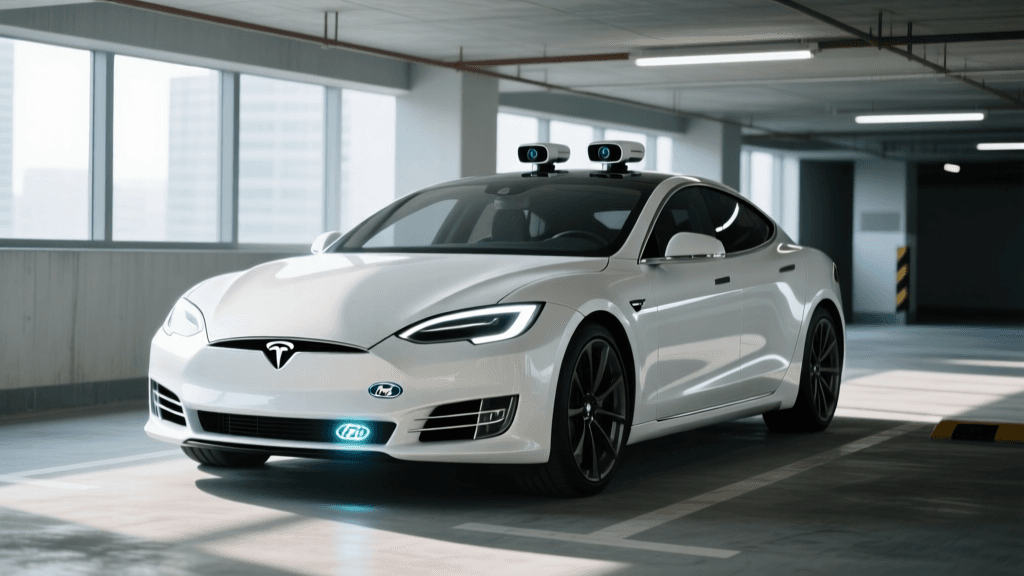
Tesla's Autopark and Smart Summon features represent a bold departure from industry norms by relying entirely on cameras, having phased out ultrasonic sensors (USS) in recent models. Utilizing its powerful HW3/HW4 computers and neural networks, Tesla's system identifies empty spaces and draws a virtual bounding box. While the vision-only approach allows for highly advanced semantic understanding (e.g., recognizing a space is meant for compact cars only), it has faced criticism for occasional hesitancy in low-light conditions or when painted lines are heavily faded. However, its Smart Summon feature, which allows the car to navigate complex parking lots to reach the driver, remains one of the most ambitious remote-parking applications on the market, operating within a 150-foot radius of the user's smartphone.
BMW: Remote Parking and the Reversing Assistant
BMW takes a heavily redundant, sensor-fusion approach. Their standard Parking Assistant uses 12 ultrasonic sensors and four surround-view cameras to handle parallel and perpendicular parking with exceptional smoothness. Where BMW truly shines is the Reversing Assistant. The vehicle continuously records the steering inputs and GPS/sensor data of the last 50 meters driven at speeds under 22 mph. If you find yourself trapped in a narrow, dead-end alley or a tight spiral garage ramp, activating the Reversing Assistant will autonomously back the car out along the exact path you just drove, while the driver simply monitors the surroundings. Furthermore, BMW's Remote Parking allows users to step out of the vehicle and use the BMW Display Key or smartphone app to command the car into a dangerously narrow garage space.
Ford: Active Park Assist 2.0
Ford's Active Park Assist 2.0 (APA 2.0) is widely regarded as one of the most reliable, no-nonsense systems in the mainstream market. Utilizing a robust array of ultrasonic sensors and cameras, APA 2.0 can identify parallel, perpendicular, and even angled parking spots. The driver simply holds a single button on the center console while the system handles steering, shifting, braking, and acceleration. Ford's system is particularly praised for its aggressive yet safe curb-detection algorithms and its ability to execute tight parallel parks in spaces barely larger than the vehicle's footprint. It operates at search speeds up to 2 mph, making it highly practical for urban street parking.
Hyundai/Kia: Remote Smart Parking Assist (RSPA)
Hyundai and Kia have democratized remote parking with their Remote Smart Parking Assist (RSPA). Available on models like the Tucson, Sonata, and EV6, RSPA allows the driver to use the smart key fob to move the vehicle forward or backward into tight spaces. While it lacks the complex lateral steering automation of BMW's remote systems (it primarily moves in straight lines into perpendicular spots), it operates at speeds up to 4 km/h and features automatic braking if an obstacle is detected. It is a highly practical, everyday solution for shopping mall parking lots where door-dings are a constant threat.
Feature Comparison Matrix
| Brand / System | Primary Sensor Suite | Max Search Speed | Remote Capability | Best Use Case |
|---|---|---|---|---|
| Tesla (Autopark) | 8x Cameras (Vision Only) | 15 mph | Smart Summon (App) | Open lots, navigating to driver |
| BMW (Parking Asst. Pro) | 12x Ultrasonic, 4x Cameras, LiDAR (Opt.) | 22 mph | App / Display Key (Lateral & Straight) | Narrow garages, dead-end reversals |
| Ford (APA 2.0) | 12x Ultrasonic, 4x Cameras | 2 mph (Search) | None (In-cabin only) | Tight urban parallel parking |
| Hyundai (RSPA) | 12x Ultrasonic, 4x Cameras | 2 mph (Search) | Smart Key Fob (Straight Line) | Tight perpendicular mall spots |
Real-World Limitations and Safety Considerations
Despite their sophistication, automated parking systems are not infallible. The Insurance Institute for Highway Safety (IIHS) consistently reminds consumers that these systems are classified as driver assistance, not autonomous replacements. Drivers must remain vigilant and keep their foot hovering over the brake (or be ready to intervene via the key fob/app). Environmental factors heavily impact performance: heavy rain, snow, or mud can blind cameras and muffle ultrasonic waves, leading to system disengagement. Furthermore, systems that rely heavily on painted lines for spatial orientation will struggle in older parking garages where the paint has worn away, or in unmarked gravel lots. Curb detection remains a specific challenge; while ultrasonic sensors can detect the vertical face of a curb, they may miss steeply angled drop-offs or low concrete parking blocks, potentially leading to bumper scuffs if the driver is not paying attention.
The Future: Automated Valet Parking (AVP)
The next frontier is Automated Valet Parking (AVP), a technology that pushes parking automation into the realm of Level 4 autonomy. As defined by the SAE International J3016 standard, Level 4 automation allows the vehicle to perform all driving tasks under specific conditions without any human intervention. In an AVP scenario, the driver drops the car off at the entrance of a smart parking garage and walks away. The vehicle then communicates with the garage's local infrastructure (V2I - Vehicle to Infrastructure), which uses overhead cameras and LiDAR to guide the car to an available spot, navigate around pedestrians, and park itself. When the driver returns, the car is summoned back to the pickup zone. Brands like Mercedes-Benz and Bosch have already pioneered and received regulatory approval for early AVP systems in select European and US garages. As sensor costs drop and edge-computing in parking structures becomes more prevalent, AVP will transition from a luxury novelty to a standard feature of urban mobility, fundamentally changing how we design parking architecture and interact with our vehicles.