If you have ever merged on a highway only to be startled by a vehicle hiding in your mirror's dead zone, you already understand the appeal of auto blind spot detection. On modern electric vehicles, this feature has evolved from a simple warning light into an active intervention system that can apply steering torque or braking to keep you out of a collision. But not every system is created equal, and none of them replace your eyes.
This guide breaks down exactly how blind spot detection and blind spot intervention work on 2026-model EVs, what the technology can and cannot do, which automakers include it standard versus as a paid upgrade, and the real-world limitations every EV owner should know before trusting the system on a rainy interstate.
What Auto Blind Spot Detection Actually Does
At its core, auto blind spot detection uses rear-facing sensors to monitor the lanes beside and slightly behind your vehicle. When another vehicle enters your blind zone — typically defined as the area from roughly your B-pillar back about 10 to 15 feet — the system alerts you. There are two tiers of this technology on 2026 EVs:
- Blind Spot Monitoring (BSM): Passive alerts only. A visual indicator illuminates in or near your side mirror, sometimes accompanied by an audible chime if you activate your turn signal while a vehicle is detected.
- Blind Spot Intervention (BSI) / Blind Spot Assist: Active correction. If you begin changing lanes while a vehicle occupies your blind spot, the system can apply subtle steering torque to guide you back into your lane, apply selective braking on one side of the car, or both.
Some automakers extend the system's coverage to rear cross-traffic alert (RCTA), which scans laterally behind you when reversing out of a parking space. While technically a separate function, it shares the same rear radar or camera hardware and is almost always bundled together.
Blind spot detection and intervention are classified as SAE Level 1 driver-assistance features. They provide support in a single axis (lateral steering or braking) under specific conditions. Even when combined with adaptive cruise control or lane-keeping assist (which together form a Level 2 system), the driver must remain fully engaged, hands on the wheel, and eyes on the road at all times. This is not autonomous or self-driving technology. You are the responsible operator of the vehicle.
How It Works: Radar, Cameras, and Sensor Fusion
Most 2026 EVs use one of two sensor architectures for blind spot detection:
Rear-Corner Radar (Most Common)
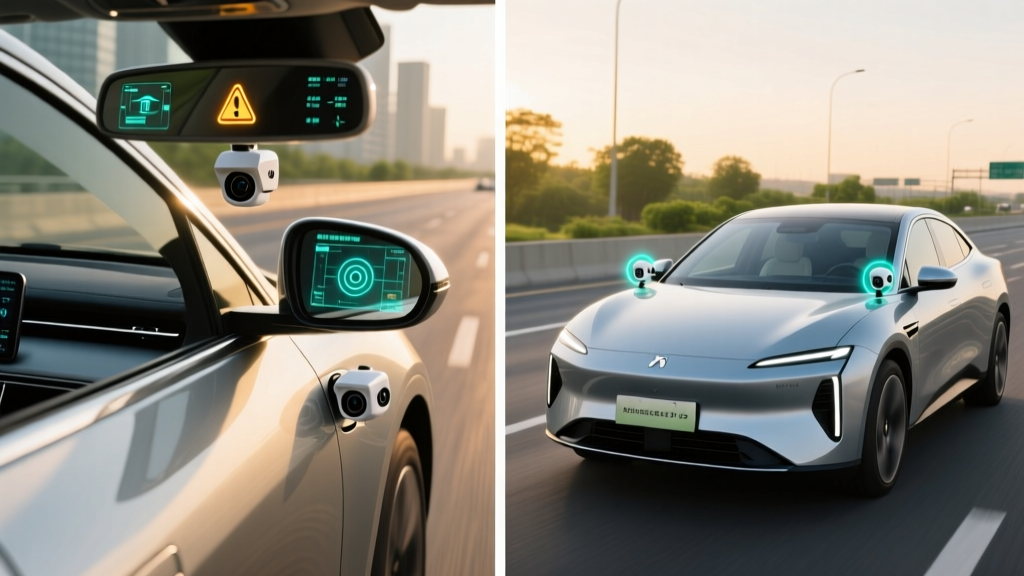
Two 77 GHz millimeter-wave radar modules are mounted behind the rear bumper fascia, one on each corner. These radars emit electromagnetic waves that reflect off nearby objects. Because they operate at high frequency, they can detect vehicles at ranges up to approximately 50 meters (164 feet) to the rear and 5 meters (16 feet) laterally, even through the bumper plastic. Radar works in rain, fog, and darkness — conditions where cameras struggle — but it has lower angular resolution than cameras, meaning it can occasionally misclassify stationary objects or fail to distinguish a motorcycle from a guardrail at certain angles.
Camera-Based Systems (Emerging)
Tesla's vision-only approach (post-2022 hardware) uses its suite of external cameras, including rearward-facing repeater cameras mounted on the front fenders, to construct a real-time occupancy model of adjacent lanes. The neural network processes video frames to identify vehicles, estimate their speed, and predict their trajectory. The advantage is richer object classification; the disadvantage is degraded performance in heavy rain, direct sun glare, or when camera lenses are obstructed by road grime or ice.
Sensor Fusion (Premium Tiers)
Some higher-end platforms, such as those on the Mercedes-Benz EQS and BMW iX, combine radar and camera data in a fused model. The radar provides reliable range and velocity data regardless of weather, while the camera adds classification precision. This dual-redundancy approach reduces false positives but adds cost, which is why it remains mostly on vehicles above $60,000 MSRP.
| Sensor Type | Detection Range | Weather Resilience | Object Classification | Common EVs Using |
|---|---|---|---|---|
| 77 GHz Radar | ~50 m rear / ~5 m lateral | Excellent (rain, fog, dark) | Moderate | Hyundai Ioniq 5, Ford Mustang Mach-E, Kia EV6, Rivian R1S |
| Camera (Vision) | ~80 m (varies by lens) | Reduced (glare, rain, dirt) | High (AI-classified) | Tesla Model Y, Model 3 (HW4) |
| Radar + Camera Fusion | Combined coverage | Best (redundant) | Highest | Mercedes EQS, BMW iX, Genesis GV60 |
Brand-by-Brand: What It's Called, Where It's Standard
One of the most confusing aspects of blind spot tech is that every automaker uses different marketing names for essentially the same functionality. Here is how the major EV brands label and package blind spot detection as of 2026 model-year vehicles:
| Brand | Feature Name | Standard / Optional | Intervention Included? |
|---|---|---|---|
| Tesla | Blind Spot Monitoring (within Autopilot) | Standard on all models | Yes (steering nudge) |
| Hyundai / Kia / Genesis | Blind-Spot Collision-Avoidance Assist (BCA) | Standard on SEL+ trims and above | Yes (braking + steering) |
| Ford | BLIS (Blind Spot Information System) with Cross-Traffic Alert | Standard on most EV trims | Alert only on base; intervention on higher trims |
| Rivian | Blind Spot Warning + Rear Cross-Traffic | Standard on all R1T/R1S | Warning only (no active steering) |
| BMW | Active Blind Spot Detection | Standard on i4, iX, i7 | Yes (steering correction) |
| Mercedes-Benz | Active Blind Spot Assist | Included in Driver Assistance Package (~$1,950 add-on for some trims) | Yes (steering + exit warning) |
The key takeaway: blind spot monitoring is increasingly standard on EVs above $40,000, but active intervention — where the car physically steers or brakes to prevent a lane-change collision — still frequently requires a mid-level trim or an optional package. Always check the specific window sticker, not just the brand's marketing page.
Real-World Limitations: When Blind Spot Detection Fails
Blind spot detection is a support system, not a replacement for mirror checks and shoulder glances. The following conditions can degrade or disable the feature entirely:
- Heavy rain or snow accumulation on rear bumper fascia can block radar signals. Camera-based systems are even more affected by lens obstruction.
- Motorcycles and bicycles present smaller radar cross-sections and may not be detected until they are very close, or at all on some systems.
- Rapid lane changes by adjacent vehicles — if a car enters your blind zone at high relative speed, the system may not alert you before you begin your own maneuver.
- Stationary objects such as guardrails, concrete barriers, and parked cars are often filtered out by the algorithm to reduce false positives, meaning the system may not warn you about a fixed obstacle.
- Curved roads — on tight highway curves, radar beams may point away from the adjacent lane or detect vehicles in a non-adjacent lane, causing missed alerts or false positives.
- Towing a trailer — most systems do not account for extended vehicle length and will not widen their monitoring zone, leaving the trailer's blind area uncovered.
In real-world highway driving, most owners find blind spot monitoring highly reliable for standard passenger vehicles in clear conditions. According to a study by the Insurance Institute for Highway Safety (IIHS), blind spot detection systems are associated with a 14% reduction in lane-change crashes. That is a meaningful but not total reduction — roughly one in seven potential crashes prevented. You still need to do your own visual checks.
One particularly useful feature that several brands (Hyundai, Kia, Genesis, Honda) offer is a blind spot view monitor: when you activate your turn signal, a camera feed from the blind spot side appears in your instrument cluster or center display. This gives you a live video of what is beside you, supplementing the radar alert with actual visual confirmation. It is one of the most practical implementations of the technology and costs nothing extra once the hardware is present.
Cost Breakdown: Included, Packaged, or Subscription?
Unlike advanced driver-assist suites such as Tesla's Full Self-Driving (Supervised) or GM's Super Cruise, standalone blind spot detection is almost never sold as a subscription. It is typically included in the vehicle's purchase price — either as standard equipment or bundled into a trim-level upgrade or optional package. Here is how the costs break down:
| Brand / Model | Cost Structure | Approximate Cost to Add |
|---|---|---|
| Tesla Model Y / Model 3 | Standard (no extra cost) | $0 — included with base Autopilot |
| Hyundai Ioniq 5 (SE trim) | Standard from SE trim up | $0 — included in ~$42,600 SE MSRP |
| Ford Mustang Mach-E | Standard on Select and above | $0 — included from ~$43,000 MSRP |
| Mercedes-Benz EQB | Optional (Driver Assistance Package) | ~$1,950 package (includes multiple ADAS features) |
| BMW i4 | Standard on all trims | $0 — included from ~$52,200 MSRP |
| Rivian R1S / R1T | Standard on all builds | $0 — included from ~$75,900 MSRP |
The pattern is clear: on mainstream EVs (Tesla, Hyundai, Ford, Kia), blind spot detection is standard at virtually every trim level. On luxury brands, it may be bundled into a $1,500–$2,500 driver-assistance package. No major automaker currently charges a monthly subscription specifically for blind spot monitoring, though it rides along inside broader subscription suites like Tesla's FSD (Supervised) at $99/month or $8,000 one-time — which you do not need to purchase just for blind spot alerts.
How It Compares to Full ADAS Suites
Blind spot detection is one piece of a larger ADAS puzzle. Here is how it fits alongside other common driver-assist features on 2026 EVs:
| Feature | SAE Level | What It Does | Driver Required? |
|---|---|---|---|
| Blind Spot Monitoring | Level 1 | Alerts to vehicles in blind zone | Yes — fully |
| Blind Spot Intervention | Level 1 | Actively steers/brakes to prevent lane-change crash | Yes — fully |
| Lane-Keeping Assist (LKA) | Level 1 | Keeps vehicle centered in lane | Yes — fully |
| Adaptive Cruise Control (ACC) | Level 1 | Maintains set speed and following distance | Yes — fully |
| Combined ACC + LKA (e.g., Autopilot, BlueCruise) | Level 2 | Simultaneous longitudinal + lateral control | Yes — hands on, eyes on (or eyes on for BlueCruise hands-off) |
| Robotaxi (Waymo, Zoox) | Level 4 | Full self-driving in geofenced areas | No — vehicle handles all driving tasks in zone |
The important distinction: blind spot detection operates independently of your car's cruise control or lane-centering system. You can benefit from it even if you never engage Autopilot, BlueCruise, or any other Level 2 feature. It is always on in the background, monitoring your flanks, whether you are driving manually or with assist systems active.
Should You Prioritize Blind Spot Detection in Your EV Purchase?
Given that blind spot monitoring is standard on most 2026 EVs above $40,000, the real question is whether to prioritize active intervention over passive alerts. Here is a practical decision framework:
Choose a vehicle with active blind spot intervention if:
- You frequently drive on multi-lane highways with heavy traffic
- You share the vehicle with less experienced drivers
- You regularly drive in conditions with high traffic density (urban interstates, rush-hour corridors)
- The cost difference between passive monitoring and active intervention trims is under $2,000
Passive blind spot monitoring is sufficient if:
- You primarily drive on two-lane roads or in low-traffic areas
- You are a confident, habitual mirror-and-shoulder-check driver
- You are budget-constrained and the intervention feature requires a significant trim upgrade
One final note on safety: the National Highway Traffic Safety Administration (NHTSA) classifies blind spot detection as a recommended but not mandated technology. Unlike automatic emergency braking (AEB), which NHTSA has pushed toward standardization, blind spot systems remain at automaker discretion regarding detection range, alert aggressiveness, and intervention thresholds. This means the "feel" of the system varies significantly between brands — some apply a gentle steering nudge, others brake one side of the car abruptly. Test-driving the specific model and paying attention to how the blind spot system behaves during a lane change is the best way to determine if you will find it helpful or intrusive.
Frequently Asked Questions
Is auto blind spot detection the same as self-driving?
No. Auto blind spot detection is an SAE Level 1 feature that monitors your blind zones and may apply a corrective steering or braking input. It does not control the vehicle's speed, steering, or navigation. The driver remains fully responsible for all driving decisions. Only Level 4 robotaxi services like Waymo operate without a human driver, and those are geofenced to specific cities.
Does blind spot detection work at low speeds or in parking lots?
Most systems are designed to activate above approximately 20 mph, targeting highway and arterial-road lane changes. At parking-lot speeds, the related rear cross-traffic alert (RCTA) function takes over, scanning laterally behind you as you reverse. RCTA is effective at speeds under 5 mph but covers a different zone than traditional blind spot monitoring.
Can I add blind spot detection to an EV that didn't come with it?
Not reliably. Factory-installed blind spot systems are integrated into the vehicle's CAN bus, steering, and braking systems. Aftermarket blind spot monitoring kits (typically $200–$500 installed) can provide mirror-indicator alerts, but they cannot provide active steering or braking intervention. For the full safety benefit, choose a vehicle with the feature from the factory.
Does Tesla's blind spot detection require the FSD subscription?
No. Tesla includes blind spot monitoring as part of its standard Autopilot suite on all current Model 3, Model Y, Model S, and Model X vehicles. You do not need to purchase or subscribe to Full Self-Driving (Supervised) to get blind spot alerts or the lane-change steering nudge. FSD adds automated lane changes, navigation on Autopilot, and other features, but basic blind spot monitoring is included at no additional cost.
Will blind spot detection detect a semi-truck or large trailer?
Yes, large vehicles with significant radar cross-sections are generally detected well. However, if a truck is partially overlapping your blind zone — for example, its cab is ahead of your B-pillar but its trailer extends into your blind spot — the system may not trigger until the trailer section enters the monitored area. Always perform a visual check for long vehicles.
Sources: IIHS Blind Spot Detection Research, NHTSA ADAS Overview, manufacturer specifications.