Why EV Owners Are Looking at Aftermarket Blind Spot Monitoring
Not every electric vehicle ships with blind spot monitoring (BSM) as standard equipment. Base trims of popular EVs — including earlier Nissan Leaf S models, certain Chevy Bolt EV trims, and some fleet-spec commercial EVs — omit the feature entirely. If you own or are buying a used EV without factory BSM, an aftermarket blind spot monitoring system can fill that safety gap. But do these add-on systems actually perform comparably to OEM solutions, and what should EV owners specifically know before installing one?
This guide covers the sensor technology, real-world limitations, cost ranges, and critical safety expectations you need to evaluate before adding an aftermarket BSM to your electric vehicle.
How Aftermarket Blind Spot Monitoring Systems Work
Factory blind spot monitoring uses either radar sensors (typically 24 GHz or 77 GHz microwave radar) mounted behind the rear bumper fascia, or camera-based systems integrated into the side mirrors and A-pillars. Aftermarket systems replicate these approaches, though with meaningful differences in integration quality.
Radar-Based Aftermarket Systems
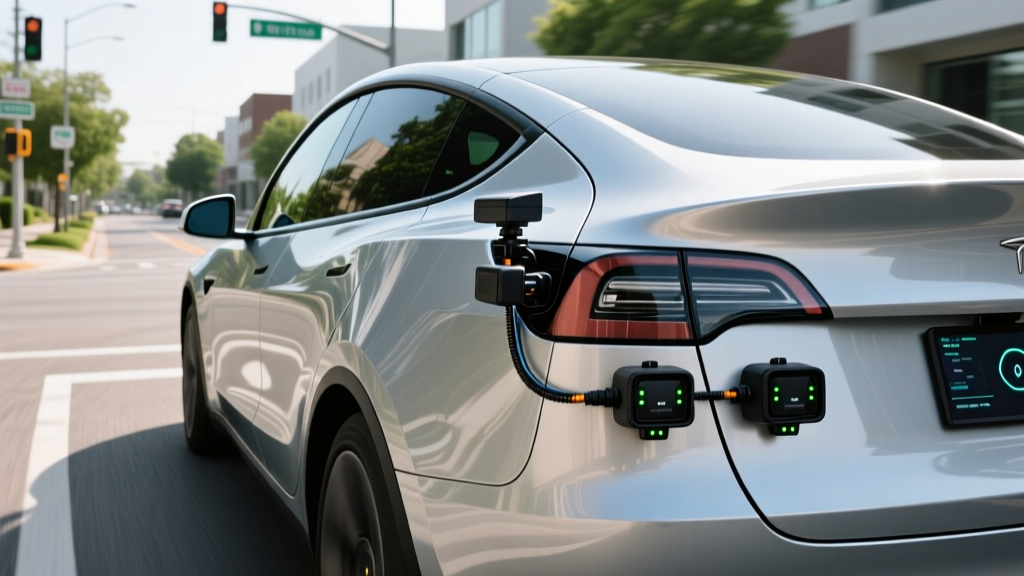
Most reputable aftermarket BSM kits use 24 GHz or 77 GHz radar modules. These mount behind the rear bumper cover (non-invasive, no drilling required on most vehicles) and detect vehicles approaching from the rear quarters at distances of 10 to 70 meters. The system triggers LED indicator pods — typically mounted on or near the A-pillars or side mirrors — when a vehicle enters the defined blind zone.
Radar systems operate independently of lighting conditions and are largely unaffected by rain, fog, or darkness. This makes them the more robust choice for all-weather driving. Quality radar-based kits from manufacturers like Brandmotion, Rydeen, and EchoMaster typically detect objects at speeds from 10 mph up to highway velocities.
Camera-Based Aftermarket Systems
Camera-based kits mount small wide-angle cameras under or integrated into the side mirror housings, feeding a video signal to a small display or the vehicle's existing infotainment screen (if compatible). When the turn signal activates, the corresponding camera feed displays on-screen. Some advanced kits add software-based object detection that highlights vehicles in the blind zone with an overlay.
Camera systems provide visual confirmation of what's beside you — a meaningful advantage over radar-only alerts. However, they degrade significantly in heavy rain, snow, direct sun glare, and nighttime low-light conditions. Lens contamination from road spray is a persistent maintenance issue.
| Attribute | Radar-Based | Camera-Based | OEM Factory BSM |
|---|---|---|---|
| Detection method | 24/77 GHz microwave radar | Wide-angle camera + software | Radar or camera (varies by brand) |
| Detection range | 10–70 meters typical | 5–30 meters (camera FOV) | 10–70 meters |
| Weather resilience | Excellent (rain, fog, dark) | Poor in heavy rain/snow/glare | Excellent (radar) / Moderate (camera) |
| Visual confirmation | No (alert indicators only) | Yes (live video feed) | Varies by brand |
| Typical install complexity | Moderate (bumper removal) | High (mirror disassembly, wiring) | N/A (factory integrated) |
| Cross-traffic alert | Yes (on most kits) | Rarely | Often bundled |
| Average kit cost | $250–$600 | $150–$400 | Included or $300–$1,200 OEM option |
SAE Automation Level: This Is Not Self-Driving
SAE Level 0 — Warning Only. Aftermarket blind spot monitoring systems are classified as SAE Level 0 automation. They provide warnings (visual, audible, or haptic) but do not intervene with steering, braking, or throttle. The driver retains 100% of the driving task at all times. Even OEM blind spot systems with "steering assist" or "lane change avoidance" remain Level 1 at most — offering momentary intervention but requiring continuous driver supervision.
No consumer blind spot system on the market qualifies as autonomous or self-driving. You are responsible for every lane change decision.
This distinction matters because some aftermarket marketing materials use language like "automatic detection" or "intelligent monitoring" that can imply the system is handling part of the driving task. It is not. BSM is an information system — it tells you something is there. You decide what to do with that information.
For context, even advanced factory ADAS suites like Tesla's Autopilot, Ford's BlueCruise, and GM's Super Cruise are classified as SAE Level 2 — meaning the driver must remain engaged and supervising at all times. A blind spot monitor is far below that threshold.
Real-World Limitations You Need to Know Before Buying
What an aftermarket BSM system does NOT do:
- It does not steer the vehicle or prevent a lane change.
- It does not detect motorcycles, bicycles, or pedestrians reliably — most radar kits are tuned for vehicle-sized objects.
- It does not function at very low speeds (typically below 10 mph) — irrelevant in parking lots.
- It does not replace the physical head-check before a lane change.
- It does not integrate with your EV's existing ADAS suite (lane keep, adaptive cruise, etc.).
False Alerts and the Guardrail Problem
The most common complaint with aftermarket radar BSM is false alerts from stationary objects — guardrails, concrete barriers, and roadside fencing on curved highways. Factory OEM systems use sophisticated filtering algorithms and vehicle-dynamics integration (steering angle, yaw rate, GPS curvature data) to suppress these false positives. Aftermarket kits lack access to the vehicle's CAN bus data in most cases, so they rely on simpler filtering that is less effective.
Expect occasional false alerts on curved highways with metal barriers. Higher-end kits ($400+) with 77 GHz radar and multi-target tracking handle this better than budget 24 GHz units, but neither matches OEM-level filtering.
EV-Specific Installation Considerations
Electric vehicles present unique challenges for aftermarket BSM installation:
- Rear bumper materials: Many EVs use thicker, more complex bumper covers with integrated aero panels and diffuser elements. Radar sensors must be positioned precisely and cannot be mounted behind metal reinforcement bars. Verify that the kit's radar modules can penetrate your specific bumper material.
- 12V electrical system: Aftermarket BSM draws power from the vehicle's 12V auxiliary system. EVs use a DC-DC converter to maintain the 12V battery from the high-voltage traction pack. Ensure the kit's power draw (typically 0.5–2A) is within your EV's 12V circuit capacity. Most kits are well within limits, but poorly designed kits with high parasitic draw can stress the 12V system over time.
- Regenerative braking behavior: One-pedal driving and aggressive regen can cause rapid deceleration without brake lights illuminating. Vehicles behind you may not anticipate your speed change. A BSM system that includes rear cross-traffic alert can help you monitor approaching vehicles when reversing out of spaces, but it won't address the following-distance dynamics unique to one-pedal driving.
- Warranty considerations: Splicing into your EV's wiring harness may affect the electrical system warranty. Use add-a-circuit fuse taps rather than cutting factory wires, and document the installation for warranty claims. According to the Magnuson-Moss Warranty Act, a dealer must prove the aftermarket device caused a failure to deny a warranty claim — but the burden of documentation falls on you.
Cost Breakdown: Kit Price, Installation, and Value
| Cost Component | Budget Kit | Mid-Range Kit | Premium Kit |
|---|---|---|---|
| Hardware (radar/camera kit) | $100–$250 | $250–$450 | $450–$700 |
| Professional installation | $150–$250 | $200–$400 | $300–$500 |
| Wiring harness / adapters | $0–$20 | $20–$50 | $30–$75 |
| Total installed cost | $250–$520 | $470–$900 | $780–$1,275 |
| Radar type | 24 GHz, basic filtering | 24/77 GHz, multi-target | 77 GHz, advanced filtering |
| Cross-traffic alert | Usually no | Often yes | Yes |
| Warranty | 1 year | 1–2 years | 2–3 years |
For comparison, adding factory BSM as an option package on a new EV typically costs $300–$1,200 as part of a trim upgrade or technology package — but that cost is bundled with other features and fully integrated into the vehicle's electronics. An OEM system will always outperform an aftermarket kit in filtering quality and reliability, which is why we recommend prioritizing a trim level with factory BSM when purchasing a new or used EV if the feature matters to you.
If you already own the EV and factory BSM was not included, aftermarket is your only option short of trading vehicles. In that scenario, a mid-range 77 GHz radar kit with professional installation ($470–$900 total) represents the best value-to-performance balance.
How Aftermarket BSM Compares to Factory Systems
| Feature | OEM Factory BSM | Aftermarket BSM |
|---|---|---|
| CAN bus integration | Full (steering angle, speed, turn signal) | Minimal or none (turn signal tap only) |
| False alert suppression | Advanced (vehicle dynamics + mapping) | Basic (speed gating, signal duration) |
| Rear cross-traffic alert | Commonly bundled | Available on mid/premium kits |
| Mirror-integrated indicators | Yes (factory mirror housings) | Retrofit pods or stick-on LEDs |
| Steering assist intervention | Some brands (Honda, Toyota, Hyundai) | Never |
| Diagnostic integration | Visible in vehicle settings/cluster | None (standalone system) |
| Reliability / weather sealing | Automotive OEM grade | Varies widely by brand |
The gap between OEM and aftermarket has narrowed in detection capability — a quality 77 GHz radar kit will find vehicles in your blind zone just as reliably as a factory system. The gap remains wide in integration: false alert suppression, indicator placement, and diagnostic feedback are areas where factory systems hold a decisive advantage.
According to IIHS research on blind spot detection, factory BSM systems reduce lane-change crashes with injuries by approximately 23%. While aftermarket systems have not been studied at the same scale, the underlying detection physics are identical — the benefit depends on the driver responding appropriately to the alert.
Which EVs Already Include BSM and Which Need Aftermarket?
Before investing in an aftermarket kit, verify whether your EV already includes or can be upgraded to factory BSM:
- Tesla Model 3 / Model Y (2021+): Blind spot monitoring is included on all trims via the camera-based Tesla Vision system. No aftermarket needed. Note: Tesla's BSM relies on cameras, not radar (radar was removed starting in 2021 for North American models).
- Hyundai Ioniq 5 / Ioniq 6: BSM is standard on SEL and above trims. The base SE trim (2022–2023 model years) lacked it; 2024+ SE trims added it. Check your trim level before purchasing aftermarket.
- Chevy Bolt EV / EUV: BSM was included in the Driver Confidence packages on 2LT trims. Base 1LT and discontinued 2024 fleet models may lack it. Aftermarket is viable for these.
- Nissan Leaf: BSM is standard on SV Plus and above (2023+). The base S trim has historically omitted it. Aftermarket kits are a common upgrade for Leaf S owners.
- Ford Mustang Mach-E: BLIS (Blind Spot Information System) is standard on all trims from 2021+. No aftermarket needed.
- Rivian R1T / R1S: BSM is standard on all configurations via the Rivian sensor suite.
If your EV already has factory BSM, an aftermarket system adds no value and may create conflicting alerts. If your trim lacks it and upgrading isn't an option, aftermarket is the practical path.
Installation Best Practices for EV Owners
If you've decided on an aftermarket blind spot monitoring system, follow these guidelines to protect your EV's electrical integrity:
- Use a professional installer experienced with EVs. High-voltage components (orange cabling) must not be disturbed. The installer should work exclusively with the 12V system and avoid any proximity to the traction battery, inverter, or high-voltage junction boxes.
- Tap power from a switched 12V fuse. Use an add-a-circuit fuse tap on a fuse that is live only when the vehicle is ON (not always-on/accessory). This prevents parasitic drain on the 12V battery, which in an EV can prevent the vehicle from "waking up" and engaging the DC-DC converter.
- Route wiring away from high-voltage harnesses. Maintain at least 6 inches of separation from any orange-sheathed high-voltage cabling to avoid electromagnetic interference with the radar sensors.
- Document everything. Photograph the installation, keep receipts for the kit and labor, and note the fuse tap location. If a 12V electrical issue arises under warranty, this documentation supports your Magnuson-Moss protections.
- Calibrate after installation. Most radar kits require a brief calibration drive (10–15 minutes at highway speed) to establish detection zones. Follow the manufacturer's calibration procedure precisely — skipping this step is the #1 cause of poor detection and excessive false alerts.
Frequently Asked Questions
Will an aftermarket blind spot monitoring system void my EV warranty?
Under the Magnuson-Moss Warranty Act, a manufacturer cannot void your entire warranty simply because you installed an aftermarket accessory. However, if the aftermarket BSM installation directly causes a 12V electrical failure, that specific repair may not be covered. Use professional installation, proper fuse taps, and keep documentation to protect yourself.
Can I install an aftermarket BSM system myself on my EV?
Technically yes, but it requires removing the rear bumper cover, routing wiring through the cabin, tapping the 12V fuse panel, and calibrating the radar modules. If you are not confident working around EV electrical systems — even the 12V side — professional installation ($150–$500) is strongly recommended. Incorrect wiring can cause 12V battery drain or electrical faults.
Do aftermarket BSM systems work with Tesla vehicles?
Teslas from 2021 onward already include blind spot monitoring via Tesla Vision (camera-based). Installing an aftermarket system on a Tesla is unnecessary and not recommended, as it could create conflicting visual alerts and requires tapping into Tesla's proprietary 12V architecture, which is more complex than conventional vehicles.
How accurate are aftermarket blind spot monitors compared to factory systems?
Detection accuracy for vehicles in the blind zone is comparable — a quality 77 GHz radar kit will detect cars and trucks at similar ranges to OEM radar. The main difference is false alert rate: aftermarket systems generate more false positives from guardrails and barriers because they lack the vehicle-dynamics data (steering angle, yaw rate) that OEM systems use for filtering.
Does an aftermarket BSM system include rear cross-traffic alert?
Mid-range and premium radar kits ($300+) often include rear cross-traffic alert (RCTA), which detects vehicles approaching from the sides when reversing. Budget kits ($100–$250) typically do not. If you want both blind spot and cross-traffic coverage, budget for at least a mid-range kit.
What is the best aftermarket blind spot monitoring system brand?
Among NHTSA-referenced aftermarket safety equipment categories, brands like Brandmotion (RDBS-2500 series), Rydeen (BLISS systems), and EchoMaster produce radar-based kits with reasonable detection performance. Look for 77 GHz radar, multi-target tracking, and at minimum a 2-year warranty. Read owner reviews specifically for your vehicle model, as bumper geometry affects performance.