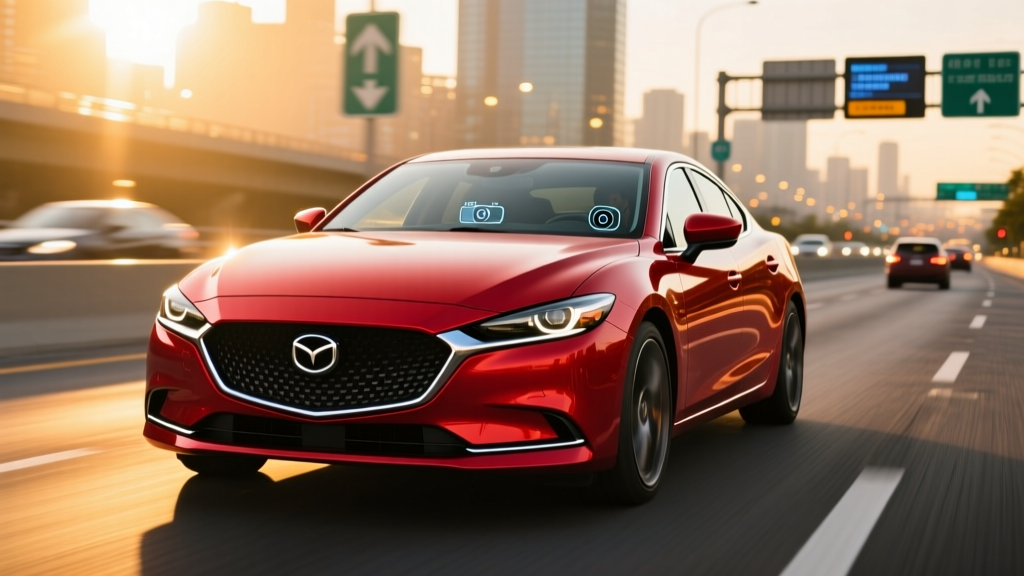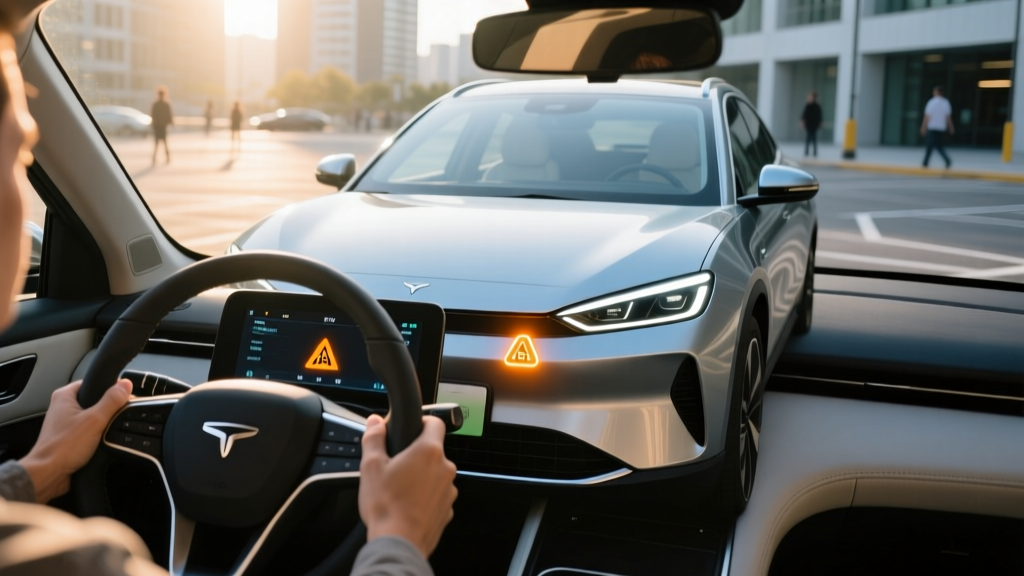
You're driving your Tesla Model Y, Hyundai Ioniq 5, or Ford Mustang Mach-E, and suddenly an amber icon appears on your instrument cluster — often a car rear-ending another car, or the letters "AEB" with an exclamation mark. Your Automatic Emergency Braking system is telling you something is wrong, and understanding that message matters for your safety and the safety of everyone around you.
AEB is one of the most consequential active-safety features on modern electric vehicles. It can apply the brakes faster than any human reaction time to prevent or mitigate a collision. When its warning light illuminates, the system may be partially or fully disabled. Here's exactly what that light means, why it appeared, and what to do about it.
What Automatic Emergency Braking Actually Does
Automatic Emergency Braking (AEB) is an active-safety system that continuously monitors the road ahead using a combination of sensors — typically a forward-facing camera mounted behind the windshield and a millimeter-wave radar unit behind the front grille or bumper. Some vehicles, like the Tesla Model 3 and Model Y, also rely on a camera-only vision suite (Tesla Vision), while higher-end models from Mercedes-Benz and BMW may add lidar sensors for redundancy.
When the system detects an imminent forward collision with a vehicle, pedestrian, or in some cases a cyclist, it first issues an audible and visual alert. If the driver does not react in time, AEB autonomously applies the brakes — often at full braking force — to either prevent the crash entirely or reduce its severity. According to the Insurance Institute for Highway Safety (IIHS), vehicles equipped with AEB show a 50% reduction in front-to-rear crashes compared to vehicles without the feature.
On most 2025 and 2026 model-year EVs, AEB is standard equipment across all trims. It is mandated by the National Highway Traffic Safety Administration (NHTSA) under FMVSS regulations that require forward collision warning and AEB on all new light-duty vehicles by September 2029, but nearly every major automaker has already adopted it voluntarily.
AEB is classified as an SAE Level 0 or Level 1 driver-support feature. It does not steer or maintain speed — it only intervenes with braking in emergency scenarios. It is emphatically not self-driving. The driver remains 100% responsible for vehicle operation at all times. Even when AEB is functioning perfectly, it cannot replace attentive driving.
What the AEB Warning Light Means
When the AEB warning light illuminates on your dashboard or center display, it indicates that the Automatic Emergency Braking system is currently unavailable, degraded, or has detected a fault. The exact icon varies by manufacturer:
- Tesla: A "Forward Collision Warning Unavailable" or "Automatic Emergency Braking Unavailable" popup on the touchscreen, often accompanied by a chime.
- Hyundai / Kia / Genesis: An amber car-with-brake-lines icon and the message "Forward Collision-Avoidance Assist Disabled."
- Ford: An amber triangle with "Pre-Collision Assist Not Available" in the instrument cluster.
- Chevrolet / GMC (Ultium EVs): "Automatic Emergency Braking Off" message with a car-and-exclamation icon.
- BMW / Mercedes-Benz: "Active Brake Assist Currently Unavailable" in the driver information display.
The light itself is not a malfunction indicator in the traditional sense — it's a status notification that the system cannot guarantee proper operation. In most cases, the vehicle remains fully drivable, but you lose a critical layer of collision protection.
Common Causes of an AEB Warning Light
Understanding what triggered the light helps you determine whether it's a quick fix or requires a service visit.
1. Obstructed or Dirty Sensors
This is the single most common cause. The forward camera behind your windshield can be blocked by dirt, ice, snow, condensation, or even a misplaced toll transponder or dashcam mount. The front radar unit behind the grille can be obscured by road grime, snow buildup, or a license plate bracket that extends into its field of view. On EVs without a traditional grille (like the Tesla Model Y or Rivian R1S), the radar may be integrated lower in the bumper — still susceptible to snow and slush.
2. Windshield Replacement or Camera Misalignment
If you've recently had your windshield replaced, the forward-facing camera module may not have been recalibrated. AEB systems require precise camera alignment — even a fraction of a degree off can cause the system to disable itself. Most manufacturers require a static or dynamic calibration procedure after any windshield replacement. This typically costs $150–$350 at a dealership or qualified glass shop.
3. Extreme Weather Conditions
Heavy rain, fog, snow, or direct low-angle sunlight can temporarily overwhelm camera and radar sensors. The system will self-disable and illuminate the warning light until conditions improve. This is normal behavior, not a defect.
4. Software Glitches or OTA Update Issues
Modern EVs receive frequent over-the-air (OTA) software updates. Occasionally, a firmware update can introduce a sensor-fusion bug that triggers a false AEB fault. In many cases, a vehicle restart (power cycle) resolves the issue. Tesla owners can initiate a reboot by holding both scroll wheels on the steering wheel for ~10 seconds.
5. Radar or Camera Hardware Failure
If the warning light persists across multiple drives in clear conditions with clean sensors, a hardware component may have failed. Radar modules and camera units do wear out, though this is uncommon within the typical 5-year/60,000-mile bumper-to-bumper warranty period that covers most 2026 EVs.
6. Aftermarket Modifications
Installing an aftermarket front bumper, bull bar, grille cover, or even certain license plate frames can physically block the radar sensor's field of view. Window tinting that extends over the camera area behind the rearview mirror can also interfere. Remove the obstruction and the light will typically clear after the next drive cycle.
- AEB does not make your EV self-driving. You must remain fully engaged, hands on the wheel, eyes on the road.
- AEB may not detect animals, stationary objects at high speed, cross-traffic, or vehicles that cut in abruptly at close range.
- AEB performance degrades in heavy rain, fog, snow, and low-light conditions — sometimes below the threshold of human visibility.
- AEB is not a substitute for defensive driving, following distance, or speed management.
- On icy or wet roads, AEB cannot overcome physics — braking distance increases regardless of how quickly the system reacts.
How to Troubleshoot and Clear the AEB Warning Light
Before scheduling a service appointment, work through these steps in order:
- Clean all sensors. Wipe the windshield area in front of the rearview mirror (camera zone) with glass cleaner. Clear the front grille/bumper area where the radar is housed. Remove any snow, ice, or debris.
- Check for obstructions. Verify that no aftermarket accessories, toll passes, dashcams, or license plate brackets are blocking sensor fields of view.
- Restart the vehicle. Power the EV off completely, wait 30 seconds, and power it back on. This clears transient software faults.
- Drive in clear conditions. Some systems require a drive cycle in good weather to re-validate sensor function. Drive for 10–15 minutes on a clear, well-marked road.
- Check for OTA updates. Ensure your EV's software is current. Tesla, Rivian, Ford, and Hyundai/Kia all push safety-system fixes via OTA.
- Verify windshield calibration. If you've had glass work done recently, confirm that the ADAS calibration was performed.
- Schedule a diagnostic scan. If the light persists, a dealership or qualified EV service center can pull fault codes from the ADAS control module. Common codes relate to radar alignment, camera communication bus errors, or module-level failures.
AEB Across EV Brands: Naming, Availability, and Cost
Every major EV manufacturer includes AEB as standard equipment, but the naming conventions, sensor configurations, and advanced capabilities vary significantly. Here's how the systems compare across popular 2026 electric vehicles:
| Brand / System Name | Sensor Suite | Pedestrian Detection | Cyclist Detection | Junction/Cross-Turn Assist | Standard on All Trims | Additional Cost |
|---|---|---|---|---|---|---|
| Tesla — Automatic Emergency Braking (Tesla Vision) | Camera-only (8 cameras, no radar on 2026 models) | Yes | Yes | Limited | Yes | Included (FSD Supervised is a separate $8,000 add-on or $99/mo subscription, but base AEB is free) |
| Hyundai / Kia — Forward Collision-Avoidance Assist (FCA) | Front camera + front radar | Yes | Yes (select trims) | Yes (Limited/Calligraphy trims) | Yes (base AEB); junction assist on higher trims | Included |
| Ford — Pre-Collision Assist with AEB | Front camera + front radar | Yes | Yes | Yes (intersection assist on Platinum/GT trims) | Yes | Included |
| Chevrolet — Automatic Emergency Braking (Super Cruise vehicles use enhanced sensor suite) | Front camera + front radar | Yes | Limited | Yes (with Super Cruise package) | Yes (base AEB) | Included; Super Cruise is $2,200 option or $25/mo subscription |
| BMW — Active Brake Assist (Front Collision Warning) | Front camera + front radar + optional lidar (iX, i7) | Yes | Yes | Yes (Cross-Traffic Alert with brake intervention) | Yes | Included |
| Mercedes-Benz — Active Brake Assist | Front camera + front radar + optional lidar (EQS, EQE with DRIVE PILOT) | Yes | Yes | Yes | Yes | Included; DRIVE PILOT (Level 3, limited markets) is a $2,500/yr subscription |
| Rivian — Forward Collision Warning + AEB | Front camera + front radar | Yes | Yes | Limited | Yes | Included |
A critical distinction: base AEB is universally included at no extra cost on 2026 EVs. The subscription and upcharge models apply to higher-level ADAS features like Tesla's FSD Supervised, GM's Super Cruise hands-free driving, or Ford's BlueCruise — none of which are required for AEB to function. AEB is a standalone safety feature that operates independently of any premium driver-assist subscription.
Real-World AEB Performance: What Testing Shows
Not all AEB systems perform equally. The IIHS evaluates forward collision prevention through standardized track tests at 12 mph and 25 mph target speeds, with both vehicle-to-vehicle and vehicle-to-pedestrian scenarios. As of early 2026, most EVs earning the IIHS Top Safety Pick+ designation demonstrate AEB systems that either avoid contact entirely or reduce impact speed to below 5 mph in the 25-mph test.
However, real-world performance diverges from controlled testing in several important ways:
- High-speed scenarios: Most consumer AEB systems are optimized for city-speed collisions (under 50 mph). At highway speeds (65–80 mph), AEB can reduce impact severity but often cannot prevent a collision entirely, particularly with a stationary target.
- Phantom braking: Some systems — Tesla's camera-only approach has drawn particular scrutiny — occasionally apply brakes when no obstacle is present. This "phantom braking" can itself create a rear-end hazard. NHTSA opened an investigation into Tesla phantom braking incidents, and while software updates have reduced frequency, it remains a known limitation of vision-only systems.
- Low-light and night performance: Camera-based systems lose effectiveness at night. Radar-equipped systems (Hyundai, Ford, BMW) maintain more consistent nighttime detection, which is why sensor fusion (camera + radar) is generally considered more robust than camera-only approaches for AEB specifically.
- Cut-in scenarios: When a vehicle merges into your lane at close range, AEB reaction time varies. Systems with longer radar range (typically 150–200 meters) detect and respond to cut-in vehicles more quickly than shorter-range or camera-only systems.
For EV buyers prioritizing AEB performance, the IIHS vehicle ratings database at iihs.org/ratings provides model-specific crash prevention scores. Look for "Superior" ratings in both vehicle-to-vehicle and vehicle-to-pedestrian categories.
When to Seek Professional Service
If you've cleaned sensors, restarted the vehicle, and driven in clear conditions but the AEB warning light remains illuminated, the system likely requires professional diagnosis. Here's what to expect:
- Diagnostic scan: A technician will connect to the ADAS control module via OBD-II (or the manufacturer's proprietary diagnostic port) to read fault codes. This typically costs $100–$200 if out of warranty.
- Radar calibration: If the radar module has been disturbed (minor front-end impact, bumper removal), it requires recalibration using a reflector target at a precise distance. Cost: $200–$400.
- Camera recalibration: Similar to radar, the forward camera requires static calibration (target board in a shop) or dynamic calibration (driving on well-marked roads with a diagnostic tool connected). Cost: $150–$350.
- Module replacement: In rare cases of hardware failure, a radar module replacement runs $400–$800 (parts + labor), while a forward camera replacement is typically $300–$600. These are usually covered under the vehicle's 5-year/60,000-mile bumper-to-bumper warranty.
Do not ignore a persistent AEB warning light. While your EV will drive normally without AEB, you've lost a system that the IIHS credits with preventing half of all front-to-rear crashes. In a vehicle weighing 4,000–5,500 pounds (typical for EVs due to battery mass), that braking intervention is especially valuable.
Frequently Asked Questions
Is it safe to drive with the AEB warning light on?
Yes, the vehicle is mechanically safe to drive. However, you are operating without automatic emergency braking, which means you have no automated backup if you fail to react to a sudden obstacle. Drive with increased following distance and heightened awareness until the issue is resolved.
Will the AEB warning light cause my EV to fail a state inspection?
As of 2026, most U.S. states do not include ADAS functionality in their safety inspection criteria. However, if the light indicates a broader fault in the braking system (ABS module, brake fluid level), it could trigger a failure. A dedicated AEB system fault alone is unlikely to cause an inspection failure, but check your state's specific requirements.
Can I permanently disable AEB to avoid the warning light?
Most EVs allow you to temporarily disable AEB through the settings menu, but the system re-enables at the next ignition cycle. This is by design — NHTSA and global safety regulators require AEB to default to ON. Permanently disabling it is not supported and may violate federal motor vehicle safety standards.
Does AEB drain the EV battery?
Negligibly. AEB sensors (camera, radar) draw minimal power — typically under 20 watts combined — and are active whenever the vehicle is on. The energy consumption is trivial compared to the traction motor, climate control, and battery thermal management systems. You will not notice any range impact from AEB operation.
My Tesla shows "AEB Unavailable" after an OTA update — is this normal?
Occasionally, Tesla software updates recalibrate the vision system, which can temporarily disable AEB. Drive for 15–20 miles in clear conditions to allow the system to re-validate. If the message persists beyond 50 miles of driving, contact Tesla Service through the app to schedule a remote or in-person diagnostic.
Does AEB work with adaptive cruise control?
Yes. On virtually all modern EVs, AEB operates independently of and in conjunction with adaptive cruise control (ACC). If ACC is maintaining your set following distance and the lead vehicle brakes suddenly beyond ACC's deceleration capability, AEB will intervene with maximum braking force. They are complementary layers of the same safety architecture.