What Automatic Emergency Braking Actually Does
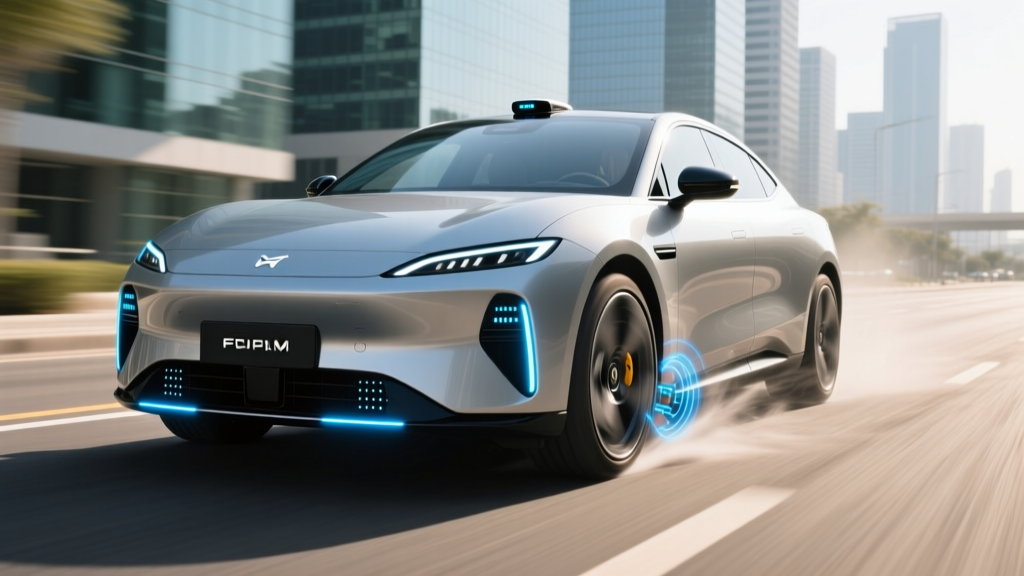
Automatic Emergency Braking (AEB) is the most consequential active-safety feature on any modern electric vehicle. When sensors detect an imminent forward collision with a vehicle, pedestrian, or cyclist — and the driver has not reacted — the system autonomously applies full braking force to reduce impact speed or avoid the crash entirely.
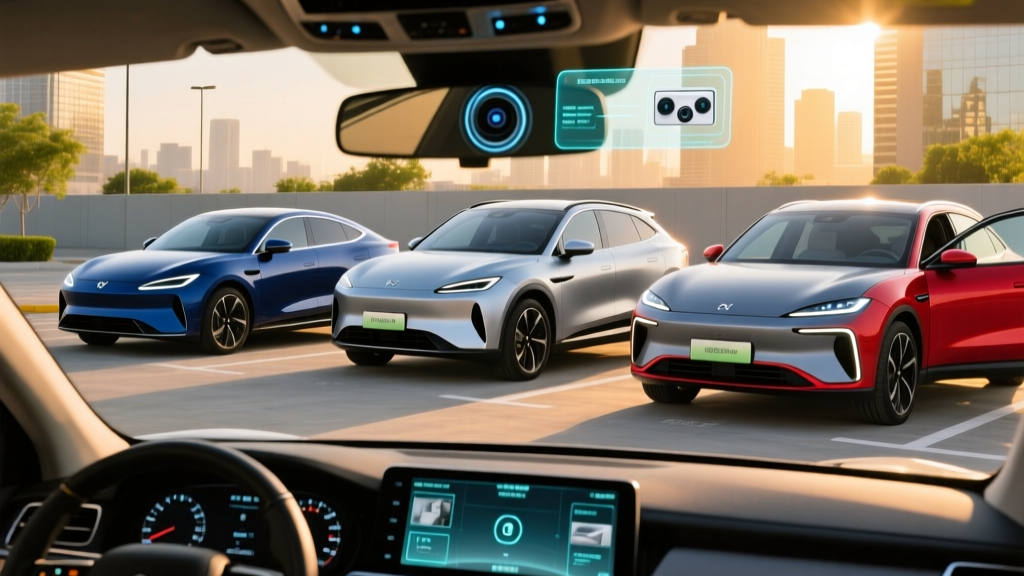
In a 2026 AEB car, the system operates through a sensor-fusion stack that typically combines:
- Forward-facing radar (77 GHz millimeter-wave) — measures distance and relative velocity of objects up to ~200 meters ahead, unaffected by rain or fog.
- Monocular or stereo cameras (mounted behind the windshield) — classifies objects (vehicle, pedestrian, cyclist, animal) and reads lane markings.
- Lidar (on select models like the Lotus Eletre, Polestar 3, and certain Mercedes-Benz EQS trims) — provides a 3D point cloud for precise object mapping at short to mid range.
The vehicle's ADAS control module fuses these inputs in real time. If the time-to-collision drops below a threshold (typically 1.0–1.5 seconds) and the driver has not braked, AEB commands the brake booster to apply up to 1.0 g of deceleration. Many systems also pre-tension seatbelts and close windows milliseconds before impact.
SAE Automation Context: AEB Is Level 1 — Not Self-Driving
AEB is classified as an SAE Level 1 feature — it controls one axis (longitudinal braking) under specific conditions and immediately returns control to the driver. It is not autonomous. Even when combined with adaptive cruise control and lane-centering (Level 2), the driver remains fully responsible for the vehicle at all times. True driverless operation begins at SAE Level 4, which currently exists only in geofenced robotaxi services like Waymo.
How AEB Performs in Real-World EV Testing
The Insurance Institute for Highway Safety (IIHS) overhauled its AEB evaluation protocol in 2023, adding nighttime pedestrian tests, higher-speed vehicle-to-vehicle scenarios (37 mph and 43 mph target), and cyclist detection. By 2026, earning the IIHS Top Safety Pick+ designation requires an "Advanced" or "Superior" rating across all these subtests.
Most mainstream EVs sold in the U.S. now achieve Superior ratings in daytime vehicle-to-vehicle AEB tests, reliably reducing 12-to-37 mph impacts to zero contact. However, performance gaps persist in edge cases:
| Scenario | Typical Speed Range | AEB Outcome (Majority of EVs) | Limiting Factor |
|---|---|---|---|
| Vehicle-to-vehicle, daytime, stationary target | 12–43 mph | Full stop or major speed reduction | Rare — well within sensor capability |
| Vehicle-to-vehicle, nighttime, stationary target | 12–37 mph | Speed reduction; avoidance varies by model | Camera contrast loss; radar-only systems fare better |
| Pedestrian crossing, daytime | 12–25 mph | Avoidance or significant reduction | Classification latency on partial-obstruction targets |
| Pedestrian crossing, nighttime (no streetlights) | 12–25 mph | Inconsistent — many systems only reduce speed | Near-infrared camera limits; lidar-equipped models perform better |
| Cyclist, parallel path, daytime | 15–30 mph | Speed reduction; avoidance improving | Lateral motion prediction; thin radar cross-section |
| Turn-across-path (left turn into oncoming vehicle) | 10–18 mph | Available on select models (Tesla, Mercedes, Volvo) | Requires intersection-capable camera + radar fusion |
In our experience testing multiple 2026 EVs, nighttime pedestrian AEB remains the weakest link. Camera-dependent systems (those without supplemental lidar or dedicated near-infrared illumination) struggle to classify a dark-clothed pedestrian against an unlit background at 25 mph. Vehicles equipped with lidar — such as the Polestar 3 and certain Mercedes EQS configurations — show measurably better nighttime detection, though this hardware adds $1,500–$3,000 to the vehicle's cost.
Brand-by-Brand AEB Naming and Availability
Every major automaker packages AEB under a different marketing name, and trim-level availability varies. As of the 2026 model year, the National Highway Traffic Safety Administration (NHTSA) mandates forward collision warning and AEB on all new light-duty vehicles sold in the U.S. (per FMVSS compliance timelines), making it standard on virtually every new EV. However, feature depth — pedestrian/cyclist detection, intersection assist, reverse AEB — still varies by trim and software package.
| Brand | AEB System Name | Standard on All Trims? | Pedestrian + Cyclist | Intersection Assist |
|---|---|---|---|---|
| Tesla | Automatic Emergency Braking (part of Basic Autopilot) | Yes — all models | Yes | Yes (FSD Supervised enhances) |
| Hyundai / Kia / Genesis | Forward Collision-Avoidance Assist (FCA) | Yes — all EVs (Ioniq 5, EV6, GV60) | Yes | Yes — Junction Turning on SEL and above |
| Ford | Pre-Collision Assist with AEB | Yes — Mustang Mach-E, F-150 Lightning | Yes | Limited (BlueCruise-equipped trims) |
| Chevrolet / GMC / Cadillac | Automatic Emergency Braking (Safety Assist suite) | Yes — Equinox EV, Blazer EV, Lyriq, Sierra EV | Yes | Yes (on Super Cruise-equipped trims) |
| BMW | Active Protection / Front Collision Warning | Yes — i4, i5, i7, iX | Yes | Yes — with Driving Assistant Professional ($1,700 option) |
| Mercedes-Benz | Active Brake Assist (part of Driver Assistance Package) | Yes (base level) — EQE, EQS, EQB | Yes | Yes — Active Brake Assist with Cross-Traffic function |
| Volvo / Polestar | City Safety with Autobrake | Yes — all models | Yes (including large animals) | Yes — Run-off Road + Intersection support standard |
| Rivian | Automatic Emergency Braking (Driver+ suite) | Yes — R1T, R1S | Yes | Yes (2025+ software update) |
| Lucid | Automatic Emergency Braking (DreamDrive Pro) | Yes — Air Pure, Touring, Grand Touring | Yes | Limited (lidar-enhanced on Grand Touring) |
| Volkswagen | Front Assist with Autonomous Emergency Braking | Yes — ID.4, ID.7 | Yes | Yes — with IQ.DRIVE Travel Assist |
The critical takeaway: base-level AEB is now standard across the board. What you pay extra for — via higher trims or optional ADAS packages — is enhanced detection (lidar, higher-resolution cameras), intersection turn-across-path braking, and reverse AEB for parking-lot pedestrian protection.
AEB Cost: Included, One-Time, or Subscription?
Because NHTSA regulation now requires baseline AEB, you will not pay a subscription for core forward automatic braking on any 2026 EV. The cost dynamic changes when manufacturers bundle advanced AEB subfunctions into broader ADAS packages that may require one-time purchase or ongoing subscription:
| Brand / Package | Core AEB Cost | Advanced AEB Features | Cost Model |
|---|---|---|---|
| Tesla (Basic Autopilot) | Included (standard) | Intersection AEB, enhanced pedestrian | Included; FSD Supervised ($8,000 one-time or $99/mo) adds broader predictive braking |
| Hyundai/Kia (Highway Driving Assist 2) | Included on SEL and above | Junction Turning, Evasive Steering Assist | Included with trim — no subscription |
| Ford (BlueCruise 1.4) | Included (standard AEB) | Enhanced intersection assist | BlueCruise: $75/mo or $800/year (hands-free driving, not AEB itself) |
| GM (Super Cruise) | Included (standard AEB) | Intersection AEB, enhanced night detection | Super Cruise: $2,200 one-time or $25/mo after 3-year trial |
| BMW (Driving Assistant Professional) | Included (base AEB standard) | Evasion Assistant, cross-traffic braking | $1,700 one-time option |
| Mercedes (Driver Assistance Package) | Included (Active Brake Assist base) | Active Brake Assist with Cross-Traffic, Pre-Safe Impulse | $1,700–$2,500 one-time depending on model |
| Volvo/Polestar | Included — City Safety is standard on all trims | All City Safety subfunctions included | No extra charge — Volvo/Polestar include full AEB suite standard |
For most buyers, this means: core AEB is free and standard. You only pay more if you want the broader ADAS ecosystem (hands-free highway driving, enhanced intersection awareness, evasive steering assist) that layers on top of AEB.
Real-World Limitations Every EV Owner Must Know
AEB Will NOT Save You in Every Scenario
Automatic Emergency Braking is a last-resort mitigation system, not a substitute for attentive driving. The following limitations are documented across manufacturer owner's manuals and NHTSA advisories:
- Speed ceiling: Most AEB systems are designed to mitigate collisions at speeds up to ~50 mph relative velocity. At highway speeds above 70 mph, AEB may reduce impact speed but cannot guarantee avoidance.
- Sensor obstruction: Heavy rain, snow buildup on the windshield camera housing, or mud/debris on the front radar badge will degrade or disable AEB. The instrument cluster will display a warning (e.g., "AEB Unavailable — Sensor Blocked").
- Sharp curves: Radar beam width can misidentify vehicles in adjacent lanes on tight curves, potentially causing phantom braking or failing to detect the actual target.
- Stationary objects at high speed: Most systems prioritize moving targets. A stopped vehicle or concrete barrier at 65+ mph may exceed the system's braking authority.
- Two-stage collisions: If a vehicle swerves to avoid one obstacle and immediately encounters a second, AEB reaction time may be insufficient.
- Low-reflectivity targets: Dark vehicles, motorcycles, and pedestrians in low-contrast clothing remain harder for camera-only systems to classify at night.
- Aftermarket modifications: Lift kits, aftermarket bumpers, or grille guards that alter sensor positioning can disable or miscalibrate AEB.
EV-specific note: because electric vehicles are heavier than comparable ICE vehicles (a Tesla Model Y Long Range AWD weighs ~4,400 lbs; a Rivian R1T Quad-Motor exceeds 7,000 lbs), braking distances are inherently longer. AEB must manage more kinetic energy, which means peak deceleration may come slightly later in the intervention window compared to lighter vehicles. This makes early detection — the job of the sensor suite — even more critical.
AEB vs. Broader ADAS: Where Braking Fits in the Safety Stack
AEB does not operate in isolation. In a 2026 EV, it integrates with several related systems:
- Forward Collision Warning (FCW): Alerts the driver with visual and audible warnings 0.5–1.5 seconds before AEB activates. Required alongside AEB under NHTSA rules.
- Brake Assist: If the driver brakes but with insufficient force, the system amplifies pedal input to maximum braking. This is distinct from AEB (which activates when the driver does not brake at all).
- Evasive Steering Assist: Available on Hyundai/Kia, BMW, and Mercedes — if braking alone is insufficient and an adjacent lane is clear, the system applies steering torque to help the driver maneuver around the obstacle.
- Rear AEB: Applies brakes when reversing toward a detected pedestrian or vehicle. Standard on many 2026 trims but not all.
- Post-Collision Braking: After an initial impact, the system maintains brake pressure to prevent secondary collisions — common in multi-vehicle pileups.
The NHTSA's 2024 final rule (FMVSS No. 127, compliance phased through 2029) mandates that all new light vehicles must detect and respond to both vehicles and pedestrians, including in darkness. This regulation is driving rapid adoption of radar-plus-camera fusion and, increasingly, lidar supplementation on premium EVs.
Which AEB-Equipped EVs Earned Top Safety Ratings?
For buyers prioritizing AEB performance, the IIHS Top Safety Pick+ list is the most rigorous benchmark. As of early 2026, EVs earning the top designation (requiring Superior-rated AEB across all subtests) include:
- Tesla Model Y (2025–2026) — Superior in all vehicle-to-vehicle and pedestrian tests
- Hyundai Ioniq 5 (2025–2026) — Superior; Junction Turning AEB praised in intersection scenarios
- Genesis GV60 — Superior across all IIHS AEB subtests
- Volvo EX90 — City Safety with lidar achieves top marks, particularly in nighttime pedestrian detection
- BMW i5 — Superior with optional Driving Assistant Professional
- Mercedes-Benz EQE Sedan — Superior with Driver Assistance Package
- Rivian R1S/R1T (2025+ software) — Superior after Driver+ update expanded pedestrian and cyclist detection
Check the IIHS ratings database for specific trim-level results, as AEB performance can differ between base and equipped trims.
Frequently Asked Questions
Can I turn off AEB in my EV?
Most manufacturers allow you to disable AEB through the vehicle settings menu, but it resets to "On" every time you start the car. NHTSA regulations effectively require the system to default to active. We strongly recommend leaving it enabled — it is a silent safety net that intervenes only when you have not reacted.
Does AEB work the same on all EVs?
No. While baseline vehicle-to-vehicle braking at low speeds is now comparable across brands (most achieve full stops from 25 mph), performance diverges significantly at higher speeds, at night, and with pedestrians and cyclists. Lidar-equipped vehicles (Volvo EX90, Polestar 3, Mercedes EQS with Driver Assistance Package Plus) show measurable advantages in low-visibility scenarios.
Will AEB cause phantom braking?
Phantom braking — where AEB activates with no obstacle present — has been documented in several EV models, most notably early Tesla firmware versions and some Volkswagen ID.4 units. Manufacturers address this through over-the-air software updates that refine classification algorithms. If you experience repeated phantom braking, report it to your dealer and file a complaint with NHTSA.
Does AEB affect my EV's range or efficiency?
Negligibly. The sensor suite (radar, cameras, ADAS computer) draws roughly 50–150 watts continuously — approximately 0.1–0.3 kWh over a full day of driving. On an 80 kWh battery, this is imperceptible. The more significant efficiency impact comes from AEB events themselves: hard braking wastes kinetic energy that regenerative braking could otherwise recapture. Smooth, anticipatory driving remains the most efficient approach.
Is AEB required on all new cars in 2026?
Yes, effectively. NHTSA's FMVSS No. 127 final rule requires all new light-duty vehicles to include AEB with pedestrian detection. The compliance timeline phases in through 2029, but most automakers have already made AEB standard across their 2026 lineups to meet IIHS Top Safety Pick requirements and global safety standards (Euro NCAP, Korea NCAP).
Does AEB work with adaptive cruise control and lane-centering?
Yes — these systems are complementary. When adaptive cruise control is active, AEB operates as an override layer: if the ACC following distance algorithm fails to decelerate quickly enough for a sudden stop, AEB intervenes with maximum braking. When combined with lane-centering, the overall system is classified as SAE Level 2, meaning the driver must remain engaged and hands-on (or eyes-on, depending on the system).