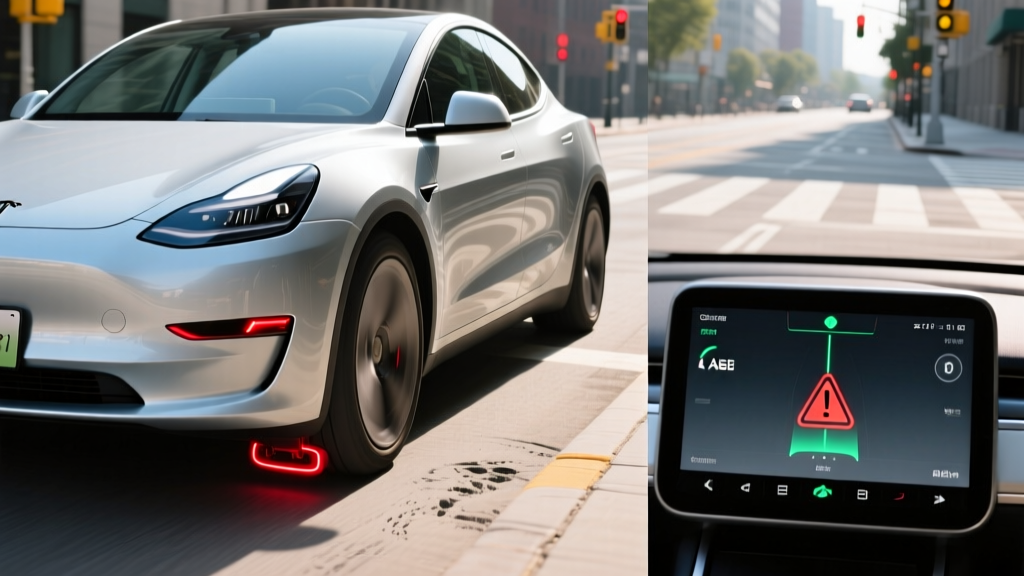
If you've driven a modern electric vehicle in the last few years, you've almost certainly been startled by a sudden dashboard warning or an unexpected brake application. That's your car's AEB (automatic emergency braking) system intervening — a technology that the National Highway Traffic Safety Administration (NHTSA) now considers so critical that it mandated the feature across all new light-duty vehicles sold in the United States, with compliance phased in through 2029.
But AEB is far from a uniform technology. The system in a 2026 Tesla Model 3 operates on entirely different hardware and philosophy than the one in a Hyundai Ioniq 6 or a Ford Mustang Mach-E. Understanding the differences — what the sensors can actually detect, where the systems fail, and what you're paying for — separates informed EV buyers from those who assume "my car will stop itself."
This guide breaks down AEB across the current EV landscape: the engineering underneath, the brand-specific implementations, the real-world performance gaps, and the costs baked into your purchase or subscription.
What AEB Automatic Emergency Braking Actually Does
Automatic emergency braking is a collision-avoidance system that monitors the road ahead and applies the vehicle's brakes — either partially or with full force — when it detects an imminent forward collision that the driver has not responded to.
The typical sequence works in three stages:
- Forward Collision Warning (FCW): Visual and audible alerts warn the driver of a potential crash. No braking occurs yet.
- Pre-charge / brake assist: The system pre-fills the brake hydraulics so that if the driver does stomp the pedal, maximum braking force is available instantly rather than after a delay.
- Automatic braking intervention: If the driver does not react, the system applies braking autonomously — either to reduce collision severity or, at lower speeds, to prevent the collision entirely.
The critical distinction: AEB is a reactive safety system, not a predictive driving system. It does not navigate, steer, or plan routes. It watches for trouble and hits the brakes when you don't.
AEB is classified under SAE J3016 as a Level 0 momentary intervention — the system acts only in emergencies and returns full control immediately. When AEB is bundled with adaptive cruise control and lane-centering (as in Tesla Autopilot or Ford BlueCruise), the combined package operates at SAE Level 2, meaning the driver must remain fully engaged, hands on or near the wheel, eyes on the road. No consumer vehicle sold in 2026 is self-driving.
How AEB Works: The Sensor Stack Explained
Every AEB system relies on a sensor suite that perceives the environment ahead of the vehicle. The three primary sensor types used in 2026 EVs are:
| Sensor Type | How It Works | Strengths | Weaknesses |
|---|---|---|---|
| Camera (mono or stereo) | Captures visual data; neural networks classify objects (vehicles, pedestrians, cyclists) | Excellent object classification; reads signs and lane markings; low cost | Struggles in low light, fog, heavy rain, direct sun glare; no native distance measurement |
| Radar (77 GHz millimeter-wave) | Emits radio waves and measures reflections to determine object distance and relative velocity | Works in rain, fog, darkness; excellent at measuring speed and distance | Poor object classification; can miss stationary objects or misidentify overhead signs as obstacles |
| Lidar | Fires laser pulses to build a 3D point cloud of the environment | Precise 3D mapping; excellent distance accuracy; works in varied lighting | Expensive; limited consumer adoption; degraded by heavy precipitation on sensor surface |
Camera-only approach: Tesla transitioned to its "Tesla Vision" camera-only architecture starting in 2021, removing radar and ultrasonic sensors from the Model 3, Model Y, Model S, and Model X. By 2026, all Tesla vehicles rely on an 8-camera suite processed by the HW4 (Hardware 4) computer. The advantage is a simpler hardware bill of materials and heavy reliance on neural-network object detection. The trade-off: cameras can be blinded by direct sun at dawn/dusk, heavy rain, or a dirty windshield — scenarios where radar would continue functioning.
Camera + radar fusion: Most other automakers — including Hyundai/Kia, Ford, BMW, Mercedes-Benz, Rivian, and Volkswagen — use a sensor-fusion approach that combines a forward-facing camera with a front-mounted radar unit. This is the dominant architecture in 2026 and provides redundancy: if one sensor type is compromised by conditions, the other can maintain detection capability.
Lidar integration: A handful of premium vehicles, notably certain Chinese-market EVs and the Volvo EX90 (which uses a roof-mounted Luminar lidar unit), incorporate lidar into their AEB stack. Lidar provides centimeter-accurate 3D perception but adds significant cost — typically $1,000-$2,000 to the vehicle price — and remains rare in U.S.-market consumer EVs as of 2026.
AEB Across Brands: What Each Automaker Calls It
One of the most confusing aspects of shopping for an EV with AEB is that every manufacturer brands the feature differently. Here's how the major EV brands name and package their automatic emergency braking systems in 2026:
| Brand | AEB Brand Name | Suite Name | Standard on All Trims? | Sensor Stack |
|---|---|---|---|---|
| Tesla | Automatic Emergency Braking | Active Safety (part of base); FSD adds more | Yes — all models, all trims | 8 cameras (Tesla Vision, HW4) |
| Hyundai / Kia / Genesis | Forward Collision-Avoidance Assist (FCA/FCA2) | Hyundai SmartSense / Kia Drive Wise | Yes — standard on all 2026 EV trims | Camera + radar fusion |
| Ford | Pre-Collision Assist with AEB | Ford Co-Pilot360 | Yes — standard across Mach-E, F-150 Lightning | Camera + radar fusion |
| BMW | Frontal Collision Warning with City Collision Mitigation | BMW Driving Assistant / Professional | Base AEB standard; enhanced version optional | Camera + radar; lidar on i7 |
| Mercedes-Benz | Active Brake Assist | Mercedes Driver Assistance Package | Yes — standard on EQE, EQS, EQB | Camera + radar fusion |
| Rivian | Automatic Emergency Braking | Rivian Driver+ | Yes — standard on R1T and R1S | Camera + radar fusion |
| Volvo / Polestar | Collision Avoidance with Auto Brake | Pilot Assist / Volvo IntelliSafe | Yes — standard on all models | Camera + radar; lidar on EX90 |
| Volkswagen | Front Assist (Autonomous Emergency Braking) | IQ.DRIVE | Yes — standard on ID.4, ID.7 | Camera + radar fusion |
The good news: thanks to the NHTSA mandate and the IIHS TOP SAFETY PICK requirements, basic AEB is now standard equipment on virtually every 2026 EV sold in the U.S. You do not need to pay extra or select a specific trim to get forward collision warning and automatic braking. The differentiation comes in enhanced AEB features — pedestrian detection, cyclist detection, intersection turn assist, and higher-speed effectiveness — which are sometimes bundled into higher trims or optional packages.
What AEB Can Detect: Pedestrians, Cyclists, and Intersections
Basic AEB detects the rear of a vehicle directly ahead. But modern 2026 systems have expanded their detection scope considerably:
- Vehicle-to-vehicle (rear-end): The baseline capability. All systems detect a stopped or slower-moving vehicle ahead. Effective speed range varies: most systems can prevent collisions at speeds up to 50-55 mph and reduce severity at speeds up to 85-100 mph.
- Pedestrian detection: Standard on most 2026 EVs. The system identifies human-shaped objects and applies braking. Daytime performance is generally strong; nighttime pedestrian detection depends heavily on the sensor stack — camera-only systems (Tesla) are more limited in darkness than camera+radar fusion systems.
- Cyclist detection: Increasingly common but not universal. Hyundai's FCA2, Ford's Co-Pilot360 2.0+, and Volvo's IntelliSafe all include cyclist detection as standard in 2026. Some base systems from other brands still require an optional package.
- Intersection / turn assist: The newest frontier. Systems like Hyundai's FCA-JT (Junction Turning) and Mercedes' Active Brake Assist with Cross-Traffic Function can detect oncoming vehicles when you're making a left turn across traffic, or crossing vehicles at an intersection. This capability is typically limited to higher trims or optional packages.
- Rear cross-traffic braking: When reversing out of a parking space, the system detects approaching vehicles and brakes. Often bundled with AEB packages and standard on most 2026 EVs.
Real-World Limitations: Where AEB Falls Short
- AEB does not replace attentive driving. It is a last-resort safety net, not a co-pilot.
- AEB does not steer around obstacles. It only brakes.
- AEB does not guarantee collision avoidance at all speeds. Above ~55 mph, it typically reduces severity rather than preventing impact entirely.
- The driver remains 100% responsible for vehicle control at all times.
Even the best AEB systems in 2026 have well-documented edge cases that every EV owner should understand:
Weather and Visibility Degradation
Heavy rain, snow, and fog reduce sensor effectiveness across the board. Camera-based systems suffer from reduced contrast and obscured lenses. Radar penetrates precipitation better but can produce false positives from rain droplets or standing water. Tesla's camera-only system has drawn particular scrutiny: in IIHS evaluations, Tesla Vision-based AEB scored lower in nighttime pedestrian detection than radar-equipped competitors.
Sensor Obstruction
A dirty windshield (in front of the camera module), mud or ice on the front radar unit, or even a bug-splattered camera lens can disable AEB entirely. Most systems will alert you with a dashboard message like "AEB Unavailable" or "Sensor Blocked," but this means you're driving without the safety net until the obstruction is cleared. In winter conditions, this can happen within minutes of driving on salted roads.
Stationary Object Challenges
Radar-based AEB has historically struggled with stationary objects — particularly at highway speeds. The system's filtering algorithms may classify an overhead sign gantry, a parked fire truck, or a concrete barrier as non-threatening stationary clutter rather than an obstacle. This is the root cause of several well-documented incidents where adaptive cruise control (which uses the same sensor stack) failed to brake for stationary emergency vehicles. Camera-based and lidar-based systems handle stationary objects better, but the problem is not fully eliminated in any 2026 consumer system.
Phantom Braking
The flip side of missing an obstacle: false-positive braking, where the system slams the brakes for no apparent threat. This is most commonly triggered by shadows, overhead structures, or vehicles in adjacent lanes that the system momentarily classifies as being in your path. Tesla owners have reported phantom braking events more frequently than owners of radar-equipped vehicles, though no system is immune. Sudden deceleration on a highway — even if the system corrects itself within a second — can cause rear-end collisions from following traffic.
Speed and Angle Limitations
Most AEB systems are optimized for straight-ahead, rear-end collision scenarios. They are significantly less effective in:
- Offset or angled collisions (e.g., a vehicle cutting in diagonally)
- Very high-speed scenarios (above 80-90 mph differential)
- Curved roads where the target vehicle moves out of the sensor's narrow detection cone
- Low-speed parking scenarios where the vehicle's AEB may not activate below ~5 mph (some systems do, some don't)
AEB Cost: What You're Paying For
Because basic AEB is now mandated and standard on virtually all 2026 EVs, the core feature does not add to your purchase price. However, enhanced AEB capabilities — and the broader ADAS suites they're bundled with — carry costs that vary significantly by brand:
| Brand / System | Base AEB | Enhanced ADAS Cost | Subscription Model? |
|---|---|---|---|
| Tesla (Base Autopilot) | Included (standard) | FSD (Supervised): $8,000 one-time or $99/month | Yes — FSD available as monthly subscription |
| Hyundai / Kia | Included (standard) | Enhanced FCA2 (junction, cyclist) included on SEL+ and above (~$3,000 trim step) | No — one-time purchase via trim selection |
| Ford (Co-Pilot360) | Included (standard) | BlueCruise (hands-free highway): $2,100 one-time or $75/month | Yes — BlueCruise available as subscription |
| BMW (Driving Assistant Pro) | Included (standard) | Driving Assistant Professional: $1,700 option package | No — one-time purchase option |
| Mercedes-Benz | Included (standard) | Driver Assistance Package: $1,950-$2,500 depending on model | No — one-time purchase option |
| Volvo / Polestar | Included (standard) | Pilot Assist included on most trims; Plus package adds features (~$2,000) | No — one-time purchase |
Key takeaway: You are not paying extra for basic AEB in 2026 — it's included in every EV's sticker price. The subscription and option costs apply to the broader ADAS suites (lane centering, adaptive cruise, hands-free driving) that AEB is a component of. If you only care about automatic emergency braking and not about hands-free highway cruising, the base trim of any of these vehicles already has you covered.
AEB Effectiveness: What the Safety Data Shows
The real-world impact of AEB on crash reduction is well-documented. According to IIHS research, front crash prevention systems (which include AEB) reduce rear-end collisions by approximately 50% and rear-end injuries by about 56%. The effect is even more pronounced at lower speeds: city-speed AEB (below 30 mph) can prevent up to 70% of rear-end collisions.
However, not all AEB systems perform equally. The IIHS evaluates vehicles through its crashworthiness and crash avoidance ratings, and the IIHS rating pages show significant variation between systems. Vehicles earning the TOP SAFETY PICK+ designation must demonstrate superior or advanced front crash prevention in vehicle-to-vehicle, vehicle-to-pedestrian (day and night), and vehicle-to-cyclist testing.
In the 2025-2026 testing cycle, vehicles with camera+radar fusion systems — particularly from Hyundai/Kia, Volvo, and Mercedes-Benz — consistently scored "Superior" in both daytime and nighttime pedestrian AEB tests. Tesla's camera-only system has shown improvement with successive software updates but has historically scored "Acceptable" or lower in nighttime pedestrian scenarios.
AEB vs. the Full ADAS Suite: Understanding the Package
Buyers often conflate AEB with broader driver-assistance features. Here's how AEB fits into the larger picture:
- AEB (Automatic Emergency Braking): Brakes only in imminent collision scenarios. Active only when danger is detected. Level 0 intervention.
- ACC (Adaptive Cruise Control): Maintains a set following distance behind a lead vehicle. Active continuously when engaged. Level 1.
- Lane Centering: Provides continuous steering input to keep the vehicle centered in its lane. Level 1 alone; Level 2 when combined with ACC.
- Full ADAS suites (Autopilot, BlueCruise, Super Cruise, Highway Driving Assist): Combine ACC + lane centering + AEB + additional features into a Level 2 package. The driver must remain engaged.
AEB operates independently of whether you have ACC or lane centering engaged. Even if you never activate cruise control, AEB is always monitoring (unless manually disabled in settings, which most manufacturers discourage). This makes AEB the most passively beneficial ADAS feature — it works whether you think about it or not.
Frequently Asked Questions About AEB
Can I turn off AEB in my EV?
Yes, most vehicles allow you to disable AEB through the infotainment settings or a physical button. However, the system typically re-enables every time you start the car. The NHTSA strongly discourages disabling AEB, and doing so may affect insurance rates or liability in a collision.
Does AEB work at highway speeds?
Partially. Most 2026 AEB systems can detect vehicles ahead at highway speeds (65-80 mph) and will apply braking. However, at high speed differentials, AEB typically reduces collision severity rather than preventing the crash entirely. Full collision avoidance is generally only achievable at speed differentials below 30-40 mph.
Will AEB brake for animals?
Some enhanced systems include large-animal detection (moose, deer, cattle). This is more common in camera+radar systems from Volvo, Subaru, and Mercedes-Benz. Camera-only systems and basic radar systems typically do not classify animals and will not brake for them.
Does AEB affect my EV's range or efficiency?
No meaningful impact. AEB uses the same sensor suite that's already powered for other ADAS features. The compute load is negligible relative to the vehicle's traction battery (typically 60-100+ kWh). You will not see a measurable range difference whether AEB is active or not.
Is Tesla's camera-only AEB as good as radar-equipped systems?
In daylight, clear-weather vehicle-to-vehicle scenarios, Tesla's AEB performs comparably to radar-equipped competitors. The gap widens in challenging conditions: nighttime pedestrian detection, heavy rain, and scenarios involving stationary objects. The IIHS testing data reflects this — radar-fusion systems have consistently outperformed camera-only systems in nighttime and adverse-weather evaluations.
If my AEB fails to prevent a crash, is the automaker liable?
No. All manufacturers explicitly state that AEB is a supplemental safety feature and that the driver remains responsible for vehicle operation at all times. AEB is designed to mitigate, not guarantee avoidance. Consult a legal professional for specific liability questions.