Why 'AEB Abbreviation Medical' Searches Lead to Your Car, Not a Hospital
If you've ever typed "AEB abbreviation medical" into a search bar, you're not alone — but you've likely landed in the wrong domain. In healthcare, AEB can stand for "Aortic Ejection Block" or appear in niche clinical contexts. In the automotive world — and specifically in the electric vehicles you're researching or driving — AEB stands for Automatic Emergency Braking. It's one of the most consequential active-safety features on any 2026 EV, and understanding what it does (and doesn't do) could prevent a collision.
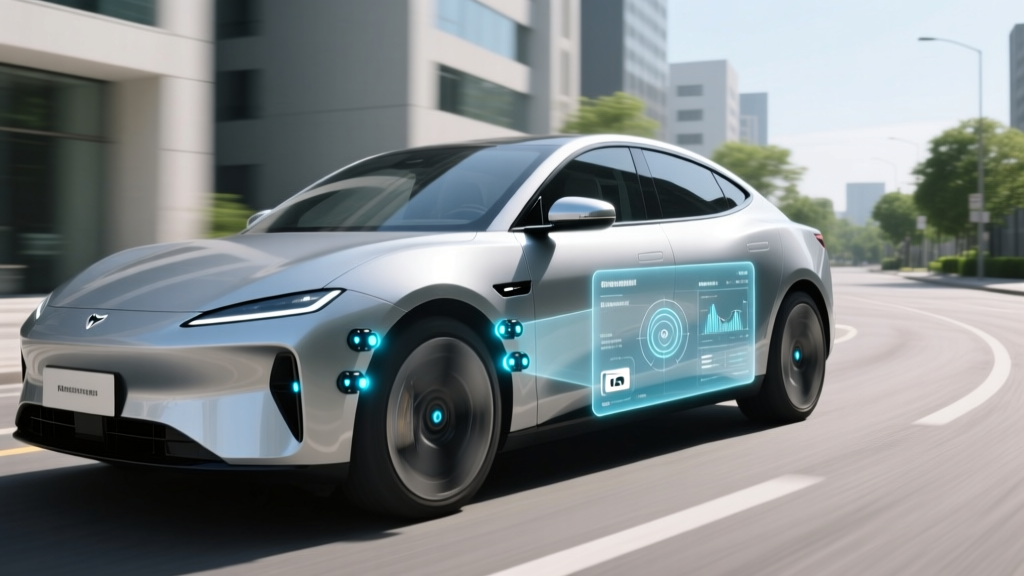
Automatic Emergency Braking uses a combination of forward-facing radar, cameras, and sometimes lidar to detect an imminent collision with a vehicle, pedestrian, or cyclist ahead. If the driver doesn't react in time, the system applies the brakes autonomously to either avoid the crash entirely or reduce its severity. The National Highway Traffic Safety Administration (NHTSA) has mandated AEB as standard equipment on all new light-duty vehicles by September 2029, but most 2026 EVs already include it across all trims.
How AEB Actually Works: Sensors, Fusion, and Braking Logic
AEB isn't a single sensor doing one job. It's a sensor-fusion system that cross-references multiple data streams in real time:
- Millimeter-wave radar (77 GHz typical): Measures distance and relative speed to objects ahead, effective in rain, fog, and darkness where cameras struggle.
- Forward-facing camera (typically 8 MP or higher in 2026 models): Classifies objects — distinguishing a car from a pedestrian from a shadow — using neural-network object detection.
- Ultrasonic sensors (short-range): Assist at low speeds, particularly for pedestrian detection in parking scenarios.
- Lidar (select models): Vehicles like the Volvo EX90 and upcoming Polestar 4 use lidar to generate a 3D point cloud, improving object classification and detection range beyond 250 meters.
When the system calculates that a collision is probable — typically using time-to-collision (TTC) thresholds of around 1.5 to 2.5 seconds — it first issues a visual and audible Forward Collision Warning (FCW). If the driver doesn't brake, AEB engages the hydraulic or regenerative braking system. On most 2026 EVs, AEB can apply up to 1.0g of deceleration, enough to stop a vehicle from 30 mph in roughly 30 feet under ideal conditions.
| Detection Type | Typical Speed Range | Sensor Used | Effectiveness (IIHS Rating Criteria) |
|---|---|---|---|
| Vehicle-to-Vehicle (rear-end) | 5–90 mph | Radar + Camera | Collision avoidance up to ~50 mph; mitigation above |
| Pedestrian Detection (daylight) | 5–50 mph | Camera + Radar | Avoidance up to ~30 mph; mitigation to ~45 mph |
| Pedestrian Detection (nighttime) | 5–40 mph | Radar (camera limited) | Reduced — varies by thermal/IR camera availability |
| Cyclist Detection | 5–45 mph | Camera + Radar | Moderate — lateral movement complicates prediction |
| Intersection / Cross-Traffic | 5–25 mph | Corner Radar + Camera | Available on select models (e.g., Toyota TSS 3.0, GM Super Cruise) |
SAE Automation Level: AEB Is Level 0–1, Not Self-Driving
This distinction matters because some marketing materials blur the lines. Tesla's Full Self-Driving (Supervised), GM's Super Cruise, and Ford's BlueCruise are all Level 2 systems. AEB operates independently of these — it will intervene even if you have cruise control off, the car in Park-to-Drive transition, or no ADAS subscription active. Think of AEB as the last-resort safety net, not a driving assistant.
AEB Across 2026 EV Brands: Naming, Availability, and Cost
Every major EV manufacturer includes some form of AEB as standard equipment in 2026, but the naming conventions, sensor suites, and feature depth vary significantly. Here's how the major brands label and package their systems:
| Manufacturer | System Name | Standard or Optional | Sensor Suite | Notable Capability |
|---|---|---|---|---|
| Tesla | Automatic Emergency Braking (within Tesla Vision) | Standard on all models | 8 cameras, no radar (camera-only since 2022) | Pedestrian/cyclist detection; intersection assist on HW4 |
| Hyundai / Kia / Genesis | Forward Collision-Avoidance Assist (FCA) | Standard on all EVs (Ioniq 5, EV6, GV60) | Radar + Camera | Junction-turning detection; rear cross-traffic braking |
| GM (Chevy / Cadillac) | Automatic Emergency Braking (within Chevy Safety Assist / Cadillac Smart System) | Standard on Equinox EV, Blazer EV, Lyriq, Celestiq | Radar + Camera | Front Pedestrian Braking; works with Super Cruise (Level 2) |
| Ford | Pre-Collision Assist with AEB (within Co-Pilot360) | Standard on Mustang Mach-E, F-150 Lightning | Radar + Camera | Evasive Steering Assist on higher trims |
| BMW | Frontal Collision Warning with City Braking | Standard on i4, i5, i7, iX | Radar + Camera | Cross-traffic warning integrated |
| Volvo / Polestar | Collision Avoidance with Full Auto Brake | Standard on EX30, EX90, Polestar 2/3/4 | Radar + Camera + Lidar (EX90, Polestar 4) | Lidar extends detection to 250m; large-animal detection |
| Toyota / Lexus | Pre-Collision System (PCS) within TSS 3.0 / Lexus Safety System+ 3.0 | Standard on bZ4X, RZ | Radar + Camera | Intersection assist; oncoming vehicle detection |
| Rivian | Forward Collision Warning + AEB (within Driver+) | Standard on R1T, R1S (2026 refresh) | Radar + Camera | Highway Assist integration |
Cost breakdown: AEB itself is not a subscription feature. It is included as standard safety equipment on every 2026 EV listed above. You do not need to pay for Tesla's FSD ($8,000 one-time or $99/month) to get AEB — it ships with the base vehicle. Similarly, GM's Super Cruise ($2,100 option or included on premium trims) and Ford's BlueCruise (included for 1 year, then $75/year) are Level 2 highway-assist systems that operate separately from AEB. The braking safety net is always on.
| Feature | Cost | Subscription Required? |
|---|---|---|
| Automatic Emergency Braking (AEB) | $0 — Standard on all trims | No |
| Tesla FSD (Supervised) — includes enhanced AEB logic | $8,000 or $99/month | Yes (for FSD features; AEB is free) |
| GM Super Cruise | $2,100 option or included on Premium/Luxury trims | Free for 3 years, then $25/month |
| Ford BlueCruise | Included on select trims | Free 1 year, then $75/year |
| BMW Driving Assistant Professional | $1,700 option | No subscription (one-time purchase) |
Real-World Limitations: Where AEB Falls Short
- AEB does NOT replace attentive driving. It is a last-resort intervention, not a co-pilot.
- AEB does NOT guarantee collision avoidance at all speeds. Above ~50 mph relative speed, it will mitigate but may not prevent a crash.
- AEB does NOT reliably detect animals, debris, potholes, or stationary objects at highway speeds.
- AEB performance degrades in heavy rain, snow, fog, direct sun glare, and when sensors are obstructed by dirt or ice.
- AEB does NOT function below ~5 mph (parking-lot speeds) on most platforms — that's handled by separate low-speed auto-brake systems.
In IIHS testing, top-rated AEB systems consistently avoid rear-end collisions at 12 mph and 25 mph in vehicle-to-vehicle scenarios. However, pedestrian detection remains more variable. The IIHS updated its pedestrian AEB test protocol in 2024 to include nighttime scenarios, and many 2026 models still score "Acceptable" rather than "Good" in darkness — primarily because camera-based systems lose classification confidence without sufficient light.
Cold-weather and sensor obstruction: In winter conditions, radar domes and camera housings can accumulate ice and road salt. Most 2026 EVs include heated sensor housings (Tesla added a heated camera washer in the Model Y Juniper refresh), but in heavy slush or freezing rain, AEB may issue a "sensor blocked" warning and temporarily deactivate. This is not a malfunction — it's a safety design choice. The system would rather disable itself than act on corrupted data.
Phantom braking: A documented issue particularly with camera-only systems (Tesla Vision being the most discussed), phantom braking occurs when AEB activates without a genuine obstacle — often triggered by shadows, overpasses, or roadside signage misclassified as obstacles. NHTSA has opened multiple investigations into this phenomenon. Radar-equipped systems (Hyundai, GM, BMW) exhibit fewer phantom-braking events because radar cross-references the camera's classification with physical distance data.
AEB vs. Forward Collision Warning: What's the Difference?
A common point of confusion: Forward Collision Warning (FCW) and AEB are related but distinct. FCW alerts you — visually, audibly, and sometimes with a haptic seat or steering-wheel vibration — that a collision is imminent. It does NOT apply the brakes. AEB includes FCW as its first stage but adds autonomous brake application as the second stage if you don't respond.
On virtually every 2026 EV, FCW and AEB are bundled together and enabled by default. You can usually adjust the FCW sensitivity (early/normal/late) through the vehicle's settings menu, but AEB itself cannot be permanently disabled — it re-enables every time you start the car, per NHTSA guidance.
Which 2026 EVs Have the Best AEB Performance?
Based on IIHS crash-prevention ratings and NHTSA NCAP test data, the strongest AEB implementations in the 2026 EV market include:
- Volvo EX90: Lidar-augmented system provides the longest detection range (~250 m) and best nighttime pedestrian performance in its class. IIHS "Superior" rating for both vehicle-to-vehicle and pedestrian scenarios.
- Toyota bZ4X (TSS 3.0): Consistent "Superior" ratings with intersection-turning detection — a feature many competitors still lack. Toyota's dual-radar setup handles cross-traffic scenarios reliably.
- Hyundai Ioniq 5 / Kia EV6: Junction-turning AEB and rear cross-traffic braking provide 360-degree coverage. IIHS "Superior" across all test scenarios.
- BMW i5: City Braking Function integrates pedestrian, cyclist, and vehicle detection with smooth, progressive brake application. Minimal phantom-braking reports.
- Tesla Model Y (HW4): Improved significantly over HW3 camera-only limitations. However, still lacks radar cross-reference, making it more susceptible to phantom braking in edge cases.
Frequently Asked Questions
What does AEB stand for in cars?
AEB stands for Automatic Emergency Braking. It is an active-safety system that automatically applies the brakes when it detects an imminent forward collision and the driver has not responded. It is standard on virtually all 2026 EVs.
Is AEB the same as self-driving?
No. AEB is classified as SAE Level 0–1 — a momentary intervention system. It does not steer, navigate, or drive the vehicle. Even advanced Level 2 systems like Tesla FSD (Supervised), GM Super Cruise, and Ford BlueCruise require the driver to remain fully engaged at all times. No 2026 consumer vehicle is autonomous.
Do I have to pay extra for AEB on a Tesla or other EV?
No. AEB is standard equipment on every 2026 Tesla, Hyundai, GM, Ford, BMW, Volvo, Toyota, and Rivian EV. You do not need to purchase FSD, Super Cruise, or any ADAS subscription to receive AEB functionality.
Does AEB work at night and in bad weather?
AEB works at night but with reduced effectiveness, particularly on camera-dominant systems. Radar-based systems perform better in darkness. In heavy rain, snow, fog, or when sensors are obstructed by ice or dirt, AEB may temporarily deactivate and alert the driver. Heated sensor housings on many 2026 models mitigate this but don't eliminate it entirely.
What's the difference between AEB and FCW?
Forward Collision Warning (FCW) alerts you to a potential crash with visual, audible, or haptic signals. AEB includes FCW but goes further — if you don't brake in time, AEB applies the brakes for you. On 2026 EVs, both are bundled and enabled by default.
Can AEB cause accidents through phantom braking?
Phantom braking — when AEB activates without a real obstacle — is a documented issue, particularly with camera-only systems. NHTSA has investigated multiple reports. Radar-equipped systems are less prone to this behavior. If you experience phantom braking, report it to NHTSA at nhtsa.gov/report-a-safety-problem and to your vehicle manufacturer.
Why did my search for 'AEB abbreviation medical' bring up cars?
AEB in automotive contexts is a high-traffic search term because it's a critical safety feature. The abbreviation occasionally overlaps with niche medical terminology, but for the vast majority of searches, AEB refers to Automatic Emergency Braking — especially among EV shoppers and owners researching safety technology.