The Evolution of ADAS: From Single Sensors to Sensor Fusion
The automotive industry is undergoing a seismic shift in how vehicles perceive the world. Advanced Driver Assistance Systems (ADAS) have evolved from simple, single-sensor applications like basic radar cruise control into complex, multi-layered sensor fusion networks. As we look toward the future of autonomous and smart driving, understanding the distinct roles, limitations, and technological trajectories of cameras, radar, LiDAR, and ultrasonic sensors is critical for both industry insiders and EV buyers.
According to the National Highway Traffic Safety Administration (NHTSA), ADAS technologies are fundamentally designed to augment human driving, reduce collision severity, and eventually pave the way for higher levels of automation. However, no single sensor type can handle every environmental condition. This reality has sparked an intense industry race to perfect sensor fusion—the algorithmic blending of multiple sensor inputs to create a redundant, 360-degree digital twin of the vehicle's surroundings.
Breaking Down the Core ADAS Sensor Types
Cameras: The Foundation of AI Vision
Cameras are the only ADAS sensors capable of reading text, recognizing traffic light colors, and identifying complex semantic objects like pedestrians, animals, and road signs. Modern ADAS suites rely on high-resolution, high-dynamic-range (HDR) cameras paired with powerful neural processing units (NPUs).
Future Trend: The industry is moving from standard 2D object detection to pixel-level semantic segmentation and occupancy networks. Instead of just drawing a bounding box around a car, AI vision models now map the exact 3D volume of all objects in a scene, including irregular obstacles like fallen trees or overturned trucks. However, cameras remain fundamentally limited by poor lighting, heavy rain, fog, and direct sun glare, necessitating redundant sensor layers.
Radar: The Leap to 4D Imaging
Traditional 3D radar has been a staple of adaptive cruise control for decades, excelling at measuring the distance and relative velocity of objects ahead, regardless of weather or lighting. However, legacy radar struggled with static object detection and lacked vertical resolution, often causing phantom braking when detecting overhead bridges or metallic debris.
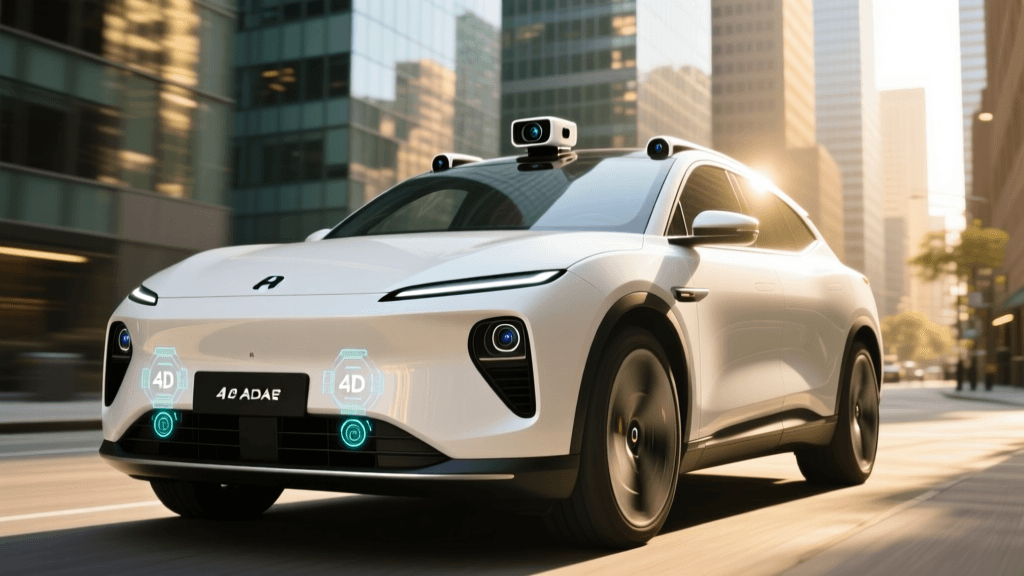
Future Trend: The advent of 4D Imaging Radar is revolutionizing this space. By utilizing massive MIMO (Multiple Input Multiple Output) antenna arrays, 4D radar adds elevation data to the traditional range, azimuth, and velocity metrics. This allows the radar to generate a dense point cloud similar to LiDAR, enabling the vehicle to distinguish between a stopped car and an overhead gantry. Companies like Continental and Bosch are aggressively scaling 4D radar, positioning it as a cost-effective alternative to LiDAR for highway autonomy.
LiDAR: Solid-State and the Path to Mass Adoption
Light Detection and Ranging (LiDAR) uses laser pulses to create highly accurate, millimeter-precise 3D maps of the environment. It is widely considered the gold standard for achieving Level 3 and Level 4 autonomy because it provides exact depth perception independent of ambient light.
Future Trend: Early mechanical spinning LiDAR units cost upwards of $75,000, restricting them to robotaxi test fleets. The future belongs to solid-state and semi-solid-state LiDAR, which have no moving parts and can be integrated seamlessly into vehicle rooflines or windshields. Companies like Luminar, Innoviz, and Hesai have driven the cost of these units below $1,000, with projections suggesting sub-$300 price points by the end of the decade. Furthermore, the shift from 905nm to 1550nm laser wavelengths allows for higher power output, extending detection ranges beyond 250 meters while remaining eye-safe.
Ultrasonic Sensors: Short-Range Reliability
Ultrasonic sensors use high-frequency sound waves to detect objects at very close ranges (typically under 5 meters). They are the backbone of parking assist, cross-traffic alert, and low-speed automatic emergency braking (AEB).
Future Trend: While some automakers, most notably Tesla, have attempted to remove ultrasonic sensors in favor of 'vision-only' parking solutions, the broader industry views this as a risky compromise. Vision-based parking often struggles with transparent objects, thin poles, and low-light conditions. The industry consensus is that ultrasonic sensors will remain a vital, low-cost redundancy layer for low-speed maneuvering, even as camera resolutions improve.
Sensor Fusion vs. Vision-Only: The Industry Debate
The most polarizing debate in the ADAS sector centers on architecture. Tesla has famously pursued a 'Tesla Vision' approach, relying entirely on cameras and neural networks while removing radar and ultrasonic sensors. The company argues that human drivers rely solely on vision, and therefore, AI should be able to do the same with sufficient training data.
Conversely, the rest of the automotive industry—including Mercedes-Benz, Volvo, and Waymo—champions Sensor Fusion. Testing by the Insurance Institute for Highway Safety (IIHS) consistently highlights the limitations of vision-only systems in edge cases, such as heavy fog or direct sunlight blinding the lens. Sensor fusion uses Kalman filters and advanced AI to cross-reference data; if a camera fails to see a white truck against a bright sky, the radar and LiDAR will still detect the physical mass, triggering AEB and preventing a collision.
ADAS Sensor Comparison Chart: 2025 Projections
| Sensor Type | Primary Function | Max Effective Range | Weather/Light Resilience | Est. Unit Cost (2025) | Future Outlook |
|---|---|---|---|---|---|
| AI Cameras | Semantic recognition, lane reading, traffic signs | 250m (High-Res Telephoto) | Low (Blinded by glare, fog, dark) | $20 - $50 | Shift to occupancy networks and end-to-end AI models. |
| 4D Imaging Radar | Velocity tracking, static object detection, point clouds | 300m | High (Pierces fog, rain, snow) | $60 - $120 | Rapid adoption as a primary sensor for highway L2+/L3 systems. |
| Solid-State LiDAR | Millimeter-precise 3D mapping, depth perception | 250m - 300m (1550nm) | Medium (Degraded by heavy snow/rain) | $400 - $800 | Integration into rooflines; essential for L3/L4 urban autonomy. |
| Ultrasonic | Parking, near-field obstacle detection, glass detection | 5m | High (Unaffected by light; minor wind issues) | $2 - $5 | Remains standard for redundancy; vision-only parking is niche. |
Future Industry Outlook: What to Expect by 2030
As we look toward the end of the decade, the U.S. Department of Transportation and global regulatory bodies are preparing frameworks for Level 3 and Level 4 autonomous deployment on public roads. To achieve this, the hardware stack must become commoditized. We expect the following macro-trends:
- Concentrated Sensor Zones: Instead of scattering 15 sensors around the car, automakers will consolidate them into 'smart pods' (e.g., a single roof-mounted module containing LiDAR, forward cameras, and radar) to reduce wiring harness weight and calibration complexity.
- Software-Defined Sensors: Hardware will become standardized, while the differentiation will occur in the software layer. Over-the-air (OTA) updates will unlock new ADAS features by improving the neural networks that process the raw sensor data.
- V2X Integration: Vehicle-to-Everything (V2X) communication will act as a 'fifth sensor,' allowing cars to receive data from smart city infrastructure, traffic lights, and other vehicles, effectively allowing the car to 'see' around corners.
Actionable Advice for Smart Car and EV Buyers
If you are in the market for a new EV or smart vehicle, understanding these sensor trends can save you money and ensure you get the safety features you actually need.
- Don't Overpay for LiDAR if You Only Need Highway Assist: If your daily commute is strictly highway driving, a vehicle equipped with high-quality 4D imaging radar and advanced AI cameras (like the latest Mobileye SuperVision or Ford BlueCruise systems) is more than sufficient for Level 2+ hands-free driving. LiDAR is currently most beneficial for complex, unmapped urban environments.
- Verify the Sensor Cleaning Systems: As cameras and LiDAR become more critical, ask the dealer if the vehicle features active sensor cleaning (e.g., high-pressure fluid jets or air blowers for cameras). A $1,000 LiDAR unit is useless if it is covered in highway salt or mud.
- Check for Redundancy: Be cautious of vehicles that have entirely removed ultrasonic sensors or radar in favor of vision-only systems, especially if you live in an area prone to heavy rain, snow, or fog. Redundancy is the cornerstone of ADAS safety.
- Understand Subscription Models: Many automakers are now gating advanced sensor fusion features behind monthly software subscriptions. Before purchasing a vehicle with a massive sensor suite, verify whether features like automated lane changes or hands-free cruising require a recurring monthly fee.
The future of ADAS is not about a single 'magic bullet' sensor, but rather the symphony of sensor fusion. By combining the semantic understanding of cameras, the all-weather reliability of 4D radar, and the precise depth mapping of solid-state LiDAR, the automotive industry is steadily bridging the gap between human-driven cars and true autonomous mobility.