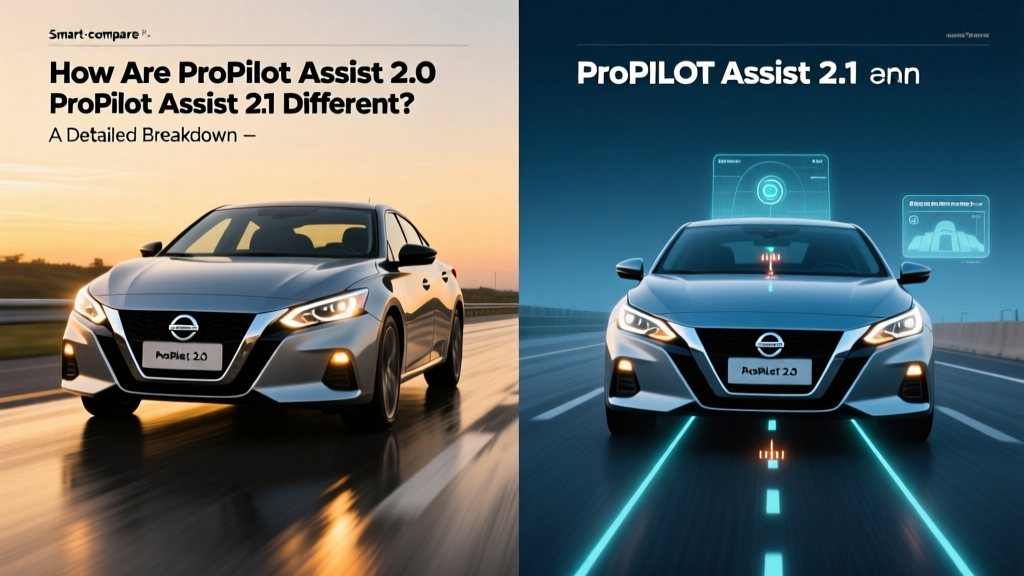
Nissan's ProPILOT Assist suite has evolved quickly over the last few model years, and the naming can be confusing. If you're shopping for a new Ariya, Leaf, or Rogue and wondering how are ProPILOT Assist 2.0 and ProPILOT Assist 2.1 different, the answer comes down to three things: hands-free highway operation, automated lane-change capability, and the sensor hardware underpinning the system. Below, we map every meaningful difference so you can pick the right trim and set realistic expectations before you drive off the lot.
What ProPILOT Assist Actually Does
ProPILOT Assist is Nissan's branded advanced driver-assistance system (ADAS). At its core, it combines adaptive cruise control (ACC) with lane-centering assist (LCA) to manage steering, acceleration, and braking on highways and, in later versions, on surface streets. It is designed to reduce fatigue on long trips and in stop-and-go traffic — not to replace the driver.
Both ProPILOT Assist 2.0 and 2.1 are classified as SAE Level 2 driver-assist systems per SAE International's J3016 taxonomy. This means the system can control steering and speed simultaneously, but the driver must remain fully attentive, supervise the system at all times, and be prepared to take over instantly. Neither version is "self-driving." For true driverless operation (Level 4), you would need a commercial robotaxi service like Waymo.
Sensor Hardware: The Foundation That Separates 2.0 from 2.1
The biggest architectural difference between these two generations lies in the sensor stack. ProPILOT Assist 2.1 adds hardware that 2.0 simply doesn't have, which unlocks its headline features.
| Attribute | ProPILOT Assist 2.0 | ProPILOT Assist 2.1 |
|---|---|---|
| Front radar | 1 long-range radar | 1 long-range radar |
| Front camera | 1 forward-facing camera | 1 forward-facing camera (higher resolution) |
| Corner radars | None (or rear-only for BSW) | 4 corner radars (front + rear) |
| High-definition map | No | Yes (for supported highway sections) |
| Driver monitoring camera | No (torque-based steering detection) | Yes (infrared cabin camera) |
| Hands-off steering (highway) | No — hands on wheel required | Yes — on compatible divided highways |
| Automated lane change | No | Yes (driver-confirmed) |
| Lane-change assist (signaled) | No | Yes (activates when turn signal is used) |
| Navigate-on-route (auto exit ramp) | No | Yes (on mapped highways) |
| Stop-and-go ACC | Yes | Yes |
| Operating speed range | 0–~90 mph (with lane markings) | 0–~90 mph (hands-off on mapped divided highways) |
The addition of four corner radars and an HD map module in ProPILOT Assist 2.1 is what enables the system to "see" adjacent lanes and anticipate upcoming highway geometry (curves, merges, exits). The infrared driver-monitoring camera mounted on the steering column or instrument cluster verifies that your eyes are on the road, replacing the crude steering-torque sensor used in 2.0.
Hands-Free Highway Driving: The 2.1 Advantage
With ProPILOT Assist 2.0, you must keep at least one hand on the steering wheel at all times. If the system detects no steering torque for a sustained period, it issues escalating warnings — visual, audible, and eventually a brake pulse — before disengaging.
ProPILOT Assist 2.1 changes this dynamic on compatible pre-mapped divided highways (typically limited-access interstates and expressways). When conditions are met — clear lane markings, GPS-confirmed mapped road, traffic within system speed limits — you may remove both hands from the wheel. The driver-monitoring camera tracks your gaze; if you look away from the road for too long, the system alerts you and eventually escalates to a controlled stop if you don't respond.
- Weather: Heavy rain, fog, snow, or direct sun glare can blind cameras and radar, causing sudden disengagement. Expect reduced availability in Pacific Northwest winters or monsoon-season Southwest storms.
- Lane markings: Faded, covered, or absent lane lines will cause ProPILOT to disengage. Construction zones are a common failure point.
- HD map coverage (2.1 only): Hands-free operation requires a pre-mapped road. Rural highways, newly constructed interstates, and some state routes may not be mapped yet, reverting 2.1 to hands-on mode.
- Curve handling: Both versions can struggle with sharp highway curves at speed, sometimes braking abruptly or drifting within the lane.
- Cut-in scenarios: A vehicle merging closely into your lane may not be detected instantly. Always be prepared to brake manually.
- Not for city streets (hands-free): Hands-off mode is highway-only on 2.1. Surface-street driving remains hands-on with lane centering.
Automated Lane Changes: How 2.1 Handles Them
ProPILOT Assist 2.1 introduces two lane-change features that 2.0 lacks entirely:
- Driver-confirmed lane change: When the system detects a slower vehicle ahead and an adjacent lane is clear, it suggests a lane change. You confirm by holding the turn-signal stalk, and the car steers itself into the next lane.
- Navigate-on-route (auto lane change for exits): When a navigation route is active and you approach an exit or interchange on a mapped highway, the system can initiate the lane change toward the exit ramp. You must still confirm the maneuver and remain attentive.
In both cases, the corner radars monitor blind spots and rear-approaching traffic. If a vehicle is in the target lane or closing quickly, the system waits. This is a meaningful safety improvement over manually checking mirrors while the ACC manages speed.
Which Nissan Models and Trims Offer Each Version?
Availability varies by model year and trim. As of the 2025–2026 model years, here is the general distribution:
| Model | ProPILOT Assist 1.1 (Basic) | ProPILOT Assist 2.0 | ProPILOT Assist 2.1 |
|---|---|---|---|
| Ariya (Engage+ / Venture+) | ✓ (1.1) | — | — |
| Ariya (Evolve+ / Empower+ / Platinum+) | — | ✓ | — |
| Ariya (Platinum+ e-4ORCE, 2026 MY) | — | — | ✓ |
| Leaf (SV Plus / 2025+) | ✓ (1.1) | — | — |
| Rogue (Platinum, 2025+) | — | ✓ | — |
| Pathfinder (Platinum, 2026 MY) | — | — | ✓ |
Key takeaway: ProPILOT Assist 2.1 is currently limited to top-tier trims on select models. If hands-free highway driving is a priority, verify the exact trim and option package with your dealer — Nissan has been gradually expanding 2.1 availability across model years, but it is not yet standard on most vehicles. Always confirm on the official Nissan ProPILOT page for the latest model-year specifics.
Cost: What You'll Pay for Each Version
Unlike Tesla's Full Self-Driving (Supervised) or GM's Super Cruise, Nissan does not currently charge a separate subscription fee for ProPILOT Assist 2.0 or 2.1. Both are bundled into the vehicle's MSRP as part of the trim's technology package.
| Cost Element | ProPILOT 2.0 | ProPILOT 2.1 |
|---|---|---|
| Upfront purchase | Included in trim MSRP | Included in trim MSRP |
| Monthly subscription | None | None (as of 2026 MY) |
| HD map updates | N/A | OTA updates included (verify long-term policy) |
| Trim price premium (approx.) | +$2,000–$4,000 over base | +$5,000–$8,000 over base (top trims only) |
The trade-off is that you can't add ProPILOT 2.1 to a lower trim after purchase — it requires the hardware package from the factory. Plan your trim selection accordingly.
ProPILOT Assist vs. Competing ADAS Systems
How does Nissan's system compare to the other major Level 2 ADAS offerings? Here's a quick positioning map:
- Tesla Autopilot / FSD (Supervised): Tesla's FSD is more aggressive in city-street scenarios and does not rely on HD maps, but it is not hands-free on highways. The driver must keep hands on the wheel (torque-based detection). FSD costs $8,000 upfront or $99/month. ProPILOT 2.1 offers hands-free highway driving that Autopilot does not.
- GM Super Cruise: Also hands-free on mapped highways using HD maps and a driver-monitoring camera — very similar in concept to ProPILOT 2.1. Super Cruise covers over 750,000 miles of mapped roads in North America and is available across Cadillac, Chevrolet, and GMC models. Subscription may apply after an initial included period.
- Ford BlueCruise: Hands-free on mapped divided highways ("Blue Zones") with a driver-facing camera. Available on Mustang Mach-E, F-150 Lightning, and select Lincoln models. Requires a subscription after the initial trial period (typically $75/year or $2,100 for a multi-year plan).
- Hyundai/Kia HDA2: Offers lane-centering and ACC with lane-change assist on some models, but remains hands-on. No hands-free highway mode as of 2026.
ProPILOT 2.1 places Nissan in the same functional tier as Super Cruise and BlueCruise for highway driving, with the advantage of no current subscription fee. Its mapped-road coverage, however, is narrower than GM's or Ford's as of early 2026.
Safety Data and NHTSA Context
Nissan's ProPILOT Assist systems operate within the framework of the vehicle's broader Nissan Safety Shield 360 suite, which includes automatic emergency braking, blind-spot warning, rear cross-traffic alert, and lane-departure warning. The National Highway Traffic Safety Administration (NHTSA) has not issued specific recalls targeting ProPILOT 2.1 as of early 2026, though NHTSA's Standing General Order requires all manufacturers to report crashes involving Level 2+ systems. Always check the NHTSA recalls database for the specific model year you're considering.
The Insurance Institute for Highway Safety (IIHS) has evaluated partial-automation systems and consistently found that driver-monitoring cameras (like the one in ProPILOT 2.1) are significantly better at keeping drivers engaged than steering-torque sensors alone. This is a meaningful safety advantage of 2.1 over 2.0.
Frequently Asked Questions
Is ProPILOT Assist 2.1 truly self-driving?
No. ProPILOT Assist 2.1 is an SAE Level 2 system. It can steer, accelerate, and brake on your behalf on compatible highways, and it allows hands-off operation in specific conditions, but you must remain fully attentive and ready to take over at any moment. It cannot handle all road scenarios, construction zones, unmapped roads, or severe weather without driver intervention.
Can I upgrade my ProPILOT 2.0 vehicle to 2.1 via software?
No. ProPILOT Assist 2.1 requires additional hardware — specifically, four corner radars, an HD map module, and an infrared driver-monitoring camera — that are not present in 2.0-equipped vehicles. This is a factory-installed package, not an over-the-air upgrade.
Does ProPILOT 2.1 work in the rain?
It can operate in light rain, but heavy precipitation, fog, or snow may cause the cameras or radar to lose confidence, triggering a disengagement warning. The system errs on the side of caution and will alert you to take over. Always be prepared to resume manual control in adverse weather.
How does ProPILOT 2.1 compare to Tesla Autopilot for highway driving?
ProPILOT 2.1 offers hands-free driving on mapped highways, which Tesla Autopilot does not (Tesla requires hands on the wheel). However, Tesla's system operates on virtually any road with lane markings, while ProPILOT 2.1's hands-free mode is limited to pre-mapped divided highways. For non-highway use, Tesla's FSD (Supervised) covers more scenarios, though it still requires driver supervision.
Is there a monthly fee for ProPILOT Assist?
As of the 2026 model year, Nissan does not charge a subscription for ProPILOT Assist 2.0 or 2.1. Both are included in the vehicle's trim MSRP. This contrasts with Ford BlueCruise and potentially future GM Super Cruise renewals, which require ongoing subscriptions. However, always confirm with your dealer, as Nissan's policy could change for future model years or HD map update services.
What happens if I take my eyes off the road with ProPILOT 2.1?
The infrared driver-monitoring camera will detect that your gaze is not directed at the road. You'll receive a visual and audible warning. If you don't look back at the road, the system escalates: it slows the vehicle, activates hazard lights, and eventually brings the car to a controlled stop with an emergency call (if equipped with NissanConnect services).
Which is better for daily commuting — 2.0 or 2.1?
If your commute is primarily on well-marked, divided interstate highways that are in Nissan's HD map database, ProPILOT 2.1 is meaningfully less fatiguing because of hands-off operation and automated lane changes. If your commute involves surface streets, unmapped roads, or frequent construction zones, 2.0 provides solid adaptive cruise and lane centering at a lower trim cost — you just need to keep your hands on the wheel.
Bottom Line: Which Version Should You Choose?
If you're deciding between a Nissan equipped with ProPILOT Assist 2.0 versus 2.1, the decision hinges on how much highway driving you do and whether you value hands-free operation enough to pay the trim premium. ProPILOT 2.0 is a competent, no-subscription Level 2 system that handles highway cruising and traffic jams well — as long as you keep your hands on the wheel. ProPILOT 2.1 is a generational leap in hardware and capability, offering genuine hands-off highway driving, automated lane changes, and superior driver monitoring. For frequent road-trippers and interstate commuters, the 2.1 upgrade is the most impactful ADAS investment Nissan currently offers.