Does Tesla Use Lidar? The Short Answer
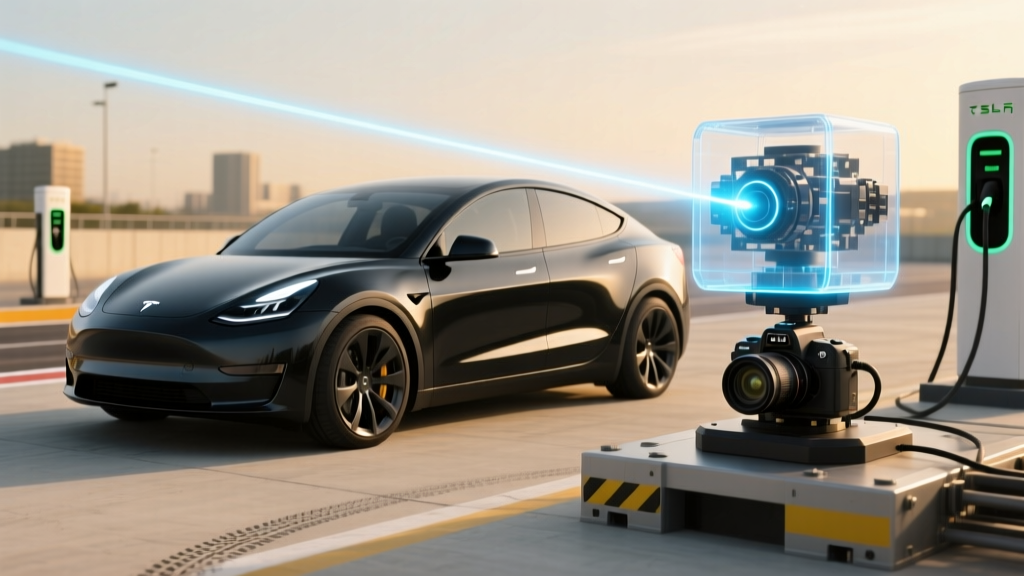
No. As of 2026, Tesla does not use lidar on any production vehicle. The company relies exclusively on a camera-only perception system branded as Tesla Vision, paired with neural-network processing to interpret the driving environment. This philosophy stands in sharp contrast to nearly every other automaker deploying advanced driver-assistance or autonomous systems, which supplement cameras with lidar, radar, or both.
Elon Musk has famously dismissed lidar as a "crutch" and a "fool's errand," arguing that if humans drive using only eyes and a brain, a car should be able to drive using only cameras and software. Whether that bet has paid off is one of the most debated questions in the EV and autonomous-driving world.
How Tesla Vision Works Without Lidar
Tesla Vision replaces traditional sensor fusion (cameras + radar + lidar) with a pure vision pipeline. Here's what that looks like technically:
- Cameras: Current Tesla vehicles (Model 3 Highland, Model Y Juniper, refreshed Model S/X) use a suite of high-resolution cameras — typically 8 to 9 units — providing 360-degree coverage around the vehicle. Front-facing cameras include narrow, main, and wide-angle lenses for different focal ranges.
- No radar (mostly): Tesla removed millimeter-wave radar from Model 3 and Model Y in mid-2021, and from Model S and Model X shortly after. A brief experiment with a high-resolution 4D imaging radar (from Phoenix-based Arbiter AI) appeared in some 2023–2024 Model S/X builds, but Tesla's primary architecture remains camera-dominant.
- No lidar: Zero Tesla production vehicles ship with lidar sensors. None are announced for future models.
- Neural network processing: Tesla's in-house FSD computer (Hardware 4 / AI5) processes raw camera feeds through deep-learning models that perform object detection, depth estimation, lane prediction, and path planning — tasks that lidar traditionally handles via direct distance measurement.
| Attribute | Tesla Vision (Camera-Only) | Lidar-Based Systems (Waymo, Mobileye, etc.) |
|---|---|---|
| Primary sensor | 8–9 cameras | Lidar + cameras + radar |
| Depth perception | Software-estimated (neural net) | Direct measurement (laser time-of-flight) |
| Night performance | Dependent on ambient/headlight illumination | Active illumination — works in total darkness |
| Adverse weather | Degraded by fog, heavy rain, snow, lens obstruction | Lidar also degrades in heavy precipitation, but radar fills gaps |
| Cost per vehicle | Lower (cameras are cheap) | Higher (lidar units add $500–$5,000+) |
| Redundancy | Single sensor modality | Multi-modal redundancy |
What Tesla's Driver-Assist Features Actually Do
Tesla offers two tiers of driver assistance. The naming is specific and often confused:
Autopilot (Standard — Included)
- Traffic-Aware Cruise Control: Maintains set speed and following distance.
- Autosteer: Keeps the vehicle centered in a clearly marked lane.
- Available on all new Tesla vehicles at no additional cost.
Full Self-Driving (Supervised) — Optional Upgrade
- Includes all Autopilot features, plus:
- Auto Lane Change: Suggests and executes lane changes on highways.
- Navigate on Autopilot: Handles highway on-ramps to off-ramps, including interchanges.
- Autopark: Detects and executes parallel and perpendicular parking.
- Summon / Smart Summon: Moves the car short distances in parking lots (driver nearby).
- Traffic Light and Stop Sign Control: Detects and responds to signals.
- City Street Autosteer: Assists on surface streets with turns and intersections.
Both Autopilot and Full Self-Driving (Supervised) are SAE Level 2 driver-assistance systems. This means the vehicle can control steering and acceleration simultaneously, but the human driver must remain fully attentive, keep hands on the wheel (or demonstrate engagement via Tesla's camera-based attention monitoring), and be ready to take over instantly. The "Supervised" in Tesla's current FSD branding is deliberate — it is not autonomous driving. Only Level 4 systems like Waymo's robotaxi service operate without a human driver in geofenced areas.
Real-World Capabilities and Honest Limitations
Tesla FSD (Supervised) has improved substantially through iterative neural-network updates. In favorable conditions — clear weather, well-marked roads, moderate traffic — the system handles highway merges, complex intersections, and unprotected left turns with increasing competence. But the camera-only architecture introduces specific failure modes that lidar-equipped systems handle more gracefully:
- Sun glare and backlighting: Direct sunlight into camera lenses can blind the system momentarily, causing phantom braking or disengagement.
- Heavy rain, fog, and snow: Reduced visibility degrades camera performance before it degrades a human driver's. Lidar and radar see through precipitation better at range.
- Faded or missing lane markings: Construction zones, rural roads, and poorly maintained infrastructure challenge the vision system's lane-keeping.
- Phantom braking: The NHTSA has investigated complaints of Tesla vehicles braking unexpectedly for shadows, overpasses, or roadside objects — a known limitation of monocular depth estimation.
- Edge-case objects: Overhanging loads, unusual road debris, or non-standard vehicles may not be classified correctly.
- Night driving on unlit roads: Without active illumination (lidar), depth perception depends entirely on headlight-limited camera data.
The driver is legally and practically responsible at all times. Treat FSD as an advanced co-pilot, not a chauffeur.
How Much Does Tesla FSD Cost in 2026?
Tesla has restructured FSD pricing several times. As of early 2026, the current structure is:
| Option | Cost | Notes |
|---|---|---|
| One-time purchase | $8,000 | Transfers to new owner if selling via Tesla; otherwise vehicle-bound |
| Monthly subscription | $99/month | No long-term commitment; cancel anytime |
| Autopilot (basic) | Included | TACC + Autosteer on all new Teslas |
For context, Tesla previously charged up to $15,000 for FSD as a one-time purchase before reducing the price. The subscription option makes sense for buyers who want to evaluate the system before committing, or who plan to keep the vehicle for fewer than ~7 years (the break-even point at $99/month vs. $8,000 upfront).
Which Tesla Models Include Autopilot and FSD?
Every new Tesla sold in the U.S. ships with Basic Autopilot as standard equipment. FSD (Supervised) is available as an add-on across the entire lineup:
- Model 3 (Highland refresh): All trims — Autopilot standard, FSD optional.
- Model Y (Juniper refresh): All trims — Autopilot standard, FSD optional.
- Model S: Autopilot standard, FSD optional.
- Model X: Autopilot standard, FSD optional.
- Cybertruck: Autopilot standard, FSD optional (rolled out progressively through 2024–2025 OTA updates).
Hardware 4 (also called AI5 in later references) is standard on all current-production vehicles and is required for the latest FSD neural-network stack. Older vehicles with Hardware 3 can still run FSD but receive less capable model versions.
Tesla Vision vs. Competing Systems: How Do They Compare?
Tesla's camera-only bet is an outlier. Here's how it stacks up against other Level 2+ systems that use multi-sensor approaches:
| System | Brand | Sensors | SAE Level | Hands-Free? | Cost |
|---|---|---|---|---|---|
| FSD (Supervised) | Tesla | Cameras only | Level 2 | No (attention monitored) | $8,000 or $99/mo |
| Super Cruise | GM (Cadillac, Chevy) | Cameras + radar + lidar map | Level 2 | Yes (on mapped highways) | $2,500 + $25/mo after trial |
| BlueCruise | Ford / Lincoln | Cameras + radar | Level 2 | Yes (on pre-qualified highways) | $2,100 or $75/mo |
| ProPILOT Assist 2.0 | Nissan | Cameras + radar | Level 2 | Yes (on mapped highways) | Included on select trims |
| Toyota Safety Sense 3.0 | Toyota | Cameras + radar | Level 2 | No | Included on all trims |
| Honda Sensing | Honda | Cameras + radar | Level 2 | No | Included on all trims |
The key differentiator: GM's Super Cruise and Ford's BlueCruise offer true hands-free driving on pre-mapped divided highways, with driver monitoring via infrared cameras. Tesla's system covers more road types (including city streets) but still requires active driver engagement. Neither approach is Level 3 or above — the driver remains responsible in all cases.
According to IIHS research, driver-monitoring systems that use eye-tracking cameras (like Super Cruise and BlueCruise) are more effective at ensuring driver attention than steering-wheel torque sensors or camera-based gaze detection alone. Tesla moved to camera-based attention monitoring in 2021, which is an improvement over torque-based detection but still draws scrutiny from safety advocates.
Why Tesla Bet Against Lidar — and Whether It's Working
Tesla's argument is fundamentally economic and philosophical:
- Cost: Lidar units, while dropping in price, still add hundreds to thousands of dollars per vehicle. At Tesla's production scale (roughly 1.8 million vehicles in 2024), even a $500 per-unit lidar cost translates to ~$900 million annually.
- Scalability: Tesla's neural-network approach trains on data from millions of customer vehicles driving billions of miles. More data, Tesla argues, leads to better models — a flywheel that lidar-based development can't easily replicate.
- Sufficiency: If a camera system can eventually match human-level perception, adding lidar is redundant. Tesla's position is that the problem is solvable with software alone.
The counterargument is that redundancy saves lives. Lidar provides direct, physics-based distance measurement independent of lighting conditions. In safety-critical applications — and particularly in Level 4 robotaxi operations — nearly every serious player (Waymo, Cruise, Zoox, Aurora) uses lidar as a core sensor. Even NHTSA incident reports suggest that many Tesla collisions investigated under the Standing General Order occurred in conditions where camera-only perception may have been challenged.
Frequently Asked Questions
Does any Tesla vehicle have lidar?
No. No production Tesla vehicle — Model 3, Model Y, Model S, Model X, or Cybertruck — has ever shipped with lidar. Tesla has never announced plans to add lidar to future vehicles.
Is Tesla FSD actually self-driving?
No. Tesla FSD (Supervised) is an SAE Level 2 driver-assistance system. The driver must remain fully attentive and ready to take over at any moment. The "Supervised" label is a legal and technical distinction acknowledging this requirement. Only Level 4 services like Waymo operate without a human driver.
Why doesn't Tesla use lidar when other companies do?
Tesla's leadership believes camera-based perception, powered by large-scale neural-network training on real-world driving data, can match or exceed lidar-based systems at a fraction of the cost. This remains an unproven hypothesis at the Level 4 autonomy threshold, though it has produced a capable Level 2 system.
Can I add lidar to my Tesla aftermarket?
No. Tesla's software stack is not designed to ingest lidar data, and there is no supported integration path. Aftermarket lidar kits exist for research platforms but cannot interface with Tesla's FSD computer.
How does Tesla handle depth perception without lidar?
Tesla uses neural networks trained on billions of miles of camera data to estimate depth from visual cues — similar to how a human brain infers distance from a 2D retinal image. This works well in typical conditions but can struggle with edge cases like unusual objects, extreme lighting, or obscured cameras.
Is Tesla FSD worth the cost?
That depends on your driving patterns and expectations. If you commute on highways daily and value reduced cognitive load, the $99/month subscription is worth a 30-day trial. If you expect a self-driving car that lets you disengage, you will be disappointed — and potentially unsafe. FSD is an assistive tool, not a replacement driver. For buyers who prioritize hands-free highway driving on known routes, GM Super Cruise or Ford BlueCruise may deliver a more polished experience at lower cost, though with narrower operational scope.