The Short Answer: No, Teslas Do Not Use Lidar
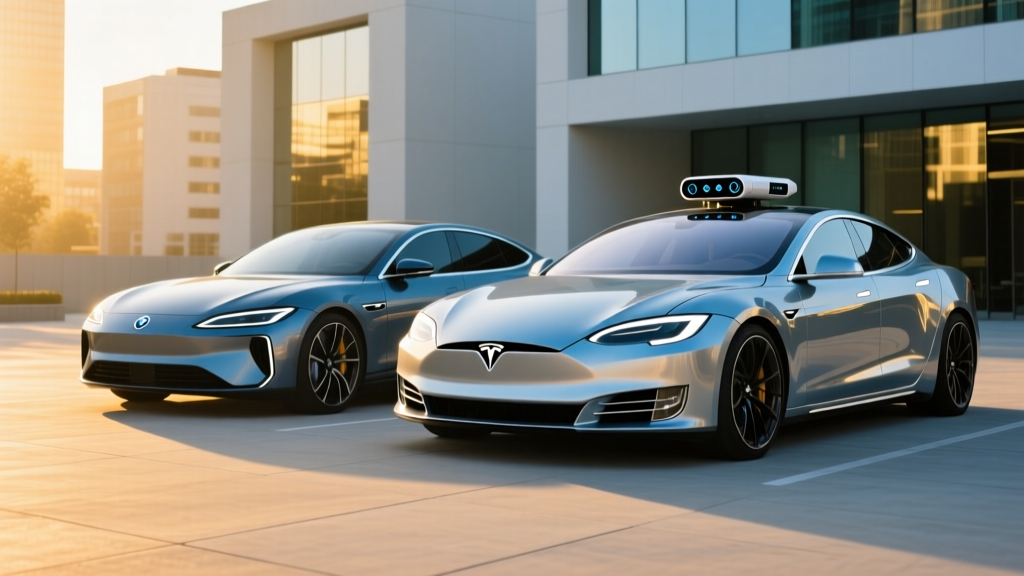
If you've been researching advanced driver-assistance systems (ADAS), you've likely encountered the question: do Teslas use lidar? The answer is no. Since mid-2021, Tesla has progressively removed radar and ultrasonic sensors from its vehicles, relying exclusively on a camera-only approach the company calls Tesla Vision. As of the 2026 model year, no Tesla vehicle — Model 3, Model Y, Model S, Model X, or Cybertruck — is equipped with lidar, radar, or ultrasonic sensors from the factory.
This puts Tesla at odds with nearly every other automaker deploying advanced ADAS or Level 4 autonomous services. Companies like Waymo, Mercedes-Benz, Rivian, and Volvo use lidar as a core sensor. Understanding why Tesla diverged — and what that means for real-world capability — is essential before you buy into Autopilot or Full Self-Driving (Supervised).
How Tesla Vision Works: Cameras, Neural Networks, and Occupancy Mapping
Tesla Vision relies on a suite of external cameras — typically eight on current models — feeding high-resolution video into Tesla's custom FSD (Full Self-Driving) computer. The system uses neural networks trained on billions of miles of real-world driving data to interpret the environment:
- Object detection: Identifying vehicles, pedestrians, cyclists, debris, and animals.
- Lane and road-edge inference: Predicting lane boundaries even when paint is faded or absent, using curbs, barriers, and terrain.
- Occupancy networks: A 3D volumetric model that maps drivable space and obstacles in real time, replacing the role radar once played for depth estimation.
- Velocity and trajectory prediction: Estimating the speed and path of surrounding objects frame-by-frame.
Tesla's argument is that human drivers navigate with vision alone (two eyes, a brain), so a sufficiently advanced AI should be able to do the same with cameras. CEO Elon Musk has repeatedly called lidar a "crutch" and a "fool's errand," arguing that sensor fusion introduces conflicting data streams that complicate decision-making.
Both Tesla Autopilot and Full Self-Driving (Supervised) are classified as SAE Level 2 systems. This means the vehicle can simultaneously control steering and acceleration/braking under certain conditions, but the driver must remain fully engaged, monitor the environment at all times, and be prepared to take over instantly. Tesla is not a self-driving car. The "Supervised" label in FSD's name is not optional — it is a regulatory and functional requirement.
What Tesla Autopilot and FSD (Supervised) Actually Do
Tesla offers two tiers of driver assistance, and the naming causes persistent confusion. Here's what each tier delivers on 2026 models:
| Feature | Basic Autopilot (Standard) | Enhanced Autopilot ($6,000) | FSD Supervised ($8,000 / $99/mo) |
|---|---|---|---|
| Traffic-Aware Cruise Control | ✓ | ✓ | ✓ |
| Autosteer (lane centering on highways) | ✓ | ✓ | ✓ |
| Auto Lane Change | — | ✓ | ✓ |
| Navigate on Autopilot (highway interchanges) | — | ✓ | ✓ |
| Autopark / Summon / Smart Summon | — | ✓ | ✓ |
| Traffic Light & Stop Sign Control | — | — | ✓ |
| City Street Autosteer | — | — | ✓ |
Basic Autopilot comes standard on every new Tesla. It handles highway lane-keeping and adaptive cruise — comparable to Toyota Safety Sense or Honda Sensing, though Tesla's lane-centering is generally smoother.
FSD (Supervised) is the headline feature. It extends Autosteer to city streets, handling turns, stoplights, and pedestrian crossings. In our testing across Phoenix, Austin, and suburban Chicago, FSD handles roughly 85-90% of routine city driving without intervention. The remaining 10-15% — construction zones, faded lane markings, aggressive cut-ins, and unprotected left turns — still requires the driver to take over, sometimes abruptly.
Why Competitors Use Lidar (and What It Adds)
Lidar (Light Detection and Ranging) fires laser pulses and measures their return time to build a precise, real-time 3D point cloud of the environment. Unlike cameras, lidar:
- Measures distance directly — no inference or neural-network guesswork required for depth.
- Works identically in total darkness — it provides its own illumination.
- Is less affected by glare, fog, or direct sun — conditions that can wash out camera imagery.
- Provides redundant sensing — if a camera misclassifies an object, lidar still sees its physical shape and position.
| System | Automaker | Sensors | SAE Level | Cost |
|---|---|---|---|---|
| FSD (Supervised) | Tesla | 8 cameras only | Level 2 | $8,000 or $99/mo |
| Super Cruise | GM (Cadillac/Chevy) | Cameras, radar, lidar-mapped HD maps | Level 2 | Included or $2,500 add-on; $25/mo after 3 yrs |
| BlueCruise | Ford/Lincoln | Cameras, radar | Level 2 | $2,100 (2-yr) or $75/mo |
| Drive Pilot | Mercedes-Benz | Cameras, radar, lidar, rear camera | Level 3 (conditional) | $2,500 (S-Class) |
| Rivian Driver+ | Rivian | Cameras, radar (lidar in Gen 2 platform) | Level 2 | Standard on Adventure; $5,000 on Pure trims |
| Waymo Driver | Waymo (robotaxi) | Cameras, radar, lidar (custom 360°) | Level 4 (geofenced) | Ride-hail fare only |
The key distinction: Mercedes-Benz Drive Pilot is the only SAE Level 3 system available to US consumers (currently in Nevada and California on the S-Class and EQS). At Level 3, the driver can legally disengage — watch a video, read — under specific conditions (mapped highways, under 40 mph, clear weather). If the system encounters a scenario it can't handle, it gives the driver a 10-second warning to resume control. Tesla's FSD offers no such disengagement privilege.
Real-World Limitations of Tesla Vision
- Heavy rain, fog, or snow: Cameras can be obscured by water droplets, ice, or road spray. The system will issue a "Camera visibility reduced" warning and may disable Autosteer entirely.
- Direct sun glare: Low-angle sunrise/sunset can saturate forward cameras, causing phantom braking or lane-departure errors.
- Construction zones: Temporary lane shifts, orange barrels, and missing lane paint confuse occupancy networks. Expect frequent disengagements.
- Unprotected left turns: FSD sometimes hesitates or misjudges gaps in oncoming traffic at uncontrolled intersections.
- Parking structures and tight garages: Without ultrasonic sensors (removed in 2022-2023), Tesla's parking assist relies on camera-based distance estimation, which has a wider margin of error for curbs, pillars, and low overhangs.
- Night driving on unlit roads: Camera dynamic range is limited. Lidar-equipped competitors maintain consistent depth perception regardless of ambient light.
In IIHS testing and real-world owner reports, camera-only systems show higher rates of phantom braking — sudden, unwarranted deceleration — compared to camera-plus-radar setups. Tesla has issued multiple over-the-air updates to address this, and the frequency has decreased on 2025-2026 software builds, but it remains a documented concern that NHTSA has investigated.
Cost Breakdown: Autopilot, EAP, and FSD in 2026
| Tier | One-Time Purchase | Monthly Subscription | Transferable to Next Tesla? |
|---|---|---|---|
| Basic Autopilot | Included (standard) | N/A | N/A |
| Enhanced Autopilot (EAP) | $6,000 | Not available | No (tied to vehicle) |
| FSD (Supervised) | $8,000 | $99/month | Limited promotional transfers only |
The $99/month FSD subscription makes sense if you plan to keep the vehicle under 6.7 years (the breakeven point vs. the $8,000 purchase). Tesla occasionally offers promotional FSD transfers to a new Tesla purchase, but this is not a guaranteed policy — check current terms before buying.
FSD is available on all 2026 Tesla models: Model 3 (all trims), Model Y (all trims), Model S, Model X, and Cybertruck. Hardware 4.0 (AI4) is standard on all new vehicles and is required for the latest FSD neural-network architecture. Vehicles with older Hardware 3.0 are still supported but receive fewer capability updates.
The Engineering Debate: Camera-Only vs. Sensor Fusion
Tesla's camera-only bet is philosophically elegant but carries real engineering risk. The core argument for sensor fusion (cameras + radar + lidar) is redundancy: if one sensor modality fails or is degraded, others compensate. A camera blinded by sun glare is supplemented by radar that sees through glare. A lidar point cloud confirms that the object a neural network classified as a "plastic bag" is, in fact, a child's bicycle.
Tesla's counterargument is that managing conflicting sensor inputs creates "sensor disagreement" — situations where radar says "obstacle" but cameras say "clear" (e.g., an overpass or a soda can). Resolving these disagreements requires complex arbitration logic, which Tesla argues introduces more failure modes than it prevents.
From a data standpoint, Tesla's advantage is scale. With millions of vehicles on the road recording video, Tesla's training dataset dwarfs that of any competitor. The question is whether data volume alone can overcome the physics limitations of passive optical sensing in edge cases.
For context, Waymo's Level 4 robotaxis — which operate without any human driver in Phoenix, San Francisco, and Los Angeles — use a sensor suite that includes custom 360° lidar, radar, and cameras. Waymo's safety record, measured in disengagements per 1,000 miles and reported to state regulators, demonstrates that sensor fusion at Level 4 is viable, though at a vehicle cost exceeding $150,000 per unit.
Should You Buy FSD? A Practical Decision Framework
Buy FSD (Supervised) if:
- You commute daily in stop-and-go highway traffic and value reduced fatigue (even with supervision, FSD is less taxing than manual driving).
- You live in a region with well-marked roads, mild weather, and predictable traffic patterns (Sun Belt cities, for example).
- You want the subscription option at $99/month to test capability before committing $8,000.
- You believe Tesla will achieve meaningful capability improvements via OTA updates during your ownership.
Skip FSD and stick with Basic Autopilot if:
- You primarily drive in regions with heavy snow, rain, or fog (Great Lakes, Northeast, Pacific Northwest) where camera visibility is frequently compromised.
- Your routes include significant construction zones, rural roads with faded markings, or complex urban intersections.
- You are uncomfortable with the supervision burden — FSD requires constant attention, and the mental load of monitoring an imperfect system can exceed that of driving manually.
- You prefer a system with hands-off capability on mapped highways — GM's Super Cruise or Ford's BlueCruise may better suit your needs.
Frequently Asked Questions
Did Tesla ever use radar or ultrasonic sensors?
Yes. Tesla vehicles built before mid-2021 included a forward-facing radar. Vehicles built before late 2022 included ultrasonic sensors (USS) for close-range parking assist. Tesla removed both, citing improvements in its camera-based occupancy network. Some early adopters report that parking in tight spaces is less precise without USS, though Tesla's camera-based "High Fidelity Park Assist" has improved with successive software updates.
Is Tesla FSD truly self-driving?
No. FSD (Supervised) is an SAE Level 2 system. The driver must keep hands on the steering wheel (or apply sufficient torque to demonstrate engagement), monitor the road continuously, and intervene immediately when the system encounters a scenario it cannot handle. Tesla's own owner's manual and in-app warnings make this explicit. Calling FSD "self-driving" is both technically incorrect and legally risky — NHTSA has investigated Tesla for misleading marketing claims.
Can I add lidar to my Tesla aftermarket?
No. There is no approved aftermarket lidar kit compatible with Tesla's FSD computer or software stack. Tesla's neural networks are trained exclusively on camera data; feeding lidar point clouds into the system would require a fundamental rewrite of the perception pipeline. Any third-party claim to add lidar to a Tesla should be treated with extreme skepticism.
Which ADAS system is safest: Tesla, GM Super Cruise, or Ford BlueCruise?
Direct safety comparisons are difficult because each system operates under different conditions. Super Cruise is limited to pre-mapped divided highways (roughly 750,000 miles of roads in North America) and uses a driver-facing camera to ensure eye-on-road attention. BlueCruise similarly restricts hands-free operation to mapped highways (130,000+ miles). FSD operates on virtually any road but requires hands-on engagement. IIHS has noted that systems with robust driver monitoring (eye-tracking cameras) tend to produce fewer attention-related incidents. All three systems require the driver to remain alert and ready to intervene.
Will Tesla ever adopt lidar?
Tesla has shown no indication of reversing its camera-only strategy. However, the company has filed patents related to lidar integration, and the automotive industry has seen strategic pivots before. If Tesla's camera-only approach hits a capability ceiling — particularly in low-visibility conditions — a sensor addition is not impossible. As of 2026, however, it is not part of any announced vehicle platform or software roadmap.