What Lane Keeping Assist Actually Does on the Road
Lane keeping assist (LKA) is a driver-assistance feature that uses forward-facing cameras and, in some systems, radar to detect painted lane markings and gently steer the vehicle back toward the center of its lane if it begins to drift. Unlike lane departure warning—which merely beeps or vibrates the seat—LKA applies corrective torque to the steering column or uses the electric power steering rack to nudge the car back into position.
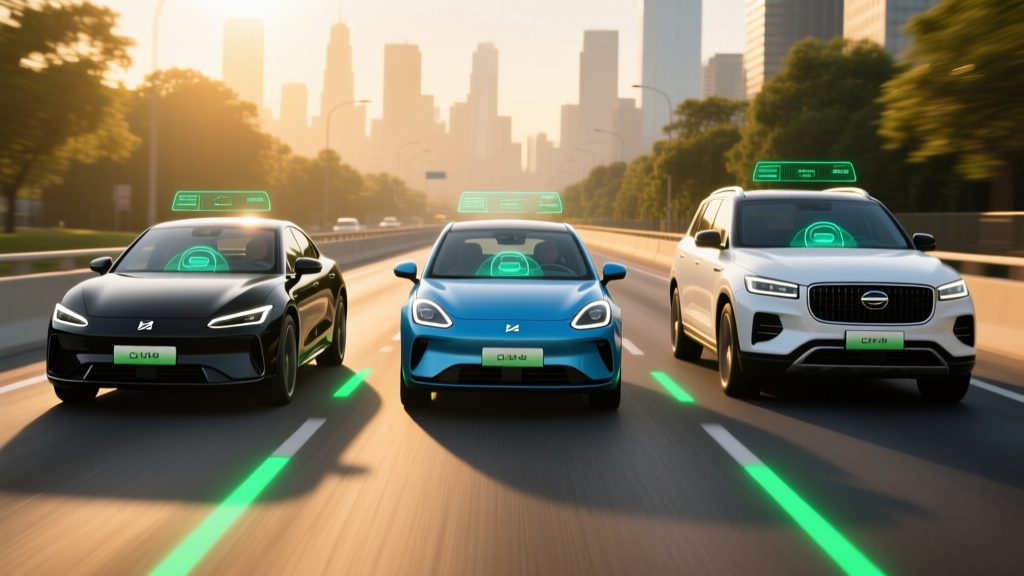
On modern EVs and hybrids, lane keeping is rarely sold as a standalone feature. It's bundled into broader ADAS (Advanced Driver Assistance Systems) suites that pair it with adaptive cruise control, automatic emergency braking, and sometimes automated lane-change assist. The result is a system that can handle sustained highway driving with reduced driver effort—though never without driver supervision.
Every consumer lane keeping system available in 2026—from Toyota Safety Sense to Tesla's Full Self-Driving (Supervised)—is classified as SAE Level 2. This means the system can control steering and acceleration simultaneously, but the driver must remain fully engaged, monitor the road at all times, and be prepared to take over instantly. No production consumer vehicle offers Level 3 or higher automation for general use in the United States.
How Lane Keeping Systems Work: Cameras, Radar, and Sensor Fusion
The core sensor for lane keeping is a forward-facing camera mounted behind the windshield, typically near the rearview mirror. This camera feeds image data to an onboard processor that identifies lane markings—solid lines, dashed lines, and sometimes road edges or curbs—using computer vision algorithms trained on millions of road images.
More advanced systems layer in additional sensor data:
- Millimeter-wave radar (mounted in the front grille or bumper) tracks the distance and speed of vehicles ahead, enabling the system to follow a lead car even when lane markings fade.
- Ultrasonic sensors (short-range, mounted around the bumper) assist at low speeds and in parking scenarios.
- High-resolution surround cameras (as on Tesla's vision-only architecture) attempt to build a 360° model of the driving environment, replacing radar entirely.
- LiDAR (used in some luxury systems and robotaxis like Waymo) provides precise depth mapping but remains rare in consumer lane keeping due to cost.
The processed data feeds into the vehicle's electric power steering (EPS) module, which applies small corrective torques—typically 1–3 Nm—to keep the car centered. On systems with adaptive cruise integration, the car can also modulate throttle and braking to maintain following distance, creating what manufacturers market as a "highway driving assist" experience.
Brand-by-Brand Comparison: What Each Automaker Calls Lane Keeping
Naming is one of the most confusing aspects of lane keeping assist. Every manufacturer brands their ADAS suite differently, and the lane keeping component within that suite has its own sub-name. Here's how the major systems compare as of the 2026 model year:
| Manufacturer | ADAS Suite Name | Lane Keeping Feature Name | Standard On | Subscription? |
|---|---|---|---|---|
| Tesla | Autopilot / FSD (Supervised) | Autosteer / Lane Keep | All models (base Autopilot) | FSD: $8,000 one-time or $99/mo |
| Hyundai / Kia | Highway Driving Assist (HDA / HDA2) | Lane Following Assist (LFA) | Most trims above SE | No |
| Ford | Co-Pilot360 / BlueCruise | Lane Centering Assist | BlueCruise on select trims | BlueCruise: $75/mo or $2,500 (varies by model) |
| GM (Chevy/Cadillac) | Super Cruise / Ultra Cruise | Lane Centering (within Super Cruise) | Available on ~30+ models, higher trims | Super Cruise: $2,200–$2,500 option; 3 yrs included, then ~$25/mo |
| Toyota / Lexus | Toyota Safety Sense 3.0 / Lexus Safety System+ 3.0 | Lane Tracing Assist (LTA) | Standard on nearly all 2026 models | No |
| Honda | Honda Sensing | Lane Keeping Assist System (LKAS) | Standard on most 2026 models | No |
| Rivian | Driver+ | Highway Assist (lane centering) | All R1T/R1S with Driver+ package | No (one-time $5,000 option) |
A few things stand out in this comparison. Toyota and Honda include lane keeping as standard equipment on nearly every trim—a significant value proposition. Tesla, Ford, and GM segment their most capable lane centering features behind premium packages or subscriptions. Hyundai/Kia occupies a middle ground: basic lane following is widely available, but the full HDA2 system with lane-change assist requires higher trims like the SEL Premium or Limited.
Real-World Capabilities: Where Lane Keeping Excels and Struggles
In controlled conditions—dry, well-marked interstate highways with clear lane paint and gentle curves—modern lane keeping systems perform remarkably well. During our testing on I-5 and I-95 corridors, systems like GM's Super Cruise and Hyundai's HDA2 maintained lane centering within roughly ±6 inches of the lane midpoint at speeds from 45 to 80 mph, handling gradual curves (radius > 500 meters) without intervention.
| Scenario | Typical System Behavior | Driver Action Required |
|---|---|---|
| Clear lane markings, dry highway | Reliable centering, smooth corrections | Monitor, hands on or near wheel |
| Faded or missing lane paint | System may disengage or wander | Take over steering immediately |
| Construction zones / shifted lanes | Unreliable—follows old markings or disengages | Full manual control required |
| Heavy rain or snow-covered roads | Camera obstruction causes alerts/disengagement | Drive manually until conditions improve |
| Sharp curves (radius < 300m) | May cut corner or request takeover | Be ready to steer through curves |
| Lane merges / exits | System may not anticipate merge; follows disappearing lane | Manually navigate all merges and splits |
The most dangerous failure mode is not total disengagement—it's partial confidence. When lane markings become ambiguous (e.g., old paint visible alongside new paint in a repaved section), some systems will follow the wrong line or oscillate between two possible lane positions. This is why every manufacturer requires the driver to maintain visual attention on the road.
- It does not read traffic signs or adjust speed for curves autonomously (unless paired with a map-based system like Super Cruise).
- It does not navigate interchanges, exits, or complex merges without driver input.
- It does not function reliably in heavy precipitation, fog, or when the windshield camera is obstructed by dirt, ice, or direct sun glare.
- It does not replace the driver. Every system monitors for hands-on-wheel contact or eye gaze (via infrared cabin cameras on BlueCruise and Super Cruise) and will issue escalating warnings before disengaging.
Cost Breakdown: What You'll Pay for Lane Keeping Across Brands
The cost of lane keeping assist varies enormously depending on whether it's included as standard safety equipment, bundled in a trim upgrade, or sold as a subscription. Here's a realistic breakdown for 2026 buyers:
| System | Access Model | Cost | Notes |
|---|---|---|---|
| Toyota Safety Sense 3.0 (LTA) | Standard equipment | $0 (included in MSRP) | Available on all trims including base |
| Honda Sensing (LKAS) | Standard equipment | $0 (included in MSRP) | Available on all trims including base |
| Hyundai HDA2 (LFA) | Trim-dependent | $0 on SEL Premium+ and above; ~$1,500–$2,000 trim step-up from SE | Basic LKA standard on most trims; full centering requires HDA2 |
| Tesla Autopilot (Autosteer) | Standard | $0 (included) | Basic lane centering on all Teslas |
| Tesla FSD (Supervised) | One-time or subscription | $8,000 purchase or $99/month | Adds auto lane change, navigate on Autopilot; still Level 2 |
| Ford BlueCruise | Subscription or bundled | $75/month or ~$2,500 (3-yr plan varies by model) | Hands-free on pre-mapped highways; requires camera monitoring |
| GM Super Cruise | Option package + subscription | $2,200–$2,500 option; 3 yrs free, then ~$25/month | Hands-free on 750,000+ mi of mapped roads per GM |
| Rivian Driver+ (Highway Assist) | One-time option | $5,000 | Lane centering + adaptive cruise; no subscription |
The key insight for buyers: if lane keeping assist is a priority and you want zero ongoing costs, Toyota and Honda offer the best value. If you want hands-free highway driving (still with eyes-on supervision), GM's Super Cruise and Ford's BlueCruise represent the most mature implementations—but budget for the subscription after the initial trial period ends.
Hands-Free vs. Hands-On: Understanding the Supervision Requirement
A critical distinction in 2026 ADAS is between hands-on and hands-free lane keeping systems. Both remain SAE Level 2, but the driver monitoring approach differs:
Hands-on systems (Tesla Autopilot, Hyundai HDA2, Toyota LTA, Honda LKAS) require the driver to maintain physical contact with the steering wheel. The system detects torque on the wheel or uses capacitive touch sensors in the wheel rim. If you remove your hands, you'll receive an audible and visual warning within 15–30 seconds, followed by escalating alerts and eventual system disengagement.
Hands-free systems (GM Super Cruise, Ford BlueCruise) allow you to remove your hands from the wheel entirely on approved roadways, but they require continuous eye monitoring via an infrared camera mounted on the steering column or instrument cluster. If your gaze drifts from the road for more than a few seconds, the system alerts you and will eventually disengage. According to NHTSA, these driver monitoring systems are essential to ensuring the human remains the responsible operator.
Neither approach makes the car autonomous. In both cases, the driver is legally responsible for all vehicle operation and must be prepared to intervene. The hands-free systems simply reduce physical fatigue on long highway stretches—they do not eliminate the cognitive requirement of driving.
Which Cars with Lane Keeping Offer the Best Value in 2026?
Based on our evaluation of system reliability, cost, availability, and real-world performance, here's how we'd rank the landscape for buyers specifically prioritizing lane keeping assist:
Best for budget-conscious buyers: The Toyota bZ4X and Hyundai Ioniq 5 both include capable lane keeping as standard or near-standard equipment. The Ioniq 5's HDA2 on the SEL trim ($46,250 MSRP) provides smooth lane centering and adaptive cruise without any subscription. The bZ4X includes Toyota Safety Sense 3.0 with Lane Tracing Assist on every trim starting at $38,465.
Best for hands-free highway driving: GM's Super Cruise remains the benchmark for mapped-road hands-free lane centering. Available on the 2026 Cadillac Lyriq (from $58,590) and Chevy Silverado EV (from $57,900 for 4WT, higher trims for Super Cruise availability), it covers over 750,000 miles of pre-mapped North American roads. The eye-tracking driver monitor is among the most robust in the industry.
Best for tech-forward buyers willing to pay: Tesla's FSD (Supervised) at $99/month offers the most feature-rich lane keeping experience, including automated lane changes and navigation-guided routing. However, per IIHS evaluations of driver assist systems, Tesla's approach to driver monitoring (torque-based steering detection) is less stringent than camera-based systems, and FSD's real-world reliability in complex scenarios remains debated among owners and safety researchers.
Frequently Asked Questions
Is lane keeping assist the same as self-driving?
No. Lane keeping assist is an SAE Level 2 feature that helps center the vehicle within a lane. The driver must remain fully engaged, monitor the road, and be prepared to take over at any moment. Self-driving (Level 4/5) vehicles like Waymo's robotaxi operate without a human driver, but these are not available for consumer purchase.
Does lane keeping work in rain and snow?
Performance degrades significantly in heavy rain, snow, or when lane markings are obscured. The forward-facing camera can be blocked by precipitation, dirt, or ice on the windshield. Most systems will alert the driver and disengage when visibility drops below their operational threshold. Always drive manually in adverse weather.
Can lane keeping assist steer through curves?
Yes, but with limitations. Gentle highway curves (radius greater than ~500 meters) are typically handled well. Sharper curves, especially on two-lane roads or interchange ramps, may exceed the system's capability, prompting a takeover request. Never rely on LKA for winding roads.
Do I need to pay a monthly subscription for lane keeping?
It depends on the brand. Toyota, Honda, and Hyundai include lane keeping in the vehicle's purchase price at no additional cost. Ford's BlueCruise and GM's Super Cruise require subscriptions after an initial trial period. Tesla's basic Autosteer is included, but FSD (Supervised) costs $8,000 upfront or $99/month.
What happens if I take my hands off the wheel?
On hands-on systems (most brands), the car will issue visual and audible warnings within 15–30 seconds, followed by escalating alerts (seat vibration, repeated chimes), and eventually the system will disengage and may slow the vehicle. On hands-free systems (Super Cruise, BlueCruise), an infrared camera monitors your eyes—if your gaze leaves the road, similar escalating warnings apply.
Which system has the fewest disengagements in real-world use?
GM's Super Cruise consistently reports the lowest disengagement rates on its approved mapped road network, owing to its HD map data and robust driver monitoring. On unmapped roads, Hyundai's HDA2 and Toyota's LTA offer reliable performance with fewer unexpected disengagements than vision-only systems in our experience, particularly in construction zones and areas with degraded lane markings.