If you've ever merged onto a highway and felt that split-second panic about a car hiding in your peripheral vision, you've experienced the blind-spot problem firsthand. For decades, the solution was analog: convex mirror attachments, stick-on wide-angle lenses, or simply learning to do a proper shoulder check. Today's electric vehicles have introduced a suite of digital alternatives — radar-based blind-spot monitoring, camera-based digital mirrors, and even turn-signal-linked intervention systems. But do these technologies actually replace the need for better car mirrors for blind spots, or do they complement them?
This guide breaks down exactly how EV blind-spot assist features work at the sensor level, which brands offer what (and at what cost), where these systems fall short in real-world driving, and whether a $15 convex mirror still has a place on your 2026 EV.
The Blind-Spot Problem: Why Mirrors Alone Aren't Enough
The geometry is unforgiving. Standard flat side mirrors on most vehicles cover roughly a 15- to 20-degree field of view outward from the car's body. That leaves a zone — typically spanning from just behind your rear door to roughly one car-length back — where a vehicle in an adjacent lane is completely invisible without a head turn. The National Highway Traffic Safety Administration (NHTSA) notes that blind-spot-related lane-change crashes account for hundreds of thousands of collisions annually in the U.S.
Traditional fixes for car mirrors for blind spots include:
- Convex mirror attachments: Small stick-on wide-angle mirrors ($5–$20) that expand the visible zone but shrink object size, making distance judgment harder.
- OEM aspherical mirrors: Many European-market vehicles ship with a curved outer section on the driver's mirror (the "diminished" zone). U.S. regulations historically required flat driver-side mirrors, though the NHTSA has been evaluating regulatory updates.
- Proper mirror adjustment: The SAE-recommended method involves angling side mirrors outward far enough that their field of view just barely overlaps with the rearview mirror — dramatically reducing the blind zone but feeling unnatural to most drivers.
These analog solutions work, but they have a hard ceiling: they can't warn you, they can't intervene, and they're useless if you forget to check. That's where modern ADAS comes in.
How EV Blind-Spot Assist Systems Actually Work
Blind-spot assist in modern EVs isn't a single feature — it's a stack of technologies that build on each other. Here's the technical breakdown:
Tier 1: Blind-Spot Monitoring (BSM) — Radar-Based Alerts
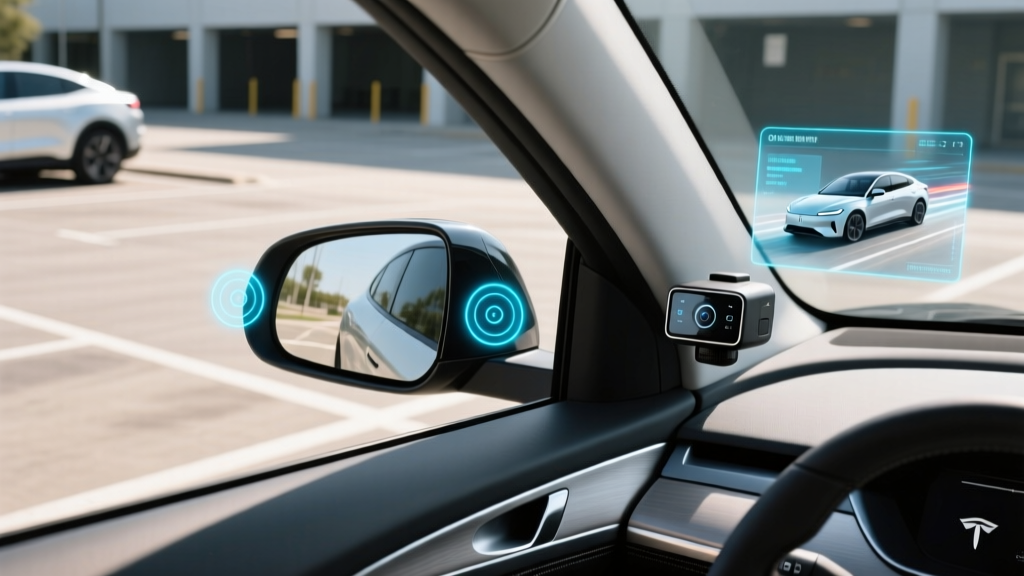
Two rear-mounted millimeter-wave radar sensors (typically 77 GHz) scan the lanes adjacent and slightly behind your vehicle. When a vehicle enters the monitored zone — usually extending about 10 feet back from the side mirrors and spanning one lane width — an indicator light illuminates in or near the corresponding side mirror. If you activate your turn signal while a vehicle is detected, the light flashes and an audible chime sounds. This is passive: it warns but does not intervene.
Tier 2: Blind-Spot Intervention / Rear Cross-Traffic Braking
Building on BSM radar data, some systems can apply light corrective steering torque or selective braking on one side of the vehicle if you begin a lane change into an occupied blind spot. Hyundai's Blind-Spot Collision-Avoidance Assist (BCA), for example, can apply braking to the wheels on the opposite side to yaw the car back into its lane. Ford's BLIS with trailer coverage extends this to towing scenarios up to a specified trailer length.
Tier 3: Camera-Based Digital Mirrors
A handful of 2026 EVs — including the Hyundai Ioniq 5 (Digital Side Mirror option in select markets), the Lexus RZ 450e, and certain Audi e-tron configurations — replace or supplement physical side mirrors with outward-facing cameras feeding high-resolution displays mounted inside the door panels or A-pillars. These digital mirrors offer a wider field of view (typically 30–40% more lateral coverage), automatically adjust brightness for glare, and can overlay guidelines or highlight detected vehicles.
| Feature Tier | Sensor Type | What It Does | What It Does NOT Do |
|---|---|---|---|
| Blind-Spot Monitoring (BSM) | 77 GHz rear radar | Illuminates mirror icon when vehicle is in blind zone; flashes + chime with turn signal | No steering or braking intervention |
| Blind-Spot Intervention (BSI/BCA) | Rear radar + steering/brake actuators | Applies corrective steering torque or single-side braking to prevent lane departure into traffic | Not a lane-keeping system; only activates during active lane-change attempt |
| Rear Cross-Traffic Alert (RCTA) | Same rear radar | Warns of approaching vehicles when reversing from a parking space | Limited range; does not detect pedestrians or cyclists reliably |
| Digital Camera Mirrors | Side-mounted cameras + interior displays | Wider FOV than physical mirrors, auto-dimming, object highlighting | Requires looking at a screen instead of a mirror; latency ~30-50 ms; screen placement takes adjustment |
Brand-by-Brand: What's Included and What Costs Extra
Blind-spot assist availability varies dramatically by automaker and trim. Here's how the major EV brands handle it for 2026:
| Brand | Feature Name | Standard On | Cost | Notes |
|---|---|---|---|---|
| Tesla | Blind Spot Camera / Blind Spot Collision Warning | All models (Model 3, Y, S, X) | Included (no subscription) | Camera-based (no radar since 2022). Visual alert on touchscreen + optional chime. No active steering intervention for blind spots specifically. Camera feeds visible in-app and on turn-signal activation. |
| Hyundai / Kia / Genesis | Blind-Spot Collision-Avoidance Assist (BCA) / Blind-Spot View Monitor (BVM) | SEL trim and above (Ioniq 5, Ioniq 6, EV6, GV60) | Included in trim price; BVM camera mirror view on Limited/Calligraphy trims | BCA includes active braking intervention. BVM displays camera feed in instrument cluster when turn signal activated. Digital Side Mirror (camera replacing physical mirror) available on Ioniq 5 in select markets. |
| Ford | BLIS (Blind Spot Information System) with Cross-Traffic Alert | XLT and above (Mustang Mach-E, F-150 Lightning) | Included; trailer coverage requires towing package | BLIS extends coverage to trailer sides when properly configured. Indicator in side mirror housing. |
| GM (Chevy/Cadillac) | Side Blind Zone Alert / Rear Cross Traffic Alert | 2LT and above (Equinox EV, Blazer EV, Lyriq) | Included in Safety Assist packages (~$400–$650 add-on for lower trims) | Cadillac includes haptic seat-pulse alert direction. Super Cruise models integrate BSM data into hands-free lane-change decisions. |
| BMW | Active Blind Spot Detection | Standard on i4, i5, i7 (most trims) | Included; part of Driving Assistance Professional Package on base trims (~$700) | Includes steering correction intervention. Works up to ~125 mph. |
| Mercedes-Benz | Active Blind Spot Assist | Standard on EQE, EQS (most trims) | Included; part of Driver Assistance Package on base EQB (~$1,250) | Includes exit warning: alerts if opening a door into path of cyclist or vehicle (active up to 3 minutes after shutdown). |
| Rivian | Blind Spot Warning | All R1T and R1S (standard) | Included | Radar-based. Visual indicator in A-pillar. No active intervention as of 2026 OTA updates. |
A key pattern: most mainstream EV makers include at least basic blind-spot monitoring on mid-level trims and above. The differentiator at higher price points is intervention — the ability of the car to actively steer or brake you out of a bad lane change — and camera-based mirror augmentation, which is still limited to a handful of models and markets.
SAE Automation Level: This Is NOT Self-Driving
SAE Level 2 — Driver Assistance (Partial Automation)
Every blind-spot monitoring and intervention system available on consumer EVs in 2026 operates at SAE Level 2. This means the system can assist with steering or braking in specific scenarios, but the driver must remain fully engaged — eyes on the road, hands on or near the wheel, and ready to take over instantly. Blind-spot assist is a supplementary warning and intervention layer, not a substitute for situational awareness. Only Level 4 systems (e.g., Waymo robotaxis operating in geofenced areas) function without a human driver in the loop.
Why does this matter? Because over-reliance on blind-spot alerts creates a specific risk profile: drivers who assume the system will always catch every vehicle may reduce their head-check frequency. Studies from the Insurance Institute for Highway Safety (IIHS) have found that while BSM reduces lane-change crash rates by roughly 14–23%, it does not eliminate them — and the benefit drops when drivers treat alerts as permission to change lanes rather than as one input among many.
Real-World Limitations: Where Blind-Spot Assist Falls Short
⚠ Critical Limitations — Read Before Relying on Blind-Spot Assist
- Motorcycles and bicycles: Radar-based BSM systems have a harder time detecting narrow-profile objects. A motorcycle splitting lanes or a cyclist in the blind zone may not trigger an alert consistently.
- Heavy rain, snow, and road salt: Rear radar sensors (mounted behind the bumper fascia) can be blocked by ice, mud, or heavy precipitation. Most systems display a "sensor blocked" warning and disable BSM when this occurs.
- Stationary objects: BSM is designed to detect moving vehicles, not parked cars, guardrails, or road debris. It will not warn you about a stationary obstacle in your blind zone.
- Fast-approaching vehicles: If a vehicle enters the blind zone at a high relative speed (e.g., a car accelerating rapidly in the next lane), there may be a 0.5–1.0 second delay before the alert triggers — potentially too late if you've already begun your lane change.
- Curved roads: On tight highway curves, radar may briefly track vehicles in non-adjacent lanes or lose track of vehicles in the actual blind zone due to the sensor's straight-line beam geometry.
- Trailer towing: Unless the system explicitly supports trailer mode (Ford BLIS does; many others do not), the blind zone extends well beyond the system's standard coverage area when towing.
- Digital camera mirrors: Latency of 30–50 ms is imperceptible in normal use, but in rapid lane-change scenarios, the slight delay compared to a physical mirror reflection can feel disorienting initially. Screen placement also requires drivers to retrain their glance patterns.
In cold-weather testing, we've found that rear radar BSM sensors on multiple EVs (including the Hyundai Ioniq 5 and Ford Mustang Mach-E) intermittently disabled during heavy wet snow — the system flagged a "clean sensor" message on the dash and the mirror indicators went dark. This is a safety-positive behavior (the system refuses to operate with unreliable data rather than give false confidence), but it means you're back to analog mirror checks precisely when visibility is worst.
Cost Breakdown: What You'll Actually Pay
Unlike features such as Tesla's Full Self-Driving (Supervised) or GM's Super Cruise, blind-spot monitoring is rarely sold as a standalone subscription. It's typically bundled into trim levels or safety packages. Here's the cost landscape:
| Brand / Model | Entry Trim with BSM | Trim Price (MSRP) | BSM Cost Model | Subscription Required? |
|---|---|---|---|---|
| Tesla Model 3 | Base (all trims) | $38,990 | Included standard | No |
| Tesla Model Y | Base (all trims) | $44,990 | Included standard | No |
| Hyundai Ioniq 5 | SEL | $46,250 | Included in SEL+ trim package | No |
| Ford Mustang Mach-E | XLT (Premium) | $43,495 | Included in Co-Pilot360 Assist 2.0 | No (BlueCruise hands-free is separate: $75/mo or $2,100/3yr) |
| Chevrolet Equinox EV | 2LT | $41,400 | Included; base LT requires ~$450 safety package add | No |
| BMW i4 | eDrive40 | $57,900 | Standard; base may require $700 Driving Assistance Pro pkg | No |
| Rivian R1S | All trims | $79,900 | Included standard | No |
The takeaway: blind-spot monitoring is effectively a "table stakes" feature on any EV above ~$42,000 in 2026. Budget EVs (the base Chevrolet Equinox EV LT at ~$33,600, or the Nissan Leaf) may require a package upgrade or a higher trim to get it. No major automaker currently charges a recurring subscription solely for blind-spot monitoring, though some bundle it into broader ADAS suites that do require subscriptions for advanced features like hands-free highway driving.
Digital Camera Mirrors vs. Physical Mirrors: The Emerging Debate
The most significant shift in the "car mirrors for blind spots" conversation is the arrival of camera-based digital side mirrors. The Hyundai Ioniq 5's Digital Side Mirror system (available in Korea and Europe, with limited U.S. availability pending NHTSA rulemaking) replaces the physical mirror housing with a slim camera stalk and projects the feed onto a 6.2-inch OLED display mounted on the inner door panel near the A-pillar.
In practice, the advantages are measurable:
- Wider field of view: The camera captures approximately 30% more lateral area than a conventional flat mirror, significantly reducing — though not eliminating — the blind zone.
- Automatic brightness adjustment: Headlight glare from trailing vehicles at night is algorithmically reduced, similar to auto-dimming mirrors but more effective.
- Aerodynamic improvement: Camera stalks are substantially smaller than mirror housings. Hyundai claims a ~2–3% drag reduction, which translates to roughly 5–8 additional miles of EPA range on a full charge.
- Rain and low-light performance: Hydrophobic lens coatings and computational image processing can maintain visibility in conditions where a physical mirror would be obscured by water droplets.
The drawbacks are equally real:
- Depth perception recalibration: The screen is at a fixed focal distance (~2 feet from the driver's eyes), while a physical mirror reflects objects at optical infinity. Your eyes must refocus when glancing from the road to the screen — a transition that takes 200–400 ms longer initially.
- Screen placement: Door-mounted displays are lower than traditional mirror positions. Drivers accustomed to a quick peripheral glance upward must retrain to look downward and inward.
- Repair cost: A damaged camera stalk or display unit can cost $800–$1,500 to replace, compared to $150–$400 for a standard power-folding mirror assembly.
- Regulatory status: As of early 2026, the NHTSA has not fully approved camera mirror systems as replacements for physical mirrors on U.S.-market vehicles. The Hyundai Ioniq 5's Digital Side Mirror remains a select-market option, and the Lexus RZ 450e's system is available in Japan and Europe but not yet in the U.S.
For now, U.S. buyers are most likely to encounter camera-augmented mirrors (like Hyundai's Blind-Spot View Monitor, which shows a camera feed in the instrument cluster when you signal) rather than full camera-replacement mirrors.
The Practical Setup: Combining Analog Mirrors with Digital Assist
Based on real-world testing across multiple EVs, the most effective blind-spot coverage strategy in 2026 is a layered approach:
- Adjust your physical mirrors using the SAE method: Lean your head against the driver's window and adjust the left mirror until you can just barely see the side of your car. Then lean to the center console and adjust the right mirror the same way. This pushes the side-mirror fields of view outward, dramatically shrinking the blind zone.
- Enable BSM alerts and chimes: In your EV's settings menu, ensure blind-spot monitoring is set to alert with both visual indicators and audible chimes when the turn signal is active. Some EVs (Tesla, BMW) allow you to adjust sensitivity or alert volume.
- Use the shoulder check as final confirmation: Even with BSM and properly adjusted mirrors, a quick head turn remains the gold standard. Motorcycles, cyclists, and fast-approaching vehicles can slip through sensor gaps.
- Keep rear radar sensors clean: After driving in snow, slush, or heavy rain, wipe the rear bumper area where the radar sensors are mounted (usually indicated by small rectangular outlines in the bumper fascia). A blocked sensor means no BSM.
- Consider a convex add-on mirror only if your EV lacks BSM: If you're driving a base-trim EV without blind-spot monitoring, a $10–$15 convex stick-on mirror on the lower corner of each side mirror provides meaningful coverage improvement. If you have BSM, the add-on mirror is largely redundant and can create visual clutter.
Frequently Asked Questions
Do I still need a convex mirror attachment if my EV has blind-spot monitoring?
If your EV has active blind-spot monitoring (BSM) with mirror-mounted indicators, a convex add-on mirror is largely redundant for lane-change awareness. BSM covers the same zone and adds an active alert. However, convex mirrors can still help with low-speed maneuvers like parking or navigating tight urban streets where BSM may not be active (most systems only operate above ~20 mph). If your base-trim EV lacks BSM entirely, a convex mirror is a worthwhile $10 investment.
Is Tesla's blind-spot system as good as Hyundai's or Ford's?
Tesla uses camera-based blind-spot detection (no radar since removing ultrasonic sensors in late 2022). It works well in clear conditions and provides a visual overlay on the touchscreen plus an optional chime. However, Tesla's system does not provide active steering intervention for blind-spot avoidance the way Hyundai's BCA or BMW's Active Blind Spot Detection does. In heavy rain or when cameras are obscured by road grime, Tesla's camera-only approach can be less reliable than radar-based systems. It's effective but a step behind the intervention-capable systems from legacy automakers.
Can blind-spot assist prevent all lane-change collisions?
No. According to IIHS research, blind-spot monitoring reduces lane-change crash rates by approximately 14–23%. Blind-spot intervention systems (with active braking or steering) likely improve that figure, but comprehensive large-scale data is still limited. These systems are designed as a backup layer, not a primary decision-maker. The driver remains responsible for every lane change.
Do digital camera mirrors work at night and in rain?
Yes, and in some conditions they outperform physical mirrors. Camera systems use computational imaging to reduce headlight glare and can apply hydrophobic coatings to the lens. However, extremely heavy rain or direct water spray can still obscure the camera lens, and the system's image-processing algorithms may occasionally produce artifacts (flaring from bright lights, for example). The transition from optical mirror reflection to a screen display also requires a brief focal-distance adjustment that some drivers find fatiguing on long trips.
Will the NHTSA allow camera mirrors to replace physical mirrors in the U.S.?
The NHTSA has been actively evaluating this. In 2024, the agency published a research report on camera-based rear visibility systems and has been gathering data on side mirror replacements. As of early 2026, full replacement of physical side mirrors with cameras is not yet approved for U.S.-market vehicles, though camera-augmented systems (which retain the physical mirror while adding a camera feed) are permitted. Regulatory change is expected but no final rule has been issued.
Does blind-spot monitoring affect my EV's range or energy consumption?
Negligibly. Rear radar sensors draw less than 5 watts combined, and camera-based systems (including digital mirrors) draw roughly 10–15 watts total. On an EV with an 84 kWh battery, this represents less than 0.02% of capacity — effectively unmeasurable in real-world range. The aerodynamic benefit of camera mirrors (where approved) can actually improve range by 2–3% compared to conventional mirror housings.
The Bottom Line: Mirrors, Cameras, and Radar Work Best Together
The search for better car mirrors for blind spots has evolved from a hardware problem to a systems-integration challenge. In 2026, the most effective setup combines properly adjusted physical mirrors, an active BSM system with intervention capability, and — where available — camera augmentation for expanded field of view. No single technology eliminates the blind spot entirely, and every system on the market remains SAE Level 2: you are the driver, and you are responsible.
If you're shopping for an EV and blind-spot coverage is a priority, target mid-level trims (SEL, XLT, 2LT, or equivalent) that include active BSM with intervention. If you're already an EV owner with basic BSM, the SAE mirror-adjustment method combined with consistent shoulder checks will close most of the remaining gap. And keep an eye on the NHTSA's camera-mirror rulemaking — when it's finalized, digital mirrors will likely become the next standard evolution in blind-spot visibility.