Stick-On Blind Spot Mirrors vs. Built-In EV Sensors: What Actually Works?
If you drive a modern electric vehicle, you likely already have radar-based blind spot monitoring (BSM) baked into your car's ADAS suite. Yet thousands of EV owners still search for the right placement of aftermarket convex blind spot mirrors — the small stick-on circles that widen your side-mirror field of view. The question is practical: where do you put blind spot mirrors to get maximum coverage without blocking the view you actually need?
The answer depends on whether you're supplementing a vehicle that lacks BSM, adding redundancy to an existing system, or driving an older EV (say, a 2018 Nissan Leaf or early Chevy Bolt) whose factory sensors have degraded or were never equipped. This guide covers exact placement geometry, then compares stick-on mirrors against the radar- and camera-based blind spot systems found on 2026 EVs from Tesla, Hyundai, Ford, Rivian, and BMW.
Where Do You Put Blind Spot Mirrors? Exact Placement Guide
The most common mistake is placing the convex mirror dead-center on the side mirror glass. That blocks your primary flat-mirror view — the one you need for judging distance of vehicles directly behind and beside you. Here is the placement hierarchy:
Optimal Position: Outer Lower Corner
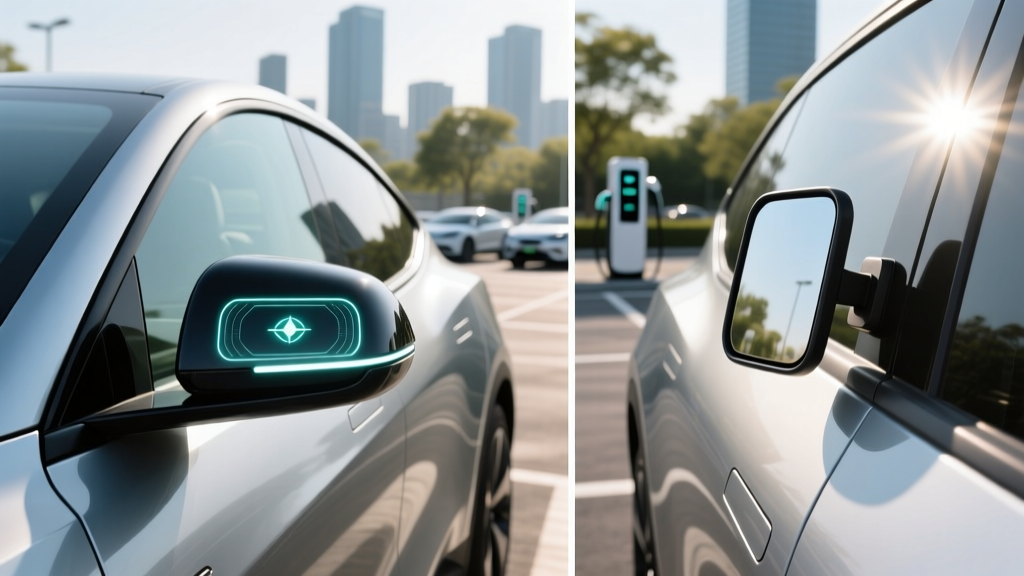
Place the convex blind spot mirror in the outer-bottom corner of your side mirror housing. For the driver-side mirror, that's the bottom-left edge (farthest from the car body). For the passenger side, it's the bottom-right edge. This position:
- Preserves the upper and inner mirror area for standard rear-lane distance judgment
- Angles the convex surface to cover the lane beside you — the classic "blind spot" zone from roughly your B-pillar back to about 15 feet behind your rear bumper
- Keeps the mirror low enough that it doesn't interfere with checking traffic at eye level
Alternative: Outer Upper Corner
Some drivers prefer the outer-top corner, especially on taller EVs like the Rivian R1S or Ford F-150 Lightning where the side mirrors sit higher relative to eye level. The upper position gives a slightly wider downward angle into adjacent lanes but sacrifices a small portion of your distance-judgment zone.
What Size Convex Mirror?
Stick-on blind spot mirrors range from 1.5 inches to 3.75 inches in diameter. For most EVs with standard-sized side mirrors, a 2-inch to 2.5-inch convex mirror provides adequate coverage without overwhelming the primary mirror surface. Frameless designs with 3M adhesive backing tend to hold up better through automated car washes and cold-weather thermal cycling.
How EV Blind Spot Monitoring Systems Actually Work
Modern EVs use two primary sensor types for blind spot detection, and many combine both:
Rear-corner radar (24 GHz or 77 GHz millimeter-wave): Two radar units mounted behind the rear bumper fascia on either side of the vehicle. These detect moving objects in adjacent lanes up to approximately 30–50 feet behind the rear axle. Radar works in rain, fog, snow, and darkness — conditions where cameras and human eyes struggle. The system illuminates an amber icon in or near the side mirror when a vehicle is detected in the blind zone.
Camera-based systems: Some manufacturers supplement radar with side-facing cameras or use the surround-view camera array to detect vehicles. Tesla relies entirely on its camera suite (Tesla Vision) for blind spot monitoring, having removed radar from Model 3 and Model Y production since mid-2021. When you activate a turn signal, Tesla's system can display a camera feed of the blind spot area on the central touchscreen.
Feature Capability Breakdown
| Capability | Stick-On Convex Mirror | Radar-Based BSM | Camera-Based BSM |
|---|---|---|---|
| Detection range | Visual only (~15 ft) | 30–50 ft behind axle | 20–40 ft (depends on lens) |
| Works in rain/fog/dark | Limited (driver vision) | Yes — radar penetrates | Degraded in low visibility |
| Active alert (audible/haptic) | No | Yes — chime + steering assist on some | Yes — visual + audible |
| Rear cross-traffic alert | No | Yes (most systems) | Varies by manufacturer |
| Cost | $5–$15 | Included in trim or ADAS package | Included in trim or software |
| Requires driver shoulder check | Yes — always | Yes — always | Yes — always |
Brand-by-Brand: Blind Spot Monitoring Across 2026 EVs
Every major EV manufacturer includes some form of blind spot monitoring, but naming, standard availability, and behavior vary significantly. Here is how the systems compare on current models:
| Manufacturer | Feature Name | Sensor Type | Standard On | Cost |
|---|---|---|---|---|
| Tesla | Blind Spot Camera / Autopilot BSM | Camera only (Tesla Vision) | All Model 3/Y/S/X (standard) | Included — no subscription |
| Hyundai / Kia | Blind-Spot Collision-Avoidance Assist (BCA) | Rear-corner radar | Ioniq 5 SEL and above; EV6 Wind and above | Included in trim price |
| Ford | BLIS (Blind Spot Information System) | Rear-corner radar | Mustang Mach-E Select and above; F-150 Lightning XLT and above | Included in trim price |
| Rivian | Blind Spot Warning | Camera + radar | All R1T / R1S trims (standard) | Included — no subscription |
| BMW | Active Blind Spot Detection | Rear-corner radar | i4 / iX all trims (standard) | Included in MSRP |
| Chevrolet | Side Blind Zone Alert | Rear-corner radar | Equinox EV 2LT and above; Blazer EV standard | Included in trim price |
Notably, blind spot monitoring is one of the few ADAS features that manufacturers almost universally include at no extra subscription cost. Unlike Tesla's Full Self-Driving (Supervised) at $8,000 one-time or $99/month, or GM's Super Cruise hands-free driving package, basic BSM is bundled into the vehicle's standard safety suite. According to IIHS research on ADAS adoption, blind spot monitoring has become one of the highest-rated features by owner satisfaction.
SAE Automation Level: BSM Is a Level 1 Warning System
For context, here is how SAE automation levels apply to the systems you interact with daily:
- Level 0: No automation. A basic stick-on convex mirror lives here — it's a passive optical aid.
- Level 1: Single-axis assistance or warning. BSM alerts, lane-departure warning, adaptive cruise control (one at a time).
- Level 2: Combined lateral + longitudinal control. Tesla Autopilot, Ford BlueCruise, GM Super Cruise — the driver must remain fully engaged and supervise.
- Level 4: True driverless operation in defined conditions. Waymo robotaxis in Phoenix, San Francisco, and Los Angeles. Not available in consumer vehicles.
Real-World Limitations: When Blind Spot Systems Fail You
Neither stick-on mirrors nor electronic BSM systems are foolproof. Understanding the edge cases is critical for safe lane changes:
Radar-Based BSM Limitations
- Motorcycles and bicycles: Narrow-profile objects can fall between radar beam lobes or return a weak signal. Multiple NHTSA ADAS advisories note that smaller objects are less reliably detected.
- Stationary vehicles: Most BSM systems filter out stationary objects to reduce false positives from guardrails and parked cars. A stopped vehicle in your blind zone may not trigger an alert.
- High-speed differentials: A vehicle approaching rapidly from far behind may not enter the detection zone until it's very close. Radar typically covers 30–50 feet; at a 30 mph speed differential, that's roughly 1.1 seconds of warning.
- Sensor blockage: Heavy snow, ice buildup, or mud on the rear bumper can occlude radar sensors. Most systems will display a "sensor blocked" warning on the instrument cluster.
- Trailer towing: On the F-150 Lightning or Rivian R1T, towing a trailer can extend your vehicle length beyond the radar detection zone, requiring trailer-specific BSM calibration (available on Ford's Pro trailer system).
Camera-Based BSM Limitations (Tesla Vision)
- Low-light and glare: Camera-based systems can struggle at dusk, dawn, or when direct sun hits the side cameras. Tesla's blind spot camera view on the touchscreen may show a washed-out image in these conditions.
- Rain and condensation: Water droplets on camera lenses degrade detection. Tesla's camera heaters help but don't eliminate the issue entirely during heavy precipitation.
- Lack of radar redundancy: Without rear-corner radar, Tesla Vision has no independent sensor to cross-reference camera data. If the camera misclassifies an object, there is no secondary confirmation.
Stick-On Mirror Limitations
- Distance distortion: The convex surface compresses spatial perception. A car that appears 40 feet away may actually be 20 feet away.
- No active warning: You must actively look at the mirror — it won't alert you if you're not checking.
- Adhesive failure: Temperature cycling (especially in climates with sub-freezing winters and hot summers) can degrade the adhesive bond. Check placement monthly.
- Limited field expansion: A 2-inch convex mirror adds roughly 15–20 degrees of field of view. That may not cover a fast-approaching vehicle in the far lane.
So Where Should You Put Blind Spot Mirrors on Your EV?
If your EV already has factory BSM — and nearly every 2026 EV from $35,000 and up does — stick-on convex mirrors serve as a low-cost redundancy layer, not a primary system. Here is the practical decision framework:
- You drive an older EV without factory BSM (2017–2020 Leaf, Bolt, early Model 3 without the camera-based feature enabled)
- You want visual redundancy as a backup to your electronic system
- You frequently drive in conditions where radar/camera systems may be degraded (heavy road salt, frequent ice buildup on bumpers)
- You tow a trailer that extends beyond your BSM radar zone and your vehicle lacks trailer-specific calibration
Rely solely on factory BSM if:
- Your EV is a 2023 or newer model with radar-based blind spot monitoring
- You prefer a clean mirror surface without visual obstruction from a convex add-on
- Your vehicle includes rear cross-traffic alert, which stick-on mirrors cannot replicate
For placement: outer lower corner, 2-inch diameter, frameless convex design. Adjust the angle so that when your head is in normal driving position, you can see the adjacent lane from your B-pillar to roughly two car-lengths behind you — without blocking the flat mirror's view of directly-behind traffic.
Frequently Asked Questions
Does adding a blind spot mirror to my side mirror affect my EV's camera or radar sensors?
No. Stick-on convex mirrors attach to the mirror glass surface and have zero interaction with rear-bumper-mounted radar units or body-panel-mounted cameras. They won't interfere with Tesla Vision, Ford BLIS, Hyundai BCA, or any other factory system.
Is blind spot monitoring standard on all 2026 EVs?
Not on every base trim. For example, the base Hyundai Ioniq 5 SE ($42,600 MSRP) does not include Blind-Spot Collision-Avoidance Assist — that starts on the SEL trim (~$46,100). The Tesla Model 3 base rear-wheel-drive ($39,990) does include camera-based blind spot monitoring standard. Always check the specific trim's equipment list before purchasing.
Can I use blind spot mirrors on a Tesla with camera-based BSM?
Yes. Many Tesla owners add small convex mirrors for redundancy, particularly because Tesla Vision's camera-only approach lacks radar backup. The stick-on mirror provides an always-available visual reference that doesn't depend on camera clarity or software state.
What's the difference between blind spot monitoring and rear cross-traffic alert?
Blind spot monitoring watches adjacent lanes while you're driving forward. Rear cross-traffic alert uses the same rear-corner radar sensors but activates when you're in reverse — detecting vehicles approaching from either side while backing out of a parking space. Most radar-based BSM systems bundle both features together. Camera-only systems like Tesla Vision may offer BSM without equivalent reverse cross-traffic detection.
Are there any EVs where blind spot monitoring requires a subscription?
As of 2026, no major manufacturer charges a subscription specifically for blind spot monitoring. It is included either as standard equipment or bundled into a trim level. Subscriptions apply to higher-level features: Tesla FSD (Supervised) at $99/month, GM Super Cruise on mapped highways, and Ford BlueCruise hands-free driving on approved routes. BSM remains a base safety feature, not a premium add-on.
How do I clean my EV's blind spot radar sensors?
Rear-corner radar units are typically housed behind the rear bumper fascia — you won't see them. If your instrument cluster displays a "radar blocked" or "blind spot system unavailable" message, wash the rear bumper area with water and a soft cloth to remove mud, road salt, or ice. Avoid high-pressure washers aimed directly at sensor housing seams. If the warning persists after cleaning, a dealer diagnostic scan can check for sensor misalignment.
Whether you opt for a $10 pair of convex mirrors, rely on your EV's factory radar and camera suite, or — as many cautious drivers do — use both, the physics of lane-change safety don't change. Check your mirrors, check the stick-on convex, check the BSM indicator, and then turn your head. No single system, electronic or optical, replaces that final shoulder check.