The Low-Tech Fix Meets High-Tech EVs
You've seen them — those small, round, convex mirrors stuck to the corners of side-view mirrors. A custom accessories blind spot mirror costs $5 to $20 and promises to eliminate the dangerous zone beside your vehicle. But if you're driving a 2026 electric vehicle equipped with radar-based Blind Spot Monitoring (BSM), does the analog add-on still make sense? Or is it redundant — possibly even counterproductive?
The answer depends on what your EV's ADAS suite actually covers, how you drive, and whether you understand the real limitations of both solutions. This guide breaks down the technical differences, real-world effectiveness, and cost trade-offs between aftermarket blind spot mirrors and the factory-installed blind spot systems found on current EVs from Tesla, Hyundai, Ford, BMW, and others.
How a Custom Accessories Blind Spot Mirror Works
A convex blind spot mirror is a passive optical device. It uses a curved reflective surface — typically with a 2x to 4x curvature — to widen the field of view beyond what your flat factory side mirror provides. Mounted at the outer edge or upper corner of your existing mirror housing, it lets you see vehicles in the adjacent lane that would otherwise be hidden in the 15-to-30-foot "blind zone" behind your peripheral vision.
Technical profile:
- Type: Passive optical (no electronics, no power source)
- Field of view gain: Approximately 15°–25° additional coverage per mirror
- Distance distortion: Objects appear 30–50% smaller and farther away than actual
- Installation: Adhesive-backed, 2-minute peel-and-stick
- Cost: $5–$25 per pair (Amazon, auto parts stores)
- Maintenance: Clean with glass cleaner; replace when adhesive fails or surface scratches
The physics are straightforward: a convex surface reflects light across a wider angle. The trade-off is distance perception. The familiar warning "objects in mirror are closer than they appear" exists for a reason — your brain must recalibrate to judge gap distance through a curved lens, which takes practice and introduces cognitive load during lane changes.
How EV Blind Spot Monitoring Systems Work (Radar + Camera Fusion)
Modern EVs use active sensor systems to detect vehicles in blind zones. The two primary technologies:
Short-range radar (24 GHz or 77 GHz): Mounted behind the rear bumper fascia on each side, these millimeter-wave radar modules emit electromagnetic pulses and measure reflections. They detect vehicles up to approximately 30–50 meters behind and beside the car, regardless of lighting, rain, fog, or darkness. When a vehicle enters the monitored zone, the system illuminates a warning indicator — usually an amber LED in the side mirror housing or A-pillar.
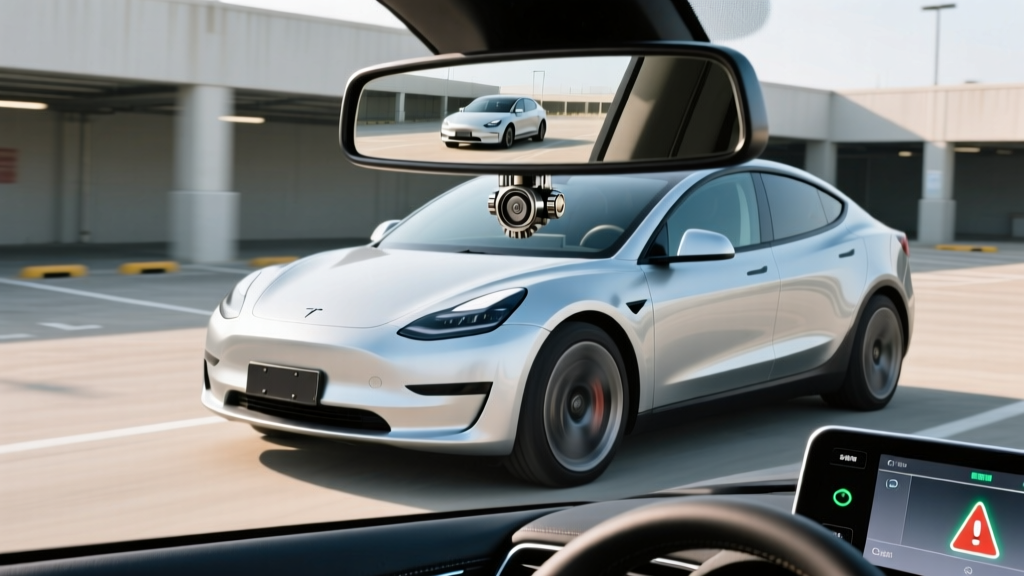
Camera-based systems: Some manufacturers (notably Tesla with its camera-only Tesla Vision approach, and Hyundai/Kia with their camera-based blind spot view monitor) supplement or replace radar with side-repeater cameras. These feed image data to a neural network that classifies vehicles, cyclists, and pedestrians. The camera feed may appear on the instrument cluster or center display when you signal a lane change.
Blind Spot Monitoring is classified as SAE Level 0 (warning only) or Level 1 (if equipped with active steering intervention like Blind Spot Collision Avoidance). In either case, the driver is fully responsible for the lane-change decision. This is not autonomous driving — it is an advisory and, in some cases, a corrective nudge.
| Attribute | Custom Accessories Blind Spot Mirror | Factory BSM (Radar/Camera) |
|---|---|---|
| Detection range | Visual only, ~1–2 car lengths | 30–50 m behind, 1–2 lanes wide |
| Night operation | Requires ambient light | Full capability (radar) or IR-enhanced |
| Rain/fog performance | Obscured by water/condensation | Radar: unaffected; Camera: reduced |
| Cyclist/pedestrian detection | Manual scanning required | Yes (camera-based AI classification) |
| Active intervention | None | Steering brake correction (some brands) |
| Cross-traffic alert (reversing) | None | Yes — Rear Cross-Traffic Alert standard |
| Cost | $5–$25 | Included (most trims) or $300–$800 option |
| False alerts | None | Occasional (guardrails, parked cars) |
Brand-by-Brand: BSM Availability on 2026 EVs
Not all blind spot systems are equal. Here's how the major EV manufacturers handle it for the 2026 model year:
| Brand | Feature Name | Standard On | Cost / Notes |
|---|---|---|---|
| Tesla | Blind Spot Camera (Tesla Vision) | All models (camera-only, no radar since 2022) | Included; visual + audible chime on turn signal |
| Hyundai (Ioniq 5/6) | Blind-Spot Collision-Avoidance Assist (BCA) | SEL trim and above | Included in SEL (~$46,000 MSRP); SE base lacks it |
| Kia (EV6/EV9) | Blind-Spot View Monitor + BCA | GT-Line and above | Included; camera feed on cluster when signaling |
| Ford (Mustang Mach-E, F-150 Lightning) | BLIS (Blind Spot Information System) with Cross-Traffic Alert | Premium trim and above (standard on Lightning Lariat+) | Included; Select base trim requires $1,095 Co-Pilot360 Active 2.0 pkg |
| BMW (i4, i5, iX) | Active Blind Spot Detection | Standard on all 2026 i-models | Included; steering correction above 12 mph |
| Volkswagen (ID.4, ID.7) | Side Assist (Blind Spot Monitor) | Pro S trim and above | Included; base Standard trim lacks it |
| Rivian (R1S, R1T) | Blind Spot Warning | All trims (Standard, Adventure, Ascend) | Included; camera-based with mirror indicators |
The pattern is clear: most 2026 EVs at mid-trim and above include BSM as standard equipment. The gap exists primarily on base trims of more affordable models (Hyundai Ioniq 5 SE, VW ID.4 Standard, Ford Mach-E Select). If you're buying at those entry points, a custom accessories blind spot mirror becomes a practical $15 stopgap — but you should plan to upgrade trim or add the safety package.
Real-World Limitations: Where Both Solutions Fall Short
- Neither solution makes the lane-change decision for you. You must still check over your shoulder. BSM is advisory, not autonomous.
- Radar BSM may not detect motorcycles, bicycles, or fast-approaching vehicles in the second lane over.
- Camera-based systems (Tesla Vision, Kia Blind-Spot View Monitor) can degrade in heavy rain, direct sun glare, or when the camera lens is dirty/iced.
- Convex blind spot mirrors distort distance — a car that looks 4 car-lengths back may actually be 2.
- Neither system detects stationary objects (curbs, bollards, poles) during low-speed lane positioning.
- BSM false positives from guardrails, concrete barriers, and parked cars on tight urban streets are common and may cause alert fatigue.
Cold weather is the great equalizer. In sub-freezing conditions, camera lenses ice over, and adhesive on aftermarket convex mirrors can fail. Radar-based BSM (Ford BLIS, BMW Active Blind Spot, Hyundai BCA) continues to function because the radar modules sit behind the bumper fascia, protected from the elements. If you live in Minnesota, Maine, or anywhere with sustained winter conditions, radar BSM has a meaningful reliability advantage over both camera systems and stick-on mirrors.
Highway merging at speed is another edge case. Most BSM systems are calibrated for vehicles approaching at similar speeds. A car approaching at 30+ mph faster than you (common on German autobahns, less so on US interstates but still relevant) may enter and exit the detection zone faster than the alert cycle can trigger. A physical convex mirror, properly adjusted, gives you continuous visual awareness without latency.
Cost Breakdown: Aftermarket Mirror vs. Factory BSM vs. ADAS Subscriptions
The economics are stark. Here's what you're actually paying:
| Solution | Upfront Cost | Recurring Cost | Vehicle Resale Impact |
|---|---|---|---|
| Custom accessories blind spot mirror (pair) | $5–$25 | $0 | None (removable) |
| Factory BSM (included on mid/high trim) | $0 incremental (built into trim price) | $0 | Positive — safety packages add $500–$1,500 resale value |
| Factory BSM (added as option package) | $300–$1,095 | $0 | Partial recoup (~50–70%) |
| Tesla FSD (Supervised) — includes enhanced BSM + lane change automation | $8,000 one-time (2026 price) | Or $99/month subscription | Negligible — FSD does not transfer reliably at resale |
| GM Super Cruise (includes lane change on confirm) — on Cadillac Lyriq, Chevy Blazer EV | $2,200 (3-year prepaid) | Then $25/month | Minimal resale lift |
For context, the Insurance Institute for Highway Safety (IIHS) requires functioning blind spot monitoring for a vehicle to earn its Top Safety Pick+ designation. That means a car without BSM — even with a stick-on convex mirror — will not achieve the highest IIHS rating. This affects both safety outcomes and insurance premiums (some carriers offer 5–10% discounts for IIHS Top Safety Pick vehicles).
When a Custom Accessories Blind Spot Mirror Still Makes Sense
Despite the superiority of radar-based BSM, there are legitimate scenarios where the $15 convex mirror earns its place:
1. You're buying a base-trim EV without BSM. The 2026 Hyundai Ioniq 5 SE ($42,600 MSRP) and VW ID.4 Standard ($39,735 MSRP) omit blind spot monitoring. Until you upgrade or trade, a convex mirror provides tangible coverage improvement for negligible cost.
2. You tow a trailer. Radar BSM systems on most EVs deactivate or become unreliable when a trailer is attached (the trailer blocks the radar field). A convex mirror on your tow vehicle or EV side mirror provides continuous visual coverage. The Ford F-150 Lightning with the Max Trailer Tow Package does offer trailer-aware BSM, but it requires the $1,995 tow package and Lariat+ trim.
3. You want a redundancy layer. Even with radar BSM, experienced drivers often supplement with a convex mirror for close-in visual confirmation. The mirror provides instant, zero-latency awareness that doesn't depend on sensor processing cycles or software updates.
4. You drive an older EV without BSM. Early Nissan Leafs (2011–2017), first-gen Chevy Bolts (2017–2019), and base Tesla Model 3 Standard Range variants from 2019–2020 may lack or have limited BSM capability. A convex mirror is the cheapest upgrade path.
The Correct Mirror Adjustment Technique (Most Drivers Get This Wrong)
Whether you add a convex mirror or rely on factory BSM, proper side-mirror adjustment eliminates more blind spots than most drivers realize. The National Highway Traffic Safety Administration (NHTSA) and SAE International recommend the following method:
- Lean your head against the driver's side window. Adjust the left mirror so you can just barely see the side of your car.
- Lean your head to the center console. Adjust the right mirror so you can just barely see the right side of your car.
- Sit normally. You should NOT see your own car in either side mirror. The rearview mirror covers directly behind you; the side mirrors cover the adjacent lanes.
This SAE-recommended adjustment pushes the side-mirror viewing angle outward enough that the blind zone overlaps with what the opposite mirror covers. A vehicle passing you transitions smoothly from the rearview mirror → side mirror → peripheral vision with minimal gap. Adding a convex blind spot mirror on top of this adjustment provides overlap insurance — a final check for motorcycles or fast-approaching vehicles that transition too quickly.
Frequently Asked Questions
Can I install a custom accessories blind spot mirror on an EV that already has BSM?
Yes. A convex mirror does not interfere with radar modules (mounted behind the bumper) or camera systems (mounted in mirror housings or fenders). Just ensure the adhesive pad doesn't cover any camera lens or LED indicator built into your mirror housing. Check your mirror housing for small camera windows before applying.
Is Tesla's blind spot camera system better than a physical blind spot mirror?
For most scenarios, yes. Tesla Vision uses side-repeater cameras to detect vehicles and display a visualization on the center screen when you signal. It works at night and in rain. However, it requires you to look at the center screen — a glance-down that some drivers find less intuitive than a mirror check. A convex mirror keeps your eyes at mirror height. Many Tesla owners use both.
Does adding a blind spot mirror void my EV warranty?
No. A stick-on convex mirror is a removable accessory and does not modify any electrical or structural component. Under the Magnuson-Moss Warranty Act, a manufacturer cannot void your warranty for an aftermarket accessory that doesn't cause the failure. If your mirror housing LED fails, the dealer would need to prove the accessory caused it — which is extremely unlikely with a passive mirror.
What size convex blind spot mirror should I buy?
For most EV side mirrors (which tend to be compact and aerodynamically shaped), a 2-inch (50mm) round convex mirror with 2x or 3x magnification provides the best balance of coverage and distance perception. Larger 3-inch mirrors offer more field of view but increase distance distortion and may look awkward on sleek mirror housings like those on the Hyundai Ioniq 6 or Tesla Model 3.
Do I need blind spot mirrors on both sides?
The driver's side blind spot is typically smaller because you can turn your head more easily. The passenger side blind spot is larger and harder to check. If you use only one convex mirror, mount it on the passenger side. For full coverage, install on both sides.
The Verdict: Layered Awareness Wins
A custom accessories blind spot mirror and a factory radar BSM system solve the same problem through fundamentally different approaches — passive optics versus active sensing. The convex mirror costs $15, works without software, and never throws a false alert from a guardrail. Factory BSM covers a wider zone, works in darkness and fog, and can actively brake the car to prevent a collision.
If your 2026 EV includes radar-based BSM (BMW, Ford BLIS, Hyundai BCA above base trim), the convex mirror is optional redundancy — useful but not essential. If you're on a base trim without BSM, the $15 mirror is the single highest-value safety upgrade you can make while you plan your next move. And if you tow, drive in extreme cold, or simply want the most complete awareness picture possible, there's no reason you can't use both. The best blind spot solution is the one that matches your actual driving conditions — not just the spec sheet.