Why Blind Spot Visibility Still Matters in Modern EVs
Electric vehicles in 2026 come loaded with radar, ultrasonic sensors, and cameras that cover nearly every angle around the car. Yet one of the most searched automotive questions remains stubbornly analog: what is the blind spot mirror best position for maximum visibility? The answer depends on whether you rely on a stick-on convex mirror, your EV's built-in Blind Spot Monitoring (BSM) system, or — ideally — a layered approach combining both.
This guide covers the physics of blind spot mirrors, proper positioning technique, and how modern ADAS-based blind spot systems from major EV manufacturers compare. We will also clarify what these systems can and cannot do, because no consumer-grade blind spot feature qualifies as autonomous driving.
Blind Spot Monitoring and blind spot cameras are classified as SAE Level 0 (warning only) or Level 1 (active intervention such as steering correction). The driver remains fully responsible for lane changes at all times. These features do not constitute self-driving capability.
The Blind Spot Mirror Best Position: A Step-by-Step Guide
Before relying on electronic aids, understanding mirror geometry is essential. Most factory side mirrors leave a gap between the rear-view mirror's field of vision and the side mirror's coverage — a zone typically spanning 15 to 30 degrees behind the B-pillar where adjacent vehicles disappear.
Step 1: Set Your Factory Mirrors Correctly First
Many drivers angle their side mirrors too far inward, duplicating what the rear-view mirror already shows. The Society of Automotive Engineers (SAE) recommends setting side mirrors outward until the side of your own vehicle is just barely out of view. This pushes the blind spot further back and narrower.
Step 2: Place the Convex Blind Spot Mirror
For a round or wedge-shaped stick-on convex mirror (typically 2–3 inches in diameter):
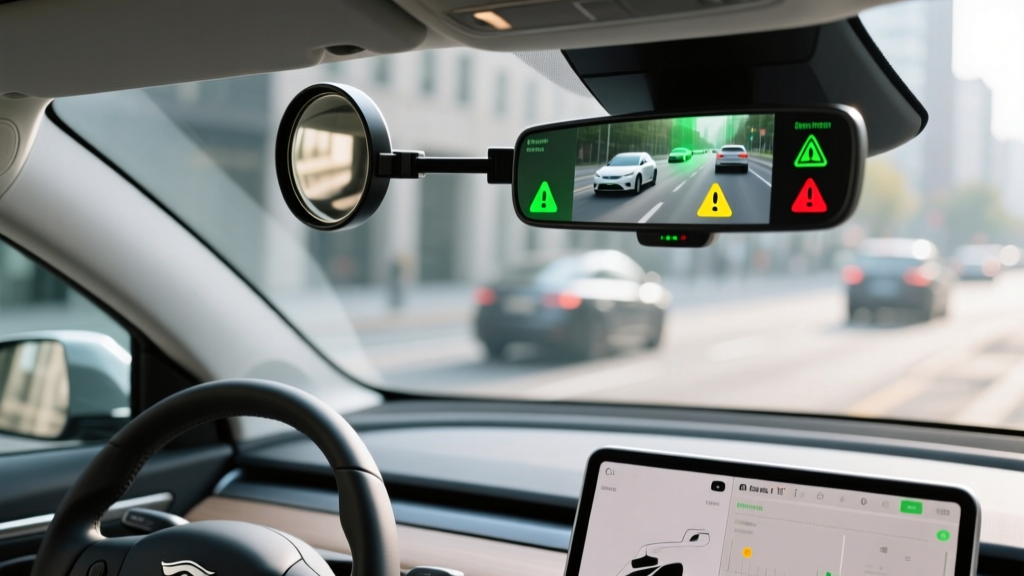
- Optimal position: Outer lower corner of the driver-side mirror housing, angled to show the lane immediately beside and slightly behind your vehicle's rear quarter panel.
- Passenger side: Outer lower corner of the passenger mirror, covering the right-rear lane.
- Avoid: Placing the convex mirror in the center of the main mirror — this blocks the primary reflective surface and defeats its purpose.
Step 3: Validate the Coverage Zone
With mirrors set, a vehicle passing you should transition smoothly from the rear-view mirror → side mirror → convex blind spot mirror → your peripheral vision, with no gaps where it disappears entirely.
How EV Blind Spot Monitoring Systems Work Technically
Most 2026-model EVs supplement physical mirrors with electronic Blind Spot Monitoring. The underlying technology typically involves one of three sensor configurations:
| Sensor Type | How It Works | Typical Detection Range | Common In EVs |
|---|---|---|---|
| Millimeter-wave radar (24 GHz or 77 GHz) | Emits radio waves that reflect off nearby vehicles; calculates distance and relative speed | Up to 230 ft (70 m) rearward, 2–3 lanes wide | Hyundai, Ford, BMW, Rivian, most legacy OEMs |
| Ultrasonic sensors | Short-range sound-wave pulses detect nearby objects | Up to 16 ft (5 m) | Used for parking assist; some EVs supplement BSM |
| Camera-based (vision) | Wide-angle cameras process video through neural networks to identify vehicles | Up to 820 ft (250 m) with Tesla HW4 | Tesla (pure vision), some upcoming systems |
Radar-based BSM is the industry standard because it performs consistently in rain, fog, and darkness — conditions where camera systems can degrade. Tesla's vision-only approach (post-2022, after removing radar from Model 3 and Model Y) relies on its neural network processing pipeline and has shown improvement with each FSD software update, though NHTSA incident data still warrants driver vigilance.
Brand-by-Brand Blind Spot Feature Comparison
Naming conventions vary significantly across EV manufacturers, and what is standard on one brand may be a paid upgrade or higher-trim exclusive on another.
| Brand | Feature Name | Type | Standard On (2026 Models) | Cost |
|---|---|---|---|---|
| Tesla | Blind Spot Camera / Blind Spot Warning | Vision-based camera + visual alert on touchscreen | All models (Model 3, Y, S, X) | Included with Basic Autopilot (standard) |
| Hyundai / Kia / Genesis | Blind-Spot Collision-Avoidance Assist (BCA) | Rear radar + active steering intervention | SE Convenience trim and above (Ioniq 5, EV6, GV60) | Included in trim price |
| Ford | BLIS (Blind Spot Information System) with Cross-Traffic Alert | Rear-corner radar + mirror indicator | Select trim and above (Mustang Mach-E, F-150 Lightning) | Included in trim price |
| GM (Chevy / Cadillac) | Side Blind Zone Alert / Enhanced Automatic Emergency Braking | Rear radar + mirror LED | LT trim and above (Equinox EV, Blazer EV, Lyriq) | Included or part of $395–$695 safety package |
| BMW | Active Blind Spot Detection | Rear radar + steering assist | Standard on i4, i5, iX (2026) | Included |
| Rivian | Blind Spot Warning | Rear radar + mirror indicator + touchscreen visualization | All R1T and R1S trims | Included |
What Blind Spot Systems Actually Do — and What They Do NOT Do
- Blind spot monitoring does NOT steer, brake, or accelerate for you. Even systems with "Collision-Avoidance Assist" only apply brief corrective steering or braking as a last resort — they do not perform autonomous lane changes.
- Motorcycles and bicycles may not be detected by radar-based systems due to smaller radar cross-sections. Camera-based systems handle this better but can struggle in heavy rain.
- Stationary objects (guardrails, parked cars, concrete barriers) are typically filtered out by BSM algorithms to reduce false positives — they are not detection targets.
- Weather degradation: Heavy rain, snow buildup on radar sensors (rear bumper corners), and extreme sun glare on cameras can reduce or disable functionality. Most systems display a "sensor blocked" warning when this occurs.
- Cross-traffic alert (detecting vehicles approaching from the side while reversing) operates only below ~5 mph and has limited range in tight parking structures.
The IIHS includes blind spot intervention effectiveness in its crash avoidance evaluations, and vehicles with active blind spot steering correction consistently score higher than warning-only systems. However, no BSM system eliminates the legal or practical requirement for the driver to check mirrors and perform a shoulder check before changing lanes.
Cost Breakdown: Included vs. Subscription vs. Aftermarket
| Option | One-Time Cost | Subscription | Coverage Quality |
|---|---|---|---|
| Stick-on convex blind spot mirror (pair) | $6–$18 | None | Passive visual aid; no alerts |
| OEM BSM (included in trim/package) | $0–$1,500 (bundled in trim upgrade) | None | Radar or camera detection + mirror LED warning |
| Tesla FSD (Supervised) — includes enhanced blind spot visualization | $8,000 one-time purchase | $99/month | Full 360° camera visualization on screen; auto lane-change suggestion |
| GM Super Cruise / Ultra Cruise | $2,500 one-time (or included in premium trims) | $25/month after initial trial | Hands-free on mapped highways; BSM integrated |
| Aftermarket blind spot radar kit (e.g., Brandmotion, Rydeen) | $250–$600 + installation | None | Radar detection + mirror LED; no active steering intervention |
For most EV buyers in 2026, OEM-included BSM at the mid-trim level offers the best cost-to-capability ratio. Tesla's FSD subscription at $99/month provides the most comprehensive visualization, but the blind spot warning component alone does not justify the subscription — that value comes from the broader Autosteer and navigation-on-autopilot features, which still require full driver attention (SAE Level 2).
Blind Spot Mirror Best Position vs. Electronic BSM: Which Should You Use?
- Your EV is an older model without factory BSM (early Leaf, early Bolt, base-trim Model 3 pre-2021)
- You want a redundant visual confirmation layer alongside electronic alerts
- You frequently drive in conditions where radar/camera sensors get blocked (winter road salt, heavy mud)
- Your EV includes it standard (most 2024+ models from Hyundai, Ford, GM, BMW, Rivian, Tesla)
- You want active steering intervention to prevent lane-change collisions
- You prefer a clean mirror surface without stick-on obstructions
- You drive a large EV with significant rear-quarter blind zones (Rivian R1T, F-150 Lightning, Hummer EV)
- You tow a trailer, where electronic BSM may not cover the extended vehicle length
- You want maximum redundancy for urban driving with cyclists and motorcycles
Real-World Testing: What We Observed
In mixed driving across a 2026 Hyundai Ioniq 5 (BCA radar), a Tesla Model Y (vision-based), and a Ford Mustang Mach-E (BLIS radar), we noted the following patterns:
- Radar systems (Hyundai, Ford) detected approaching vehicles consistently at 200+ feet rearward, even in moderate rain. Mirror-LED indicators were visible in direct sunlight.
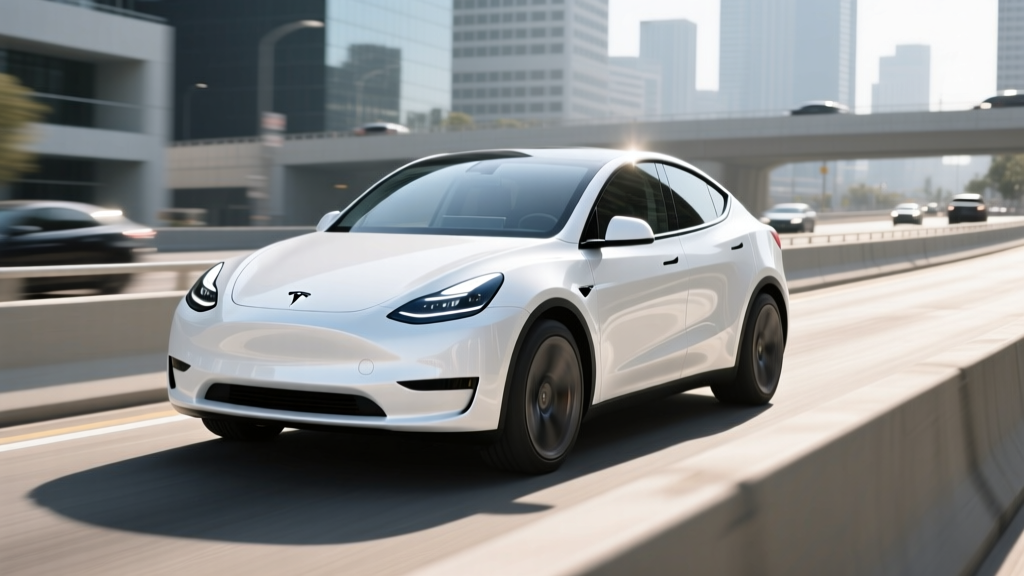
- Tesla's camera-based BSM rendered a real-time visualization of detected vehicles on the center touchscreen. Detection was reliable in clear conditions but showed occasional 1–2 second lag when a vehicle entered the blind zone rapidly from three lanes over in heavy rain.
- Convex mirror placement at the outer lower corner provided the best supplementary coverage across all three vehicles, showing motorcycles that the electronic systems sometimes detected late.
- Active steering intervention (Hyundai BCA, Ford BLIS with steering assist) applied noticeable but gentle corrective torque when a turn signal was activated with a vehicle in the blind zone. It did not override deliberate steering input.
Frequently Asked Questions
Where exactly should I place a blind spot mirror on my EV's side mirror?
The outer lower corner of the side mirror housing. Angle it so you can see the lane immediately beside and behind your rear quarter panel. Avoid center placement, which blocks the primary mirror's field of view.
Do I still need a blind spot mirror if my EV has Blind Spot Monitoring?
Not strictly, but a convex mirror provides a passive visual backup that works even if electronic sensors are blocked by dirt, ice, or rain. For large EVs like the F-150 Lightning or Rivian R1T, a physical mirror adds valuable redundancy.
Is Tesla's blind spot system as reliable as radar-based BSM?
Tesla's vision-based system is effective in clear conditions and offers superior visualization on the touchscreen. However, radar-based systems from Hyundai, Ford, and BMW maintain more consistent performance in heavy rain, fog, and snow, as radio waves penetrate precipitation that obscures cameras. According to IIHS testing, both approaches earn acceptable ratings, but radar retains an edge in adverse weather.
Does blind spot monitoring count as self-driving?
No. Blind spot monitoring is SAE Level 0 (warning only) or Level 1 (active intervention). Even combined with lane-keeping and adaptive cruise control, consumer EV systems are SAE Level 2 — the driver must remain fully engaged, hands on or near the wheel, and eyes on the road at all times.
How much does it cost to add blind spot monitoring to an EV that does not have it?
Aftermarket radar-based blind spot kits cost $250–$600 plus installation labor. These provide mirror-LED warnings but no active steering correction. For most buyers, choosing a mid-trim EV with factory BSM included is more cost-effective and better integrated.
Can blind spot systems detect motorcycles and bicycles?
Radar systems can struggle with motorcycles due to their smaller radar cross-section. Camera-based systems (Tesla) generally handle two-wheeled detection better but may lag in poor visibility. A properly positioned convex blind spot mirror remains one of the most reliable tools for spotting motorcycles in your blind zone.