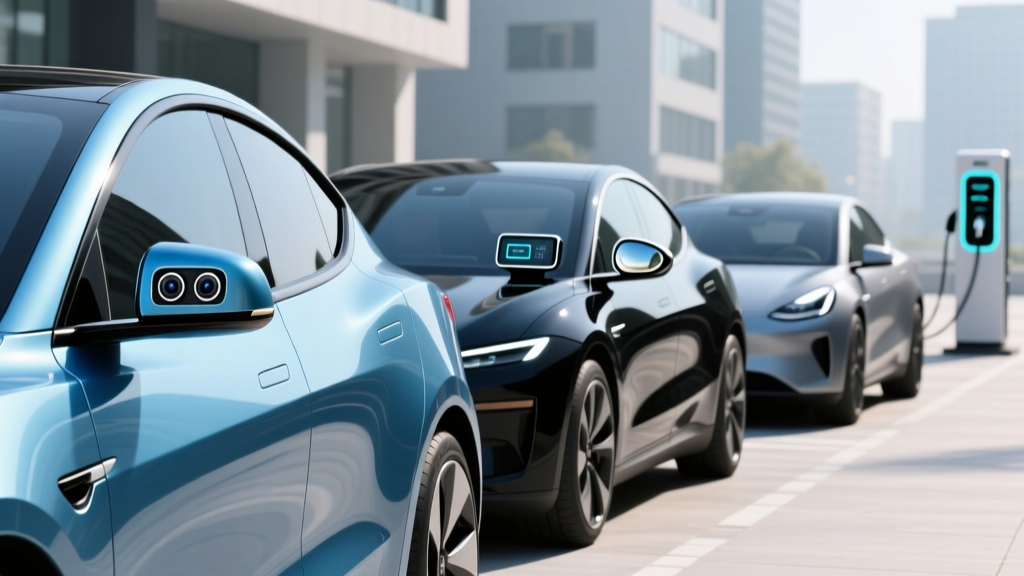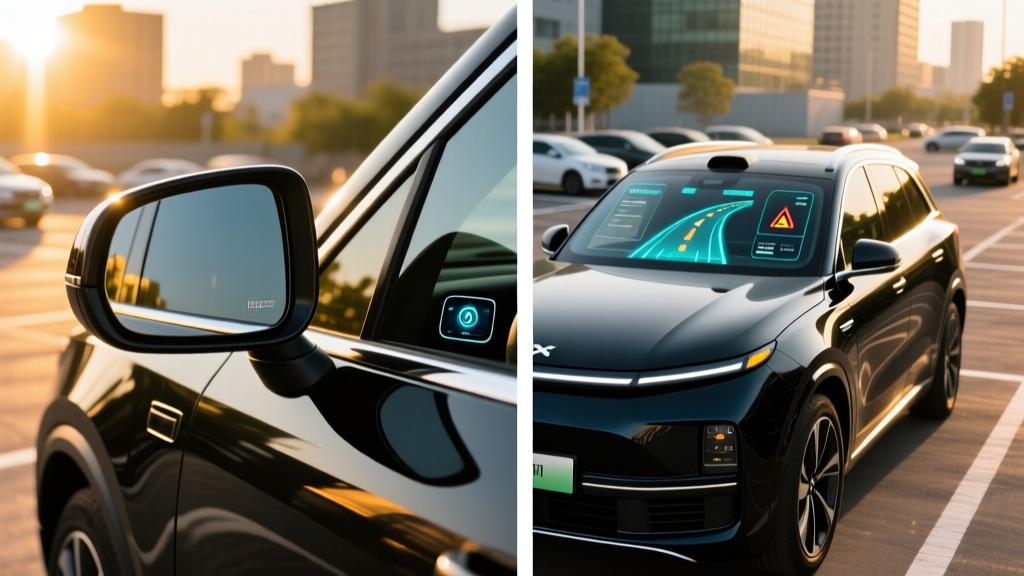
If you drive an electric vehicle equipped with modern driver-assistance technology, you might wonder whether old-school car blind spot mirror placement still matters. The short answer: yes, it does — even on a 2026 Tesla Model Y, Hyundai Ioniq 5, or Ford Mustang Mach-E with full sensor suites. But the long answer is more interesting. Today's radar- and camera-based blind spot monitoring (BSM) systems have fundamentally changed how drivers manage lane-change awareness, and understanding both the analog mirror technique and the digital ADAS layer is essential for anyone behind the wheel of an electrified vehicle.
This guide breaks down the proper mirror setup method, how EV blind spot monitoring systems actually work at the sensor level, what they cost, and — critically — what they cannot do. Because no matter how advanced your EV's ADAS package is, it remains a SAE Level 2 driver-assist system that requires your full attention.
The SAE Reality: Blind Spot Monitoring Is Level 2 Assistance
Blind spot monitoring, lane-centering assist, and adaptive cruise control are all SAE Level 2 features. This means the system can provide steering and speed support simultaneously, but the driver must remain fully engaged — eyes on the road, hands on or near the wheel, and ready to take over instantly. No production consumer vehicle sold in 2026 is self-driving. Only Level 4 robotaxi services like Waymo One (available in Phoenix, San Francisco, and Los Angeles) operate without a human driver. Your EV's BSM is a tool, not a replacement for your judgment.
The National Highway Traffic Safety Administration (NHTSA) classifies blind spot detection as a crash-avoidance technology, not an autonomous driving feature. This distinction matters both legally and practically: if you change lanes based solely on your BSM indicator without checking your mirrors, and a collision occurs, you are at fault — not the system.
Car Blind Spot Mirror Placement: The Analog Foundation
Before any electronic system enters the picture, proper mirror geometry reduces your blind zones dramatically. The Society of Automotive Engineers (SAE) recommended mirror-setting method — widely endorsed by driving instructors and the Insurance Institute for Highway Safety (IIHS) — works as follows:
Step-by-Step Mirror Adjustment
- Rearview mirror: Frame the rear window completely. This covers the zone directly behind you.
- Driver-side mirror: Lean your head against the driver-side window glass, then adjust the mirror outward until you can just barely see the side of your own car. When you sit normally, the car's flank will be mostly out of view — this is correct. It pushes the mirror's field outward to overlap minimally with the rearview, eliminating the near-side blind zone.
- Passenger-side mirror: Lean your head toward the center of the cabin (roughly above the center console), then adjust the passenger mirror outward until you just barely see the passenger-side body panel. Again, sitting normally, the car should be nearly out of view.
This "SAE method" creates a near-seamless panoramic sweep from rearview through both side mirrors, with the side mirrors covering the zones that the rearview cannot reach. The remaining blind spots — small wedges directly alongside the rear quarter panels — are precisely where electronic BSM systems intervene.
Stick-On Convex Blind Spot Mirrors
The small round convex mirrors (typically 2-3 inches in diameter) that adhere to your side-mirror glass serve a specific purpose: they widen the field of view in the lower-outer quadrant of each mirror. Place them in the outer lower corner of each side mirror. This position captures the zone where a vehicle in the adjacent lane might hide just behind your rear pillar, without obstructing the main mirror's flat-glass view of traffic further back.
On EVs with frameless door mirrors or aerodynamic mirror housings (common on the Tesla Model 3, Lucid Air, and Rivian R1S), stick-on convex mirrors remain compatible and cost under $10. However, if your EV already has integrated BSM indicator lights embedded in the mirror glass or housing, place the convex add-on so it does not cover the BSM LED.
How EV Blind Spot Monitoring Systems Actually Work
Modern EVs typically deploy BSM using one of two sensor architectures — and many premium models combine both:
Radar-Based BSM (Most Common)
Two short-range radar units (typically 24 GHz or 77 GHz) are mounted behind the rear bumper fascia, one on each side. These radars emit electromagnetic waves that reflect off nearby vehicles and return to the sensor. The system's electronic control unit (ECU) calculates:
- Range: Distance to the detected object (typically 3–5 meters laterally, up to 30–70 meters rearward)
- Relative velocity: Whether the object is approaching, stationary, or receding
- Direction: Which adjacent lane the object occupies
Radar operates in rain, fog, snow, and darkness — conditions where cameras struggle. This makes radar-based BSM highly reliable across weather scenarios.
Camera-Based BSM (Supplementary or Primary)
Some EVs supplement or replace radar with cameras mounted under the side mirrors or in the rear quarter-panel area. Tesla's current vision-only approach (post-2022, after removing radar hardware) uses its surround-view camera array to detect vehicles in adjacent lanes. The onboard neural network processes video frames in real time, identifying vehicles, estimating their distance via monocular depth estimation, and triggering the BSM warning on the central touchscreen.
Hyundai's Highway Driving Assist 2 (HDA2) on the Ioniq 5 and Ioniq 6 combines both front radar and rear-corner radars with cameras for a fused-sensor approach, which generally provides faster and more accurate detection than camera-only systems in edge cases.
| Capability | Rear-Corner Radar | Camera-Only (Vision) | Fused (Radar + Camera) |
|---|---|---|---|
| Detection range (rearward) | Up to ~70 m | Up to ~40–50 m | Up to ~70 m |
| Rain / fog performance | Excellent | Degraded | Good (radar compensates) |
| Night / low-light | Full performance | Reduced (depends on IR/low-light sensor) | Good |
| Object classification | Vehicle vs. non-vehicle (limited) | Detailed (car, truck, motorcycle, cyclist) | Detailed |
| Rear cross-traffic alert | Yes | Yes (with limitations) | Yes |
| Typical examples | Ford Mach-E, VW ID.4, Toyota bZ4X | Tesla Model 3/Y (2023+) | Hyundai Ioniq 5/6, Genesis GV60, BMW iX |
Brand-by-Brand: BSM Naming, Availability, and Cost
Every automaker brands its ADAS suite differently, and BSM availability varies by trim level — sometimes standard across the lineup, sometimes locked behind a premium package. Here is a 2026 snapshot of how major EV brands handle blind spot monitoring:
| Brand / System Name | BSM Standard From | Sensor Type | Additional Cost | Active Intervention |
|---|---|---|---|---|
| Tesla — Autopilot (included) / FSD Supervised | All trims (vision-only) | Camera (8 surround cameras) | BSM included; FSD $8,000 one-time or $99/mo | Steering nudge (with FSD) |
| Hyundai/Kia/Genesis — Highway Driving Assist 2 / Blind-Spot Collision-Avoidance Assist | SEL/EX trims and above | Rear-corner radar + camera | Included in package (~$1,500–$2,500 trim step-up) | Yes — active steering correction |
| Ford — Co-Pilot360 (BLIS — Blind Spot Information System) | Standard on most Mach-E trims | Rear-corner radar | Standard; BlueCruise hands-free adds $2,100 or $75/mo | Yes — steering assist on select trims |
| BMW — Driving Assistant Professional | Optional on i4; standard on iX xDrive50+ | Radar + camera fusion | $1,700 package (i4); included (iX) | Yes — active lane-change assist |
| Mercedes-Benz — Active Blind Spot Assist (part of Driver Assistance Package) | Optional on EQB/EQE; standard on EQS | Radar + camera | $1,950 package (EQE); standard (EQS) | Yes — active brake intervention on one side |
| Toyota/Subaru — Toyota Safety Sense 3.0 / EyeSight (Blind Spot Monitor) | Standard on bZ4X Limited; optional on base | Rear-corner radar | Included on Limited; ~$600 add-on for base | Rear cross-traffic braking; no steering correction |
A key distinction: passive BSM only alerts you (visual indicator in the mirror, audible chime). Active BSM (sometimes called Blind Spot Collision-Avoidance Assist) can apply corrective steering or braking to prevent a lane-change collision. Hyundai, Ford, BMW, and Mercedes all offer active variants, but usually only on mid-to-high trims or within an optional ADAS package.
Real-World Limitations: What BSM Cannot Do
- Fast-approaching vehicles: A motorcycle or car closing rapidly from 50+ meters back may enter the detection zone too late for a useful warning. Radar-based systems handle this better than camera-only, but there is always a detection-latency window.
- Stationary objects: BSM is designed to detect moving vehicles, not parked cars, guardrails, or road debris. Do not expect alerts for static hazards.
- Heavy rain, snow, or mud on sensors: Radar units behind the rear bumper can be blocked by accumulated snow, ice, or road grime. Camera lenses can be obscured by water droplets. Most systems will display a "sensor blocked" warning and disable BSM — at which point your analog mirrors become your only blind-spot coverage.
- Adjacent-lane curves: On sharp highway curves, radar beams may track vehicles in a non-adjacent lane or lose tracking of a vehicle in the true adjacent lane. Camera-based systems can struggle similarly when lane markings curve sharply.
- Trailers and bike racks: Towing a trailer or carrying a rear-mounted bike rack can physically block radar sensors or confuse camera algorithms. Most owner's manuals instruct you to disable BSM or recalibrate when towing.
- Two-lane roads with oncoming traffic: BSM is calibrated for same-direction multi-lane highways. Oncoming vehicles on two-lane roads may trigger false positives or be filtered out unpredictably.
Cold-weather EV owners should pay particular attention to sensor blockage. In temperatures below freezing, ice accumulation on the rear bumper (where radar units are hidden behind the fascia) can disable BSM entirely. Preconditioning your EV while plugged in helps, but it does not heat the rear bumper area on most models. Carry a soft brush to clear the bumper surface in winter conditions.
Proper Mirror Placement + BSM: The Combined Strategy
The safest approach layers both systems. Here is the decision framework for integrating analog mirrors with electronic BSM:
- Use the SAE mirror method as your primary spatial-awareness tool. It works when the battery is dead, when sensors are blocked, and when electronic systems throw errors.
- Treat BSM as a confirmation layer, not a primary information source. When the BSM indicator illuminates, it confirms what a proper shoulder check would also reveal.
- Always shoulder-check before lane changes, regardless of BSM status. No consumer ADAS system in 2026 eliminates this requirement — and no system's owner's manual claims it does.
- Keep stick-on convex mirrors as a low-cost redundancy, especially on EVs with small or aerodynamically shaped side mirrors that offer a narrower field of view than traditional flat mirrors.
- If your BSM malfunctions or displays a sensor-blocked warning, immediately revert to heightened mirror and shoulder-check vigilance. Schedule a service visit — radar calibration can drift after bumper impacts or bodywork.
Cost Breakdown: BSM as Part of the EV ADAS Ecosystem
Blind spot monitoring is rarely sold as a standalone feature. It is bundled into the vehicle's broader ADAS suite, and the cost structure varies significantly:
| Cost Model | Examples | What You Get | Price Range |
|---|---|---|---|
| Included standard (all trims) | Tesla Model 3/Y, Ford Mach-E (most trims) | Passive BSM alerts; no subscription needed | $0 additional |
| Trim-level gate | Toyota bZ4X (Limited only), Hyundai Ioniq 5 (SEL+) | BSM + rear cross-traffic alert + active intervention | $1,500–$3,500 trim premium |
| Optional ADAS package | BMW i4, Mercedes EQE | BSM + lane-keeping + adaptive cruise + active lane-change | $1,700–$2,500 package |
| Subscription-enhanced | Tesla FSD Supervised, Ford BlueCruise | BSM + hands-free highway driving + auto lane-change | $75–$99/month or $2,100–$8,000 one-time |
| Aftermarket BSM kit | Brandless radar kits (Amazon/retail) | Basic radar BSM with LED mirror indicators | $80–$250 + installation |
For EV buyers prioritizing BSM without paying a premium-trim premium, the Tesla Model 3 and Ford Mustang Mach-E are notable because BSM is included on every trim at no extra cost. On the Hyundai Ioniq 5, stepping from the base SE ($42,600 MSRP) to the SEL ($45,350 MSRP) adds Blind-Spot Collision-Avoidance Assist — a $2,750 trim jump that also includes additional features. Evaluate whether the full package justifies the cost for your driving patterns.
Frequently Asked Questions
Is blind spot monitoring self-driving?
No. BSM is an SAE Level 2 driver-assist feature. It alerts you to vehicles in adjacent lanes and, on some models, can apply corrective steering or braking. But the driver remains 100% responsible for lane-change decisions. No consumer EV sold in 2026 is autonomous — only Level 4 robotaxi services like Waymo operate without a human driver, and those are not available for personal purchase.
Does car blind spot mirror placement still matter if my EV has BSM?
Yes. BSM systems can fail due to sensor blockage (snow, ice, dirt), software errors, or hardware damage. Properly positioned mirrors using the SAE method give you reliable blind-zone awareness at all times, regardless of electronic system status. Think of BSM as a backup to good mirror habits, not a replacement.
Where should I place stick-on convex blind spot mirrors on my EV?
Place them in the outer lower corner of each side mirror. This captures the blind zone directly alongside the rear quarter panel without blocking the main mirror's view of traffic further back. Make sure the convex mirror does not cover the factory BSM indicator LED if your EV has one embedded in the mirror housing.
Can I add blind spot monitoring to an EV that didn't come with it?
Aftermarket radar-based BSM kits exist ($80–$250 plus professional installation), but they lack the integration of factory systems — no steering intervention, no dashboard or HUD warnings, and potentially unreliable detection compared to OEM radar placement. For most EV buyers, selecting a trim that includes factory BSM is a better investment than retrofitting.
Why does my EV's BSM sometimes show false alerts?
Common causes include: guardrails and concrete barriers on tight curves reflecting radar returns; adjacent-lane vehicles several car-lengths back that the system considers "in your blind zone"; metallic road signs or roadside infrastructure; and sensor misalignment after minor bumper impacts. If false alerts persist, a dealer recalibration (typically $100–$200) can resolve radar aiming drift.
Does BSM work when I'm towing a trailer with my EV?
Usually no. A trailer blocks the rear-corner radar field of view and extends the vehicle's effective length beyond what the BSM algorithm expects. Most EV owner's manuals (Tesla, Ford, Hyundai) recommend disabling BSM when towing. Rely on extended towing mirrors and careful shoulder checks instead. Some premium models (BMW iX, Mercedes EQS) offer a trailer-mode recalibration, but this is not universal.