Why EV Owners Are Still Searching for a Blind Spot Mirror Attachment
Modern electric vehicles pack more driver-assistance technology than any car in history. Radar arrays, ultrasonic sensors, surround-view cameras, and cross-traffic alerts come standard on many 2025-2026 EVs. Yet searches for a simple blind spot mirror attachment — those small convex mirrors that stick to your side mirror — remain surprisingly common among EV buyers.
The reason is straightforward: even the most advanced blind spot monitoring (BSM) systems have edge cases, and a $6 convex mirror fills gaps that a $1,200 technology package sometimes misses. This guide breaks down exactly what built-in BSM does, where a physical mirror attachment still adds value, and how the two approaches stack up for real-world EV driving.
How Built-In Blind Spot Monitoring Actually Works
Factory blind spot monitoring relies on one of two sensor technologies, depending on the automaker and trim level:
Radar-Based BSM (Most Common)
Two short-range radar units — typically 24 GHz or 77 GHz — sit behind the rear bumper cover, one on each side. These millimeter-wave radar sensors sweep a zone roughly 10 feet to the side of the vehicle and up to 25 feet behind the rear axle. When a vehicle enters that detection zone, the system illuminates an amber indicator in or near the corresponding side mirror. If you activate a turn signal while a vehicle occupies the blind zone, the indicator flashes and an audible chime may sound.
Radar-based BSM operates in rain, fog, and darkness because millimeter-wave frequencies penetrate precipitation and do not require ambient light. This is a significant reliability advantage over camera-only systems.
Camera-Based BSM (Supplemental)
Some automakers — notably Hyundai, Kia, Genesis, and Honda — supplement radar BSM with camera-based blind spot view displays. When you signal a lane change, a camera feed from the side-view mirror appears in the instrument cluster or center screen. Hyundai calls this Blind-Spot View Monitor (BVM); Honda integrates it into Honda Sensing 360. These cameras provide visual confirmation but can struggle in heavy rain, direct sun glare, or when the lens is dirty.
Blind spot monitoring is classified as SAE Level 1 — a single-axis driver-assistance function. It warns you of hazards but does not steer, brake, or accelerate the vehicle. Even when combined with lane-keeping assist (Level 1 steering), the combined system remains Level 2 at most. The driver must remain fully engaged at all times. No production consumer vehicle sold in the U.S. operates at Level 3 or above without geographic and conditional restrictions.
Feature Capability Comparison: BSM vs. a Blind Spot Mirror Attachment
| Capability | Factory Radar BSM | Blind Spot Mirror Attachment |
|---|---|---|
| Detection zone | ~10 ft lateral, ~25 ft rearward per side | Varies by mirror size/curvature; typically ~1-2 lane widths adjacent |
| Active alert (visual + audible) | Yes — mirror indicator + chime on signal | No — passive visual only, requires driver to glance |
| Rain/fog performance | Excellent (radar penetrates precipitation) | Poor — water on mirror surface obscures view |
| Night performance | Full capability (radar is light-independent) | Reduced — depends on headlights and ambient light |
| Detects motorcycles/bicycles | Sometimes — small radar cross-sections may be missed | Yes — optical, sees anything visible |
| Detects stationary objects (poles, curbs) | No — filters stationary targets to reduce false alerts | Yes — shows all objects in reflected field of view |
| Cost | $0 (standard) to $1,200+ (package-dependent) | $5–$18 per pair |
| Installation | Factory-installed only | Adhesive-backed, 2-minute DIY |
Real-World Limitations of Factory Blind Spot Monitoring
Blind spot monitoring is a warning system, not a collision-prevention system. It does not steer the car back into your lane, does not apply brakes, and does not guarantee detection of every vehicle or object. You must still perform a physical shoulder check before changing lanes. The NHTSA explicitly states that ADAS features supplement but do not replace attentive driving.
Based on real-world driving across multiple EV platforms, here are the documented limitations of factory BSM:
Motorcycles and Bicycles
Millimeter-wave radar detects objects based on their radar cross-section (RCS). A motorcycle has roughly 1/10th the RCS of a sedan. Several owner forums for Tesla, Hyundai, and Ford EVs report missed motorcycle detections, particularly when the motorcycle is approaching rapidly from far behind. Radar-based BSM may not illuminate an indicator until the motorcycle is already partially alongside the vehicle — sometimes too late if you have already initiated a lane change.
Rapidly Approaching Vehicles
Most BSM systems have a maximum relative-velocity detection threshold. A vehicle approaching at 30+ mph faster than your speed (common on highways with speed differentials between lanes) may not trigger an alert until it enters the near-zone, which can be as close as 10 feet behind your rear axle. At 70 mph, that gives you under one second of warning.
Stationary Objects and Tight Spaces
Radar BSM intentionally filters stationary objects — poles, parked cars, guardrails, curbs — to prevent nuisance alerts. This means BSM provides zero assistance when pulling out of a tight parking space, navigating a narrow construction zone, or judging clearance to a concrete barrier. A convex blind spot mirror attachment, by contrast, shows everything in its field of view regardless of whether the object is moving.
Sensor Blockage
Heavy mud, ice buildup on the rear bumper, or even a bike rack mounted over the radar units can disable BSM entirely. The system will typically display a "sensor blocked" warning on the instrument cluster. In winter conditions across northern U.S. states, this is not uncommon — and a physical mirror attachment continues working regardless.
Brand-Specific BSM Naming, Trims, and Cost
Every major EV automaker offers blind spot monitoring, but the naming, availability, and cost structure differ significantly. Here is a 2025-2026 breakdown for popular EV models:
| Brand / System Name | Included On (2025-2026) | Cost Structure | Active Intervention? |
|---|---|---|---|
| Tesla — Blind Spot Camera (no radar BSM since 2022) | All models (Model 3, Y, S, X) — camera-based only | Included standard; no subscription | Visual indicator + audible chime; no steering intervention for BSM alone |
| Hyundai — Blind-Spot Collision-Avoidance Assist (BCA) | Ioniq 5 (SEL and above), Ioniq 6 (SEL and above) | Included in trim price; ~$3,000 trim step-up | Yes — applies braking to avoid collision if turn signal is active |
| Ford — BLIS (Blind Spot Information System) | Mustang Mach-E (Select and above), F-150 Lightning (XLT and above) | Standard on most trims; included | Alert only; Cross-Traffic Alert included |
| Chevrolet — Side Blind Zone Alert | Equinox EV (2LT and above), Blazer EV (2LT and above), Silverado EV (WT fleet optional) | Part of Driver Confidence packages, ~$500-$1,200 add-on | Alert only with haptic seat vibration on some trims |
| BMW — Active Blind Spot Detection | i4, i5, iX (standard on most U.S. trims) | Included standard on U.S.-spec models | Yes — steering correction if lane change is initiated with vehicle in blind zone |
| Rivian — Blind Spot Warning | R1S and R1T (all trims, standard) | Included standard | Alert only; highway assist includes lane-change assist |
Key takeaway on cost: Unlike Tesla's Full Self-Driving (Supervised) — which costs $8,000 outright or $99/month — blind spot monitoring is not a subscription feature on any major EV platform. It is either standard or bundled into a trim-level equipment package. You will never pay a monthly fee for BSM alone.
When a Blind Spot Mirror Attachment Still Makes Sense
Given that most 2025-2026 EVs include competent radar or camera-based BSM, when does a physical blind spot mirror attachment add genuine value? Based on testing and owner feedback, here are the scenarios:
1. Low-Speed Maneuvering and Parking
BSM systems activate at higher speeds (typically above 20 mph) and filter stationary objects. When parallel parking, pulling into a tight garage, or navigating a parking structure, a convex mirror attachment mounted on the lower corner of your side mirror gives you a wide-angle view of the curb, adjacent pillars, and ground-level obstacles. This is particularly useful on larger EVs like the Ford F-150 Lightning (218.9" length) or Rivian R1S (217.3" length).
2. Motorcycle and Bicycle Detection Backup
If you ride in urban environments with heavy bicycle and motorcycle traffic, a convex mirror provides a continuous optical view that does not depend on radar cross-section. It serves as a redundant confirmation layer alongside your factory BSM.
3. Winter Driving with Sensor Blockage
In regions with heavy road salt, slush, and ice accumulation, rear-bumper-mounted radar units can become obstructed. A mirror attachment on the side mirror housing — which is higher and more exposed to airflow — tends to stay clearer and provides a fallback visual reference when BSM is disabled.
4. Older or Fleet EVs Without BSM
Not every EV on the road has BSM. Base-trim early Nissan LEAF models, older Chevrolet Bolt EVs (pre-2022), and some fleet-spec commercial EVs lack blind spot monitoring entirely. For these vehicles, a $10 blind spot mirror attachment is a meaningful safety upgrade.
Installation Tips for Blind Spot Mirror Attachments on EVs
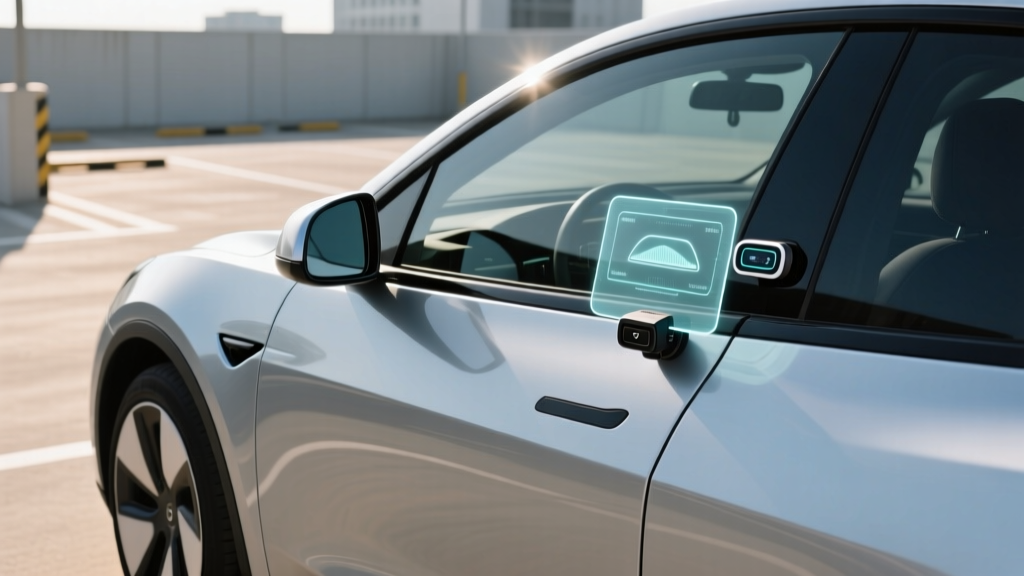
Installing a convex mirror attachment on an EV requires one consideration that does not apply to gas cars: do not mount anything that obstructs the side-mirror-integrated turn signal, puddle light, or BSM indicator.
Most modern EV side mirrors house:
- The BSM amber indicator LED (usually upper-outer quadrant of the mirror glass)
- An integrated turn-signal repeater (outer edge of the mirror housing)
- A puddle lamp (bottom of the housing)
- A camera lens (for surround-view or BVM systems — Hyundai, Honda, Genesis)
Mount the convex attachment on the lower-inner quadrant of the flat mirror glass, angled to show the adjacent lane. Use a frameless 3" or 3.5" convex mirror with 3M VHB adhesive — avoid clip-on styles that may interfere with mirror auto-fold mechanisms, which are common on EVs like the Tesla Model Y and Hyundai Ioniq 5.
Recommended Specs for a Blind Spot Mirror Attachment
- Size: 3" to 3.5" diameter — large enough for useful field of view, small enough to not block the main mirror
- Curvature: Convex with approximately 2x-3x field-of-view expansion (look for "wide angle" or "5x magnification" labeling — note that higher magnification means smaller apparent objects)
- Mounting: Adhesive-backed (3M VHB preferred); avoid suction cups which fail in temperature extremes
- Frame: Frameless design to minimize obstruction of the primary mirror
- Cost: $5–$18 for a quality pair; brands like Utopicar, Ampper, and Blindspotter consistently rate well in owner reviews
Blind Spot Mirror Attachment vs. EV BSM: Decision Framework
- Your EV includes BSM standard (most 2025-2026 models above base trim)
- You drive primarily on highways and multi-lane roads at speeds above 25 mph
- You value active alerts (chime + flashing indicator) over passive visual confirmation
- You drive in rain and fog frequently (radar advantage)
Add a Blind Spot Mirror Attachment If:
- You drive a large EV (F-150 Lightning, R1S, Hummer EV) and need curb/pillar visibility at low speed
- You commute in heavy motorcycle/bicycle traffic where radar may miss small targets
- You live in a cold-weather region where rear radar sensors get blocked by ice/slush
- Your EV lacks BSM (older LEAF, base Bolt EV, fleet vehicles)
- You want a $10 redundant safety layer alongside electronic BSM — the two are complementary, not competing
Frequently Asked Questions
Is blind spot monitoring the same as self-driving?
No. Blind spot monitoring is a Level 1 driver-assistance feature per the SAE J3016 standard. It provides warnings only. Even when combined with lane-centering assist, the system is Level 2 at most — meaning the driver must remain fully attentive, with hands on the wheel and eyes on the road. No production consumer vehicle is self-driving.
Does Tesla's camera-only blind spot system work as well as radar BSM?
Tesla removed ultrasonic sensors and radar from all vehicles built after late 2022, relying solely on its camera-based "Tesla Vision" system. Blind spot detection works via the side-repeater cameras and displays a visual indicator on the touchscreen and instrument cluster. In clear conditions, it performs comparably to radar BSM. However, camera-only systems can be degraded by heavy rain, snow on the camera lens, or direct sun glare at certain angles — scenarios where radar-based BSM (Hyundai, Ford, BMW) maintains full functionality.
Can I add aftermarket BSM to an EV that did not come with it?
Aftermarket radar BSM kits exist (brands like Brandmotion and Rydeen) and typically cost $250–$500 installed. However, integrating aftermarket radar with an EV's CAN bus electrical system is complex and may interfere with other ADAS features. For most owners of BSM-equipped EVs, a blind spot mirror attachment is a simpler, cheaper, and risk-free supplement. For EVs without BSM, an aftermarket kit is viable but should be installed by a professional familiar with EV electrical architecture.
Will a blind spot mirror attachment interfere with my EV's auto-dimming or auto-folding mirrors?
Adhesive-mounted convex mirrors on the glass surface do not interfere with auto-dimming (electrochromic) or power-folding mechanisms. However, clip-on or strap-on attachments that wrap around the mirror housing can obstruct the folding hinge or the housing-mounted camera/turn signal. Stick with flat adhesive-mounted designs, and test your auto-fold function after installation.
What does the IIHS say about blind spot monitoring effectiveness?
The IIHS has found that blind spot monitoring reduces lane-change crashes by approximately 14% and lane-change crash injuries by 23%. These are meaningful reductions, but they also mean that BSM does not eliminate blind-spot-related crashes — reinforcing the value of a physical shoulder check and, where useful, a supplemental blind spot mirror attachment for low-speed and edge-case scenarios.